
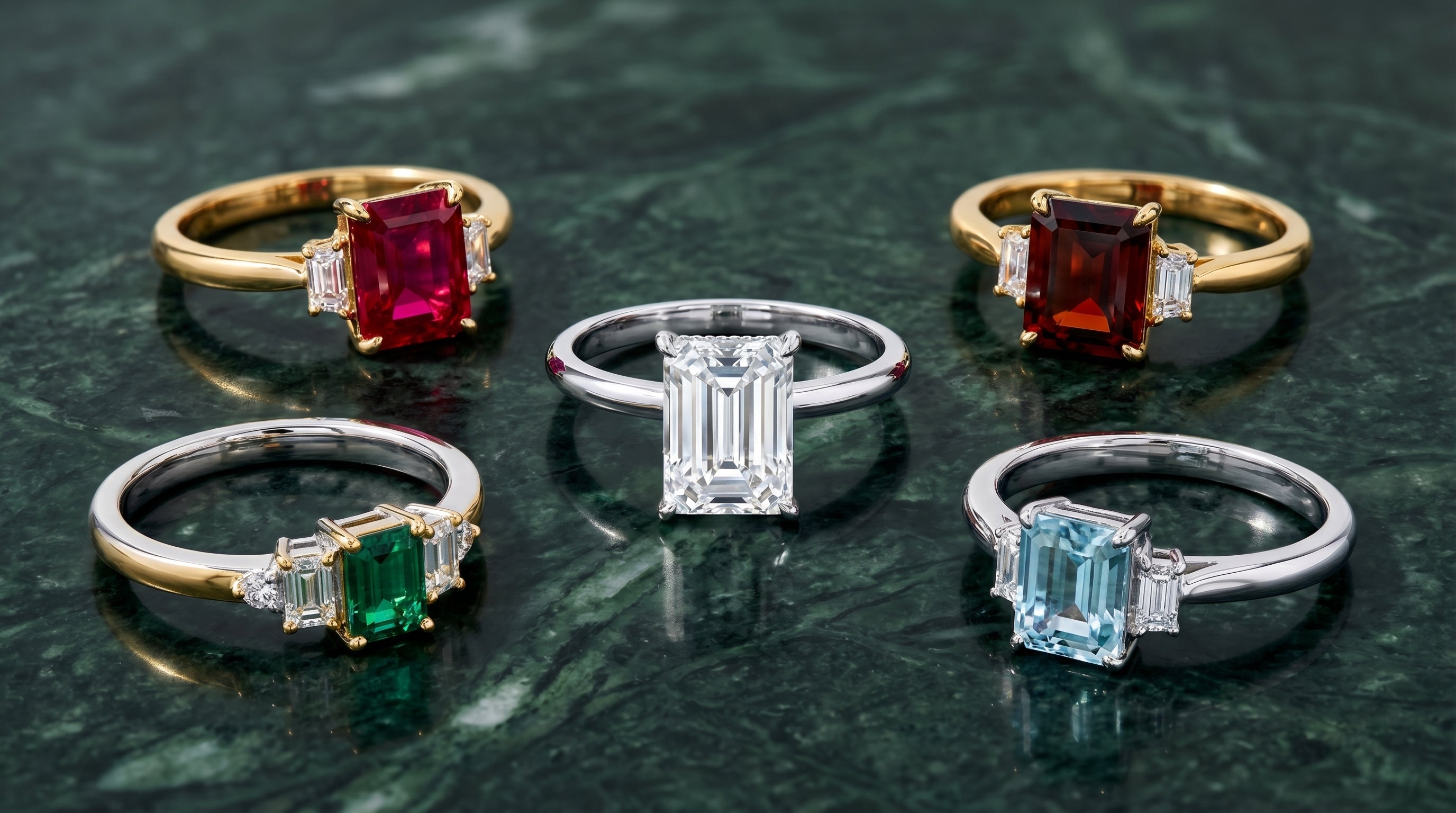
You're looking at emerald engagement rings for women, which means you already know you want something more than a standard solitaire. Good. The emerald aesthetic—whether that's a lush green stone or the iconic step-cut silhouette—is one of the most sophisticated choices in bridal jewelry. But here's the thing: not all "emerald rings" are created equal, and the difference between a ring you'll treasure for 50 years and one that chips within 18 months comes down to a few critical decisions most buyers don't know to ask about.

The term "emerald engagement ring" actually covers two very different desires. For some women, it means a ring featuring a natural green beryl gemstone—a stone steeped in history but notoriously fragile. For others, it refers to the iconic emerald cut: a sophisticated, elongated step-cut that creates a mesmerizing hall-of-mirrors effect, often executed in far more durable stones like moissanite. Whichever path calls to you, making an informed decision ensures your ring survives the rigors of everyday life while remaining as breathtaking as the day it was slipped onto your finger.
What to Know Before Buying an Emerald Engagement Ring
Before buying an emerald engagement ring, understand that natural emeralds are inherently brittle and demand special care. While they rank 7.5 to 8 on the Mohs scale, their natural internal inclusions make them highly vulnerable to chipping, cracking, and chemical damage during daily wear. That's the honest starting point every buyer deserves to hear.
The Reality of Emerald Durability
We need to have an honest conversation about durability. The Mohs scale is widely misunderstood. A natural emerald sits at 7.5 to 8, which sounds reasonably close to a diamond's perfect 10—but the Mohs scale isn't linear. It's exponential. A diamond is orders of magnitude harder than an emerald. More critically, hardness only measures resistance to scratching. It doesn't measure toughness, which is a gemstone's resistance to breaking, chipping, or cracking under impact.
Natural emeralds are brittle. Knock your hand against a granite countertop or drop your ring on a tile floor, and a natural emerald faces a real risk of fracturing. For a piece of jewelry worn every single day—through workouts, dishwashing, and daily errands—this fragility is a serious problem. Many seasoned jewelers advise against natural green emeralds for engagement rings unless the wearer accepts the very real possibility of eventually replacing the center stone.
Understanding Inclusions and "Jardin"
Look closely at almost any natural emerald and you'll notice tiny internal flaws. Gemologists classify emeralds as "Type III" gemstones, meaning visible inclusions are entirely expected. The French romantically call these inclusions jardin—"garden"—because the internal fractures and trapped minerals often resemble delicate foliage suspended inside the stone.
While jardin gives a natural emerald its unique fingerprint and proves its earth-mined authenticity, it's also the exact reason the stone is so fragile. These internal fractures act as structural weak points. A sudden impact on the edge of a heavily included emerald can cause the stone to cleave. If you're shopping for a natural stone, you have to strike a delicate balance: finding a gem with enough clarity to be structurally sound, while accepting that a completely flawless natural emerald is essentially a geological unicorn commanding tens of thousands of dollars per carat.
The Truth About Treatments
Here's a fact that surprises most first-time buyers: over 99% of natural emeralds on the market have been treated to improve their clarity. Because surface-reaching fractures are so common, gem cutters routinely submerge emeralds in cedarwood oil or modern polymer resins. These substances seep into the fractures, masking them and making the stone appear significantly clearer and more vibrant.
This is standard industry practice, but it changes how you must care for the ring. You can never put an oiled emerald in an ultrasonic cleaner—the vibrations will strip the oil right out, instantly turning a beautiful green gem into a cloudy, heavily fractured disappointment. Harsh household chemicals, hot water, and sudden temperature changes are all off-limits too. For a modern bride with an active lifestyle, these restrictions get exhausting fast.
Natural Emeralds vs. Lab-Grown vs. Moissanite
Natural emeralds offer historical romance but come with high costs and extreme fragility. Lab-grown emeralds provide better clarity at lower prices but remain brittle. Moissanite delivers the superior combination of extreme durability, exceptional brilliance, and ethical lab creation—making it the standout choice for daily engagement ring wear.
The Appeal and Drawbacks of Natural Emeralds
There's undeniable prestige in owning a natural Colombian or Zambian emerald. They carry the weight of history, evoking Old Hollywood glamour and royal collections. But that prestige comes with a steep financial and practical cost. A high-quality, one-carat natural emerald with vivid color and minimal inclusions runs between $4,000 and $10,000 in 2026. The ethical implications of colored gemstone mining remain murky too, with complex supply chains making a truly conflict-free origin difficult to guarantee.
The Rise of Lab-Grown Emeralds
Lab-grown emeralds are chemically, physically, and optically identical to natural emeralds, grown in controlled laboratory environments. This process yields stones with far fewer inclusions—meaning they're slightly tougher than their earth-mined counterparts and rarely require oil treatments. They're also significantly more affordable. However, they're still beryl. They still rank 7.5 to 8 on the Mohs scale, and they can still chip if you hit them against a hard surface. Lab-grown solves the price and ethics problem. It doesn't fully solve the durability problem.
The Moissanite Alternative
And honestly? This is where the conversation gets genuinely exciting. Originally discovered in a meteorite crater, moissanite is now expertly lab-created to produce a gemstone of staggering beauty and resilience. At 9.25 on the Mohs scale, it's second only to diamond in hardness. It won't scratch, it won't cloud, and it handles daily impacts with ease.
Moissanite's refractive index of 2.65–2.69 surpasses even diamond's 2.42, which means more light bends and bounces inside the stone. Its dispersion of 0.104 is 2.4 times that of diamond (0.044)—that's the rainbow fire you see flashing in direct sunlight, the scintillation that makes a room stop and stare. For those drawn to the architectural beauty of the emerald cut, an emerald-cut moissanite delivers that mesmerizing hall-of-mirrors depth with a brilliance that natural beryl simply cannot match. And if you want that lush green color? Green moissanite provides a vivid, deeply saturated hue with the structural integrity to last a lifetime. Our Moissanite vs Diamond Side by Side: The Full 2026 Guide shows you exactly why over 250,000 customers have made this switch.
| Feature | Natural Emerald | Lab-Grown Emerald | Moissanite (Green or Clear) |
|---|---|---|---|
| Mohs Hardness | 7.5 - 8.0 | 7.5 - 8.0 | 9.25 (Highly Scratch Resistant) |
| Durability for Daily Wear | Poor (Brittle, prone to chipping) | Fair (Fewer inclusions, but still brittle) | Excellent (Extremely tough and durable) |
| Typical Treatments | Oiling, resin filling (99% of stones) | Usually untreated | Always untreated |
| Brilliance & Fire | Low (Glows rather than sparkles) | Low (Glows rather than sparkles) | Exceptional (Higher refractive index than diamond) |
| Maintenance Required | High (No ultrasonic cleaners, gentle soap only) | Moderate | Low (Safe for ultrasonic cleaners) |
Key Factors to Consider When Shopping
When shopping for emerald engagement rings for women, prioritize vivid color and excellent cut proportions over sheer carat weight. Select protective settings like bezels or V-prongs to shield vulnerable corners, and plan your wedding band pairing early to ensure a flush, comfortable fit for everyday wear.
Prioritizing Color and Cut Over Carat Size
If you're purchasing a green gemstone, color is the absolute king of the 4 Cs. You want rich, vivid saturation—neither too pale (which looks washed out) nor too dark (which kills the light return). A smaller stone with breathtaking color will always look more luxurious than a massive stone with a dull, muddy hue.
If you're opting for an emerald-cut moissanite, cut quality becomes your primary focus. Step cuts don't hide flaws. Unlike brilliant cuts, which use dozens of tiny facets to create blinding sparkle that masks imperfections, the emerald cut features long, open facets that act like windows straight into the heart of the stone. You need exceptional clarity—which moissanite naturally provides—and perfect symmetry to achieve that hypnotic, flashing light return. Our Emerald Cut Engagement Rings Lab Grown: 2026 Buying Guide goes deeper on exactly what to look for.
Choosing the Right Setting for Protection
The setting you choose isn't just an aesthetic decision. It's a structural necessity. The corners of an emerald cut are truncated—creating distinct angles that can catch on clothing or absorb the full force of an impact. If you're setting a fragile natural emerald, a protective setting isn't optional.
A bezel setting, where a thin rim of precious metal completely encircles the girdle of the stone, offers the ultimate protection. It locks the gem in place and shields the edges from all sides. If you prefer prongs, insist on V-prongs or double-claw prongs at the corners—these provide significantly more security than standard single prongs. Even with highly durable moissanite, these setting styles look chic and add a touch of vintage architectural flair that feels unmistakably intentional.
Pairing with a Wedding Band
Elongated center stones often sit low on the finger, which creates a styling challenge when it's time to add a wedding band. A straight band will frequently bump against the basket of an emerald-cut engagement ring, leaving a visible gap. If you want a perfectly flush stack, look for rings with a "peg head" or elevated cathedral setting that allows a band to slide underneath.
Alternatively, embrace the gap or choose a contoured wedding band—shaped like a slight chevron or gentle curve—specifically designed to hug the base of your engagement ring. Thinking about this emerald engagement ring with wedding band pairing during the initial purchase saves a significant headache later. Browse our Engagement Rings collection to see which styles are designed with band compatibility in mind.
Price Ranges and True Value in 2026
In 2026, fine natural emeralds cost between $4,000 and $10,000 per carat. Lab-grown emeralds range from $800 to $1,500 per carat. Moissanite offers the most compelling value—delivering superior durability, flawless clarity, and larger face-up sizes for a fraction of the cost of mined stones.
What You Actually Pay For
When you buy a natural emerald, you're paying a massive premium for geological rarity and the complex, often inefficient supply chain required to mine, cut, treat, and transport the stone. You're paying for the romance of the earth—and for the middlemen.
With lab-grown stones and moissanite, your money goes directly into craftsmanship, cut quality, and the heavy, durable precious metals used in the setting. Because these stones are created in controlled environments, pricing reflects actual production costs rather than artificial scarcity. Our Moissanite vs Lab Diamond Price: The 2026 Breakdown offers an eye-opening look at exactly where your dollars go.
Maximizing Your Budget
A $2,000 budget applied to a natural emerald buys you a heavily included, moderately treated stone in a very simple 14k gold setting. It'll look pretty. It'll also require constant babying. That exact same $2,000 budget at Awareness Avenue secures a flawless, substantial emerald-cut moissanite set in solid 18k gold or sterling silver, complete with intricate detailing—and backed by our lifetime warranty and 30-day returns.
What matters most to you: the geological origin of the stone, or the visual impact, daily wearability, and ethical peace of mind that comes with a lab-created gem? For the modern bride, the answer is increasingly clear. We've helped over 250,000 customers find that answer for themselves.
Our Top Recommendations for 2026
Our top emerald engagement rings for women in 2026 feature stunning emerald-cut moissanite and lab-created gems that capture vintage glamour without sacrificing durability. These meticulously crafted pieces offer exceptional fire, protective settings, GRA-certified stones, and ethical origins built for a lifetime of everyday wear.
We've curated a selection of our most breathtaking rings that capture the full emerald aesthetic. Whether you want the crisp, icy perfection of an emerald-cut clear stone or a vibrant pop of color, these pieces represent the pinnacle of what's available right now.
The Mariposa: Vintage Glamour Meets Modern Brilliance
The emerald cut has been a favorite among royalty and Hollywood elite for over a century. It commands attention not through blinding sparkle, but through quiet, confident elegance. The Mariposa captures this perfectly—and then some.

Crafted with an impeccable emerald-cut center stone, The Mariposa features perfectly proportioned step facets that draw the eye deep into the heart of the gem. The setting maximizes light entry from the sides, enhancing the flashes of fire that moissanite's 0.104 dispersion makes possible. It sits with satisfying weight on the finger—substantial without being heavy—and nods to 1920s Art Deco architecture while remaining entirely modern in execution. If you love the idea of a hidden detail, our guide on Hidden Halo vs No Halo: Which Ring Style Is Right for You? shows how subtle design choices elevate a ring like this.
The Elisande: Sleek, Accessible Elegance
You don't need to spend a fortune to secure a ring that looks like a million dollars. The Elisande proves that exceptional design and high-quality materials don't have to be out of reach.

Set in premium S925 Sterling Silver with a rhodium finish that resists tarnishing, The Elisande Emerald Cut is the perfect choice for the pragmatic romantic. Refined prongs hold the center stone securely without overwhelming it, letting the crisp, clean lines of the emerald cut take center stage. It's an ideal piece for a promise ring, a travel ring, or a budget-conscious natural emerald engagement ring alternative that refuses to compromise on visual impact.
The Astrid: The Ultimate in Protective Design
For the woman who works with her hands, lives an active lifestyle, or loves the sleek look of modern metalwork, the bezel setting is the holy grail of ring design. No snagging. No anxiety. Just clean, confident elegance.

The Astrid Emerald Cut Bezel Ring wraps the center stone in a seamless ribbon of precious metal. This protects the edges from accidental impacts while visually expanding the footprint of the ring, making the center stone appear even larger. The bezel is smooth—it won't catch on sweaters, scratch a child, or snag on delicate fabrics. It's the perfect marriage of form and function, delivering the elongated elegance of the emerald cut with zero daily-wear anxiety.
The Mariposa in Gold: Warmth and Contrast
White metals offer an icy, modern look. But there's something undeniably rich and regal about pairing a crisp emerald cut with the warm glow of yellow gold—a combination that echoes the vintage emerald engagement rings of the 1920s while feeling completely current.

The Mariposa - Gold takes our beloved vintage-inspired design and bathes it in golden warmth. The contrast between the bright, flashing white light of the center stone and the rich yellow metal creates a dynamic visual tension that's flattering across a wide range of skin tones. Gold also emphasizes the geometric lines of the step cut, making the architectural elements of the ring stand out beautifully. Classic and distinctly fashion-forward, all at once.
The Arista: Radiant Brilliance
You love the elongated, rectangular shape of the emerald cut—but you also crave the blinding, crushed-ice sparkle of a brilliant cut. The radiant cut is your answer.

The Arista Ring features a radiant-cut center stone that maintains the sophisticated, truncated-corner outline of an emerald cut, but replaces the long step facets with dozens of triangular and kite-shaped facets. The result is an explosion of light and fire. This ring catches the light from every conceivable angle—the kind of scintillation that makes a room stop and stare. It's designed for the woman who wants maximum sparkle and a substantial presence on the finger, and it delivers on both counts without compromise. Explore more styles like this in our Solitaire Rings collection.
Frequently Asked Questions
Are natural emeralds good for everyday engagement rings?
Generally, no. Natural emeralds rank 7.5 to 8 on the Mohs scale, but their natural internal inclusions (jardin) make them highly brittle. They're prone to chipping, cracking, and breaking if knocked against hard surfaces. For a ring worn every single day, highly durable alternatives like moissanite (9.25 Mohs) are far safer and more practical choices for natural emerald engagement rings wearers who want zero maintenance anxiety.
How do I clean an emerald engagement ring?
If you have a natural emerald, clean it carefully. Never use an ultrasonic cleaner, steam cleaner, or harsh chemicals—these strip the oils and resins used to treat the stone, leaving it cloudy and brittle. Use only lukewarm water, a drop of mild dish soap, and a very soft brush. If you have an emerald-cut moissanite ring, you can safely use ultrasonic cleaners and standard jewelry cleaning solutions. Moissanite is tough, untreated, and never needs the delicate handling that natural beryl demands.
Why choose an emerald-cut moissanite over a natural emerald?
Choosing an emerald-cut moissanite gives you the sophisticated, vintage-inspired geometry of the step cut without any of the durability anxiety associated with natural beryl. Moissanite is exponentially harder (9.25 on the Mohs scale), completely resistant to scratching, and possesses a refractive index of 2.65–2.69—higher than diamond's 2.42—meaning it flashes with more fire and brilliance than a green emerald engagement ring featuring natural beryl ever could. It's also lab-created, GRA-certified, and ethically sourced.
Do emerald engagement rings hold their value?
The resale value of jewelry is widely misunderstood. Only exceptionally rare, untreated, museum-quality natural emeralds appreciate in value. Standard commercial emeralds—the vast majority of the market—lose a significant portion of their retail value the moment you buy them. Rather than shopping for an "investment," shop for value: a beautiful, durable ring that gives you decades of joy without an inflated luxury markup. That's a return no resale market can match.
Your Next Steps to Finding the Perfect Ring
Finding your dream ring means balancing breathtaking aesthetics with practical daily wearability. Explore our curated collections of emerald-cut and moissanite engagement rings to discover a piece that perfectly reflects your unique love story—and holds up to every chapter of it.
The journey to finding the perfect engagement ring is deeply personal. It's about finding a symbol that represents your commitment while seamlessly fitting into your daily life. You don't have to choose between a ring that looks like a vintage masterpiece and a ring that survives a trip to the gym. By choosing expertly crafted, highly durable materials, you secure a lifetime of brilliant, worry-free wear—backed by our lifetime warranty, secure checkout, and 30-day returns.
We invite you to explore our full range of stunning designs. Browse our Engagement Rings collection to see our complete bridal offerings, or focus specifically on the architectural beauty of our Emerald Cut collection. If you want to see what other modern brides are falling in love with this year, take a look at our Best Sellers. Your perfect ring is waiting—and we're here to make sure it shines brilliantly for decades to come.

Hinterlasse einen Kommentar
Diese Website ist durch hCaptcha geschützt und es gelten die allgemeinen Geschäftsbedingungen und Datenschutzbestimmungen von hCaptcha.