
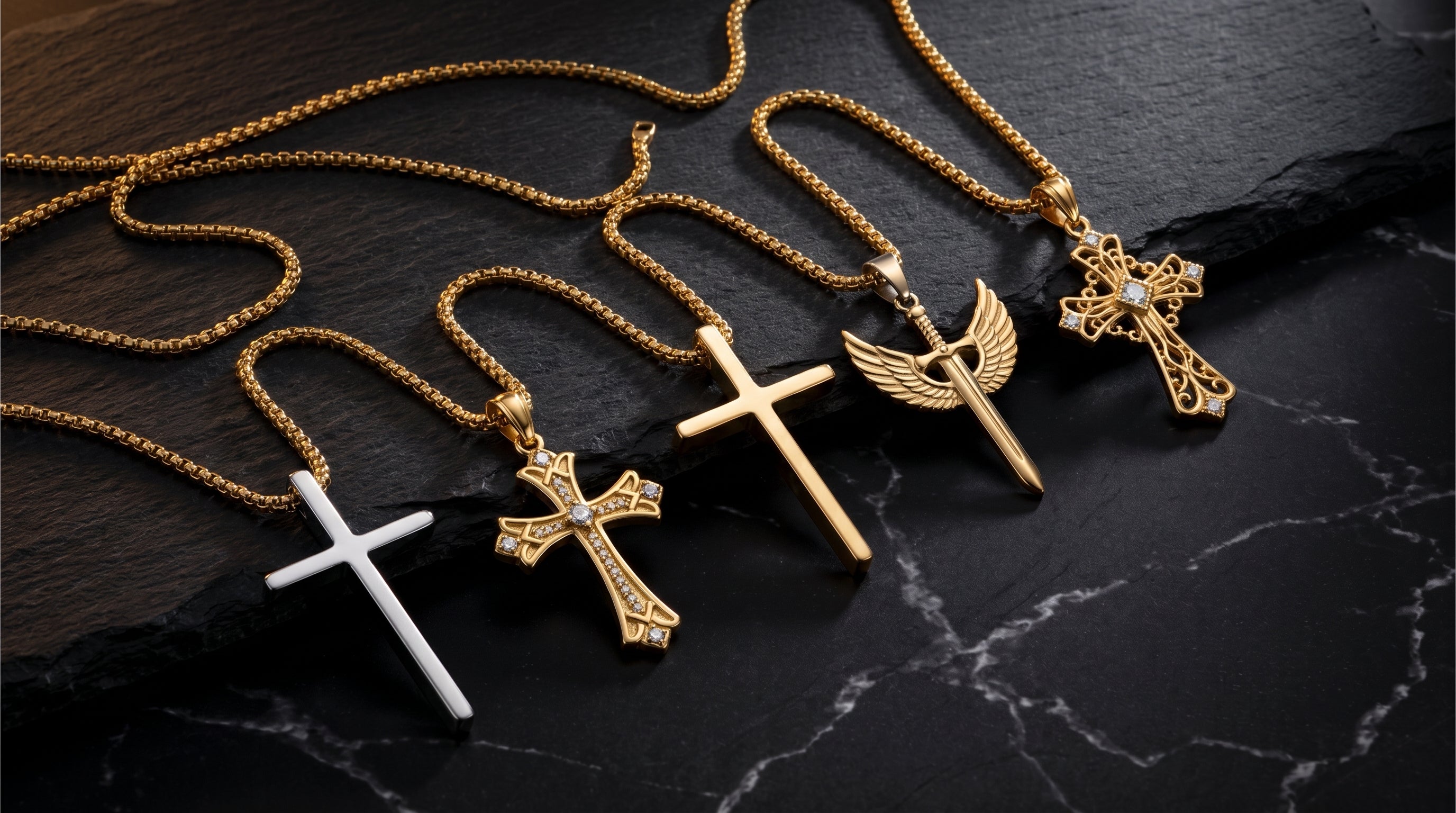
Two inches sounds trivial until you hang a pendant on it. A 20-inch chain typically lands at or just below the collarbone; 22 inches drops that same pendant onto the upper chest, where it clears a crew neckline instead of disappearing beneath it. That is the entire reason fine jewelers keep steering men toward the 22-to-24-inch band whenever a chain has to carry a cross, a medallion, or a compass. This guide is about what genuinely differs between two listings at the same length: how width and gram weight scale, how to price 14K by its metal content instead of by feel, how to separate solid gold from hollow and plated construction, and which link styles survive a heavy pendant worn every day.
What 22 Inches Actually Does on Your Body
Men's necklace lengths generally run from 18 to 30 inches. Within that range, 18 inches sits close to the base of the neck, 20 inches rests near the collarbone, and 22 inches drops just above or onto the upper chest. Anything from 24 inches upward begins to read as a longer, looser line associated with streetwear and layering rather than a single signature piece.
Those numbers are averages, not guarantees. Neck circumference, torso length, and build all shift where a chain settles. A man with a thicker neck may find a 22-inch chain sitting closer to the collarbone than the illustrations suggest, while a slimmer frame will see it drape lower. This is why the same chain photographs so differently across two models.
How to measure before you order
Wrap a soft tape measure or a length of string around the base of your neck where a chain would naturally rest, mark it, and measure it flat. Add roughly two inches for a chain that sits comfortably at the collarbone, and more if you want the pendant to fall on the chest. Cross-check against a chain you already own: measure it clasp-to-clasp with the necklace laid flat and compare where it lands. That single check prevents most returns and most disappointed unboxings.
20 inches versus 22 versus 24
A 20-inch 14K gold chain is the cleaner choice for a chain worn alone, under a collar, or in an office setting, because the drop stays high and controlled; our guide to the 20-inch rope chain works through the same proportions with a specific link style. A 24-inch 14K gold chain gives more length for layering and for larger pendants that need room, which is the trade-off examined in our 24-inch Cuban link buying guide. Twenty-two inches is the compromise position: visible above most crew necklines, long enough to place a pendant at a balanced point on the torso, short enough that it does not swing when you move.
Width, Gram Weight, and What You're Actually Buying
Length sets the drop. Width sets the presence, and width plus length sets the gram weight, which is what most of the price is made of.
Choosing a width
Buying guides written for men new to necklaces generally recommend starting in the 2 mm to 6 mm range for an everyday chain. Below about 3 mm the chain reads as subtle and works best as a pendant carrier. From roughly 4 mm to 6 mm it becomes visible on its own. Above 6 mm you are into statement territory, where the chain is the outfit rather than an accent, and where widths of 6 mm to 10 mm or more support the heavy, high-visibility look.
Product photography is a poor judge of millimeters. Compare the stated width against something physical: a standard ring band, an existing chain, or a ruler held against the screen at true scale. A chain that looks moderate in a close-up crop can feel overwhelming in a meeting.
How weight scales
Weight modeling from men's chain specialists gives useful anchors. A thin chain around 1.5 mm weighs roughly 3 grams at 16 inches and close to 6 grams at 30 inches. A thick 6.5 mm chain can exceed 40 grams at 16 inches and pass 70 grams at 30 inches. Link-specific tables show the same pattern within a style: a 2.5 mm 14K wheat chain sits just over 5 grams at 16 inches and around 5.7 grams at 18 inches, while a 4 mm version of the same wheat link exceeds 11 grams at 16 inches.
For a given link and width, gram weight tracks length close to proportionally, so a 22-inch chain lands between those published anchors. As a rough estimate, take a quoted 16-inch weight and multiply by about 1.4 to approximate the same chain at 22 inches. Use that only as a sanity check against a seller's stated weight, not as a substitute for it. A listing that advertises a substantial width but omits grams entirely is withholding the single number that determines what you are paying for.
Reading the 14K solid gold chain price
14K gold is approximately 58.5 percent pure gold by weight, which is why it is stamped 585 as often as 14K. The metal value of a chain is therefore its gram weight multiplied by 0.585 multiplied by the current price of gold per gram. Look up the spot price on the day you shop and run that math yourself; it takes thirty seconds and it tells you how much of a quoted price is metal and how much is design, labor, brand, and retail margin. The same arithmetic explains why karat matters so much to value: at identical weight, a 24K chain contains close to twice the gold of a 14K one, and 10K contains meaningfully less. Our breakdown of 14K gold chain price per gram walks through the calculation in more detail.
Two realities keep this honest. First, retail prices sit well above wholesale, which itself sits above melt value, because jewelers must cover design, labor, overhead, service, and returns. Second, when you sell, reputable gold buyers typically pay somewhere in the range of 60 to 80 percent of the metal value to cover their own margins. The gap between those two numbers is the reason a chain should be bought as something to wear rather than as a trade. Gold jewelry holds real intrinsic value, but the premium you pay at retail is not recovered at the scrap counter.
14K, 18K, 24K: Which Alloy Belongs Around Your Neck
Karat measures parts of gold out of 24. 24K is essentially pure gold. 18K is 18 parts gold to 6 parts alloy, roughly 75 percent. 14K is 14 parts gold to 10 parts alloy, about 58.5 percent. 10K contains roughly 41.7 percent gold.
Why 14K dominates men's chains
Purity and hardness pull in opposite directions. The alloy metals that dilute gold also stiffen it, so 14K resists bending, stretching, and surface scratching better than 18K or 22K, and dramatically better than 24K. For a chain that lives against skin, rubs on collars, absorbs sweat, and takes the occasional accidental yank, that hardness is not a minor spec. It is why men's 14K gold chains occupy more catalog space than any other karat, and why 18K is usually positioned as a color and prestige upgrade rather than a durability one.
What a 24K gold chain gives and costs you
Real 24K gold chains have the deepest, most saturated yellow color and the highest melt value per gram, which is a genuine draw in cultures and households where gold jewelry doubles as stored value. The trade-off is mechanical: pure gold is soft enough to deform, stretch, and mark under ordinary handling, which is why gemological educators consistently discourage it for fine everyday chains. If you are cross-shopping a 24K gold chain against 14K at the same length, you are choosing between maximum metal content and a chain you can wear without thinking about it. For a 22-inch daily-wear piece with a pendant on it, 14K is the more defensible answer, and 18K sits between the two. Our 4 mm rope chain guide at 22 inches shows how those alloy choices play out in one concrete spec.
Is a 14K gold chain for a woman a different product?
Not materially. Karat, construction, and hallmarking are identical regardless of who wears the chain; what changes is proportion. A 22-inch length that reads as mid-chest on many men will fall lower on a smaller frame, and widths that look understated on a broad chest can look bold on a narrower one. If you are shopping for a woman, the same measuring method applies, usually a length or two shorter for the equivalent visual drop.
Solid, Hollow, or Plated: The Distinction That Decides Longevity
This is where identical-looking listings diverge most sharply, and where buyers are most often surprised after the fact.
- Solid gold. Every link is gold alloy throughout. Solid gold chains for men are the most durable option over the long term, do not wear through to a base metal, and retain scrap value proportional to weight and karat.
- Hollow. The links are formed from tubes of gold around empty space, delivering the visual bulk of a thicker chain at a fraction of the gold content and weight. Hollow rope and Cuban links are common at accessible price points, but they crush, dent, and stretch far more easily, and they are difficult to repair cleanly once deformed.
- Plated or filled. A gold layer over brass, steel, or another base metal. The look is convincing when new, but friction points such as the clasp, the pendant bail, and the underside of the links wear first. Once the layer thins, the base metal shows and some wearers see skin reactions.
The word to hunt for in a listing is "solid." If a product description says 14K without saying solid, and lists a suspiciously low weight or no weight at all for its stated width, ask the seller directly whether the chain is solid or hollow. Marks like GP or GEP indicate gold plated or gold electroplated, and GF indicates gold filled; none of them mean solid gold. Plated pieces can be a perfectly rational purchase for the look, but they belong in the fashion category, not the investment one.
Link Styles That Suit a 22-Inch Chain
Cuban link
Thick, flattened, interlocking oval links with a tight profile. Cuban is the most recognizable men's chain silhouette, strong across the joint, and equally at home worn bare or under a pendant. At 22 inches it reads assertive without becoming a costume, particularly in the 4 mm to 6 mm range.
Rope
Twisted strands that catch light from every angle, which makes rope look brighter than its actual width suggests. Classic, versatile, and one of the most common 14K yellow gold options at this length. Solid rope is durable; hollow rope is one of the more failure-prone constructions on the market, so construction matters more here than almost anywhere else.
Franco and box
Both use tightly spaced, squared-off links that create a smooth, dense, low-profile line. They are among the strongest everyday structures and the best default when a heavy pendant is the centerpiece, because they distribute stress evenly and do not visually compete with the pendant.
Figaro and wheat
Figaro alternates short and long links for a vintage, continental look. Wheat interlocks twisted oval links into a flexible braid that drapes fluidly while staying durable. Both sit between rope and box in visual texture, and both work well at 22 inches for men who want something recognizable but not the default Cuban.
Pairing a Pendant with a 22-Inch Chain
A large share of demand at this length is pendant-driven, and 22 to 24 inches is the range fine jewelers specifically recommend for pendant necklaces because it places the piece at a balanced point on the chest. Too short, and a cross rides awkwardly at the base of the throat or vanishes under a collar. Too long, and it swings, hides under a shirt, or reads as unintentionally casual.
Match the chain to the pendant's mass, not just its style. A substantial pendant on a 1 mm to 2 mm chain is a structural mismatch: the thin links and the jump ring take all of the load and eventually stretch or open. Heavier pendants belong on Franco, box, or thicker Cuban links. Conversely, an oversized chain under a small pendant swallows it visually. As a working rule, let the chain be visually secondary to the pendant unless you intend the chain itself to be the statement, and check that the bail opening actually accommodates your chosen width before ordering.
If you are building the look rather than the metal portfolio, gold-tone stainless steel is a legitimate route. Pieces such as the Divine Cross Pendant in gold stainless steel or the Voyager Compass Pendant deliver the chest-level silhouette a 22-inch chain is designed for, and they let you test proportion, width, and pendant size before committing to solid gold. You can browse the wider men's jewelry collection alongside our solid gold pieces to compare the two paths directly. Our roundup of chain and pendant pairings covers the combinations in more depth.
Verifying a Real 14K Chain
Where to look for the hallmark
On necklaces, the purity stamp is almost always on or immediately next to the clasp, either on a flat face of the clasp itself or on a small tag attached to the end link. For 14K, expect 14K, 585, or both. Related marks worth recognizing include 375 for 9K and 750 for 18K, plus maker's marks and, in some countries, assay office symbols indicating where and when the piece was tested.
Authentic hallmarks are cleanly and evenly struck and legible under magnification. Blurred, shallow, or inconsistent stamping is a warning sign, as is the complete absence of any mark on a modern chain. On antique or heavily worn pieces marks can genuinely erode, which is a case for professional evaluation rather than assumption.
Quick checks you can do yourself
- Heft. Gold is dense. A chain that feels light for its apparent bulk is likely hollow or plated.
- Magnet. Gold is not magnetic. Attraction to a magnet indicates significant base metal, though a lack of attraction alone does not prove authenticity, since several non-magnetic base metals exist.
- Wear points. Inspect the clasp, the bail contact point, and the underside of the links for any color change that would indicate plating wearing through.
Tests that require a professional
Definitive answers come from acid testing, electronic conductivity testers, X-ray fluorescence analysis, or specific gravity measurement, the last of which is particularly good at exposing hollow and plated pieces by density. Acid testing can mark a piece if done badly and XRF equipment is expensive, so both belong with a jeweler, gemologist, or appraiser rather than at your kitchen table. Before that stage, the cheapest protection is buying from a seller with a clear return window and transparent specifications, which is exactly what consumer guides emphasize when they tell buyers to check policies before checking out.
Clasps, Care, and What Actually Fails
Chains rarely fail in the middle of a link run. They fail at the clasp and at stress points.
The clasp is the weak point
Lobster and spring-ring clasps rely on a small internal spring that opens and closes thousands of times over a chain's life. That spring can lose tension, slip, or snap, at which point the clasp stays open and you lose both the chain and whatever hung on it. When evaluating a chain in hand, work the clasp several times: it should move smoothly and close with a decisive, secure snap, with no play in the gate. Check jump rings and end links for fully closed, properly soldered joints too, since an open seam under a heavy pendant is a slow-motion failure.
What damages gold chains
Common culprits are stretching from snagging on clothing or sudden pulls, structural weakness from thin or poorly soldered links, and chemical exposure. Wearing a gold chain in the shower is a genuine problem: soaps, shampoos, conditioners, and cosmetic residues interact with the non-gold alloy components in 14K over time, dulling the finish and gradually weakening links. Remove chains before bathing, swimming, and applying lotions or fragrance.
Cleaning and storage
For a solid 14K chain, soak in warm water with a small amount of mild dish soap, work gently along the links with a soft-bristled brush, rinse, and dry with a soft cloth. A paste of baking soda and water can lift stubborn residue from yellow gold, but it is mildly abrasive and should be used sparingly to avoid micro-scratching. Gemstone-set pendants are better handled by a jeweler who can also check for loose stones and worn prongs.
For storage, the simplest anti-tangle trick is to thread the chain into a small zip bag with the clasp hanging outside, then seal the bag on the chain so it cannot knot on itself. Keeping chains hung straight and separate from other pieces also prevents them from scratching softer materials such as pearls.
Where This Category Sits Right Now
Context helps explain why there are so many options at this exact length. Market estimates valued the global men's jewelry segment at roughly $34.3 billion in 2023, with published projections pointing to about $71.8 billion by 2032; the broader U.S. jewelry market is projected to exceed $120 billion by 2031. Those are forecasts, not realized results, but the direction of travel matches what buyers report: survey data indicates 80 percent of U.S. adults now buy fine jewelry for themselves rather than receiving it as a gift, and 35 percent of buyers aged 18 to 29 name necklaces as their preferred category.
Research into men's jewelry buyers specifically finds that around two-thirds rank quality and durability as a primary decision factor, and more than half compare multiple options before purchasing. That is a useful signal for anyone reading this guide: the questions that separate a good 22-inch chain from a regrettable one are construction and specification questions, not styling ones. Analyses of fine jewelry buying also note how heavily emotional drivers, identity, milestones, and self-expression, shape higher-value purchases, which is precisely why a chain and pendant chosen well tends to be worn daily for years.
A Buying Checklist for a 22-Inch 14K Chain
- Measure first. Neck circumference plus your intended drop, checked against a chain you already own.
- Confirm construction. The listing should say solid, not just 14K. If it does not, ask.
- Demand a gram weight. Then check it against the width and length using the anchors above.
- Run the metal math. Grams multiplied by 0.585 multiplied by today's gold price per gram tells you what share of the price is metal.
- Match the link to the pendant. Franco, box, and thick Cuban for heavy pendants; rope, Figaro, and wheat for lighter ones or for wearing bare.
- Check the hallmark and the clasp. 14K or 585 near the clasp, cleanly struck; the clasp itself should close firmly.
- Read the return policy before you pay, and keep the packaging until you have confirmed fit and finish.
Get those seven right and a 22-inch chain becomes the piece you stop thinking about, which is the point. It clears your collar, holds a pendant where it should sit, and takes daily wear without complaint, whether you buy it in solid 14K or start with a gold-tone version while you settle on the proportions you actually like.

Hinterlasse einen Kommentar
Diese Website ist durch hCaptcha geschützt und es gelten die allgemeinen Geschäftsbedingungen und Datenschutzbestimmungen von hCaptcha.