


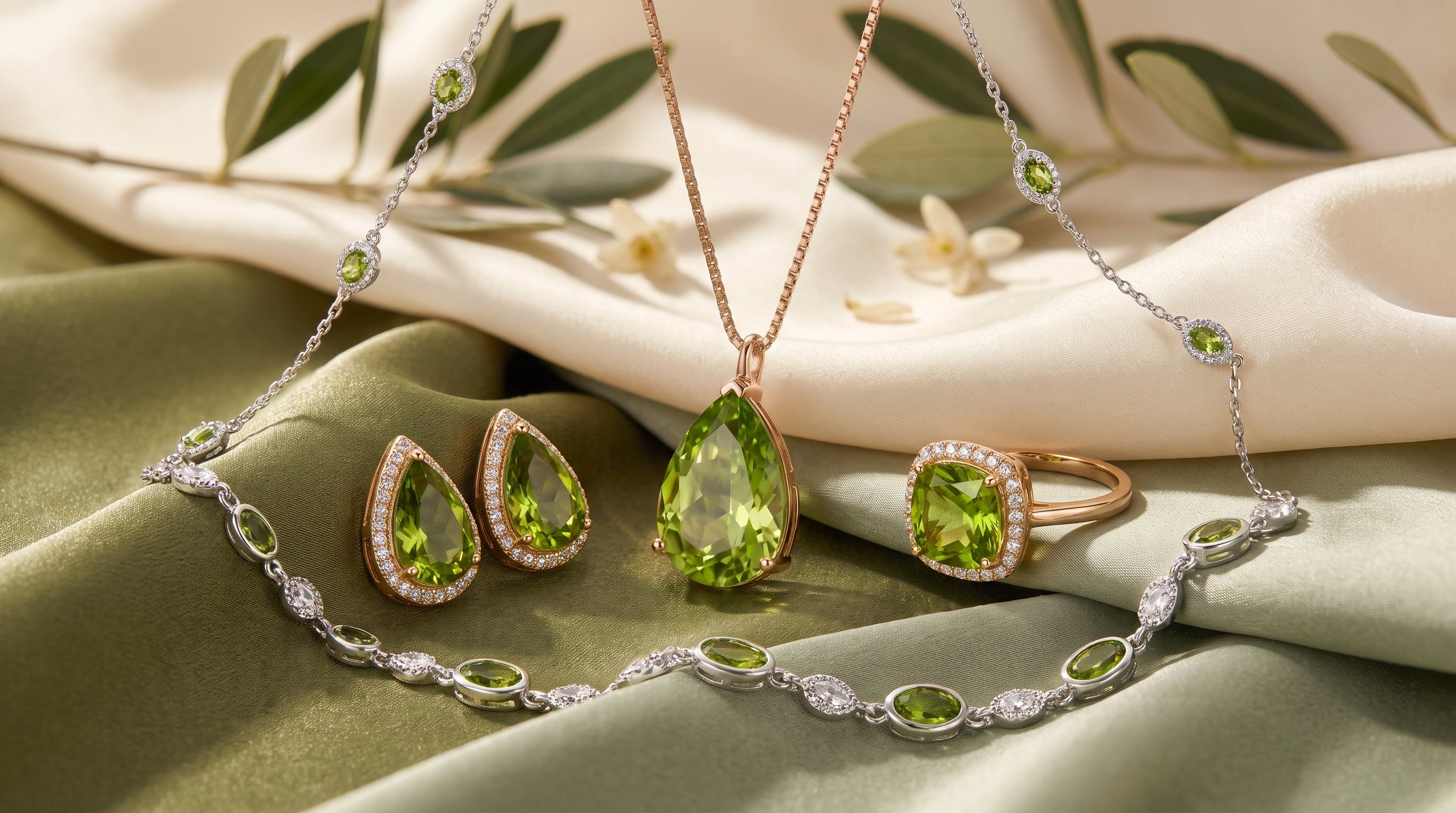
Three stones officially belong to August — peridot, spinel, and sardonyx — yet scroll almost any retailer's August birthstone jewelry page and you will see one thing: green peridot. That gap between the gemological list and the shopping grid is worth understanding before you spend, because peridot does not behave like the sapphire and diamond that most birthstone settings were designed around. Peridot rates roughly 6.5 to 7 on the Mohs hardness scale, while sapphire rates 9. That single number should influence your choice of format — ring, bracelet, necklace, or earrings — more than any design detail on the page. This roundup covers the color range you should actually expect, how to match format to how you live, which pieces fit which use case, what to verify before checkout, and the care routine that keeps a peridot looking the way it did in the photo.
The three August birthstones, and why stores show only one
The Gemological Institute of America lists peridot, spinel, and sardonyx as the birthstones for August, and notes that sardonyx is the original stone for the month, with a history stretching back more than 4,000 years. The International Gem Society's birthstone chart draws the same distinction a different way: peridot and spinel are the modern August stones, while sardonyx is the traditional one. All three are legitimate. Modern retail simply standardized around peridot.
Peridot: the modern default
Peridot is the yellowish green to greenish yellow gem variety of the mineral olivine, and it forms under extreme conditions — including deep in the Earth's mantle and, occasionally, inside meteorites. Its green comes from iron within the crystal structure, which is why the stone is never blue, pink, or colorless. Peridot is also the gem traditionally given for a 16th wedding anniversary, so an August birthstone necklace or bracelet does double duty as an anniversary gift.
Spinel: the color-flexible modern addition
Spinel was added to the August birthstone list in 2016 and appears in reds, pinks, blues, lavenders, and black. Historically, red spinels were mistaken for rubies in famous royal regalia. Practically, spinel is harder than peridot — around 8 on the Mohs scale — which makes it the sturdier choice for a high-contact ring or bracelet if you would rather not wear green at all.
Sardonyx: the traditional striped stone
Sardonyx is a banded chalcedony: layers of reddish-brown to orange-red sard alternating with white or lighter bands. Ancient carvers used it for cameos, intaglios, and protective talismans. It reads earthy and graphic rather than sparkling, which is why it rarely appears in mainstream birthstone grids but still suits carved statement pieces.
If you want the full picture of how modern and traditional stone lists differ across all twelve months, our complete birthstone jewelry guide covers the wider chart.
August birthstone color: what "correct" green looks like
The single most common source of confusion in this category is color. Peridot is always green, but the exact shade varies considerably depending on the stone's source and iron content. GIA describes the hue range as yellowish green to greenish yellow, with the most prized material showing a richly saturated, slightly yellowish green without brown. Consumer guides translate that into plainer language: anywhere from bright lime to deep olive. The one rule that holds is negative — if a stone is not green, it is not peridot.
Why two peridot pieces can look like different stones
Lighting, camera settings, backdrop color, and metal tone all shift how green reads on screen. A peridot set in yellow gold vermeil tends to look warmer and more golden-green; the same stone in sterling silver or a white metal reads cooler and closer to lime. Jewelers have long noted that peridot's green appears to hold up under low light, which earned it the nickname "evening emerald," and it is frequently mistaken for topaz or emerald by people seeing it for the first time. Variation between pieces is normal, not a sign that something is wrong.
Natural peridot versus simulated peridot
This is the specification most category pages skip, and it changes both the look and the care requirements. Natural peridot carries the color range and inclusions described above. Simulated peridot is a man-made stone chosen to reproduce the color, and it is typically cut with the eye-clean uniformity that natural material rarely delivers. Neither is inherently better — they are different products bought for different reasons. Awareness Avenue separates them, with an August simulated peridot collection and a distinct natural peridot collection, so the fastest way to confirm which you are buying is to check which collection a piece sits in and read the stone line on its product page before adding to cart.
Durability first: let Mohs 6.5–7 pick your format
Jewelers disagree about how far peridot can be pushed, and the disagreement is instructive. One long-established jeweler states plainly that peridot cannot stand up to hard wear and does not recommend it for daily-wear pieces. A retailer that sells peridot engagement rings argues the opposite — that peridot is durable enough for daily wear with mindful care and a protective setting. Gem guides land in between, describing peridot as reasonably hard and wearable but still capable of chipping if it takes a knock, and sensitive to extreme heat, which can affect its color. Reconciled, the evidence supports a simple hierarchy.
Rings: highest risk, so the setting has to work
Rings absorb more impact and abrasion than any other format. A peridot ring is a reasonable purchase if the stone is protected — bezel and halo styles shield the girdle and edges, which is exactly where chips start — and if you take it off for cleaning, gym sessions, gardening, and anything involving grit or chemicals. Open, high-set prongs on a soft stone are the combination to think twice about for an everyday band.
Bracelets: middle ground, dependent on stone size and setting height
Wrists meet desks, door frames, and car doors constantly. Bracelets with lower-profile settings and smaller stones ride out that contact far better than tall, wide centerpieces. Chain-style bracelets that let stones sit flat against the wrist are the practical pick for daily wear.
Necklaces and earrings: the safest homes for peridot
Pendants and earrings simply do not take the same hits. Gem guides consistently recommend pendants and earrings as peridot's best uses, with rings acceptable when the setting is protective. If you want August birthstone jewelry you can put on and forget about, start at the neck and ears rather than the hand.
August birthstone necklaces
Necklaces let you show more stone with less risk, which is why peridot pendants dominate this category across the market. Three silhouettes cover most preferences.
A single-stone pendant. The Elyon Peridot Pendant is the straightforward interpretation: one stone, one focal point, easy to layer under or over other chains. Warm metal tones push peridot's green toward gold; cooler metals keep it crisp.
A pear-cut drop. The Peridina Teardrop is described by Awareness Avenue as a pear-cut simulated peridot necklace in 18K gold vermeil. A pear outline elongates the neckline and gives more visible surface area than a round of the same carat weight, which is useful when you want presence without a bulky setting.
A station design. Station necklaces distribute several smaller stones along the chain instead of concentrating everything in one pendant — a quieter, more everyday read that also spreads the risk across many small stones rather than one large one. The Peridelle Station follows that format; check the product page for its current material listing.
If you plan to wear a necklace alongside matching pieces, read our guide to building an August birthstone jewelry set that actually matches before you buy piece by piece — stone tone and metal finish are much easier to coordinate up front than after the fact.
August birthstone bracelets
A bracelet is the most-gifted August birthstone format after the pendant, largely because sizing is forgiving. Awareness Avenue's August Peridot Birthstone Bracelet is described by the brand as a tribute to August-born wearers, crafted in S925 sterling silver — the literal interpretation of the search, and the safest choice when you are buying for someone whose taste you do not know well.
For a more design-led option, The Elianise Oval Bracelet uses oval stones for a different silhouette. Oval outlines read larger than rounds at the same width and sit lengthwise along the wrist, which keeps the profile relatively low; confirm metal and stone details on its product page.
Two practical checks before you buy any gemstone bracelet: confirm the chain length and clasp type on the product page, and consider how the setting height will behave against a desk or a sleeve. Our birthstone bracelet guide compares those variables across metals and stone types.
August birthstone rings
Rings are where peridot's hardness matters most, so the shortlist below is organized by how the setting handles the stone rather than by style alone.
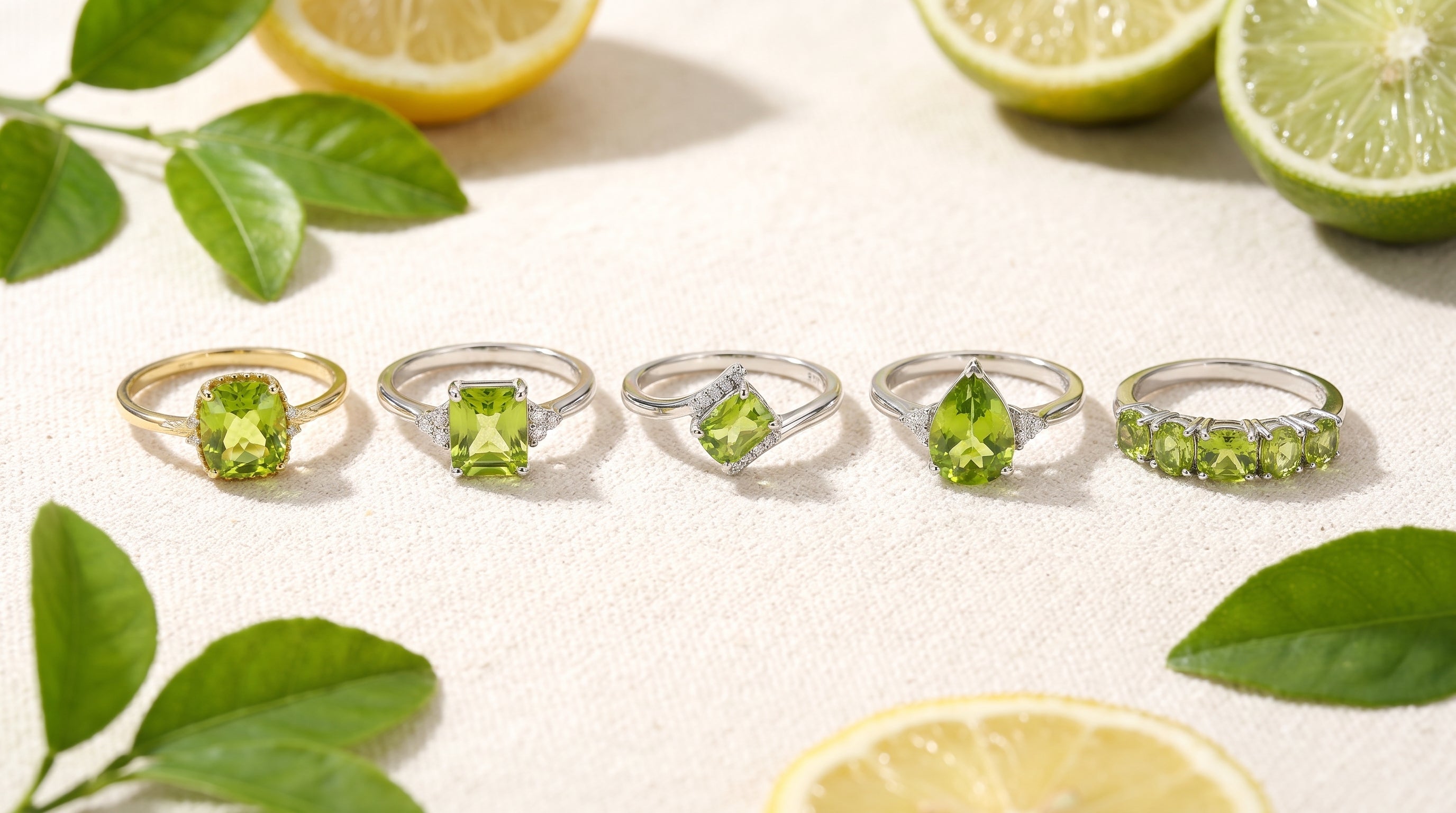
Cushion cut. The Azurina Cushion Ring uses a cushion outline — rounded corners, which are inherently less exposed than the sharp points of a marquise or pear.
Radiant cut. The Elianise Radiant Ring pairs a rectangular, brilliant-faceted outline with cropped corners, giving a more architectural look while still avoiding fragile points.
Bypass design. The Zelinda Bypass Ring uses a shank whose ends pass one another rather than meeting, an open silhouette that suits stacking.
Whichever you choose, verify the metal on the product page, and treat a peridot ring as an occasion or office piece rather than a never-remove band unless the stone is bezel- or halo-protected. For a broader comparison of settings, stone counts, and metal choices, see our birthstone ring buying guide.
August birthstone earrings: what to check before you buy
Earrings are the lowest-impact way to wear a softer gemstone, since they rarely collide with anything. Two decisions matter more than the design.
First, studs versus drops. Studs sit flush and survive hair, scarves, and headphones better; drops swing and catch light, which flatters peridot's brightness but increases the chance of a knock. Second, back and post security — a screw-back or a well-fitted friction back is worth confirming on any pair with a stone you would be sorry to lose.
Awareness Avenue also lists pieces named for their silhouette rather than their format, including The Thalira Heart and The Valerelle Drop. Open each product page to confirm the format, metal, and stone specification before ordering, and browse the wider birthstone jewelry collection if you want to compare across months.
How to care for peridot jewelry
Care advice for peridot is unusually consistent across gemological and jeweler sources, which makes it easy to follow.
- Clean with mild soap and warm water. A soft-bristle brush and warm soapy water is the recommended method. Rinse and dry gently.
- Skip ultrasonic and steam cleaners. Peridot is vulnerable to thermal shock, so mechanical cleaners and intense heat are widely discouraged. Extreme heat can also affect the stone's color.
- Keep acids away. Peridot can be damaged by acids, including long-term exposure to acidic perspiration — one reason to wipe pieces down after wear and to remove rings before workouts.
- Store it separately. Anything harder than 6.5 to 7 will scratch peridot. A separate pouch or a lined compartment prevents the dulling that comes from letting pieces rub together in a jewelry box.
- Apply products first. Perfume, lotion, and hairspray should go on before the jewelry, not after.
Follow those five habits and the stone's surface polish — the thing that makes a peridot look expensive — stays intact.
If you are specifically searching for Pandora
Searches like "Pandora August birthstone charm," "August birthstone ring Pandora," and "Pandora September birthstone ring" are brand-locked, and it is worth being clear about that. Pandora sells its own birthstone lines organized by month, typically using man-made crystals set in sterling silver, with some gold options; its September Birthstone Eternity Circle Ring, for example, is a sterling silver band with a single claw-set blue man-made crystal. Those pieces are only available from Pandora.
Awareness Avenue's peridot jewelry is not Pandora-branded and is not sold as compatible with Pandora bracelets, so if your search is specifically for a Pandora charm or a Pandora-fit ring, go to Pandora. If what you actually want is August birthstone jewelry — a peridot ring, bracelet, necklace, or pair of earrings from any maker — the pieces above address that intent directly. For bracelet builders comparing charm systems more broadly, our guide to birthstone charms for bracelets explains how different formats and fittings work.
A short pre-purchase checklist
- Confirm the stone. Natural peridot or simulated peridot? The product page and collection should tell you.
- Match format to lifestyle. Everyday hands-on work points to pendants and earrings; rings need protective settings and a habit of taking them off.
- Check the metal. Sterling silver and gold vermeil shift how the green reads. Decide whether you want a warm, golden-green or a cooler lime, and verify the listed metal on the product page.
- Read the dimensions. Chain length, stone shape, and setting height affect wearability more than photographs suggest.
- Plan the care. If you were counting on tossing it in an ultrasonic cleaner, choose a harder stone instead.
Frequently asked questions
What is the August birthstone color?
Green. Peridot ranges from yellowish green to greenish yellow — bright lime through deep olive — with the shade depending on the stone's source and iron content. If a stone marketed as peridot is not green, it is not peridot. August's other stones differ: spinel appears in reds, pinks, blues, lavenders, and black, and sardonyx shows reddish-brown bands alternating with white.
Can I wear a peridot ring every day?
It depends on the setting and on you. Peridot's 6.5 to 7 hardness means it can chip on impact and scratch against harder stones. A bezel or halo setting plus the habit of removing the ring for chores, workouts, and cleaning makes daily wear workable; an open, high-set stone on a hands-on schedule does not.
Is peridot only for birthdays?
No. Peridot is also the traditional gem for a 16th wedding anniversary, which makes it a natural anniversary gift as well as an August birthday one.
What does peridot symbolize?
Symbolism varies by source. Contemporary jewelers commonly associate peridot with strength, good fortune, and happiness; historical accounts describe it as a protective talisman believed to bring prosperity, and ancient Egyptian tradition referred to it as the "gem of the sun." Gem guides also link its green to renewal and growth. These are cultural and traditional attributions rather than verified properties.
Which August birthstone should I choose if I dislike green?
Spinel. It is a recognized modern August birthstone, comes in a wide color range, and at roughly 8 on the Mohs scale is harder than peridot — a genuine advantage for rings and bracelets that see heavy wear. Sardonyx is the other option if you prefer earthy, banded stones with a carved, historical character.

Leave a comment
This site is protected by hCaptcha and the hCaptcha Privacy Policy and Terms of Service apply.