


Two stones is the hardest count to shop for. One stone is simple: it's her month, or it's yours. Four stones announce themselves as family jewelry — retailers say so outright, like The Vintage Pearl, whose four-birthstone necklaces are described as a gift for a mom or grandma who has four children, with each child represented by a corresponding stone. Two stones sit in between. The piece stays small and wearable, but the meaning is ambiguous until you decide it: two children, a mother and her only child, two partners, or a living child and one she lost. Nobody's product page will decide that for you.
This guide works through that decision in order — who the two stones stand for, how a pair actually looks in a heart versus a bar versus a teardrop layout, which metal survives daily wear on a mom who never takes her jewelry off, what personalization is realistically available, and what to do if there's a chance the family grows. If you already know she needs three or four stones, the four-stone layout comparison covers that count in more depth.
What Two Stones Can Represent
Birthstones are gemstones tied to a calendar birth month — Pandora frames them as a way to "wear your colors" and express identity, and its birthstone range runs from January's garnet through to December's turquoise. Family birthstone jewelry takes that same month-to-gem mapping and applies it to other people instead of the wearer. That shift is the whole point of a mother's necklace: she isn't wearing her own month, she's wearing her people.
With two stones, four readings dominate, and each one changes which design suits best.
Two children
The most common interpretation, and the one that maps most directly onto how multi-stone family jewelry is marketed. Danique Jewelry's family designs, for example, use smaller stones to represent children or grandchildren; The Vintage Pearl ties stone count directly to child count. If your two stones are two kids, order matters more than you'd expect — most moms want them arranged oldest to youngest, left to right, and that's worth stating in the personalization field rather than assuming.
A mother and one child
Danique's necklace with mom and children's birthstones uses a larger center stone for the mother or grandmother, with smaller stones for children or grandchildren — so a hierarchy of stone sizes is an established convention in this category, not something you'd be inventing. If she has one child, a two-stone piece that pairs her month with her child's month tells that story cleanly. If you go this route, look for designs where the two stones are the same size when you want equality, or graduated sizes when you want the mother-and-child relationship to be legible at a glance.
Two partners
A pair of stones for her and her spouse is a couples reading rather than a motherhood one, but it's still frequently gifted on Mother's Day. This is worth flagging because it changes the design brief: couples pieces lean romantic (hearts, interlocking shapes), while child-focused pieces lean toward legible sequence (bars, evenly spaced drops). Our two-stone gift guide for couples, moms, and families covers the couples angle in more detail.
A child she carried and a child she lost
Two stones is often chosen deliberately to include a pregnancy loss, a stillbirth, or a child who died. Nothing on a product page will say this, but it's a real and frequent use of the format, and it affects the choice practically: symmetrical layouts where neither stone is subordinate tend to be preferred, and engraving of initials or dates matters more than usual. If this is the story, avoid designs where one stone is visibly "the main one" unless that's intentional.
None of these meanings are fixed by the jeweler. The stones are the stones; the story is hers. What the meaning does determine is layout, stone sizing, and whether you engrave.
Layout: How Two Stones Actually Read on the Neck
The same two gems look entirely different depending on the setting. With four or five stones, layout is mostly about accommodating the count. With two, layout is almost purely aesthetic and symbolic — you have room to choose freely.
Heart
The dominant motif in mother's jewelry, and for good reason: it does the emotional work before anyone reads the stones. Jared's personalized mother's jewelry includes a Birthstone Family & Mother's Heart Necklace configurable from two to five stones with one engraved line, and Pandora's necklace range includes a Birthstone Heart Pendant Necklace — so the heart-plus-birthstone pairing is standard across both mass-market and boutique tiers.
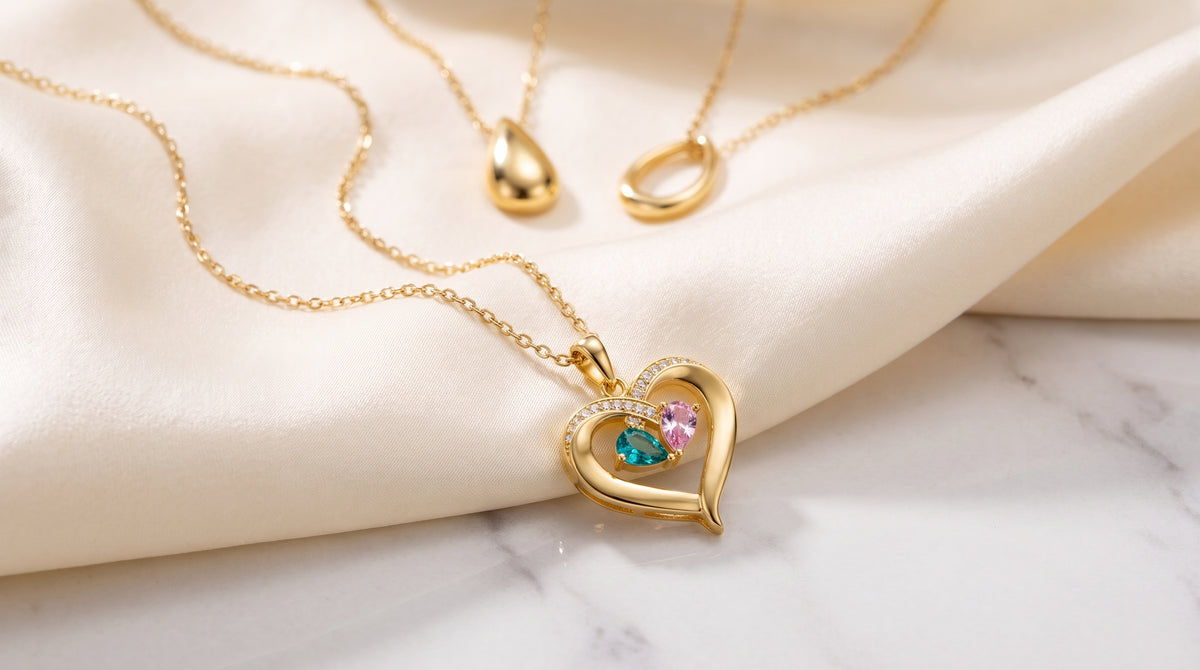
With exactly two stones, a heart is arguably at its best: the pair sits balanced inside or alongside the outline without crowding it. Our own Beautiful Mom two-birthstone heart necklace in solid gold is built for exactly this configuration. For scale reference, our custom double birthstone heart design measures roughly 2.2 cm x 2.3 cm — mid-size, visible against a plain top, but not a statement pendant. That's usually the right register for a piece she'll wear every day rather than for occasions.
Bar
A horizontal bar sets the stones in a line, which makes birth order unmistakable. It's the most minimal option and the most "modern" looking, and it layers well under or over a second chain. The trade-off: with only two stones, a bar can look sparse unless the bar itself is short or the stones are proportionally large. Bars suit moms who dislike overtly sentimental shapes but still want the stones.
Teardrop and pear settings
Faceted teardrop or pear-cut stones give a pair more presence than round stones of the same width, because the elongated shape fills more vertical space. Danique uses natural teardrop gemstones across its family birthstone designs. If you want two stones to feel like a finished piece rather than a starter piece, teardrops are the efficient way there. Our birthstone jewelry collection includes teardrop and pear silhouettes such as the Celestara Teardrop and Elenora Pear.
Leaf and cascade
Organic layouts — openwork leaves, vine forms, staggered drops — are designed to absorb more stones gracefully. Danique's family leaf birthstone necklace holds up to four birthstones around a leaf pendant, with each stone about 3 mm. At four stones, the cluster reads as full; at two, the same pendant can look like it's waiting for more. That's not a flaw, and some buyers choose it on purpose (see future-proofing below), but be aware of the visual effect before you commit.
Quick layout matching
- Wants the meaning obvious to strangers: heart.
- Wants birth order legible: bar.
- Wants presence from only two stones: teardrop or pear.
- Wants room to add later: leaf or cascade with open capacity.
- Wants near-invisible everyday wear: small round stones, 3 mm class, on a fine chain.
Stone Size, Chain Length, and Everyday Wearability
Two-stone necklaces are usually bought to be worn constantly, which makes the boring specifications the important ones.
Stone dimensions
Published dimensions in this category cluster in a narrow band. Little Sky Stone lists birthstones of 4 mm x 6 mm on both its two-birthstone and three-birthstone necklaces for mom. Danique's leaf design uses stones of roughly 3 mm. That range — call it 3 mm to 6 mm — is the practical everyday zone. Below it, the color stops reading from conversational distance. Above it, the piece starts behaving like occasion jewelry: heavier, more prone to catching, less likely to be worn under a work shirt.
If you're buying for a mom with young kids, small-to-mid stones in a secure bezel or prong setting are the pragmatic choice. Anything that snags is jewelry that ends up in a drawer.
Chain length
Eighteen inches is the default in this category — Little Sky Stone's two-birthstone necklace uses an 18-inch cable chain, and its three-stone version uses 18 inches plus a 2-inch extender. Eighteen inches typically sits at or just below the collarbone on most adults, which is the sweet spot for a mid-size pendant like a 2.2 cm heart. An extender matters more than people expect: it lets the same necklace sit higher on a crew neck and lower on a v-neck, and it makes the piece layerable with a shorter chain.
If she already wears a necklace daily, check its length before ordering. Two pendants at the same length collide and tangle.
Stone type
Birthstone jewelry uses a mix of natural gemstones, lab-created stones, and colored cubic zirconia depending on the maker and price tier — Danique specifies natural gemstones on its teardrop family designs, for instance. This is worth checking on any product page, because it drives both price and hardness. Softer stones (opal for October, pearl for June) need more care in a piece worn daily than harder ones (sapphire for September, ruby for July). If her month falls on a soft stone and the necklace is for constant wear, a lab-created or synthetic equivalent in that color is a defensible practical choice, not a compromise.
Metals: Sterling Silver, Vermeil, Gold-Filled, and Solid Gold
Metal is where the price differences in this category mostly live, and where the most confusion sits. Here's what the terms mean in general jewelry usage, followed by what specific brands offer.
The four tiers, plainly
- Sterling silver (S925): a solid precious metal alloy, 92.5% silver. It's the metal all the way through, but silver naturally darkens with air and skin contact and needs periodic polishing.
- Gold vermeil: a thick layer of gold over a sterling silver base. Because the base is solid sterling rather than brass, vermeil sits above ordinary gold plating in quality — but the gold layer is still a surface layer and will wear with time and friction.
- Gold-filled: a bonded layer of gold over a base metal core, mechanically applied. It's more robust than standard plating and is common in the mid-price handmade segment.
- Solid gold (14k or 18k): gold alloy throughout. There is no layer to wear off. It's the most expensive option and the only one where daily wear over decades doesn't change the surface.
What's actually on offer
Pandora's necklaces for women include hand-finished sterling silver, 14k rose gold-plated, and 14k gold options. Little Sky Stone's two- and three-birthstone necklaces are made in 14k gold-filled, and the brand states its two-birthstone necklace is hypoallergenic, nickel- and lead-free, and tarnish resistant. Our own custom double birthstone heart is offered in S925 sterling silver with 18k gold vermeil, solid 14k or 18k gold, or S925 sterling silver with platinum vermeil.
Two caveats worth stating clearly. First, hypoallergenic and tarnish-resistant claims are brand statements about specific products — they are not guarantees that apply across a brand's whole catalog, and no metal is universally non-reactive for every wearer. Second, if she has known metal sensitivities, solid gold and platinum-finished options remove the most common variables, but it's still worth checking the specific product page rather than assuming.
How to choose in practice
If the necklace is a keepsake she'll wear for decades and pass on, solid gold is the only tier where that's structurally true; browse solid gold pieces if that's the brief. If it's a meaningful gift with a defined budget, vermeil over sterling gives the gold look with a precious-metal base. If she's hard on jewelry — swims in it, showers in it, gardens in it — sterling silver you can re-polish or solid gold both beat any surface-layer finish over the long run.
Personalization: Stones, Engraving, and Getting the Order Right
Every piece in this category is made to order, which means personalization details are also the main source of errors.
What's typically customizable
The birthstone selections themselves, obviously. Beyond that, engraving is common — Jared's mother's heart necklace, for example, includes one line of engraving alongside its two-to-five stone configuration. Some designs also allow choice of metal, chain length, and stone arrangement. Capacity varies widely by maker: Danique's family design accommodates up to ten smaller birthstones on a single necklace, while a two-stone heart is fixed at two by design.
The details people get wrong
- Birth month vs. birthstone name. Order by month where possible. Several months have multiple recognized stones, and specifying "December" is safer than naming a stone the maker may not stock.
- Stone order. If left-to-right sequence matters (birth order, mom-then-child), write it out explicitly in the personalization field.
- Engraving length. One line is one line. Two names plus two dates rarely fits. Prioritize: initials and years usually beat full names and full dates.
- Character set. Accents, emoji, and unusual punctuation may not be supported by the engraving process.
Before you check out
Because personalized items are made to your specification, review the maker's own return and personalization policies at checkout rather than assuming a standard window applies. Policies differ meaningfully between large retailers, independent jewelers, and marketplace sellers, and personalized goods are commonly treated differently from stock inventory. This is the single check most worth doing before you pay.
Pandora vs. Family Birthstone Necklaces: Two Different Models
A large share of birthstone searches name Pandora, so it's worth being precise about what that brand does and doesn't cover for this particular use case.
What Pandora's model is built around
Pandora's birthstone approach is month-of-the-wearer and charm-based. It describes birthstones as gemstones representing your birth month and invites you to express your identity through the color; its birthstone charm range spans every month, from January's garnet through December's turquoise, and Pandora explicitly confirms it offers birthstone charms. Its necklace range includes birthstone pendants, including a Birthstone Heart Pendant Necklace, in sterling silver, 14k rose gold-plated, and 14k gold.
Where the models diverge
That structure is optimized for one month at a time. Where a Pandora-style approach represents several people, it typically does so by combining separate charms — one per person — rather than through a single pendant that sets two stones together as one unit. Family birthstone necklaces from independent jewelers work the other way around: the pendant itself is the family, with the stones physically arranged in one composition.
Practically, this means the question isn't which brand is better but which object she wants. A charm-based piece is modular and expandable but reads as an accumulation. A two-stone pendant is a fixed, finished composition — the two stones are set in a deliberate relationship to each other, which is precisely what makes it feel like a portrait of a specific pair rather than a collection.
A note on marketplace listings
Searches combining "Pandora" and "birthstone necklace" surface thousands of marketplace listings on platforms like Etsy, many of which are third-party or compatible items rather than brand products. If brand authenticity matters to you, buying direct from a brand-owned store gives you more predictable control over what arrives.
Should You Buy Two Stones — or Size Up Now?
This is the objection that stalls most purchases: what if the family grows?
When two is genuinely the right count
Two stones is right when the pair is closed — two children and no plans for more, a mother and her only child, a couple, or a specific pair with fixed meaning. It's also right when the aesthetic goal is restraint. Two stones on a small heart or a fine bar is delicate in a way a five-stone piece cannot be, and delicacy is often the actual reason people choose this count. Sizing up "just in case" trades away the look she wanted for a hypothetical.
When to consider more capacity
If another child is expected or likely, you have three sensible paths. First, choose an open layout — leaf, cascade, or cluster designs that hold more stones and simply look fuller as they fill; Danique's leaf pendant holds up to four. Second, buy the two-stone piece now and add a second, complementary piece later, which many families do deliberately so each necklace marks a moment. Third, go straight to a three- or four-stone design if you're confident about the final count; our three-stone buyer's guide and the four-stone guide compare those layouts directly.
What you should not assume is that a finished two-stone pendant can be modified after purchase to hold a third. Some makers offer add-on services and some do not; unless the product page says so explicitly, treat the stone count as permanent.
The other format question
A necklace isn't automatically the best carrier for two stones. Bracelets sit in her field of vision all day, which some moms prefer; rings put the stones front and center but constrain size. If you're not committed to a pendant, the two-stone bracelet guide and the two-stone ring guide cover the same decision in those formats, and choosing the format she'll actually wear works through the comparison end to end.
A Pre-Purchase Checklist
Run through these before you order. Most personalization problems are caught here.
- Confirm the two months. Verify both birthdays against a calendar rather than memory, and note the month, not the stone name.
- Decide the order and write it down. Left to right, oldest to youngest, or mom first — say it explicitly in the customization field.
- Match the layout to the meaning. Heart for warmth, bar for sequence, teardrop or pear for presence, open designs if you may add later.
- Check the pendant scale against her existing jewelry. A 2.2 cm heart reads mid-size; small round stones read subtle.
- Choose chain length deliberately. Eighteen inches is standard; an extender adds flexibility and layering room.
- Pick metal by wear pattern, not just budget. Solid gold for constant, decades-long wear; vermeil or gold-filled for gold appearance at lower cost; sterling silver if she's comfortable polishing occasionally.
- Draft engraving text and count the characters. One line fills faster than expected.
- Read the return and personalization policy on the specific store. Made-to-order items are often handled differently from stock pieces.
- Order with production time in mind. Custom pieces are made after you order; check the maker's stated timeline against your occasion date.
Where to Start Looking
If you've landed on a heart — the most common resolution for this search — the Beautiful Mom two-birthstone heart necklace is designed around exactly two stones in solid gold, and the wider custom double birthstone heart design is available in S925 sterling silver with 18k gold vermeil, solid 14k or 18k gold, or S925 sterling silver with platinum vermeil, with a heart of about 2.2 cm x 2.3 cm.
If a heart feels too literal for her, look at faceted single-drop and pear silhouettes — the Elianna Teardrop, the Calystine Pear, or the Aurelienne — which carry color without sentiment-forward shapes. For a broader browse, the personalized mother jewelry and necklaces collections group the mom-oriented pieces together, and our roundup of birthstone necklaces for mom compares styles across counts if you're still deciding.
Whatever you choose, check the specific product page for current materials, stone options, dimensions, engraving availability, and delivery timing before you order — those are the details that vary by variant, and they're the ones worth confirming rather than inferring.

Leave a comment
This site is protected by hCaptcha and the hCaptcha Privacy Policy and Terms of Service apply.