


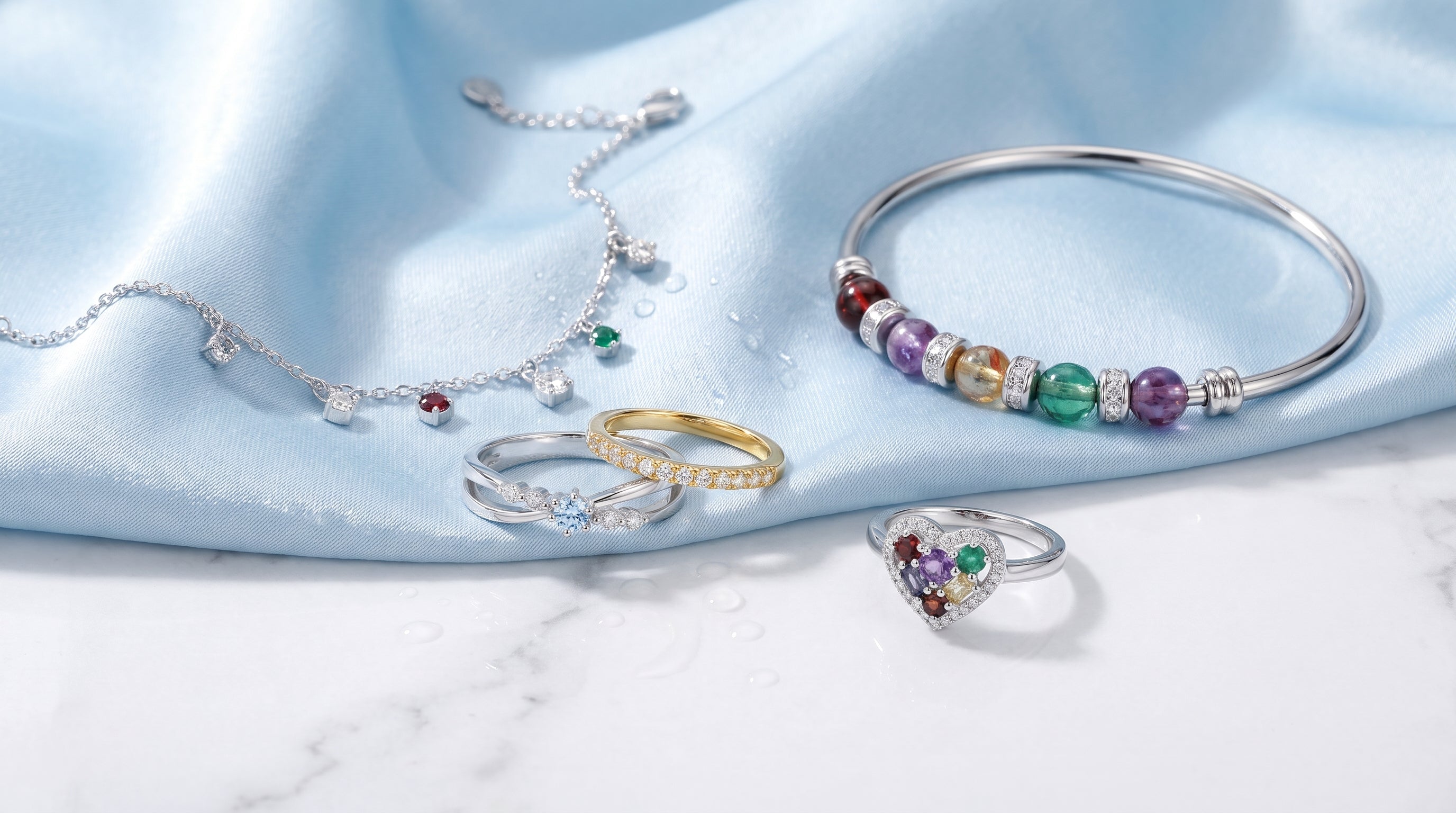
Look at how jewelers actually merchandise mother's rings and one pattern jumps out: the categories are built around headcount, not around metal or gemstone. ArtCarved lists a mother's birthstone ring with 3–5 stones next to a heart-shaped family ring that holds 2–7. Kay's personalized ring configurator splits similar silhouettes into 1–3 stones, 2–4 stones, and an asymmetric contoured design that takes up to five. MothersFamilyRings.com runs entirely separate collections for three-stone, four-stone, and five-stone rings. The Vintage Pearl states that its customizable mother's rings offer up to five birthstones.
That merchandising tells you where the real decision sits. Before you compare settings or metals, you have to answer a quieter question: who gets a stone? This guide to birthstone rings for mothers works through that question first, then maps each answer to the ring formats that handle it gracefully — including which Awareness Avenue designs suit which family shape.
What Birthstone Rings for Mothers Actually Represent
Across jewelers who specialize in this category, the definition is remarkably consistent. The Vintage Pearl describes a mother's birthstone ring as personalized jewelry that features the birthstones corresponding to the birth months of her children, with each stone standing for one child. Jewlr frames mother's rings as symbolic pieces designed to represent a mother's family, typically featuring her children's birthstones and often engraved names or a family surname. Kranich's Jewelers, writing about mother's rings as a “forever keepsake,” notes that modern versions most often carry the birthstones of all the children in a family and may include both parents.
In practice, that means this is not a gemstone fashion ring. It is a small, wearable family record. The stones are a code only she and the people she loves can fully read, which is why the arrangement matters more than the carat weight and why the ordering conversation should start with names and birth months rather than with a product page.
The stones do not have to be children
One reason shoppers hesitate is a fear of getting the “rules” wrong. There are very few. Kranich's points out that a ring made for a grandmother might carry the birthstones of all her children, all her grandchildren, or only one of those two groups, depending on preference. Awareness Avenue's broader guide to birthstone jewelry for mom uses the same framing: these pieces represent a mother's children or other loved ones. Partners, parents, and chosen family are all fair game if that is the story she would want on her hand.
Start With the List: Deciding Who Gets a Stone
Write the list before you shop. Names, birth months, and a rough sense of whether that list is finished. Five minutes here prevents the most common regret in this category, which is buying a ring that fits the family as it was rather than as it is about to be.
Children only — the classic reading
The cleanest version of a mother's ring is one stone per child, in birth order. It reads instantly, it ages well, and it is the interpretation most jewelers default to in their product copy. If the recipient is a mother of two or three, this approach keeps the design uncluttered and lets each stone stay large enough to actually show its color.
Adding the parents
Including her own birthstone, or hers and her partner's, is common enough that Kranich's mentions it directly as a feature of modern mother's rings. It changes the arithmetic: a mother of two children becomes a four-stone ring, a mother of three becomes a five-stone ring. It also changes the symbolism slightly — the ring now represents the household rather than only the children. Some mothers love that; others prefer a ring that is purely about the kids. If you can ask indirectly, ask.
Grandchildren and grandmother's rings
Once grandchildren enter the picture, stone counts climb fast, and the design question becomes how to keep a crowded band legible. Two workable strategies: choose a setting built for higher counts (ArtCarved's heart-shaped family ring is listed as accepting between two and seven stones, and HandwovenBands describes a handmade mother's ring with a center birthstone for mom plus up to six additional 2.5 mm bezel-set round birthstones for children or grandchildren), or split the story across two rings — one for children, one for grandchildren — worn stacked or on separate hands.
Blended families, stepchildren, and remembrance stones
No jeweler's category page will tell you what to do here, so treat it as a conversation rather than a rule. Most people who include stepchildren do so on equal footing, in birth order alongside biological children, because a ring that visibly ranks children is worse than no ring at all. A stone for a child who has died is also a recognized use of the format; some families set it slightly apart, others keep it in strict birth order so the sequence stays intact. Both are defensible. What matters is that the wearer, not the giver, is comfortable with the arrangement.
Leave room, or plan a second ring
If the family is still growing, you have two honest options. Buy a design with unused capacity now — several retailers explicitly sell rings that hold more stones than you currently need, and Kay notes that its 1–3 stone crossover ring fills unselected positions with lab-created white sapphire accents. Or buy a stackable format designed to be added to over time. What you should not do is assume any given ring can be reset later; resetting depends on the specific construction, and that is a question for the maker, not a guarantee you should take on faith.
Choosing by Stone Count: Two, Three, Four, Five, and Beyond
Stone count is the single most useful filter in this category, and it is how nearly every specialist retailer organizes its inventory. Here is what each count tends to look and feel like on the hand.
Two stones: birthstone rings for mom 2 stones
A two-stone ring is the most understated version of the idea. Searches for birthstone rings for mom 2 stones usually come from a mother of two, or a mother of one who wants her own stone paired with her child's. Because there are only two colors in play, the pairing is very visible — a March aquamarine next to a July ruby reads as a deliberate color choice, not a random cluster. If you are working with only two birth months, our guide to choosing a birthstone ring with 2 stones covers how to balance contrasting and closely matched color pairs.
Three stones: mothers ring 3 stones and birthstone rings for mom 3 stones
Three is the most requested configuration in the category, judging by the fact that Jewlr maintains a dedicated three-stone mother's rings page and MothersFamilyRings.com runs a separate three-stone collection. Anyone searching mothers ring 3 stones or birthstone rings for mom 3 stones is typically shopping for a mother of three children, or for a family unit of mother, father, and one child. Visually, three stones give you a natural center, which is why so many three-stone designs elevate the middle position slightly. Our dedicated three-stone birthstone ring buying guide goes deeper on arrangement and color balance.
Four stones: mothers ring 4 stones
Four stones lose the automatic center point, which is actually an advantage: the design becomes a row or an arc rather than a focal setting. A mothers ring 4 stones is the configuration for a mother of four, or for two parents plus two children. Because symmetry is built in, four-stone rings tolerate mixed cuts well — alternating baguettes and rounds, for instance. See our guide to a four-stone family ring for layout options.
Five stones: mothers ring 5 stones
Five is the practical ceiling for most standard band widths, which is why so many makers cap there. The Vintage Pearl advertises up to five birthstones; Kay's asymmetric contoured mother's ring is listed as taking up to five birthstones together with multiple engraving lines. A mothers ring 5 stones design shrinks individual stone size, so color contrast does more work than sparkle. Group similar tones together or alternate light and dark stones so the row does not blur at arm's length.
Six, seven, and larger families
Above five, look for designs built specifically for higher counts rather than trying to squeeze extra stones into a five-stone silhouette. Awareness Avenue's Custom Family 925S Heart Ring is offered with 1–7 names and birthstones, which covers large families, multi-generation lineups, and mothers who want both children and grandchildren on a single band. Confirm the exact configuration options and character limits on the product page before ordering.
Ring Styles That Carry Multiple Birthstones Well
Once the count is settled, style is mostly about how the stones sit relative to the finger and how much of the band they occupy. Four approaches cover most of what is worth considering.
Heart and cluster settings
A heart or cluster arrangement gathers the stones into a single shape rather than a straight line, which is the most forgiving choice at higher counts — the outline carries the design even when individual stones are small. It reads as unmistakably sentimental, which some mothers love and others find too literal.
Baguette and square-cut rows
Step cuts change the character of a family ring completely. Baguettes lie flat and line up edge to edge, producing a modern, architectural row instead of a row of dots. The Personalized Family Baguette Cut Birthstones Ring in S925 sterling silver and the Personalized Family Birthstones Square Cut Ring both use that geometry. Square and baguette cuts also show gemstone color more evenly than brilliant cuts, which matters when the whole point is that each stone is identifiable.
Sculptural and croissant bands
If she already owns plenty of jewelry and wants something that does not announce itself as a “mother's ring” from across the room, a sculptural band is the move. The Personalized Family Birthstones Croissant Ring in S925 sterling silver sets the family stones into a twisted, ridged band, so the piece works as a contemporary design first and a keepsake second.
Stackable rings
Stacking solves the growing-family problem more elegantly than oversizing a single band. The Personalized Family Birthstones Stackable Ring in stainless steel is built for this: start with one, add another for a new child or grandchild, and let the stack itself become the record. It is also the easiest format to wear alongside an existing wedding set.
What Makes Unique Mothers Rings Feel Unique
“Unique” is the most-used and least-defined word in this category, and searches for unique mothers rings usually mean something more specific than the label suggests. Competitor marketing leans on the word heavily — HandwovenBands, for example, presents its handmade mother's ring as a one-of-a-kind heirloom built from swirling gold and silver bands. Treat that kind of language as the maker's own positioning rather than a verified standard. In practical terms, distinctiveness in a mother's ring comes from four levers you can actually control:
- Cut, not just color. Nearly every catalog mother's ring uses round brilliants. Choosing baguettes or square cuts immediately separates the piece from the default.
- Arrangement. Asymmetric and contoured layouts — the kind Kay uses on its asymmetric mother's ring — break the predictable straight row.
- Band architecture. Twisted, ridged, or stacked bands change the silhouette even when the stones are conventional.
- Text. A surname, a short phrase, or names in a specific order turns a configurable product into something no one else owns.
Unique mothers rings 3 stones and unique mothers rings 4 stones: layout ideas
At three stones, try mixing one step cut between two rounds, or setting the middle stone in a different metal tone — a simple way to build unique mothers rings 3 stones without changing the family list. At four stones, an alternating pattern — two cuts, two colors, repeated — gives unique mothers rings 4 stones rhythm without adding clutter. Both approaches keep the stone count that matches the family while stepping away from the standard channel-set row that dominates the category. Browse the full ring collection or the birthstone collection to compare cuts side by side.
Engraving Names Alongside the Stones
Engraving is what turns a color sequence into a legible story, and it is standard practice across the category. Jewlr describes engraved family member names or a family surname as a common enhancement to custom birthstone rings. Kay's asymmetric contoured mother's ring is listed with multiple engraving lines allowing names of up to ten letters each, rendered in a script font.
Three things to decide before you type anything into a configurator:
- Names or a phrase? Names pair each stone with a person. A single phrase or surname keeps the band cleaner and works better when there are more stones than there is space.
- Order. Birth order is the safest default. Any other sequence invites questions you may not want asked.
- Character limits. These vary by design and by band width. Longer names, hyphenated names, and accented characters are the usual failure points — check the specific product page rather than assuming a limit carried over from another ring.
Fit, Finger, and Everyday Wear
Which finger she should wear it on
This is one of the few etiquette questions with published guidance. MothersFamilyRings.com's mother's rings guide advises that a mother's ring is ideally worn alone on the ring finger, commonly on either the left or right hand, while noting that it can technically be worn on any finger the wearer prefers. In practice, many mothers reserve the left ring finger for an engagement or wedding set and give the mother's ring the right ring finger, where it has room to sit flat. A slim stackable design is the exception — it is built to sit next to a wedding band rather than compete with it.
Metal and lifestyle
The category spans a wide range of materials. Kay lists sterling silver mother's rings; MothersFamilyRings.com states that its rings are made in gold and platinum with natural birthstones. Awareness Avenue's family birthstone rings are offered in S925 sterling silver and stainless steel depending on the design. Match the material to how she actually uses her hands: a mother who gardens, lifts, or works with equipment all day will get more wear out of a low-profile band than a raised cluster, regardless of what it is made from. For care and cleaning specifics, follow the instructions on the individual product page rather than general internet advice, since setting type matters more than metal here.
Sizing without ruining the surprise
Borrow a ring she already wears on the intended finger and measure the inside diameter, or trace it against a printable sizing chart. If she wears rings on both hands, measure the hand you plan the mother's ring for — dominant hands often run slightly larger. When you are between sizes on a wide or sculptural band, size up; wide bands feel tighter than narrow ones at the same measurement.
Getting the Details Right Before You Order
Month-by-month birthstone reference
Collect exact birth months before you open a configurator. The widely used modern list runs: January garnet, February amethyst, March aquamarine, April diamond, May emerald, June pearl or alexandrite, July ruby, August peridot, September sapphire, October opal or tourmaline, November topaz or citrine, and December turquoise, tanzanite, or zircon. Where a month offers alternatives, pick the color that sits better against the rest of the row — a December stone can read icy blue or deep violet depending on which option you choose, and that decision affects the whole ring.
A short pre-order checklist
- Final list of names and birth months, in the order they should appear.
- Confirmed stone count — and whether you want spare capacity.
- Ring size for the specific finger and hand.
- Engraving text checked for spelling and character count.
- Production and delivery timing, checked on the product page, if this is tied to a date such as Mother's Day or a birthday.
If you are still weighing multi-stone formats in general, our broader birthstone ring buying guide covers stones, metals, and setting types across the whole category.
If She Does Not Wear Rings
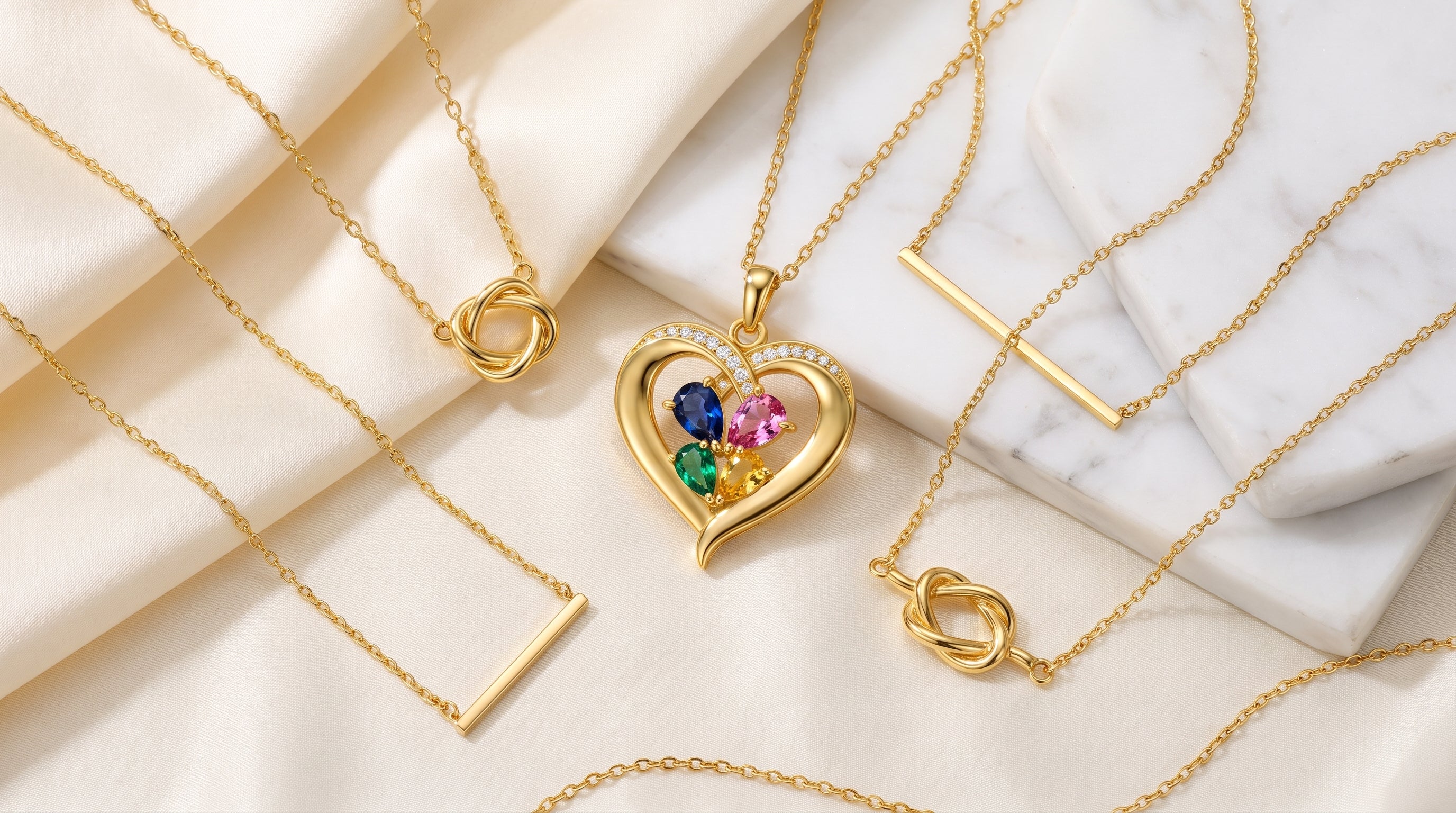
Some mothers simply do not wear rings — because of work, because of hand sensitivity, or because they never have. The same family-birthstone idea translates to other formats without losing anything. The Personalized Birthstone Beads and Family Names Bangle Bracelet in stainless steel combines birthstone beads with engraved family names on the wrist, and the Personalized Family Birthstone & Name Bar Necklace puts the same information on a bar pendant. Both are bracelets and necklaces rather than rings, so treat them as alternatives, not substitutes, if she has specifically asked for a ring.
Frequently Asked Questions
How many stones should a mother's ring have?
As many as there are people you want represented — most commonly one per child, sometimes with the parents added. Two to five stones covers the majority of families, and specialist retailers organize their collections accordingly, with dedicated three-, four-, and five-stone ranges. Above five, choose a design built for higher counts rather than crowding a smaller setting.
Can a mother's ring include grandchildren?
Yes. Kranich's Jewelers notes that a ring made for a grandmother may feature the birthstones of all the children, all the grandchildren, or only one of those groups. There is no fixed convention, so the decision comes down to what the wearer wants to see every day.
Should the stones follow birth order?
Birth order is the standard and the least ambiguous arrangement, particularly in blended families. Color-led arrangements are perfectly valid too, but decide deliberately rather than letting the configurator default choose for you.
What if the family grows after the ring is bought?
Plan for it up front. Either choose a design with unused stone positions, or choose a stackable format intended to be added to over time. Whether an existing ring can be reset to add a stone depends entirely on its construction, so ask the maker before assuming it is possible.
Is a mother's ring an appropriate gift from a partner as well as from children?
It is. Jewlr and Kranich's both describe mother's rings as family pieces rather than gifts reserved for one type of giver, and configurations that include a partner's birthstone are common. What matters is that the list of stones reflects the family she recognizes.
The short version: settle the list, then the count, then the style. A ring that names the right people in the right order will outlast every trend in setting design — and it is the only detail in this purchase that cannot be fixed later. Ready to build one? Start with the custom jewelry collection and match the design to the family you have written down.

Leave a comment
This site is protected by hCaptcha and the hCaptcha Privacy Policy and Terms of Service apply.