


Most guides to flat back earrings are written for people with a conch, a tragus, and three helix piercings. If you have two ordinary lobe piercings and you are simply tired of waking up with a sore ear, that content answers the wrong question. This guide is built for the lobe. It explains what changes when you swap a butterfly clutch for a labret-style post, which specifications actually matter at the earlobe rather than in cartilage, and where the widely repeated comfort and hypoallergenic claims come from — so you can judge them yourself before you buy.
One thing to establish up front: nearly every source in this category is a jewelry brand or a piercing retailer describing its own products. There are no dermatology clinics or independent labs in the visible landscape for this topic. That does not make the claims worthless — when Grayling, Maison Miru, Studs, Hey Rowan, JCo Jewellery, ComfyEarrings, Get Pierced Co, Pierced Owl, Impuria, and Musemond all converge on the same design logic, that convergence is meaningful. But it is industry practice and product marketing, not clinical proof, and this guide labels it as such throughout.
What a Flat Back Stud Actually Is (and How It Differs at the Lobe)
A flat back stud, sometimes called a labret-style stud, uses a straight post that terminates in a smooth, flat disc. That disc sits flush against the back of your ear. The decorative front — a disk, a bezel, a crystal, a prong-set stone — attaches to the post either by screwing into internal threads or by a threadless push-pin that wedges into the hollow post under tension. Studs describes flat back studs precisely this way: a stud with a flat backing instead of the protruding post and butterfly clutch found on traditional studs. JCo Jewellery adds the mechanical detail that the front secures via an internally threaded screw-top or a threadless push-pin, locking the piece firmly in place.
A conventional butterfly stud works in the opposite direction. The decorative front is permanently fixed to a post, and a separate butterfly-shaped clutch slides onto that post from behind, gripping a small notch by spring tension. JCo notes that this clutch is removable and interchangeable with standard clutches — convenient, but it also means the retention depends entirely on friction, and the clutch itself protrudes behind your ear.
Why the geometry matters more on a lobe than you might expect
Cartilage is rigid, so a poking clutch tends to press outward against whatever is next to it. The earlobe is soft, so a protruding butterfly back does something different: it presses the lobe against the pillow, the phone, the headphone cup, or your own neck, and the lobe compresses around it. Get Pierced Co describes exactly this failure mode, noting that long posts can stab into the skin during sleep and that bulky designs pressing against pillows are a source of irritation. A flush disc removes the protrusion entirely, which is the single mechanical reason flat backs feel different overnight.
Get Pierced Co also observes that most earrings are simply not designed to be slept in, and that wearing the wrong style overnight can slow healing and cause irritation. That framing is useful. The question is not whether flat backs are magic; it is whether your current earrings were ever engineered for the number of hours you actually wear them.
Comfort, Sleep, and 24/7 Wear: What the Evidence Supports
Comfort is the dominant selling point across this entire product category, and the claims are remarkably consistent from brand to brand.
Studs states that flat back studs are comfortable enough to sleep in and durable for everyday wear, positioning them for people who do not want to switch earrings daily. JCo Jewellery argues that flat backs win on comfort and sleepability because the flush disc back produces “zero pokes,” making them workable under headphones and hats and for side sleepers who otherwise experience soreness. ComfyEarrings frames its flat back collection specifically around preventing poking and pressure and solving the problem of waking up with sore earlobes. Hey Rowan notes that the smooth back rests against the skin, making the earrings comfortable for all-day wear including sleep. Get Pierced Co goes furthest, describing flat back studs in implant-grade titanium as widely considered the best earrings for sleeping, and stating that a well-engineered flat back lets you sleep, shower, exercise, and swim without removing the jewelry.
What this convergence does and does not prove
Five independent retailers describing the same experiential benefit is strong qualitative evidence that reduced protrusion translates into reduced overnight discomfort. What none of them provide is quantified comfort data, controlled comparison, or any measurement of how much better a flat back feels than a butterfly clutch. Individual anatomy varies, and an ill-fitting flat back can create its own problems — which is why post length, covered below, is the specification most worth getting right.
Treat sleep comfort as the primary reason to consider the format, and treat “safe to sleep in” as a design intention rather than a guarantee. Any piercing can be irritated by poor fit, rough handling, or inadequate cleaning, regardless of what the back looks like.
Materials: Titanium, 14k Gold, and Stainless Steel for Sensitive Lobes
If you have reacted to earrings before, material is the specification you should read before anything else. Three material families dominate this category.
Implant-grade titanium (ASTM F136)
This is the most frequently recommended option among piercing-oriented brands. Grayling states that its flat back earrings for sensitive ears are crafted from F136 implant-grade titanium and 14k gold, and explicitly frames the collection around sensitive ears and nickel allergies. Maison Miru describes its flat back earrings as medical-grade titanium conforming to ASTM F136, hypoallergenic, nickel-free, and safe for new and healing piercings. Get Pierced Co recommends implant-grade titanium to the ASTM F-136 standard, describing it as lightweight, hypoallergenic, tarnish-free, and safe for sensitive ears. Pierced Owl builds its threadless push-in crystal flat back studs on implant-grade titanium. Grayling's titanium collection asserts that its exclusively F-136 designs, finished to a high-polished mirror, promote safe healing.
What you can conclude: the ASTM F136 designation is the industry's shorthand for a titanium alloy specification that brands use to distinguish their material from cheaper, unspecified titanium or generic steel. If a listing says only “titanium” with no grade, you are being told less than the brands that name the standard. What you cannot conclude: none of these sources publish metallurgical compositions, nickel content figures, or independent allergy testing. “Hypoallergenic” here is a marketing descriptor, not a regulatory certification.
Solid 14k gold
Solid 14k gold is the premium alternative and the natural choice if you want warmth of color rather than titanium's cooler industrial tone. Grayling includes 14k gold alongside titanium in its sensitive-ears collection. Musemond builds entire collections of solid 14k gold flat back earrings and labret piercings, emphasizing fine solid gold rather than plated or base metals. Hey Rowan sells a 14k gold disk flat back stud measuring 2.5 mm x 2.5 mm x 0.8 mm thick, with 14k gold posts and fronts and a stainless steel pin — a useful reminder that even a gold piece can be a hybrid construction. Impuria lists 14k gold alongside titanium and surgical stainless steel across its flat back stud range.
The distinction that matters most in gold listings is solid versus plated. Plating sits on top of a base metal whose composition may be undisclosed, and it wears. Brands that specify solid 14k gold are telling you what the metal is all the way through.
Surgical stainless steel
Stainless steel appears in this category as both a full material and a component. Impuria explicitly lists surgical stainless steel among its flat back stud materials. Hey Rowan uses a stainless steel pin inside gold posts and fronts, and describes its flat backs as combining hypoallergenic gold and stainless steel components designed for safety, comfort, and durability.
Nuance is warranted here. The available product information does not specify stainless steel grades or nickel content, and stainless steel formulations vary considerably. If your nickel sensitivity is mild or unconfirmed, steel components are common and widely used. If your sensitivity is significant, implant-grade titanium and solid 14k gold are the two options that brands describe most consistently and specifically for sensitive ears.
A note on health claims
Grayling answers the question “will titanium help my piercing heal?” with a direct yes. Maison Miru describes its titanium as safe for new and healing piercings. Get Pierced Co says flat backs minimize pressure and movement, which it identifies as two of the biggest causes of irritation bumps. These are brand statements grounded in piercing-industry practice. They are not clinical findings, and no source in this space publishes infection rates, healing-time data, or allergy prevalence. If you have an active reaction, a complex allergy history, or a piercing that is not settling, a qualified piercer or healthcare provider is the appropriate next step — not a product page.
Sizing for the Earlobe: Gauge, Post Length, and Disc Diameter
This is where a lobe-specific guide diverges most from the cartilage-focused content that dominates this topic. Sizing decisions that are routine for a helix are not automatically right for a soft lobe.
Gauge: why flat backs feel thicker
Studs notes that its flat back posts are 18 gauge, which is thicker than typical butterfly-back posts at around 20 gauge, and clarifies the counterintuitive convention: the smaller the gauge number, the thicker the post. Two gauge steps is a real difference when you are used to fine fashion-earring posts.
Practically, this means three things for lobe wearers. First, an 18g post is more substantial and less prone to bending in daily wear. Second, if your lobe piercing has been sitting empty or has only ever held thin 20g posts, an 18g post may feel tight on first insertion. Third, gauge is not something to force. If a post does not pass comfortably, that is a fitting question for a professional piercer rather than something to push through.
Post length: the 6 mm versus 8 mm decision
Two lengths dominate the category. Hey Rowan offers 6 mm and 8 mm posts and warns that posts that are too long can irritate the ear while posts that are too short may not secure the earring properly. Get Pierced Co recommends the same two lengths and defines a proper fit as one where the earring does not shift or rub while sleeping.
How to reason about it for a lobe:
- Too long and the decorative front stands off the ear, rocking with every movement and creating leverage that can catch on hair, collars, and bedding.
- Too short and the post compresses the tissue, makes the closure harder to engage fully, and leaves less room to clean around.
- Right means the front sits close to the lobe without indenting it, and the disc lies flat behind without pressing in.
Lobe thickness varies substantially between individuals and even between a person's own two ears, and none of the available sources publish anatomical measurement guidance. If you are buying blind, brands that offer both lengths give you the option to correct course; if you are unsure, a piercer can measure in seconds. This same sizing logic drives how you assemble a coordinated set — our guide to building a flat back earring set that actually fits works through matching lengths across multiple placements.
Disc diameter and front profile
The disc is the part touching your ear all night, and a smooth, edge-free finish is what makes it disappear against the skin. Get Pierced Co specifies that the flat disc should sit flush with no sharp edges. Grayling emphasizes high-polished mirror finishes on its titanium pieces. On the front, low-profile designs are the practical choice for a piece you intend to leave in: Hey Rowan's 14k gold disk front is only 0.8 mm thick, and bezel-set and small prong-set stones from brands like Maison Miru, Rose & Clay, and Impuria keep the front snag-resistant.
Closure Mechanisms: Threadless Push-Pin vs Internally Threaded
The closure is the part most people find intimidating on first purchase. It is also the source of the format's main trade-off. JCo Jewellery lists three variants across its flat back range: internally threaded, push-pin (threadless) labret earrings, and secure pin-screw mechanisms.
Threadless push-pin
The front has a small pin, slightly bent. The post is hollow. You push the pin into the post, and the bend creates tension inside that holds the two pieces together. Hey Rowan describes this directly, noting that a tiny internal pin creates the tension that locks the earring in place, and advising that if the earring feels loose you can gently bend the pin a little more for a firmer hold. Pierced Owl uses this mechanism on its implant-grade titanium crystal flat back studs.
The appeal is that there is no twisting, so nothing rotates inside the piercing channel during insertion. The learning curve is real but short.
Internally threaded
The post carries internal threads and the front has a matching threaded stem that screws in, creating a mechanical interlock. It takes slightly more dexterity but is not dependent on pin tension being correctly set.
How to insert one without frustration
Both Studs and Hey Rowan publish essentially the same sequence, which is worth following exactly:
- Push the flat back post through the piercing from behind, so the disc ends up against the back of your lobe and the open end of the post faces forward.
- Hold the disc steady between finger and thumb behind the ear.
- Insert the pre-bent front pin into the opening of the post — or, for threaded designs, line up the stem and screw it in.
- Press firmly to seat it.
- Give both ends a gentle tug to confirm the connection is secure.
That final tug is the step people skip, and it is the one that catches an incomplete connection before you leave the house. Note also that no source in this category ranks one mechanism as objectively superior; they are presented as options suited to different preferences and dexterity levels.
Flat Back vs Butterfly Stud: An Honest Comparison
The table below consolidates what the sources actually claim, including the areas where butterfly studs still win.
| Factor | Flat back (labret style) | Butterfly stud |
|---|---|---|
| Back geometry | Straight post ending in a smooth flat disc that sits flush against the skin | Straight post with a removable friction clutch that protrudes behind the ear |
| Sleep comfort | Designed to eliminate poking and pressure; widely marketed as sleep-friendly and suitable for continuous wear | Frequently associated with soreness and poking, especially for side sleepers; not typically engineered for overnight wear |
| Cleaning | Smooth surfaces with no hollow clutch; described as easier to clean and less likely to trap oil, sweat, and debris | Hollow clutch and crevices can collect oil, sweat, and bacteria; harder to clean thoroughly |
| Security | Threaded or push-pin fronts lock tight; described as harder to lose, including during workouts | Friction clutch can loosen over time and is more prone to snagging and accidental loss |
| Ease of use | Requires learning back-first insertion and pin or thread alignment; a modest initial learning curve | Immediately familiar push-and-clutch routine; clutches easily swapped |
| Sensitive-ear options | Commonly offered in implant-grade titanium and solid 14k gold, marketed as hypoallergenic and nickel-free | Frequently made in unspecified metals; less consistently optimized for metal sensitivity |
The hygiene argument, stated accurately
JCo Jewellery makes the sharpest version of this point, describing the hollow interior of a butterfly clutch as a chamber that easily collects oil, sweat, and bacteria, and contrasting it with flat back components that are smooth with no such cavity. Get Pierced Co makes a related observation about butterfly backs and long posts trapping bacteria during sleep.
What follows logically is that a simpler geometry with fewer hidden spaces is easier to keep clean. What does not follow is any claim about infection rates, because no source measures them. Regular cleaning and clean hands matter regardless of which back you wear.
Where butterfly backs still make sense
JCo itself acknowledges that butterfly studs retain quick on-off familiarity — almost everyone knows the routine, and standard clutches are easily interchangeable. If you change earrings daily to suit an outfit, take them out every night, and have never had a comfort or sensitivity problem, the flat back format solves a problem you may not have. The trade-off is a genuine one: greater comfort and security in exchange for a slightly slower change-over and a short learning period.
Styling Flat Back Studs on Lobes: Minimal, Stacked, and Everything Between
Flat backs are not only a comfort format; they changed how modern ears are styled. JCo describes them as minimal and modern, sitting seamlessly against the skin and creating a clean look from every angle — which matters most in lobe stacks and multiple piercings where bulky clutches crowd each other.
The single-lobe minimalist look
One small front per lobe, worn continuously. Hey Rowan's 2.5 mm gold disk is a good reference point for scale: small enough to disappear under hair, present enough to read as intentional. This is the configuration for people who want jewelry they never think about.
The lobe stack
Two or three lobe piercings, graduated in size from the largest front nearest the face to the smallest toward the top of the lobe. Because flat backs sit flush, the pieces do not collide behind the ear the way stacked butterfly clutches do. Rose & Clay's build-your-ear-stack approach mixes flat back crystal studs with micro hoops and huggies for exactly this reason, and Maison Miru's curated stacks show the same principle applied across lobe and cartilage placements.
Mixing metals and finishes
Implant-grade titanium reads cool and slightly industrial with a high-polished finish. Solid 14k gold, offered by Grayling, Musemond, and Impuria in this format, reads warm and traditional. Many wearers pick one metal family per ear for coherence and use variation in stone color or front shape to create interest instead. If you want a deeper walkthrough of matching by finish and placement, see our guide to flat back earrings for lobes.
When you still want a statement front
Flat backs excel at low-profile, leave-in wear. They are not the format for maximum front-facing sparkle at scale — a large halo or a high-carat solitaire is a different design brief entirely. Many people run both: a discreet flat back for continuous everyday and overnight wear, and a traditional stud with real presence for occasions.
A Buying Checklist for Flat Back Studs on Earlobes
Work through these in order. The first three eliminate most bad purchases.
- Material, named specifically. Look for implant-grade titanium with the ASTM F136 or F-136 designation, or solid 14k gold. A listing that says only “titanium,” “hypoallergenic metal,” or “gold-tone” is telling you less than the brands that name a standard.
- Post length options. 6 mm and 8 mm are the two lengths repeatedly cited. A brand offering both lets you fit your actual lobe rather than an average one.
- Gauge. 18g is standard for flat backs and thicker than the roughly 20g posts on typical butterfly studs. Know this before you order so the fit does not surprise you.
- Closure type. Threadless push-pin for no rotation during insertion; internally threaded for a screw-in interlock. Neither is universally better — choose for your dexterity and preference.
- Disc quality. Smooth, no sharp edges, well-polished. This is the surface against your skin for hours.
- Front profile. Low and snag-resistant if you plan to leave the earrings in; bezel and small prong settings tend to catch less than tall or open designs.
- Realistic expectations. Budget a few minutes to learn the insertion sequence, and plan to check push-pin tension occasionally — Hey Rowan's advice to gently increase the pin bend if it feels loose is normal maintenance, not a defect.
For a broader comparison of what separates a well-made pair from a disappointing one, our overview of how to choose the right flat back earrings covers the evaluation criteria in more depth.
Where Traditional Moissanite Studs Still Fit
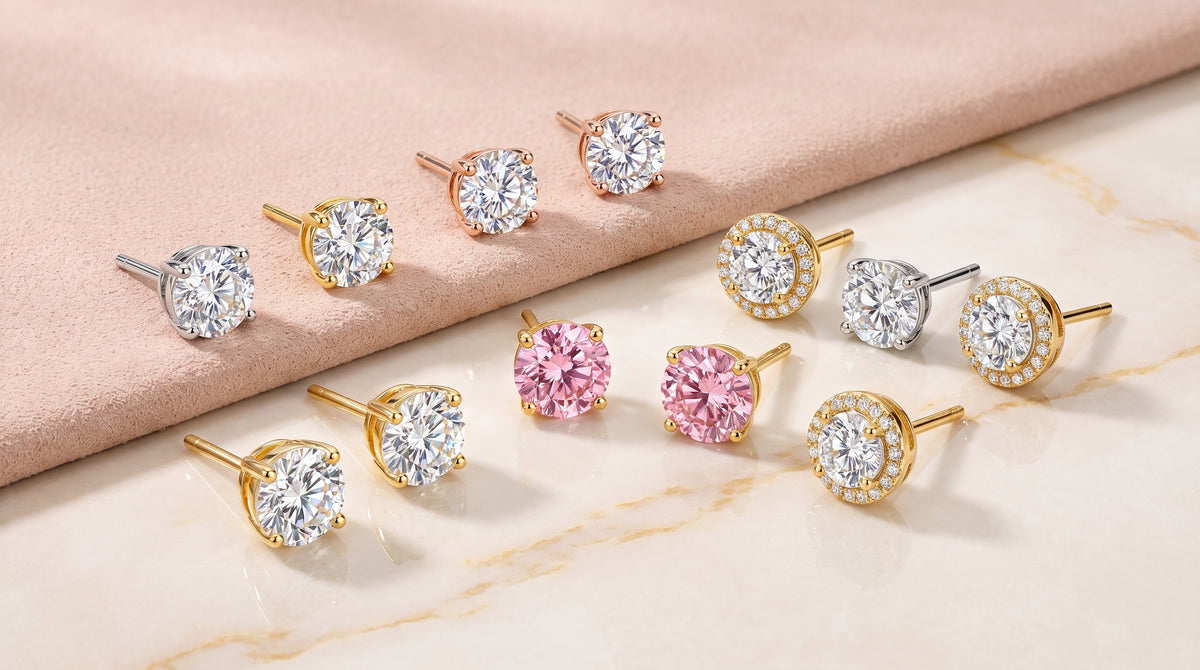
Being straightforward here is more useful than pretending otherwise. Awareness Avenue's earring range is built around moissanite studs and halo designs — pieces like the Beatrice round brilliant cut moissanite studs and the Eleanor halo moissanite earrings, available across gold and rose gold finishes. These are designed for brilliance and classic stud presence rather than as labret-style flat backs, and we are not going to describe them as something they are not. For their back type and metal specifications, check the individual product pages before ordering, especially if you have a confirmed metal sensitivity.
The practical takeaway is that these two categories answer different questions. A flush titanium or solid gold flat back is what you want for continuous, low-profile, sleep-through wear. A moissanite stud — whether a clean solitaire or a halo design with a colored center stone — is what you want when the earring is meant to be seen. Plenty of people own both and rotate by occasion rather than treating it as an either-or decision. If you are shopping the sparkle side, our breakdown of the 2 carat moissanite stud earring look covers scale, setting styles, and how to build a coordinated set.
Frequently Asked Questions
Can flat back studs be worn in ordinary lobe piercings?
Yes. Hey Rowan explicitly notes that flat backs can be used in almost every ear piercing, including lobes as well as helix, conch, tragus, and forward helix. Most of the marketing imagery in this category features cartilage stacks, but the hardware is the same and works in a standard lobe piercing.
Do flat backs come out easily?
The consistent position across sources is that they are more secure than friction clutches once correctly assembled. JCo states that threaded or push-pin fronts lock tight and are harder to lose even during workouts. The caveat is that a push-pin whose bend has relaxed can feel loose — Hey Rowan's fix is to bend the pin slightly for a firmer hold.
Titanium or 14k gold for sensitive ears?
Both are the materials brands name most often for sensitive ears and nickel allergies. Implant-grade titanium to ASTM F136 is described as lightweight, tarnish-free, and hypoallergenic, and it is the material piercing-focused retailers reach for first. Solid 14k gold is offered alongside it as the premium, warmer-toned alternative. The choice between them is largely about color, price, and preference rather than a clear functional hierarchy in the available evidence.
Are flat back studs safe for a brand-new piercing?
Several brands, including Maison Miru, describe their implant-grade titanium flat backs as safe for new and healing piercings, and Grayling states that titanium promotes safe healing. These are brand assertions rooted in piercing-industry practice rather than published clinical evidence. For a fresh piercing, follow the aftercare instructions from the piercer who performed it, and consult them before changing jewelry.
How do I clean them?
The design advantage is that there is less to clean around: no hollow clutch chamber, just a smooth post and disc. That does not remove the need for routine cleaning with clean hands and an appropriate solution. Whichever back style you wear, consistent hygiene matters more than the hardware.
The Bottom Line
If you sleep in your earrings, sleep on your side, wear over-ear headphones for hours, or have reacted to unspecified metals before, flat back studs address a specific mechanical problem: the protruding clutch behind your lobe. The design logic is sound and consistently described across the category, and the specifications that determine whether you get the benefit are narrow and checkable — a named material standard, a post length matched to your lobe, an 18g post you have anticipated, a smooth disc, and a closure you can operate confidently.
What you should not expect is a medical guarantee. Every comfort, hygiene, and hypoallergenic claim in this space comes from brands describing their own products, and none of them publish clinical data. Buy on the design logic and the specifications, ask a qualified piercer when fit or healing is genuinely in question, and keep your high-sparkle traditional studs for the occasions where being noticed is the entire point.

Leave a comment
This site is protected by hCaptcha and the hCaptcha Privacy Policy and Terms of Service apply.