


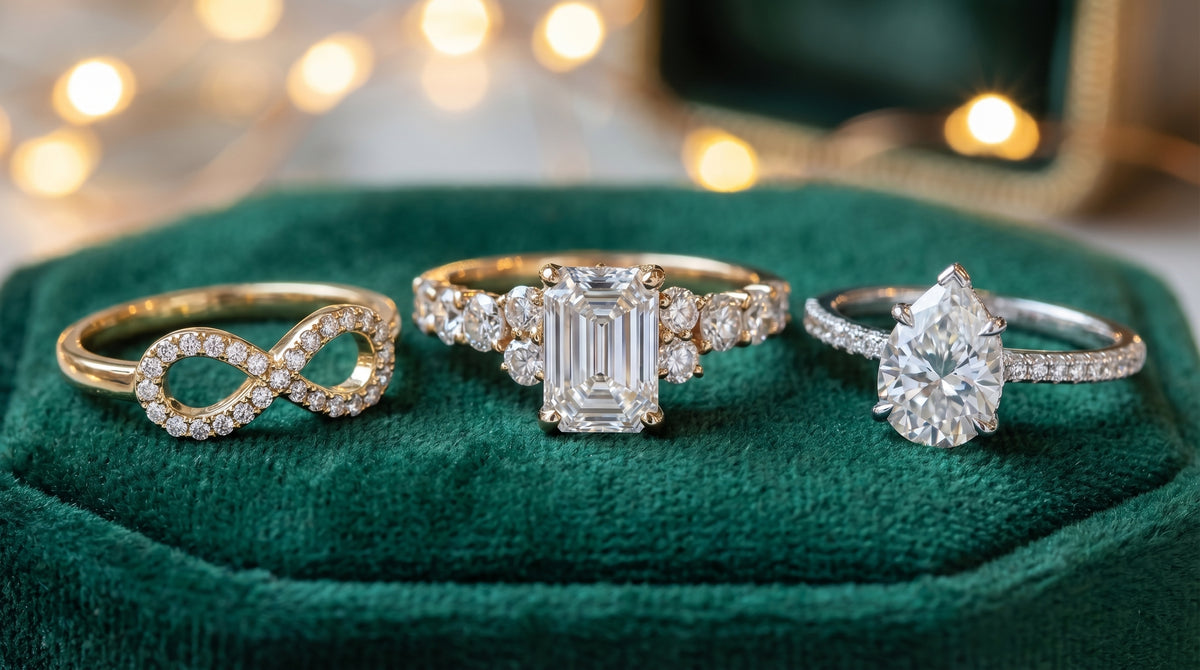
You searched for a lab grown emerald engagement ring—and you're about to discover something that changes everything about how you shop for one. The word "emerald" is doing two completely different jobs in the jewelry world, and confusing them is the single most expensive mistake a buyer can make. One refers to the green beryl gemstone. The other refers to a sleek, rectangular step-cut shape. Knowing which one you actually want—and which stone material will hold up beautifully for the next fifty years—is the difference between a ring you'll treasure forever and one that chips on a Tuesday morning.
The jewelry landscape in 2026 has shifted dramatically toward ethical, lab-created stones that deliver uncompromising beauty without the environmental toll of traditional mining. But not all lab-grown stones are created equal. Lab-grown emeralds offer a beautiful green hue—yet they carry the same structural vulnerabilities as their mined counterparts. That's exactly why so many couples are discovering green moissanite and lab-grown diamonds instead. These advanced alternatives give you the exact aesthetic you're after—that mesmerizing hall-of-mirrors effect—paired with the rugged durability a daily-wear ring demands.
What to Know Before Buying a Lab Grown Emerald Engagement Ring
A lab grown emerald engagement ring offers vibrant green color and ethical origins, but buyers must understand the difference between the emerald gemstone and the emerald cut. While lab-created emeralds are beautiful, green moissanite or emerald-cut lab diamonds provide superior durability and optical performance for daily wear, making them the smarter long-term choice.
To make an informed decision, we have to separate the gemstone material from the cutting style. The word "emerald" does double duty in the jewelry industry. First, it refers to a specific mineral species: beryl. Natural emeralds are formed deep within the earth and are famous for their lush green color, which comes from trace amounts of chromium and vanadium. They're also famous for being heavily included. These internal fractures—often romantically called the stone's "jardin" (garden)—make the gem inherently brittle. Lab-grown emeralds are chemically identical to mined emeralds, grown in controlled hydrothermal environments that usually produce fewer inclusions and more even color. But they're still beryl. They still possess a Mohs hardness of 7.5 to 8, and they still require delicate care to prevent chipping over a lifetime of wear.
Second, "emerald" refers to a specific shape and cutting style. The emerald cut is a step cut—a rectangular or square outline with cropped corners and long, linear facets arranged in parallel lines down the pavilion. This cut was originally developed specifically for emerald gemstones because the cropped corners reduced the risk of the brittle stone chipping during setting. Today, the emerald cut is applied to almost every gemstone type, prized for its sophisticated elegance and its ability to elongate the finger beautifully.
Here's the thing—if your heart is set on lush green color and architectural shape, you don't actually have to buy an emerald gemstone. Green moissanite has emerged as a spectacular alternative. Born from silicon carbide, a material originally discovered in a meteorite crater, moissanite boasts a Mohs hardness of 9.25, making it the second-hardest gemstone used in jewelry. When expertly crafted into an emerald cut and infused with a rich green hue, it delivers the exact visual impact of a flawless emerald but with durability that easily withstands the rigors of daily life. You can read more about how these stones compare structurally in our detailed breakdown of 12 Dazzling Moissanite Rings for Couples Who Love the Lab-Grown Diamond Look.
Alternatively, if you love the emerald cut but prefer a colorless stone, an emerald-cut lab-grown diamond or a colorless emerald-cut moissanite offers that icy, pristine geometry. Lab-grown diamonds are pure carbon, identical to mined diamonds, scoring a perfect 10 on the Mohs scale. Moissanite, meanwhile, carries a higher refractive index than diamond—2.65 to 2.69 versus diamond's 2.42—meaning it bends light more intensely, producing spectacular rainbow fire that catches the eye from across the room.
Key Factors: Emerald vs. Moissanite vs. Lab Diamonds
When comparing these stones, durability and optical performance are paramount. Emeralds require delicate care due to internal inclusions and lower hardness. Moissanite delivers unmatched fire and exceptional scratch resistance at a Mohs 9.25, while lab-grown diamonds offer classic brilliance and maximum hardness—making both far superior alternatives for a lab grown emerald cut ring worn every day.
An engagement ring isn't a delicate necklace worn once a month. It's a daily companion that will hit steering wheels, scrape against granite countertops, and be subjected to soaps and hand sanitizers. Understanding how different stones react to that environment is vital.
Durability and the Mohs Scale
The Mohs scale measures a mineral's resistance to scratching. Diamond sits at the absolute top at 10. Moissanite is right behind it at 9.25. Emeralds sit between 7.5 and 8. And here's where it gets interesting—the scale isn't linear. A diamond is exponentially harder than an emerald. More importantly, hardness is only half the story. Toughness measures a stone's resistance to chipping and breaking. Because emeralds (both natural and lab-grown) often have internal stress points and inclusions, their toughness is rated as poor to good. A sharp tap on the edge of a desk can chip an emerald. Moissanite and diamond possess excellent toughness, making them vastly superior choices for a ring you intend to wear every day without anxiety.
Clarity and Treatments
Natural emeralds are almost universally treated. Jewelers use cedar oil or synthetic resins to fill microscopic fissures that reach the stone's surface, improving apparent clarity. These treatments aren't permanent. Harsh cleaning chemicals, ultrasonic cleaners, or even hot water can strip the oil—suddenly revealing a cloudy, heavily fractured stone. Lab-grown emeralds are cleaner, but they can still possess flux inclusions and may occasionally be oiled.
Moissanite and lab-grown diamonds, conversely, are grown in highly controlled environments that yield exceptional clarity. They're never fracture-filled. The brilliant clarity you see on day one is the exact clarity you'll see fifty years from now. Clean them vigorously with warm soapy water and a soft brush without any fear of damaging a delicate treatment.

Optical Performance: Fire and Brilliance
The way a stone handles light defines its beauty. Brilliance refers to the white light reflected back to your eye. Fire refers to the dispersion of light into rainbow colors—those bold flashes of red, orange, and violet that ignite in direct sunlight. Emeralds have a relatively low refractive index (around 1.57), meaning they rely entirely on their rich body color for appeal; they don't sparkle intensely. Diamonds have a refractive index of 2.42, giving them their famous brilliance. Moissanite reaches 2.65 to 2.69 and carries a dispersion of 0.104—more than double diamond's 0.044. In an emerald cut, that means a moissanite stone throws bold, distinct flashes of rainbow fire that a diamond can't match, and an emerald can't even approach.
| Feature | Lab-Grown Emerald | Green Moissanite | Lab-Grown Diamond |
|---|---|---|---|
| Composition | Beryl (Mineral) | Silicon Carbide | Pure Carbon |
| Mohs Hardness | 7.5 - 8.0 | 9.25 | 10.0 |
| Toughness | Poor to Good (Prone to chipping) | Excellent | Excellent |
| Refractive Index | 1.57 - 1.58 (Low sparkle) | 2.65 - 2.69 (High fire) | 2.42 (High brilliance) |
| Treatments | Often oiled or resin-filled | None required | None required |
| Daily Wear Suitability | Requires careful handling | Highly recommended | Highly recommended |
Price Ranges and Value in 2026
In 2026, a 2 carat emerald cut diamond ring price averages $2,500 to $3,500 for lab-grown, while a 5 carat lab grown diamond price can reach $7,000 or more. Moissanite offers the same luxurious aesthetic for a fraction of the cost—a 5 carat emerald cut lab grown diamond look-alike in moissanite typically runs well under $1,000, maximizing your budget without sacrificing brilliance or durability.
Understanding the financial landscape of fine jewelry is empowering. If you were shopping for a high-quality natural emerald of significant size—say, three carats with vivid saturation and minimal inclusions—you'd easily be looking at prices soaring past $15,000 to $30,000. Natural emeralds of fine quality are exceptionally rare and priced accordingly.
Lab-grown diamonds have democratized the diamond market, but they still represent a significant investment. A 2 carat emerald cut diamond ring price in 2026 for a high-quality lab-grown option (F color, VS1 clarity) typically ranges from $2,000 to $3,500 depending on the setting. As you move up in size, prices scale sharply. A 5 carat emerald cut diamond ring price for a lab-grown stone generally sits between $4,500 and $7,000. That's a massive discount compared to a mined diamond of the same size—which could easily exceed $100,000—but it's still a substantial purchase.
This is where moissanite completely changes the paradigm. Because moissanite is grown in highly efficient, technologically advanced laboratories, the cost of production is significantly lower than that of lab-grown diamonds. You can secure a flawless, masterfully cut 3 carat lab grown emerald cut diamond ring equivalent in moissanite for well under $1,000. That value proposition means you can allocate your budget toward a more intricate setting, a matching wedding band, or a honeymoon. For a deeper dive into how these costs break down, explore our guide on Lab Created Moissanite Price: An Expert Guide to Understanding Carat, Cut, and True Value.
And honestly? Resale value is a common point of confusion worth addressing directly. Many buyers mistakenly believe lab-grown diamonds hold their value like natural diamonds once did. In reality, because lab-grown diamonds can be produced in unlimited quantities, their wholesale prices have steadily decreased. The smartest financial approach in 2026 is to view your engagement ring as an emotional investment in your daily joy—not a financial asset to be liquidated later. When viewed through that lens, moissanite's upfront affordability makes it the undisputed champion of value.
How to Spot Quality in an Emerald Cut Ring
Quality in a lab grown emerald cut ring is defined by cut precision and clarity. The step-cut facets create a hall-of-mirrors effect that easily reveals inclusions, meaning you should prioritize VS1 clarity or higher and excellent proportions for maximum light return. In moissanite, GRA-certified stones deliver inherently flawless clarity that makes this a non-issue.
The emerald cut is notoriously unforgiving. Unlike a round brilliant cut—which features dozens of tiny, kite-shaped facets designed to scatter light and hide internal flaws—the emerald cut features long, open, rectangular facets. You're essentially looking straight down into the soul of the stone. When light enters a perfectly proportioned emerald cut, it bounces back and forth between the parallel pavilion facets, creating bold flashes of alternating light and dark. It's architectural. It's deliberate. It's stunning.
Because of this open window into the stone, clarity is non-negotiable. If you're shopping for a lab grown emerald cut diamond ring, an inclusion that might be invisible in an oval or radiant cut will be glaringly obvious here. Insist on VS1 or higher. This is another area where moissanite shines. Our GRA-certified moissanite is engineered in pristine laboratory conditions, making it inherently VVS1/VVS2 equivalent. You'll never find an unsightly dark spot interrupting the sleek lines of your stone.

Color is the next critical factor. The step facets of an emerald cut concentrate color. If you're looking at a colorless lab grown emerald cut ring, any slight yellow or brown tint will be far more noticeable than it would be in a brilliant cut. You want a stone that faces up icy white. If you're opting for a colored stone—like a green or pink moissanite—you want deep, even saturation without muddy or washed-out zones. The color should be vivid and consistent from edge to edge.
Finally, consider the length-to-width ratio. A classic emerald cut diamond ring Tiffany style typically features a ratio between 1.30 and 1.40, creating a pleasing, elongated rectangle that flatters the finger beautifully. Ratios closer to 1.00 look square (often called an Asscher cut), while ratios above 1.50 look very long and narrow. There's no wrong answer—it's entirely personal preference. But ensuring the facets are perfectly symmetrical and the corners are evenly cropped is non-negotiable for a high-quality result.
Our Top Recommendations for 2026
Our curated selection features the finest step-cut designs of 2026. From vibrant green center stones to classic colorless moissanite, these rings combine architectural elegance with ethical craftsmanship—each one backed by our lifetime warranty and loved by more than 250,000 customers worldwide.
At Awareness Avenue, we've spent years crafting premium moissanite jewelry that rivals the most exclusive luxury houses in the world. We've meticulously designed our emerald-cut collection to highlight the mesmerizing hall-of-mirrors effect, using only the highest-grade silicon carbide, GRA-certified for quality and authenticity. Whether you're drawn to the classic icy brilliance of a colorless stone or the bold statement of a colored gem, our collection offers unparalleled beauty. Here are our top recommendations for your forever ring.
The Bella Jewel 3CT Emerald Cut Green Moissanite Ring
For the bride who started her search looking for a lab grown emerald engagement ring, The Bella Jewel 3CT Emerald Cut Green Moissanite Ring is the ultimate realization of that dream. This ring features a breathtaking 3-carat green moissanite center stone that delivers the lush, vibrant saturation of a museum-quality Colombian emerald—but with the unstoppable durability of moissanite. The step cuts amplify the rich green hue, while pristine VVS clarity ensures light travels freely through the stone, creating flashes of green fire that a natural emerald simply cannot produce. Set in a secure, elegant mounting, this ring is a showstopper that requires none of the stressful maintenance associated with brittle beryl.
The Adelina Rae 2CT Emerald Cut Moissanite Ring
If you're captivated by the timeless, architectural elegance of a colorless step cut, The Adelina Rae 2CT Emerald Cut Moissanite Ring is a masterpiece of understated luxury. The 2-carat size is versatile—large enough to make a distinct statement, yet perfectly proportioned for comfortable, everyday wear. The flawless clarity of our moissanite ensures the open facets remain pristine and icy white, with that satisfying, solid weight on the finger that signals quality the moment you slip it on. This ring captures the essence of vintage Hollywood glamour while utilizing the most advanced, ethical gemstone technology available today.

The Camilla 3CT Emerald Cut Pink Moissanite Engagement Ring
For those who want to step outside the traditional color palette and embrace bold, romantic individuality, The Camilla 3CT Emerald Cut Pink Moissanite Engagement Ring is an absolute revelation. Pink gemstones have surged in popularity, but natural pink diamonds are astronomically expensive, and pink sapphires often lack intense fire. This 3-carat pink moissanite delivers a delicate, mesmerizing blush tone combined with the intense light return that only moissanite's 2.65 refractive index can provide. The emerald cut gives the soft pink color a structured, modern edge—a beautiful contrast between romantic hue and geometric precision.
The Adelina Rae 5CT Emerald Cut Moissanite Ring
Sometimes, more is simply more. If you want maximum finger coverage and breathtaking presence, The Adelina Rae 5CT Emerald Cut Moissanite Ring delivers unparalleled drama. When comparing this to a 5 carat emerald cut lab grown diamond, the visual impact is identical—the same massive, mirrored facets, the same icy brilliance, the same commanding silhouette. But while a 5 carat lab grown diamond price runs into the thousands, this moissanite masterpiece lets you achieve that elite, celebrity-status look without the exorbitant price tag. In direct sunlight, the rainbow fire that erupts through those long step facets is genuinely jaw-dropping. To explore more about the nuances of these larger stones, read our comprehensive guide: 10 Dazzling Solitaire Emerald Cut Moissanite Rings for a Timeless Statement.

Frequently Asked Questions
Is a lab grown emerald durable enough for an engagement ring?
While lab grown emeralds are beautiful, they still possess the same brittle crystal structure as natural emeralds—Mohs hardness 7.5 to 8, with poor to good toughness. They're prone to chipping if hit against hard surfaces. For an engagement ring worn daily, green moissanite is the far stronger choice, offering the same vibrant color with a Mohs hardness of 9.25 and excellent toughness, ensuring it lasts a lifetime without damage or costly re-oiling treatments.
How does an emerald cut differ from a radiant cut?
Both are rectangular shapes with cropped corners, but their facet structures are entirely different. An emerald cut is a step cut, featuring long, parallel facets that create a subtle, elegant hall-of-mirrors flash. A radiant cut is a brilliant cut, featuring dozens of smaller, triangular and kite-shaped facets designed to maximize crushed-ice sparkle and hide inclusions. The emerald cut is architectural and sleek; the radiant cut is intensely glittery. Neither is better—they're just different personalities.
What is the average 3 carat lab grown emerald cut diamond ring price?
In 2026, a high-quality 3 carat lab grown emerald cut diamond ring price typically ranges from $2,800 to $4,500, depending on specific color and clarity grades and the complexity of the setting. By comparison, a flawless 3-carat emerald cut moissanite ring offers the exact same face-up size and superior fire for a fraction of that cost—usually well under $1,000.
Can I wear my green moissanite ring every day?
Absolutely. Green moissanite is non-porous, resistant to scratching, and unaffected by the soaps, hand sanitizers, and cleaning products that can strip the oil treatments from a natural emerald. Your moissanite ring can be worn during almost all daily activities. We recommend removing it during heavy weightlifting or manual labor—to protect the metal setting, not the stone itself.
Will an emerald cut make my finger look longer?
Yes. The elongated, rectangular shape of an emerald cut naturally draws the eye up and down the finger, creating a flattering, slimming effect. A length-to-width ratio between 1.35 and 1.45 provides the most classic, elongating silhouette—and it's one of the reasons this cut has remained a favorite for decades.
Final Advice for Your Forever Ring
Choosing your engagement ring is a deeply personal milestone. Prioritize a stone that aligns with your lifestyle, budget, and aesthetic desires. Whether you select a vibrant green moissanite or a classic colorless step-cut, your ring should reflect your unique, enduring love story—and it should look just as extraordinary in thirty years as it does the day you say yes.
You've navigated the complexities of gemology, understood the vital differences between beryl and silicon carbide, and discovered how modern lab-created stones offer unprecedented value and beauty. The era of compromising durability for color—or sacrificing your financial goals for a large center stone—is over. An emerald-cut ring is a statement of refined, confident taste. It doesn't rely on chaotic sparkle to capture attention. It relies on perfect geometry, pristine clarity, and bold flashes of light that stop people mid-sentence.
We've helped over 250,000 customers find their perfect piece, and every ring we craft comes backed by a lifetime warranty, GRA certification, secure checkout, and 30-day returns—because confidence in your purchase matters as much as the ring itself. As you take the next step in your journey, browse our full range of Engagement Rings to find the perfect architectural masterpiece, or discover what other couples are choosing right now in our Best Selling Moissanite Rings collection. Your forever ring is waiting.


Leave a comment
This site is protected by hCaptcha and the hCaptcha Privacy Policy and Terms of Service apply.