


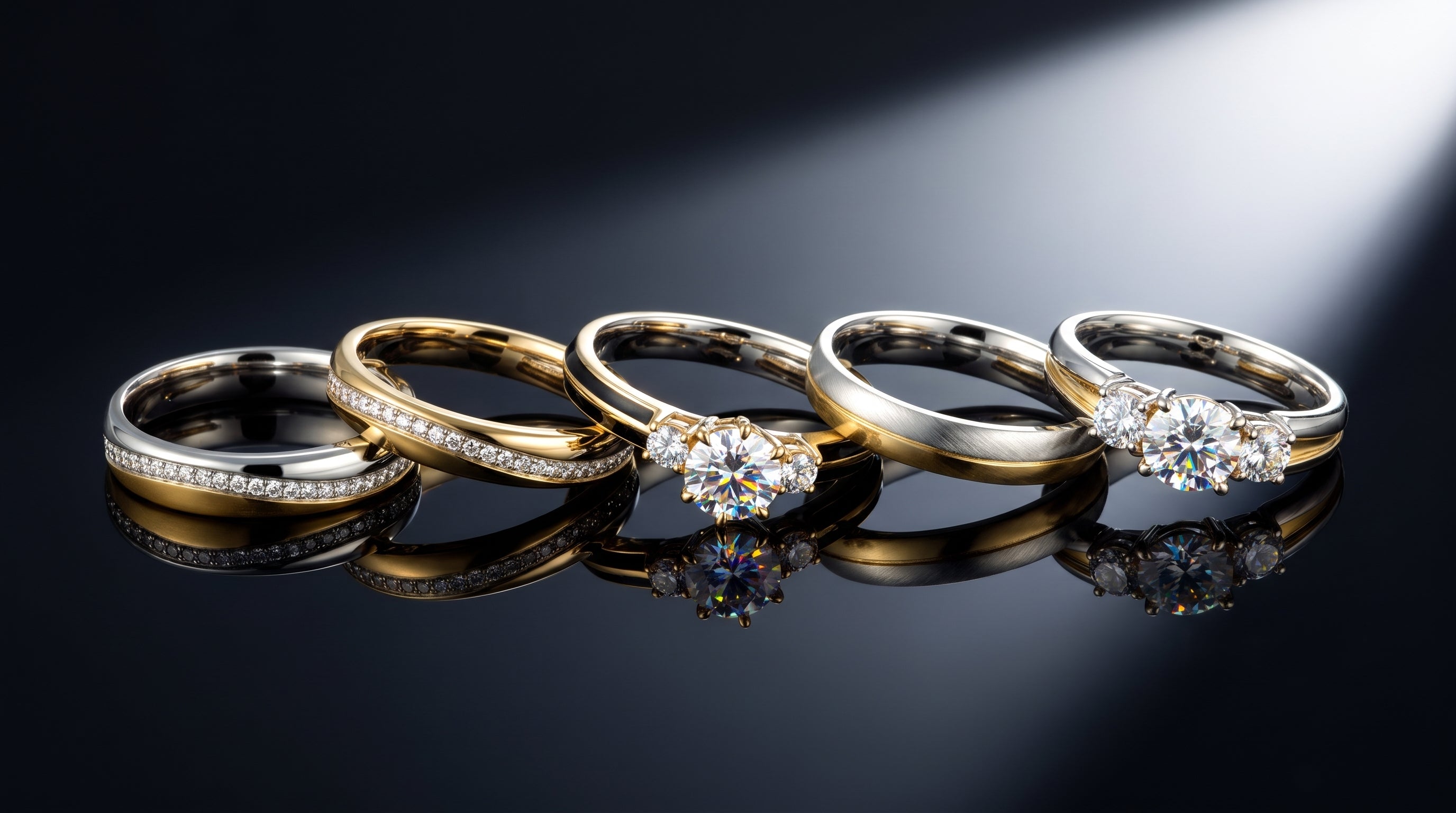
Two numbers explain most of what you will notice on your hand: 0.044 and 0.104. Those are the dispersion values commonly reported for diamond and for moissanite, and dispersion is the property that turns white light into visible rainbow flashes. Moissanite disperses light roughly 2.4 times as strongly as diamond, which is why jewelers and educational guides repeatedly describe its signature look as "fire," "rainbow flashes," or, less charitably, a "disco ball" effect. A lab-grown diamond, by contrast, shares the same crystal structure and nearly the same chemical, optical, and physical properties as a mined diamond, so its sparkle is the classic one: whiter, crisper, and more restrained.
That single contrast is where most comparison articles stop. It is not enough to make a decision with, because sparkle is not one property, it is three, and how those three combine depends on carat size, cut style, setting, and the light you happen to be standing in. Below, the optical facts are translated into the situations where you will actually judge your ring: midday sun, a dim restaurant, an office ceiling light, and your phone camera.
Sparkle is three separate effects, not one
Gemological and jeweler education content consistently breaks "sparkle" into brilliance, fire, and scintillation. Once you can see them separately, the moissanite versus lab-grown diamond difference stops being a matter of taste versus marketing and becomes something you can predict.
Brilliance: the white light coming back at you
Brilliance is the amount of white light that enters the stone and returns to your eye. It depends on refractive index, cut quality, and clarity. Diamond, including lab-grown diamond, is famous for high brilliance, with a refractive index generally cited between 2.417 and 2.419. Moissanite's refractive index is higher, usually reported in the 2.65 to 2.69 range, and several jewelers note that this makes moissanite slightly more brilliant than diamond. "Slightly" is the operative word: brilliance is the dimension where the two stones are closest.
Fire: the rainbow component
Fire is dispersion made visible — white light separated into spectral colors and thrown back as colored flashes. This is where the two materials genuinely diverge. With dispersion around 0.104 versus diamond's 0.044, moissanite produces markedly more colored light from the same light source. Ranking guides describe this as "more than twice the fire," and one jeweler puts it at roughly 2.5 times the rainbow flash of a lab-grown diamond. A lab-grown diamond still shows fire, but it is a secondary note under a dominant white flash rather than the headline.
Scintillation: the on-off pattern as you move
Scintillation is the flickering pattern of bright and dark facets as the stone, your hand, or the light moves. Facet layout and cut precision drive it, but material behavior shapes its character. Diamonds are singly refractive: light entering the stone follows a single path, which produces sharply defined facet reflections and an orderly, high-contrast flicker. Moissanite is doubly refractive in many orientations, splitting incoming light into two rays. That doubling can be seen as slightly doubled facet edges under magnification or at very close range, and jewelers use it as a diagnostic clue. In everyday viewing, it contributes to a busier, more kaleidoscopic scintillation.
The optical numbers side by side
| Property | Lab-grown diamond | Moissanite |
|---|---|---|
| Composition | Pure carbon in the diamond crystal structure | Silicon carbide |
| Gemological category | A real diamond (laboratory-grown) | Diamond simulant / alternative |
| Refractive index (reported) | ~2.417–2.419 | ~2.65–2.69 |
| Dispersion (fire) | ~0.044 | ~0.104 |
| Refraction | Singly refractive | Doubly refractive |
| Mohs hardness | 10 | ~9.25 |
| Visual signature | White brilliance, restrained fire, crisp scintillation | High brilliance plus intense rainbow fire, busy scintillation |
A useful way to read this table: the refractive index difference nudges brilliance, while the dispersion difference transforms fire. If you look at photographs of both stones and think one looks "more colorful" rather than "brighter," you are seeing dispersion, not brilliance. For a visual walkthrough of the same two stones photographed together, our side-by-side comparison covers what changes and what does not when the stones sit in the same setting.
How each stone behaves in real lighting
Optical constants set the ceiling; light sources decide how much of that ceiling you see. This is the part of the comparison most guides skip, and it is the part that determines whether you love your ring on a Tuesday morning.
Direct sunlight and bright LED spotlights
Strong directional light is moissanite's maximum-contrast environment. Multiple sources note that midday sun and intense retail spotlights are exactly where the higher dispersion becomes conspicuous, throwing distinct bursts of red, green, blue, and violet across the stone and onto skin. In the same light, a lab-grown diamond reads primarily as very bright white with brief colored edges. If you spend your days outdoors or in bright showrooms, the two stones will be at their most distinguishable. We go deeper into that specific scenario in our guide to diamond and moissanite in sunlight.
Restaurants, candlelight, and evening interiors
Low, warm, diffuse light gives every faceted stone less to work with. Under these conditions, some observers describe moissanite as producing a softer, dreamy, rainbow-tinged glow; others describe the same effect as flashy in a room where nothing else is sparkling. A lab-grown diamond in the same light typically shows fewer but cleaner white flashes. Neither behavior is objectively better — but note that this is the lighting in which many people first show a ring to friends and family, so it is worth judging in person rather than in a bright store.
Offices, overcast daylight, and mirrors
Broad, flat lighting suppresses fire in both stones and shifts the emphasis to brilliance and scintillation. This is where the two look most similar, since brilliance is where their measured properties are closest. Lab-grown diamonds are frequently praised for consistency across lighting conditions: the sparkle character does not change much between environments. Moissanite's look varies more, because it has more fire to lose when the light softens and more to display when the light sharpens.
Phone cameras and video
Cameras handle high dispersion differently than eyes do. Bright point-source flashes tend to blow out into colored streaks, so moissanite often photographs as more visibly rainbow than it appears in person, while a lab-grown diamond photographs closer to how it looks live. If you are comparing stones through social media clips, assume the moissanite is being flattered — or exaggerated, depending on your taste — by the lens.
Size, cut, and setting change everything
The same material can read as subtle or theatrical depending on how much of it there is and how it is faceted.
Small accents and pavé
In melee-size stones, individual rainbow flashes are too small to resolve separately, so moissanite pavé tends to read as a uniformly bright, glittering line rather than as visible fire. This is why a pavé band set with moissanite can look far closer to a diamond band than a large moissanite solitaire looks to a large diamond solitaire. If you want maximum-sparkle bands without the fire being obvious, small stones are the practical route — designs like faceted pavé couples rings keep the sparkle continuous and fine-grained rather than concentrated in one center stone.
Center stones around a carat and above
Brilliant Earth and Holden both note that the fire gap becomes noticeably more obvious above roughly one carat, where larger facets and a bigger surface give dispersion room to display. This is the size range where the "disco ball" description originates, and where an observer familiar with diamonds is most likely to register that a stone is behaving differently. A large cushion-cut halo such as the 4CT cushion cut halo moissanite ring illustrates the effect: a broad center throwing colored flashes, framed by small accents that read as fine white glitter. For a structured look at how carat weight changes perceived sparkle, see our comparison of what you get at different budgets.
Cut style
Round brilliant cuts are engineered to maximize both brilliance and fire, so they showcase moissanite's dispersion most dramatically. Elongated and fancy shapes distribute light along different axes and can either soften or elongate the colored flashes. Step cuts such as emerald and baguette rely on broad flashes of light rather than rapid scintillation, which mutes the fire difference in some viewing angles and makes it more obvious in others. Crushed-ice faceting scatters light into many tiny returns, which tends to blend fire into a shimmering wash instead of discrete rainbows.
Setting and metal
Metal color influences perceived body color and contrast, and low-profile or bezel settings restrict the angles at which light enters the pavilion. A halo increases the number of small stones surrounding a big one, adding white glitter that visually dilutes central fire. Two-tone and inlay designs, like three-stone couples rings, change how much of the visual attention the stones carry at all.
Identity: a real diamond versus a simulant
Sparkle is the query, but identity often decides the purchase. The distinction is well established and worth stating plainly. Laboratory-grown diamonds are diamonds: GIA describes them as sharing the diamond crystal structure and therefore having nearly the same chemical, optical, and physical properties as natural diamonds, with origin as the difference and advanced instrumentation required to tell lab-grown from mined. Moissanite is silicon carbide, categorized as a diamond simulant — a different material that imitates the look of diamond. Natural moissanite was first identified in a meteor crater and is extremely rare in gem-usable sizes, so essentially all moissanite in jewelry is lab-created.
Practically, that means choosing a lab-grown diamond gets you the culturally standard sparkle plus the word "diamond." Choosing moissanite gets you a different optical performance — more fire, comparable or slightly higher brilliance — in a material with its own name and its own grading conventions. Neither is a compromise on beauty; they are different visual signatures with different social readings.
Will anyone notice?
Honest answer: sometimes, and it depends on size, light, and the observer. Jewelers describe moissanite's rainbow flashes in larger stones as the most reliable quick visual tell, and double refraction makes the distinction straightforward under a loupe. Jeweler blogs also report the opposite social outcome — acquaintances assuming a large moissanite is an extremely expensive diamond. Both anecdotes point to the same conclusion: casual observers respond to size and sparkle intensity, not material identity, while anyone who examines the stone closely can differentiate.
Does sparkle last? Durability in plain terms
Sparkle degrades when facet edges abrade and polish dulls, so hardness matters for long-term appearance. Diamond, including lab-grown, sits at 10 on the Mohs scale. Moissanite is reported at approximately 9.25 — second only to diamond among stones commonly used in jewelry. Both are described across jeweler and retailer education content as durable enough for daily wear, including engagement rings worn continuously. In practice, neither behaves like softer simulants that cloud and lose brightness relatively quickly.
So durability is rarely the deciding factor in a sparkle comparison, though it does reassure: whichever you choose, the optical character you buy is the one you keep, assuming normal care and periodic cleaning of the film that dulls light return on any stone. One niche note for bench work: moissanite is reported to change color above roughly 1,500°C and to have higher electrical conductivity than diamond, which matters to a jeweler performing torch work or testing, not to you at dinner. Our guide to moissanite and diamond hardness covers the wear question in more detail.
Price and ethics, handled honestly
Price is a real part of this decision, but published figures come from individual retailers and shift over time, so treat any specific number you read as that seller's positioning rather than a market rule. The consistent, defensible pattern across brand and jeweler guides is directional: moissanite is generally offered at lower prices than comparable lab-grown diamonds, and lab-grown diamonds are generally offered below comparable mined diamonds. Verify current figures on the pages you are actually buying from.
On ethics, both stones avoid diamond mining, which is the primary reason many shoppers arrive at this comparison in the first place. It is worth resisting the simpler marketing framing: laboratory diamond growth can be energy-intensive, and the environmental footprint depends on each producer's energy sources and process efficiency. Moissanite is entirely lab-created, but industrial silicon carbide production is also an industrial process. "No mining" is accurate for both; "zero impact" is accurate for neither.
Resale deserves the same caution. Some jewelers report that moissanite retains a higher percentage of its original price than lab-grown diamonds, and forum discussions debate how falling lab-grown diamond prices affect that comparison. These are observations from specific market moments, not forecasts. For symbolic jewelry, sentimental and aesthetic fit are the durable considerations.
Which sparkle profile fits you?
Rather than declaring a winner, match the optical evidence to your own preferences.
Choose lab-grown diamond sparkle if…
You want the sparkle most people picture when they hear "diamond": dominant white brilliance, crisp facet definition, restrained color, and a look that stays consistent from an overcast morning to a candlelit table. You care that the stone is gemologically a diamond. You are drawn to designs where the metal and silhouette do part of the talking, and you would rather your ring be noticed on second glance than first.
Choose moissanite sparkle if…
You actively enjoy fire and want visible color in your sparkle, especially outdoors. You want a large center stone's worth of visual presence, and you find the rainbow effect delightful rather than distracting. Curved and stackable designs such as curved moissanite couples rings show how the stone reads in continuous, lower-profile sparkle rather than a single dramatic center; the broader white moissanite range shows the spread between subtle and statement.
A three-step in-person test
First, view candidates at arm's length under three light sources — window daylight, a warm indoor lamp, and overhead white light — and note which stone you keep looking at. Second, move your hand slowly and watch the flash pattern: if the colored bursts make you smile, that is a vote for moissanite; if you prefer the clean white blink, that is a vote for diamond. Third, compare at the actual carat weight you intend to buy, since the fire gap widens above roughly a carat and nearly disappears in pavé. If you cannot see stones in person, ask for unedited video shot under ordinary indoor lighting rather than showroom spotlights.
Frequently asked questions
Does moissanite sparkle more than a lab-grown diamond?
It sparkles differently, and by the measurable definition of fire, more. Moissanite's dispersion of about 0.104 versus diamond's 0.044 means substantially more rainbow flash, and its higher refractive index makes it slightly more brilliant. If "sparkle" to you means white flash and contrast, a well-cut lab-grown diamond may look better to your eye despite the lower numbers.
Is a lab-grown diamond's sparkle different from a mined diamond's?
No. Lab-grown diamonds share the diamond crystal structure and nearly identical optical properties, so cut quality — not origin — determines how a given stone performs.
What is the fastest way to tell them apart?
In larger stones, the intensity of rainbow flashes in bright light is the quickest visual clue. Under magnification, moissanite's double refraction can show as slightly doubled facet edges, which is a standard diagnostic jewelers rely on.
Is moissanite's fire less noticeable in small stones?
Yes. Accent and pavé stones are too small for individual color flashes to resolve, so they read as bright, fine glitter, which is why moissanite accents blend convincingly into classic designs.
Does one stay sparkly longer?
Both are hard enough for daily wear — diamond at Mohs 10, moissanite around 9.25 — so with normal care, neither loses its optical character the way softer simulants do. Routine cleaning matters more than the hardness gap.
If you want the wider comparison beyond sparkle, including how mined diamonds fit into the picture, continue with our three-way guide to moissanite, diamond, and lab diamond, then come back to this page to make the visual call.

Leave a comment
This site is protected by hCaptcha and the hCaptcha Privacy Policy and Terms of Service apply.