


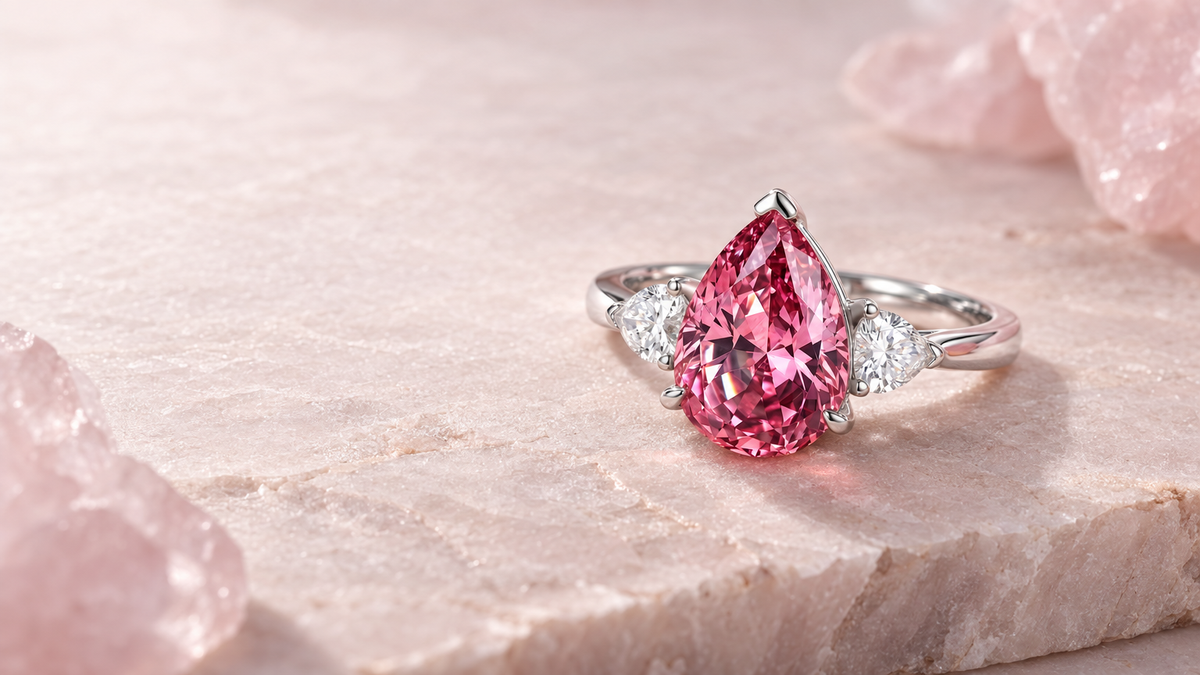
Turn a pink tourmaline ninety degrees under a north-facing window and it can look like two different stones: raspberry from one angle, a grayer, quieter pink from another. That single behavior — pleochroism — explains most of the disappointment people report after buying a pink tourmaline ring online. It also explains why the most useful buying guide is not a list of styles, but a method: how to read color, how to read a cut, how to read a listing, and how to decide whether you want a natural mined stone or a clearly disclosed simulated one. This guide walks through all four, and it separates general gemstone facts from what any specific ring you are looking at actually is.
Start With the Stone: What Pink Tourmaline Is and How It Behaves
Pink tourmaline is not its own mineral species. It is the pink-colored variety of elbaite, a member of the tourmaline group, and its color comes primarily from manganese. That single chemical fact has downstream consequences for everything a buyer cares about: the range of pinks available, the frequency of color zoning, and the way the stone reacts to light.
The pink range, from blush to rubellite
Tourmaline's pink spectrum is unusually wide. You will see pale blush and peachy pinks at one end, clean bubblegum and "hot" pinks in the middle, and deeply saturated purplish-red material marketed as rubellite at the top. Those names are commercial, not rigidly standardized, so treat "rubellite" as a claim about saturation that deserves supporting evidence — photographs in daylight, and for premium stones, documentation — rather than a guaranteed quality tier.
Color zoning is common in tourmaline crystals, meaning intensity can vary across a single stone. A cutter can orient the rough to hide zoning face-up, or fail to, and the difference is visible in a video far more reliably than in a still photo.
What Mohs 7 to 7.5 actually means on a finger
Pink tourmaline sits at roughly 7 to 7.5 on the Mohs scale. That is genuinely wearable — it is harder than glass, harder than opal, and comfortably in the range jewelers use for everyday rings. It is also softer than sapphire, which sits at 9, and that gap matters more for rings than for earrings or pendants because hands take impacts that ears never do.
Hardness is only half the story. Tourmaline breaks with a conchoidal fracture, which means a sharp knock on an exposed corner or a thin girdle can chip rather than scratch. This is the single strongest argument for choosing a protective setting, and it is the reason gemology-focused engagement ring guides consistently recommend bezels, halos, and low-profile designs for tourmaline center stones. If you already know you are hard on jewelry, that lifestyle fact should shape your setting before it shapes your carat weight.
Color Is the Price: Hue, Tone, Saturation, and the Pleochroism Trap
In colored stones generally, and pink tourmaline specifically, color drives value more than carat weight and usually more than clarity. Three variables do the work:
- Hue — is the pink a clean pink, or does it lean purplish, orangey, or red?
- Tone — how light or dark is it? Very light stones read as "washed out"; very dark ones lose life.
- Saturation — how intense and pure is the color, and how much gray or brown is mixed in? This is the lever that moves price hardest.
Two stones of identical carat weight can differ dramatically in cost purely because one is vivid and the other is muted. If you have a fixed budget, the honest trade-off is almost always: better color in a smaller stone, or more size in a softer, paler color. Decide which one you will still like in five years.
The daylight test — and how to run it remotely
Pleochroism means tourmaline shows different colors or intensities along different crystallographic directions, so the face-up color shifts as the stone is rotated. Layer warm showroom lighting or a filtered product photo on top of that, and a stone that looked electric on screen can land at home looking gray.
The practical fix is to insist on neutral-light evidence before you buy:
- Ask for photos or, better, video of the actual stone in natural daylight — outdoor shade is ideal, because direct sun blows out saturation.
- Ask for the stone to be shown next to a neutral white card, which removes the warm color cast that fabric, wood, or skin introduces.
- Ask for the stone to be rotated on camera so you can see the pleochroic shift rather than one flattering angle.
- Treat "stock photo only," no video, and no return policy as a cluster of red flags, especially for anything sold as premium-color material.
Windowing and extinction: when the cut kills the color
Cut quality in colored stones is judged differently than in diamonds. Two failure modes matter most. Windowing happens when a stone is cut too shallow: light passes straight through instead of returning, and the center looks pale and see-through. Extinction is the opposite problem — dark, dead zones where no light comes back. A well-cut pink tourmaline shows bright, even light return across the face with color that holds from edge to center.
Elongated shapes — oval, pear, cushion — are popular for tourmaline because they give the cutter room to work with the crystal's natural shape and can deepen the apparent color across a longer path of light. A pear or cushion outline also reads larger per carat than a round of equivalent weight, which is a quiet budget advantage.
Settings, Metals, and Cuts That Protect a Mid-Hardness Stone
Because tourmaline can chip, the setting is functional, not just decorative.
Protective setting styles
Bezel settings wrap metal around the girdle and offer the most protection; they also darken the stone's outline slightly, which can help a pale pink read more saturated. Halo settings add sparkle from accent stones while buffering the center stone's edges, and they make a modest center look larger. Low-profile settings keep the stone closer to the finger so it catches fewer door frames and countertops. Tall, claw-heavy solitaires look beautiful and expose the most vulnerable part of the stone; if you love that look, plan on more frequent prong checks.
Whatever you choose, prong security is an ongoing maintenance item rather than a one-time build quality question. A quick tactile check — running the ring across a knuckle or a piece of knit fabric to feel for snagging — catches a lifting prong long before it loses a stone.
Metal color changes how the pink reads
Metal choice is a color decision. Yellow gold warms a pink stone and can push blush tones toward peach. White metals such as sterling silver, rhodium-plated white gold, and platinum cool the pink and emphasize purplish or raspberry notes. Rose gold harmonizes with pink stones and is the most forgiving choice for lighter, less saturated material — it makes a pale stone look intentional rather than weak.
Maintenance differs too. White gold typically needs rhodium replating periodically to keep its bright white face, yellow and rose gold benefit from occasional polishing, and sterling silver should be stored in anti-tarnish pouches and polished regularly. If you are weighing metals for a ring you plan to wear daily, our 18k gold engagement ring buying guide covers the karat and construction trade-offs in more depth.
What Actually Drives the Price of a Pink Tourmaline Ring
Published per-carat figures for pink tourmaline vary widely between sources, and they move with market conditions, origin, and how a seller grades its own material — so no single number is worth memorizing. What is stable is the structure of pricing, and understanding that structure is more useful than a stale price table.
- Saturation is the biggest lever. A vivid stone can cost several multiples of a washed-out stone of identical weight and shape.
- Price per carat climbs non-linearly with size. Fine color in larger sizes is rarer, so the jump from a modest stone to a large one is steeper than the weight difference suggests.
- Eye-clean clarity commands a premium in pink material, where inclusions are common enough that visibly clean stones stand out.
- Tourmaline grows in relatively large crystals compared with some other colored gems, which is why generously sized center stones are more attainable here than in, say, fine pink sapphire.
- The setting is a separate budget line. Metal weight, karat, accent stones, and design complexity can rival or exceed the center stone's cost.
A useful budgeting habit: decide your priority order before you shop — color intensity, stone size, metal, or accent sparkle — and let the least important one absorb the compromise.
Treatments, Disclosure, and the Honest Limits of a Lab Report
Tourmaline can be irradiated to deepen color. This is a known and reasonably common practice, and the right response is not alarm but disclosure: ask the seller directly whether the stone has been treated, and ask for the answer in writing on the invoice, ideally using standard trade disclosure codes.
Here is the nuance most retail pages leave out. Irradiation in tourmaline can be difficult or effectively impossible to detect after the fact, which means a reputable laboratory may report "no evidence observed" rather than a definitive yes or no. A report is therefore strong evidence of identity — that the stone is tourmaline and not something else — and weaker evidence about treatment history. For premium-priced stones, especially anything sold as rubellite or anything above a carat at a significant price, a report from a recognized gem laboratory is still worth requesting; just understand what it can and cannot prove.
Origin claims deserve the same scrutiny. If a listing names a specific deposit or country, ask what documentation supports it. Unsupported origin claims are a common way to justify a premium that the stone's color alone would not.
Natural vs. Simulated Pink Tourmaline: Read the Listing Word for Word
Everything above describes natural, mined pink tourmaline. A separate and entirely legitimate category exists: simulated pink tourmaline, which imitates the look of the gem without being mined elbaite. Simulated stones are not the same material and should never be priced, described, or valued as though they were. The only thing that matters at the point of purchase is that the listing says clearly which one you are getting.
When you read a product page, look for the exact wording. "Natural pink tourmaline" and "simulated pink tourmaline" are different claims. If a listing uses neither phrase — just "pink tourmaline" with no qualifier — ask before you buy.
Awareness Avenue's simulated pink tourmaline rings
For transparency: the pink tourmaline rings in our own catalog are made with simulated pink tourmaline, not mined stones, and they are categorized that way within our October birthstone simulated pink tourmaline collection. They are designed for buyers who want the October birthstone color story and the look of a pink center stone in sterling silver, gold vermeil, or solid gold, with the material stated plainly rather than implied.
Current designs include:
- The Calystara Pear — S925 Sterling Silver, an elongated pear silhouette in a cool white metal that emphasizes the pink's cooler notes.
- The Calystara Pear — Solid Gold, the same pear outline in a warmer solid gold setting.
- The Calystara Cushion — 18K Gold Vermeil, a softer cushion outline that reads wider on the finger than a pear of similar length.
- The Arisette Cushion Ring — S925 Sterling Silver, a cushion-centered sterling silver design.
- The Aurelissa Bypass Ring — S925 Sterling Silver, a wrapped bypass shank for people who want movement in the band rather than a symmetrical solitaire.
- The Calysienne Heart Ring — S925 Sterling Silver, a heart-cut option that leans overtly romantic.


If your priority is a birthstone piece or a pink-toned everyday ring rather than a mined gemstone investment, simulated stones remove the color-grading gamble entirely: what you see in the product photography is what the design is built to deliver. If your priority is owning natural elbaite, use the color, cut, and disclosure checks earlier in this guide and shop accordingly. Both are reasonable goals; they are simply different purchases. For broader context on stone-by-month choices, see our birthstone ring buying guide.
One clarification, since the names sit near each other in our catalog: The Amourette Ring is a moissanite design, not a tourmaline one.
Pink Tourmaline vs. Pink Sapphire, Morganite, and Moissanite
Most people searching for a pink ring are really choosing between four pink options. Here is how they differ on the factors that actually change the ownership experience.
| Stone | Mineral family | Mohs hardness | Color character | Notes |
|---|---|---|---|---|
| Pink tourmaline | Elbaite (tourmaline group) | ~7–7.5 | Wide range: blush, bubblegum, raspberry, purplish red | Pleochroic; color zoning common; color generally regarded as stable |
| Pink sapphire | Corundum | 9 | Pale to vivid magenta; high saturation and brilliance | The most impact-resistant of the four; typically the most expensive per carat |
| Morganite | Beryl | ~7.5–8 | Soft peachy blush | Frequently heat treated; can lighten with prolonged sun exposure |
| Moissanite (pink varieties available) | Lab-created silicon carbide | — | Chosen primarily for brilliance and fire | A created stone; sold as moissanite, never as tourmaline |
Read that table as a set of trade-offs rather than a ranking. If you want maximum toughness for a ring worn through everything, sapphire's hardness is the decisive advantage. If you want the broadest and most saturated pink palette at a more accessible entry point, tourmaline is compelling. If you want a gentle, romantic blush and don't mind keeping the ring out of long direct sun, morganite delivers it. If your real priority is sparkle rather than a specific mineral, a created stone answers that directly — our comparison of pink moissanite and pink sapphire breaks down that particular decision.
Care and Cleaning That Keeps Pink Looking Pink
A pink tourmaline ring rewards a gentle, consistent routine far more than an occasional aggressive one.
The safe routine
- Soak the ring for about ten minutes in lukewarm water with a drop or two of mild, pH-neutral dish soap. Distilled water is preferable to tap water, because dissolved minerals can leave cloudy spots on the stone and dull the metal.
- Brush gently with a very soft toothbrush, paying particular attention to the underside of the setting, where skin oils and lotion collect and quietly gray out the color.
- Rinse under lukewarm running water.
- Dry with a lint-free microfiber cloth, or use gentle compressed air. Tourmaline is pyroelectric — friction and heat can generate a surface charge that attracts dust — so blowing water off beats rubbing it off.
A ring worn daily benefits from cleaning roughly weekly, plus a periodic check for loose prongs or a stone that rattles when tapped lightly near your ear.
What to avoid
- Ultrasonic and steam cleaners. Included stones can fracture under ultrasonic vibration, and tourmaline is sensitive to heat and sudden temperature change.
- Harsh chemicals. Household cleaners, bleach, and solvents can dull the stone and attack the metal.
- Pools and hot tubs. Chlorine and bromine can degrade the copper and zinc in gold alloys over time, which is how prongs eventually fail.
- Shared storage. Store the ring separately in a soft pouch or a fabric-lined box; harder stones will scratch tourmaline if they share a compartment. Silica gel packets or anti-tarnish strips help with humidity and tarnish, particularly for sterling silver.
- Impact activities. Take the ring off for sports, gardening, weightlifting, and heavy cleaning.
A Practical Buying Checklist and Common Questions
Before you commit, confirm all seven:
- The listing states clearly whether the stone is natural or simulated.
- You have seen the actual stone — not a stock image — in daylight video, rotated.
- The color holds from edge to center with no obvious window or dark extinction zones.
- Any treatment has been disclosed in writing on the invoice.
- The setting style matches how roughly you actually live, not how carefully you intend to.
- Millimeter dimensions are stated, not just carat weight, so you know how the stone will read on your hand.
- There is a return policy you have actually read.
Is pink tourmaline durable enough for an engagement ring?
Yes, with the right design. At Mohs 7–7.5 it is suitable for regular wear, but its conchoidal fracture means exposed corners and thin girdles are vulnerable. Bezels, halos, and low-profile mounts substantially reduce that risk. If you work with your hands constantly and want zero maintenance anxiety, sapphire's hardness of 9 is the safer specification.
Why does my stone look different in photos than in person?
Usually pleochroism plus lighting. Warm indoor bulbs and warm-toned backgrounds push pink toward vivid; neutral daylight is the truth-teller. Always judge in outdoor shade against a white card before deciding you are unhappy with the stone.
Does pink tourmaline fade?
Pink tourmaline's color is generally regarded as stable, which is one of its advantages over morganite, a stone that can lighten under prolonged sunlight. Routine care matters more for keeping the stone looking bright — most "fading" people notice is a film of oil and soap residue on the pavilion, not a change in the gem itself.
What shape flatters pink tourmaline most?
Oval, pear, and cushion cuts are the perennial favorites because they display color across a longer light path and tend to read larger per carat. Heart and elongated cushion outlines work well when the goal is an overtly romantic piece rather than a neutral everyday one.
Should I buy a loose stone and have it set?
It is the best route if you are chasing a specific color and are prepared to vet stones carefully — request millimeter dimensions so the stone fits a calibrated setting, and confirm the cut quality before committing to a mount. If you would rather not manage that process, a finished ring from a seller that discloses its material clearly is the lower-friction path.
Pink tourmaline rewards buyers who slow down at exactly one step: judging color honestly, in the light you actually live in. Do that, choose a setting that fits your hands rather than your intentions, get treatment status in writing, and the rest of the decision — shape, metal, size — becomes a matter of taste rather than risk.

Leave a comment
This site is protected by hCaptcha and the hCaptcha Privacy Policy and Terms of Service apply.