


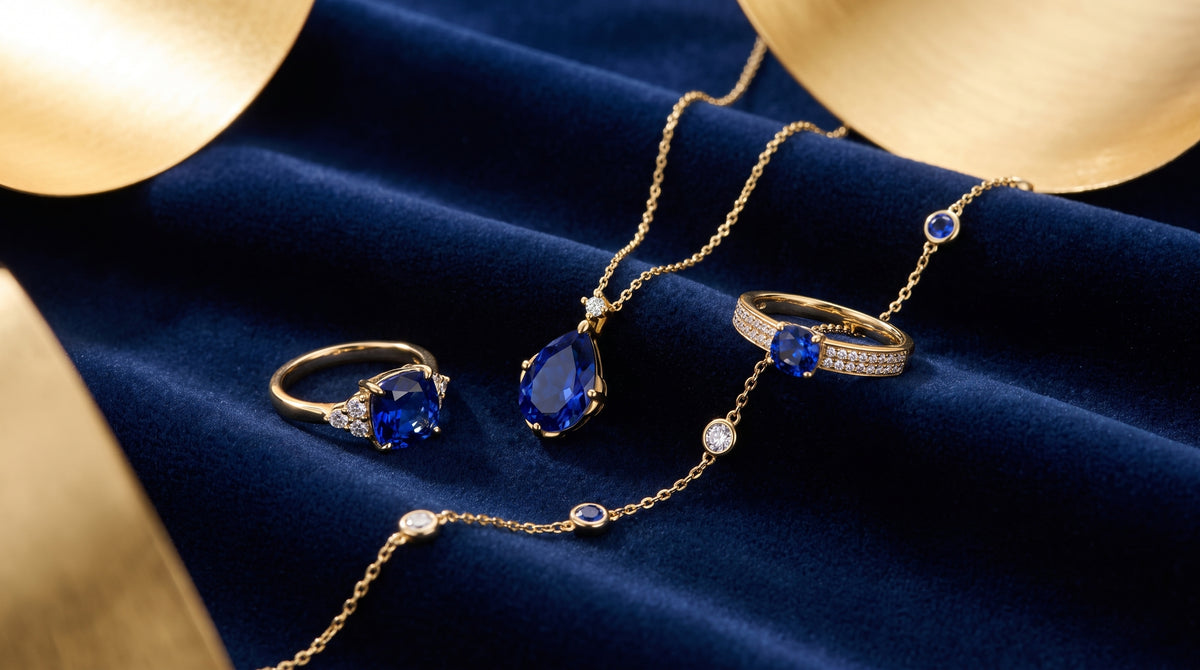
Look at how the biggest jewelry houses file their sapphire rings and you learn something useful before you spend a cent: Tiffany & Co. does not sell one sapphire engagement ring category, it sells several — platinum, gold, and rose gold each get their own door. That merchandising choice reflects how people actually shop. By the time someone types "sapphire jewelry gold" into a search bar, the gemstone question is largely settled. What remains is a pairing problem: which blue, in which gold, in which silhouette, and how do you know the stone in the photo will still look that saturated on your hand in daylight?
This guide answers that in order. First the stone, because color does most of the visual work. Then the metal, because yellow, white, and rose gold each change how a sapphire reads. Then the pieces themselves — rings, pendants, and bracelets in gold and gold vermeil — followed by the engagement question, the vintage question, and the disclosure questions that separate a confident purchase from a hopeful one.
Start With the Stone: What Makes a Sapphire Look Rich
Sapphire is the non-red variety of corundum, which means it occurs in nearly every color except the red that we call ruby, according to the Gemological Institute of America. Blue dominates the market and the imagination, but the same mineral produces yellow, pink, violet, green, and the pink-orange padparadscha family. GIA is direct about what drives value: color comes first, and the most desirable sapphires show strong to vivid color saturation regardless of which hue they are.
Hue, tone, and saturation: the sapphire color chart, decoded
When retailers reference a "sapphire colour chart," they are almost always describing the three-part color system used in gemology: hue (the color itself), tone (how light or dark it is), and saturation (how pure and intense it is versus grayish or brownish). Sapphire Ring Co's breakdown of the GIA-aligned system uses shorthand codes for hue — vslgB for very slightly greenish blue, B for blue, vB for violetish blue — with tone running on a numeric scale from very light to very dark, and saturation running from grayish at the low end to vivid at the top. As a rule of thumb from that system, higher saturation values generally correspond to greater value when everything else is equal.
| Attribute | Range described in the GIA-aligned system | What buyers typically prefer in blue sapphire |
|---|---|---|
| Hue | Very slightly greenish blue (vslgB) → blue (B) → violetish blue (vB) | Pure blue to violetish blue; visible green tends to reduce value |
| Tone | Very light through very dark (roughly 2 to 8) | Medium to medium-dark — light enough to stay bright, deep enough to read as blue |
| Saturation | Grayish through vivid (roughly 1 to 6) | Strong to vivid; the higher steps carry the premium |
The practical translation: a sapphire that is too dark reads as near-black under restaurant lighting, and one that is too light or too gray reads as washed out in photographs. The International Gem Society's guidance for engagement stones lands in the same place, pointing toward pure to violetish blue hues with medium to medium-dark tone and strong or vivid saturation, and warning that traces of green work against a stone.
Two tests you can run from a product photo or a counter
The International Gem Society describes two defects worth checking before you commit. Windowing is the pale, see-through zone in the center of a poorly cut stone where light leaks out the back instead of returning to your eye; hold the stone over printed text or white paper and a window becomes obvious. Extinction is the opposite failure — areas that go flat black because light is not returning at all. A little extinction is normal in darker sapphires; large dead zones are not. IGS also recommends rocking the stone under a light source to check that color is distributed evenly and that facets meet cleanly, rather than judging a stone from one static, backlit image.
Clarity, cut, and carat in sapphire terms
GIA's sapphire quality factors put color first, with clarity, cut, and carat weight following. Sapphires are typically expected to contain some inclusions; the question is whether they are visible enough to disturb the stone's color and transparency. Cut matters more than most buyers assume, because a well-proportioned sapphire keeps its face-up color even and lively, while an overly deep stone cut to preserve weight tends to darken. Larger sapphires become disproportionately scarce, which is why a modest step up in millimeter size often produces a larger step up in price.
Matching Sapphire Color to Yellow, White, and Rose Gold
This is the part that the gemology sources leave to you, and it is where most "sapphire jewelry gold" searches actually resolve. Metal color does not change a sapphire's grade, but it absolutely changes how the stone reads.
Yellow gold: warmth, contrast, and the heritage look
Yellow gold sits opposite blue on the color wheel, so it maximizes contrast. A medium to medium-dark blue with strong saturation looks its most regal against warm yellow — this is the pairing you see again and again in genuinely antique sapphire rings, and it makes a sapphire necklace yellow gold design the period default. Yellow gold also flatters slightly greenish-blue or teal sapphires, absorbing the green cast that looks awkward against cool metals. If your stone leans dark, yellow gold can lift it visually; if it leans very light, the warmth may overpower it.
White gold: cool, modern, and stone-forward
White gold does the opposite job. It keeps the eye entirely on the stone, reads cooler and more contemporary, and makes a pure blue or violetish blue look crisper. It is the natural choice for a "sapphire necklace white gold" search, where a solitaire pendant on a fine chain benefits from a setting that almost disappears. A caution: white gold's neutrality is unforgiving of gray saturation. A sapphire with a grayish cast that looked acceptable in a yellow mounting can look dull in white. If you are still weighing the two metals generally, our comparison of yellow gold versus white gold rings covers wear, upkeep, and styling differences in more depth.
Rose gold: the soft, unconventional pairing
Rose gold is the most polarizing and the most interesting. Its pink warmth tends to suit violetish blue and purplish sapphires, which share a red component, creating a softer, more romantic contrast than yellow gold delivers. Major houses treat rose gold sapphire engagement rings as a distinct category rather than an afterthought, which tells you there is a real audience for it. Rose gold works less well with sapphires that lean green, where the two undertones fight.
A quick way to decide
Photograph the stone (or the product image) next to a small piece of yellow metal and a small piece of white metal in indirect daylight. Whichever pairing keeps the blue looking deepest without going murky is your answer. Skin undertone is a secondary consideration, and a weaker one than most guides suggest — the stone-to-metal relationship is the dominant visual.
Gold and Gold Vermeil Settings Worth Considering
Awareness Avenue's pieces are built as gold and 18K gold vermeil settings, and the brand states that it uses only simulated, ethically sourced, or lab-grown stones alongside recycled gold, silver, and platinum. That matters for this category for one specific reason: if you want the sapphire look in gold without entering natural-stone pricing and certification territory, a simulated sapphire in a well-made gold setting is a legitimate route — provided it is labeled honestly as simulated rather than natural. Check the stone option listed on each product page before ordering, since silhouettes are offered with different stones, and browse the September birthstone simulated sapphire collection if the blue stone is the point of the purchase.
Pear silhouettes for pendants and solitaires
The pear shape is the most flattering outline for a blue stone because its tapered point draws the eye toward the deepest part of the color while the broad shoulder keeps the face-up spread generous. The Mariselle Pear in 18K gold vermeil and The Azurise Pear in 18K gold vermeil both use that geometry, and The Aethelra Teardrop in solid gold applies a similar teardrop line in a solid gold build for buyers who want the metal itself to be the long-term asset.
Cushion cuts for a soft, vintage-leaning outline
Cushion shapes — squarish with rounded corners — are the natural pick if you are drawn to older sapphire rings without wanting a genuine antique. The Arisara Cushion Ring in 18K gold vermeil and its solid gold counterpart offer the same outline at two different material commitments, while The Arwenna Cushion Ring in solid gold is a second cushion option worth comparing side by side for shoulder width and band proportion.
Marquise and radiant shapes for finger-lengthening lines
Elongated shapes read larger per carat and slim the hand. The Adalind in 18K gold vermeil and The Adalind in solid gold use a marquise outline, and the Astris radiant ring in solid gold takes the step-cut-influenced radiant route, which tends to show broad flashes of color rather than fine sparkle — often a better match for a saturated blue than a brilliant cut with a busy facet pattern.
Beyond rings: bracelets and layered gold
Sapphire-look jewelry does not have to be a solitaire. A station design distributes color along the wrist, which suits people who find a single large stone too formal for daily wear; the Nerienne Station Bracelet in solid gold is built on that principle. For a broader view of what is available in each material tier, the solid gold collection and the wider fine jewelry range are the two starting points.
One honest note on materials: 18K gold vermeil is a gold layer over sterling silver, not solid gold throughout. It is the sensible choice for pendants, earrings, and occasional-wear rings, and for trying a color pairing before committing. For an everyday ring that will meet door handles and desk edges daily, solid gold is the more durable construction.
Sapphire Engagement Rings: Meaning, Durability, and the Diamond Comparison
What the stone has stood for
GIA records that sapphire has decorated royal and clerical robes for centuries and carries long-standing associations with nobility, truth, sincerity, and faithfulness. Cross-cultural surveys of sapphire lore — drawing on Persian cosmology, medieval European Christianity, Vedic astrology, and Buddhist symbolism — converge on a similar cluster: wisdom, truth, faithful love, royal authority, and protection. For buyers comparing sapphire rings engagement styles, these cultural and historical traditions — rather than scientific claims — are the reason sapphire reads as a stone of steady commitment rather than of sudden passion. The modern anchor point is the blue sapphire engagement ring given to Lady Diana Spencer by Prince Charles, later worn by Catherine, Princess of Wales — the single piece most responsible for sapphire's contemporary engagement status. If symbolism is driving your choice, our dedicated piece on sapphire engagement rings meaning goes further into color-specific associations.
Will it survive daily wear?
Yes, with normal care. Sapphire scores 9 on the Mohs hardness scale, second only to diamond at 10, which makes it one of the very few colored stones genuinely suited to an everyday ring. Custom jewelers who specialize in gemstone engagement rings describe sapphire as both beautiful and tough for exactly this reason. Diamond still holds two advantages: it is marginally more scratch-resistant, and it refracts more light, so it returns more white sparkle. Sapphire's counter-argument is color — depth and hue that a colorless diamond cannot produce — and the fact that colored stones generally let a given budget stretch to a larger center stone than an equivalent-quality diamond would allow.
What the luxury houses reveal about assortment
If you are browsing sapphire engagement rings tiffany collections, the useful takeaway is structural rather than brand-specific: their sapphire engagement rings are organized by metal — platinum, gold, and rose gold — with sapphires appearing as both center and accent stones. Ethically positioned retailers such as Brilliant Earth take a different angle, presenting sapphire engagement rings alongside diamonds with sourcing practices and specialist consultations foregrounded. Between them, those two models cover the main trade-off: heritage storytelling on one side, sourcing transparency and customization on the other.
Vintage Sapphire Rings and Necklaces vs. Vintage-Inspired Gold
"Vintage sapphire engagement rings" and "vintage sapphire necklace" are among the strongest secondary searches in this category, and they describe two genuinely different products. True vintage stock — the kind antique specialists catalog with era labels such as a 1950s sapphire and diamond cluster ring — is one-of-a-kind, frequently set in yellow gold, and valued for period craftsmanship: cluster and halo arrangements, milgrain edges, and older diamond cuts that scatter light differently from modern brilliants. Antique necklace listings are labeled the same way, by decade and region, because provenance is the product.
Vintage-inspired jewelry borrows those design cues in new manufacture. It offers consistent sizing, modern setting security, and the ability to choose your own stone — but it has no history, and reputable sellers say so plainly. The line matters: unless a piece carries hallmarks, documentation, or a dealer's era attribution, it should be described as vintage-inspired rather than vintage. Cushion halos and marquise shapes in warm gold will get you the aesthetic; if you want the actual age, buy from specialists who date their stock. Our guide to vintage engagement rings covers how to assess condition and setting integrity on older pieces.
Treatments, Origin, and Disclosure: The Questions That Protect You
This is the least glamorous section and the one that saves the most money. Three things are worth establishing in writing before purchase.
Is the sapphire heated?
Heat treatment is common in the sapphire trade and is generally considered acceptable; it improves color and clarity and does not compromise durability. A stone sold as unheated should come with documentation confirming that status, because unheated stones command a premium and the claim is easy to make and hard to verify by eye.
Has it been fracture-filled or diffusion-treated?
Gemological guidance treats fracture filling and lattice diffusion differently from heat. These processes can compromise a stone's durability and long-term value, and buyers looking for an heirloom piece are generally advised to avoid them. Ask the question explicitly rather than assuming silence means no.
Can the origin be proved?
Premium origin names — Kashmir, Burma, Sri Lanka — carry substantial price premiums and should always be backed by a report from a reputable laboratory such as GIA, Gübelin, or SSEF. Without a certificate, an origin claim is a story, not a specification. For most everyday sapphire jewelry, origin is not the deciding factor; a well-cut, evenly colored, honestly disclosed stone is.
Natural, lab-grown, or simulated?
These are three distinct categories and the labeling should be unambiguous. Lab-grown sapphire is chemically the same corundum as mined sapphire. A simulant is a different material chosen to resemble sapphire visually. Neither is a problem when disclosed — both are widely used and both have a legitimate place, particularly in fashion and birthstone jewelry — but they are not interchangeable with natural sapphire in value, and any seller should state which one you are buying. The same principle applies to metal: ask whether "gold" means solid gold, vermeil, or plating, and at what karat.
Caring for Sapphire Jewelry in Gold
Sapphire's hardness protects the stone; it does not protect the metal around it or the other pieces in your jewelry box. Practical guidance from custom jewelers is consistent: store sapphire pieces separately, because a stone that hard will scratch softer gemstones and gold surfaces it rubs against. Remove rings for cleaning, gardening, and exercise, where impact and chemicals do more damage than ordinary wear. A monthly clean with mild dish soap, warm water, and a soft toothbrush handles most buildup behind the stone, which is where lost brilliance usually originates. Have prongs and settings checked periodically by a jeweler, and be gentler with gold vermeil than with solid gold — abrasive polishing and harsh chemicals wear through a plated layer that solid metal would shrug off.
Yellow gold shows fine surface scratches as a soft patina that many owners prefer; white gold alloys are usually rhodium-finished and will need refinishing over time to stay bright; rose gold sits somewhere between. None of this is a reason to choose one over another — it is simply the maintenance cadence you are signing up for.
Putting It Together
A satisfying sapphire purchase in gold usually comes down to four decisions made in this order. Pick the color range you actually want to look at — pure blue, violetish blue, or something deliberately unconventional — and insist on a stone with even color and no obvious window. Choose the gold that flatters that specific blue: yellow for contrast and heritage warmth, white for a cool, stone-forward look, rose for violetish and purplish stones. Choose a construction that matches how often you will wear it, with solid gold for daily rings and vermeil for pendants and occasional pieces. Then get the disclosures in writing: stone type, treatment, and metal composition.
Do that and the piece will still look right in a decade, which is the only real test. If you are shopping for someone else and want a different set of silhouettes, our overview of sapphire jewelry for men covers signet rings, pendants, and heavier gold builds; the birthstone jewelry collection is the practical place to start if the blue stone is being chosen for a September birthday rather than an engagement.

Leave a comment
This site is protected by hCaptcha and the hCaptcha Privacy Policy and Terms of Service apply.