


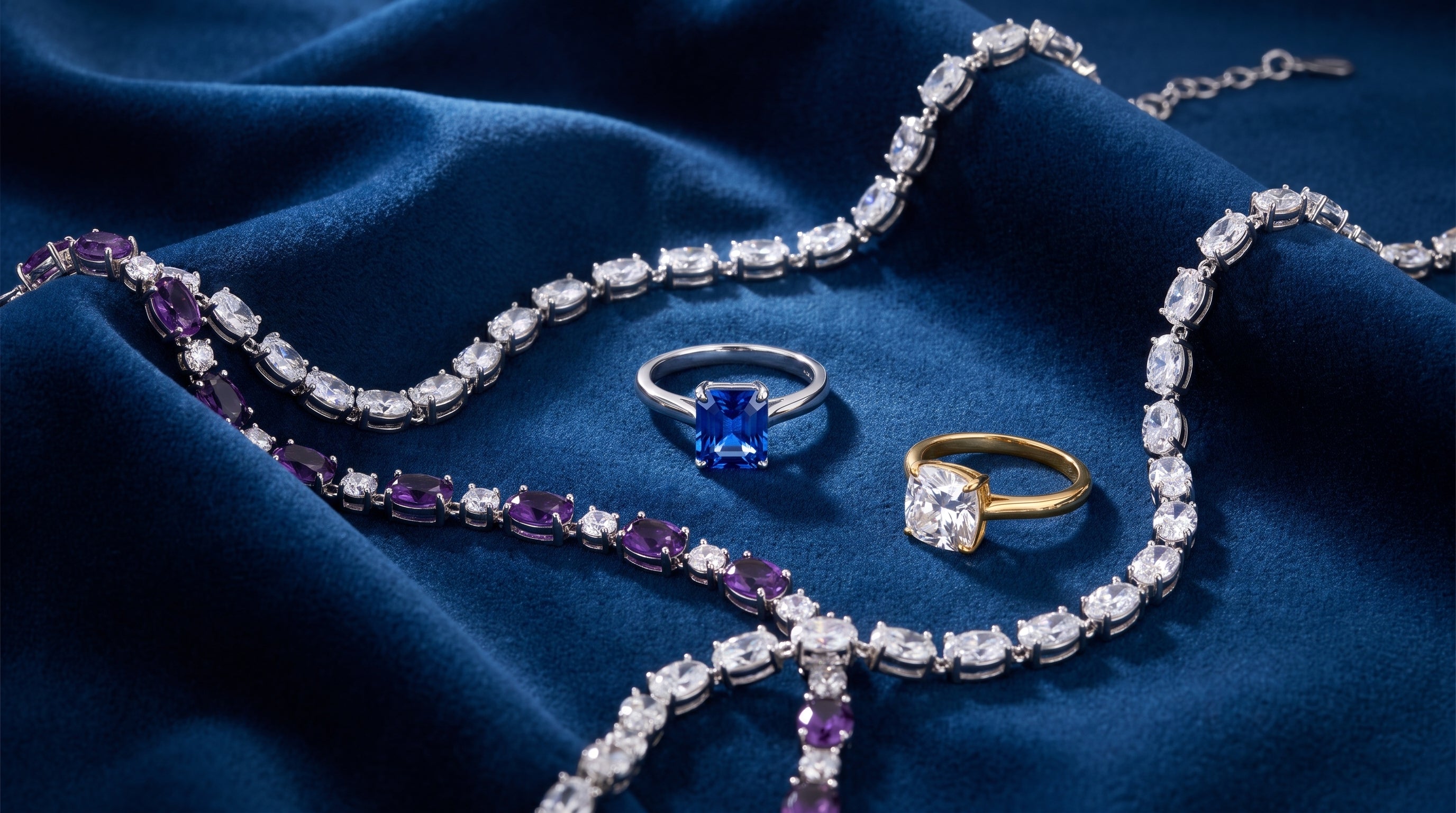
Most sapphire ring content sends you straight to platinum. Search the major engagement retailers and you will find sapphire rings engagement collections framed almost exclusively in gold and platinum mountings, with silver appearing as a footnote or a fashion-ring category. Yet mainstream jewelers do merchandise silver sapphire engagement rings as a distinct collection, and marketplace sellers push solid 925 sterling silver sapphire rings as everyday-durable gift pieces. So the real question is not whether a sapphire ring in silver exists. It is whether the combination survives ten years on a hand that washes dishes, what specifications separate a ring that does from one that bends, and where you can actually find one worth buying.
That question has an answer, and it is more quantitative than most jewelry writing admits. Sapphire's durability is a settled gemological fact. Sterling silver's durability is measurable, and there is survey and metallurgical data on exactly how it behaves under daily wear. Put the two datasets side by side and you get a genuine specification checklist: which stone attributes to insist on, which band dimensions to reject, and which care habits actually change the outcome. This guide builds that checklist, rounds up the categories of silver sapphire rings actually on the market, and shows where silver makes sense versus where gold or platinum earns its premium.
Why Sapphire Works in Silver: The Gemstone Half of the Equation
Sapphire is corundum, and it ranks 9 on the Mohs hardness scale, second only to diamond at 10. That single fact does most of the heavy lifting in any argument for sapphire as a daily-wear stone. A gem at Mohs 9 resists the scratching and abrasion that dulls softer colored stones, which is precisely why sapphire has been treated as a legitimate center stone for blue sapphire engagement rings for generations rather than an occasional-wear novelty.
Crucially, the stone's hardness is unaffected by the metal it sits in. A Mohs 9 sapphire in sterling silver is exactly as scratch-resistant as the same sapphire in platinum. What changes with metal choice is the security of the setting, the tarnish behavior of the surrounding metal, and the resistance of the band to bending. Those are engineering variables, and they are addressable through design specification rather than metal snobbery.
Color: Buy the Hue, Not the Carat Weight
Sapphire occurs across nearly the entire color spectrum. Blue is the classic and the most widely recognized shade for blue sapphire engagement rings, but pink, yellow, green, and teal sapphires are all natural corundum with the same hardness. Within blue, the most prized appearance is a vivid, slightly violet cornflower or royal blue with medium tone and strong saturation. The mistake buyers make is chasing depth: stones so dark they read as black under low indoor light. A lively medium blue frequently outperforms a larger, inkier stone in real-world visual appeal, and it does so at a lower price.
This matters doubly in silver. A white metal reflects light back into the pavilion and around the stone's perimeter, which flatters medium-tone blues and makes them read brighter. A very dark blue sapphire in a bright white setting can look like a black dot ringed by silver. If you are set on silver, weight your selection toward medium tone and high saturation rather than maximum depth.
Teal and Green Sapphire in a Cool Metal
Teal sapphire engagement rings have become a distinct category in contemporary fine jewelry, described by specialist jewelers as sitting between blue and green with hues that shift from peacock blue toward forest green depending on the light. Green sapphire engagement rings get their color from trace amounts of iron substituting for aluminum ions in the corundum lattice, which alters light absorption and produces hues ranging from soft olive to deep forest green. Symbolically, green sapphire is widely associated with renewal, loyalty, and harmony, which is part of why it appeals to couples looking for a stone with a meaning beyond the conventional.
These fancy colors are also a value lever. Yellow, green, and teal sapphires typically cost a fraction of an equivalent fine blue, while delivering identical hardness. If your budget is what pushed you toward silver in the first place, a teal or green sapphire compounds the saving without compromising durability. The cool undertone of sterling silver also tends to pull the blue notes forward in a teal stone, which is a genuine styling consideration rather than marketing language. Buyers comparing colored-stone options often find it useful to read our guide to choosing color and metal for peridot rings, since the same tone-matching logic applies across green gemstones.
Why a One-Carat Sapphire Looks Smaller Than a One-Carat Diamond
Sapphire is denser than diamond. A one-carat sapphire is physically smaller than a one-carat diamond, which means carat weight is a misleading proxy for how big the stone will look on the finger. Ask for millimeter dimensions instead. A 6.5mm round sapphire and a 6.5mm round diamond occupy the same visual footprint regardless of what the carat figures say. This is one of the most practical pieces of buying advice in the entire category, and it is routinely ignored in product listings that lead with carat weight alone.
Treatments and Documentation
Over ninety percent of sapphires are heat-treated to improve color and clarity. This is a stable, long-established practice and is considered acceptable throughout the trade, provided it is disclosed. Heat treatment does not compromise the stone's durability and does not make a sapphire less genuine.
What you should scrutinize is more aggressive treatment. Diffusion, where color-inducing elements are driven into the stone's surface, and glass-filling, where fractures are filled with lead glass, should both be clearly disclosed and should be priced substantially lower. Glass-filled material in particular can be vulnerable during repair work and resizing. For any natural sapphire above one carat, an independent laboratory report from GIA or a comparable lab stating treatment status, and ideally origin, is worth insisting on.
Lab-grown sapphire deserves a fair hearing here. Laboratory-created sapphire is chemically and physically corundum, delivering identical hardness and general appearance to mined material, and it sits at the bottom of the price range. For a buyer prioritizing a larger stone and a clean sourcing story, lab-grown sapphire in a silver setting is a coherent choice rather than a compromise, as long as it is documented as lab-grown rather than sold ambiguously. Mainstream jewelers already merchandise exactly this combination, pairing lab-created sapphire and diamond accents in sterling silver mountings.
Origin: A Price Factor, Not a Beauty Factor
Kashmir, Burma, and Sri Lanka command significant premiums as origins, and certified unheated stones from those sources reach collector-tier pricing per carat. But origin does not determine beauty. Sapphires from Madagascar or Montana can be genuinely gorgeous without carrying a name-recognition surcharge. If you are building a silver-set ring on a considered budget, origin is the first premium to drop. Judge the stone in front of you under multiple light sources and let the paperwork confirm treatment rather than justify a markup.
The Silver Half: What Sterling Actually Does Over Time
This is where most sapphire ring guides go quiet, because the honest answer requires data rather than adjectives. Fortunately, that data exists.
Deformation and Structural Performance
A 2024 survey of 4,218 US and EU consumers who wore sterling silver at least five days per week found that after twelve months, 68% reported no visible deformation. Twenty-three percent observed minor bending, and that bending was concentrated in thin bands under 1.5mm in width. Nine percent experienced prong loosening, concentrated in bezel-set or micro-pavé constructions.
Read that carefully, because the distribution matters more than the headline. The failures cluster in specific design choices, not in the metal as a category. Bands under 1.2mm in width show 3.7 times higher fracture incidence based on Jewelers of America failure data. The corresponding recommendation is a minimum band width of 1.5mm for rings, with adequate prong height and thickness for secure stone setting. A silver sapphire ring built to those dimensions is a fundamentally different product from a wispy 1mm band with paper-thin prongs, even though both are marketed identically as sterling silver.
The practical takeaway for shoppers: ask for band width in millimeters before you buy. If the seller cannot or will not state it, that silence is itself informative. For a ring holding a valuable center stone, prong dimension is not a cosmetic detail. It is the difference between keeping the sapphire and losing it down a drain.
Tarnish: The Realistic Timeline
Tarnish is silver's genuine weakness and there is no point pretending otherwise. In the same survey, median first appearance of tarnish was 3.2 weeks, with a range from one day to six months depending on skin pH, sulfur exposure, and humidity. That variance is enormous, and it means your personal experience may sit anywhere on that spectrum. Someone with acidic skin chemistry living in a humid coastal climate will see tarnish far faster than someone in a dry inland environment.
Rhodium plating changes the equation substantially. Plated sterling silver shows tarnish resistance in the 12 to 24 month range and a Vickers hardness of 800 to 850, versus 1 to 3 months of tarnish resistance and Vickers 60 to 70 for unplated polished sterling. The trade-off is a price premium and a recommended replating interval of 12 to 24 months. For a ring worn daily against a sapphire you want to keep looking bright, rhodium plating is the single most consequential upgrade available in the silver category.
Scratching and Refinishing
Forty-one percent of daily wearers observed light surface scuffs within six months, but only 7% required professional repolishing before year two. That gap is worth sitting with. Light scuffing on a silver band is common and largely cosmetic, and most people either do not notice it or come to read it as patina. Structural refinishing is comparatively rare. Silver scratches more readily than platinum or high-karat gold, but the practical consequence in the first two years is modest for most wearers.
The Resale Question
The assumption that silver has no residual value is not supported by the data. Pre-owned sterling silver jewelry from heritage brands retains on average 58.3% of original retail value after five years, which matches mid-tier platinum bands and exceeds certain 14K gold fashion pieces. Brand matters enormously in that figure, and unbranded silver will not perform the same way. But the blanket claim that silver is worthless secondhand does not survive contact with the evidence.
Top Picks: A Curated Roundup of Sapphire Rings in Silver
Silver-set sapphire rings do not come from a single source. They cluster into a handful of distinct categories, each with a different trade-off between price, verification, and design. Here is a curated selection of specific silver-set sapphire rings currently on the market, evaluated against our durability and gemological criteria.
1. Helzberg Silver Sapphire Engagement Rings (Lab-Created)
The Profile: Mainstream retail jewelers like Helzberg merchandise dedicated silver sapphire engagement ring lines pairing lab-created sapphire with diamond accents in sterling silver mountings.
The Evaluation: These are positioned as budget-conscious engagement options that still deliver the color and sparkle of a sapphire-and-diamond pairing. Because lab-created sapphires offer identical Mohs 9 hardness to natural stones, this is a highly durable choice. When shopping this category, confirm the lab-created status is stated plainly, check the stated metal stamp, and ask about band width before assuming a thin-looking online photo is deceiving you.
2. Amazon Genuine Blue Star Sapphire Sterling Silver Ring
The Profile: Independent sellers on marketplaces offer solid 925 sterling silver rings set with genuine sapphire, such as this genuine star sapphire cabochon paired with white sapphire accents.
The Evaluation: This listing foregrounds the 925 stamp, gemstone type, stone weight, and prong-setting description as trust markers, which is exactly the information this guide recommends you demand. Treat vendor claims about durability as marketing language until you can verify band width (aiming for that 1.5mm minimum) and prong height from close-up photos or direct questions.
3. Amazon 925 Sterling Silver Blue Sapphire Ring
The Profile: Another marketplace option featuring a blue sapphire center stone paired with created white sapphire accents, marketed specifically for everyday toughness.
The Evaluation: This ring emphasizes its solid 925 sterling silver construction. It represents a highly affordable way to secure a natural blue sapphire, but buyers must apply the specification checklist: verify the treatment of the natural sapphire (heat is acceptable, glass-filling is a risk) and ensure the setting is robust enough for daily wear.
4. Tiffany & Co. Silver Sapphire Rings
The Profile: Heritage brands including Tiffany & Co. offer silver sapphire rings, though they generally sit in a stacking or fashion category rather than a solitaire engagement design.
The Evaluation: If your reference point is a sapphire ring tiffany and co aesthetic, expect a slimmer accent stone and a styling-forward silhouette rather than the platinum three-stone designs the same brand reserves for its formal engagement lines. This is a reasonable way to borrow the design language and brand prestige at a lower price point, provided you accept the smaller stone that comes with it.
Awareness Avenue does not currently offer a sapphire-set ring, and nothing above should be read as suggesting otherwise. If you want a matching sterling silver piece to wear alongside a sapphire ring sourced from one of the categories above, The Azurea Radiant Ring in S925 sterling silver is the closest in-house silver ring for building a coordinated stack, and it follows the same 925 construction and care profile discussed throughout this guide.
Silver Versus Gold and Platinum for a Sapphire Ring
Here is where the comparison needs to be honest in both directions. The broader market for sapphire rings gold and platinum settings remains far larger than the silver category, and that imbalance exists for real metallurgical reasons.
Where Silver Genuinely Wins
Cost is the obvious one, and it compounds. A silver setting frees budget that can go into a better sapphire, and given that color quality drives sapphire value far more than carat weight, that reallocation buys real visual improvement. A vivid medium-blue sapphire in a well-built silver mount will outshine a dull, overdark stone in white gold at similar total spend.
Silver's white tone also harmonizes with blue, teal, and green sapphires in the same way white gold and platinum do. The cool metal keeps the stone's color as the focal point rather than introducing a warm cast. And silver is easy and inexpensive to resize, which matters more than people expect over a lifetime of wear.
There is also a legitimate low-stakes advantage: for a first ring, a travel ring, a promise ring, or a piece being given before a couple's finances have settled, silver removes the anxiety attached to a high-value object worn on the hand every day.
Where Gold and Platinum Earn the Premium
Platinum does not tarnish. High-karat gold does not tarnish. That single difference eliminates the entire maintenance category discussed above. Platinum is also denser and more resistant to prong wear over decades, which is why heirloom-grade vintage sapphire engagement rings and the luxury three-stone sapphire and diamond engagement rings from houses like Tiffany & Co. sit almost entirely in these metals.
If your intention is an heirloom passed to a child, the metal that survives seventy years without intervention is platinum. That is a real and defensible reason to pay more. If you want to understand how the same trade-off plays out with other bright center stones, our comparison of gold versus silver settings covers the metallurgy in more depth, and our breakdown of sterling silver versus white gold addresses the white-metal decision specifically.
Sapphire and Diamond Engagement Rings
Pairing sapphire with diamond accents is the most established sapphire engagement format, seen in three-stone designs where sapphire side stones flank a diamond center and in halo and target settings from the vintage market. In silver, this combination is typically executed with lab-created stones, which is what mainstream retailers offer in their silver sapphire engagement collections. The visual logic holds: the diamond or diamond-substitute accents add white brilliance that reads well against a colored center, and the silver mount keeps the whole palette cool.
One structural caution: micro-pavé and bezel-set constructions were the settings where prong and setting loosening concentrated in the durability survey. If you want accent stones in a silver ring worn daily, favor sturdier prong or channel construction over dense micro-pavé, and have the settings checked annually.
A Practical Specification Checklist Before You Buy
Combining the gemological and metallurgical evidence produces a short, concrete list of things to verify. Treat any listing that cannot answer these as incomplete rather than dishonest, then decide whether it is worth pressing the seller.
On the stone. Confirm whether the sapphire is natural or lab-grown, and expect that answer stated plainly rather than buried. Ask for treatment disclosure: heat is normal and fine, diffusion and glass-filling should be disclosed and should reduce the price. Request millimeter dimensions rather than relying on carat weight alone, because sapphire's density makes carat a poor size proxy. For natural stones above one carat, ask whether an independent lab report is available. Evaluate color for medium tone and strong saturation rather than maximum darkness, and view the stone under both daylight and indoor lighting if at all possible.
On the metal. Confirm the piece is stamped 925 solid sterling silver rather than silver-plated base metal, since the 925 stamp is the standard trust marker sellers foreground for exactly this reason. Ask for band width in millimeters and treat anything under 1.5mm as a durability concern for daily wear, with under 1.2mm being the threshold where fracture incidence rises sharply. Ask whether the piece is rhodium plated, and if so, plan for replating every 12 to 24 months. Look at prong construction in close-up images: substantial prongs with visible height, not decorative slivers.
On expectations. Accept that unplated sterling will likely show tarnish somewhere between a few weeks and a few months, depending on your skin chemistry and environment. Accept that light surface scuffing within the first six months is normal and rarely requires professional attention. Neither of these is a defect, and both are reversible.
Caring for a Sapphire Ring in Sterling Silver
Maintenance is where silver ownership is either easy or annoying, and the difference is a handful of habits.
Storage Does More Than Cleaning
Dry storage in anti-tarnish bags extends tarnish-free periods by approximately 4.1 times compared with leaving jewelry in open air. That is the single highest-leverage habit available and it costs almost nothing. A silver ring left on a bathroom windowsill is being actively degraded by humidity and airborne sulfur compounds; the same ring in a sealed anti-tarnish pouch in a bedroom drawer behaves entirely differently.
Routine Cleaning
Monthly gentle polishing with a microfiber cloth, without abrasive compounds, maintains luster without measurably thinning the metal. Abrasive polishes and dips remove metal, and repeated use on a plated ring will strip the rhodium. Wiping the surface after each wear removes skin oils and sweat before they have time to react, and a deeper clean every four to six weeks is sufficient for most wearers.
Ultrasonic Cleaning and Its Limits
Ultrasonic cleaning should be limited to a maximum of about two minutes per week, and should never be used on glued-in stones, opals, or pearls. Sapphire itself tolerates ultrasonic cleaning well given its hardness, but a heavily fractured or glass-filled sapphire is a different matter, which is another practical reason treatment disclosure is worth insisting on before purchase.
An Annual Setting Check
Given that prong loosening affected 9% of daily wearers within twelve months, an annual inspection by a jeweler is proportionate. It takes minutes, it is usually free or nominal, and it catches the failure mode that actually loses stones.
Matching the Ring to the Occasion
Not every sapphire ring is an engagement ring, and the specification bar shifts with intent.
For an Engagement Ring
If the ring is going on a hand for the next several decades without removal, prioritize band width at or above 1.5mm, substantial prongs, rhodium plating for tarnish management, and a well-cut medium-tone sapphire with documented treatment. Understand that you are choosing a maintenance schedule alongside a ring. Many buyers researching sapphire rings engagement options are entirely happy with that trade in exchange for putting the saved budget into stone quality, and mainstream retailers offering silver sapphire engagement collections have validated that the demand is real. If a lifetime-maintenance-free metal is non-negotiable, the honest answer is platinum, and our guide to platinum engagement ring styles covers what that decision involves.
For a Birthstone or Anniversary Ring
Sapphire's role as a September birthstone makes silver a natural fit for a ring worn several days a week rather than continuously. Intermittent wear dramatically reduces the tarnish and scuffing problem, because storage between wears is where anti-tarnish protection does its work. For readers approaching sapphire from that direction rather than the engagement route, our companion piece on choosing color, stone type, and metal for a sapphire birthstone ring covers the selection logic in detail.
For a Vintage Sapphire Engagement Ring Look
The market for vintage sapphire engagement rings is dominated by target rings, three-stone layouts, and sapphire-and-diamond clusters from the mid-twentieth century, almost all in platinum or yellow gold. Silver reinterpretations of those designs are a legitimate way to get the silhouette without the acquisition cost of a genuine period piece. Just recognize you are buying the design language rather than the provenance, and evaluate the construction on its own merits using the band and prong criteria above.
Building a Silver Jewelry Wardrobe Around the Ring
A cool-toned sapphire ring sets the metal temperature for everything worn alongside it. If you are assembling a coherent stack, sterling silver bracelets in the same 925 alloy keep the tone consistent across the wrist and hand, and Awareness Avenue's sterling silver bracelet collection works from that same white-metal palette. For anyone approaching sapphire specifically as a September stone rather than an engagement center, the birthstone jewelry collection is the more direct starting point.
One clarification worth making plainly: Awareness Avenue's current sterling silver pieces, including the Azurea Radiant Ring linked above, are not sapphire-set rings, and nothing here should be read as suggesting they are. They are listed as complementary silver pieces for readers building a cool-toned wardrobe around a sapphire ring bought elsewhere, not as substitutes for the sapphire ring itself. The same care guidance above, particularly the anti-tarnish storage and microfiber polishing routine, applies to any 925 sterling piece regardless of where it came from.
The Bottom Line on Sapphire Rings in Silver
A sapphire ring in sterling silver is a defensible choice, not a downgrade, provided you buy on specification rather than on price alone. The gemstone side is straightforward: at Mohs 9, sapphire is hard enough for daily wear in any metal, and the smart plays are choosing medium-tone saturated color over sheer size, checking millimeter dimensions rather than carat weight, accepting disclosed heat treatment while scrutinizing diffusion and glass-filling, and treating fancy colors like teal and green as value opportunities rather than second-tier options.
The metal side is where discipline pays. The failure data is unambiguous about where silver rings go wrong: thin bands and delicate settings. Hold the line at 1.5mm minimum band width, insist on substantial prongs, seriously consider rhodium plating if the ring will be worn every day, and store the piece dry in an anti-tarnish bag when it is off. Do those four things and you have a ring that the survey evidence suggests will show no visible deformation after a year of daily wear, alongside a stone that will still be scratch-free decades later.
Where silver genuinely loses is the no-maintenance heirloom scenario. Platinum and high-karat gold do not tarnish, which is why the vintage and luxury sapphire market, including sapphire rings gold and platinum designs from brand names like Tiffany & Co., lives there. If that is your requirement, pay for it. But if you want a beautiful, structurally sound sapphire ring, and you would rather put the difference into a better stone than into the mount, silver is a rational allocation of budget, and the data supports the choice more strongly than the category's reputation suggests.

Leave a comment
This site is protected by hCaptcha and the hCaptcha Privacy Policy and Terms of Service apply.