


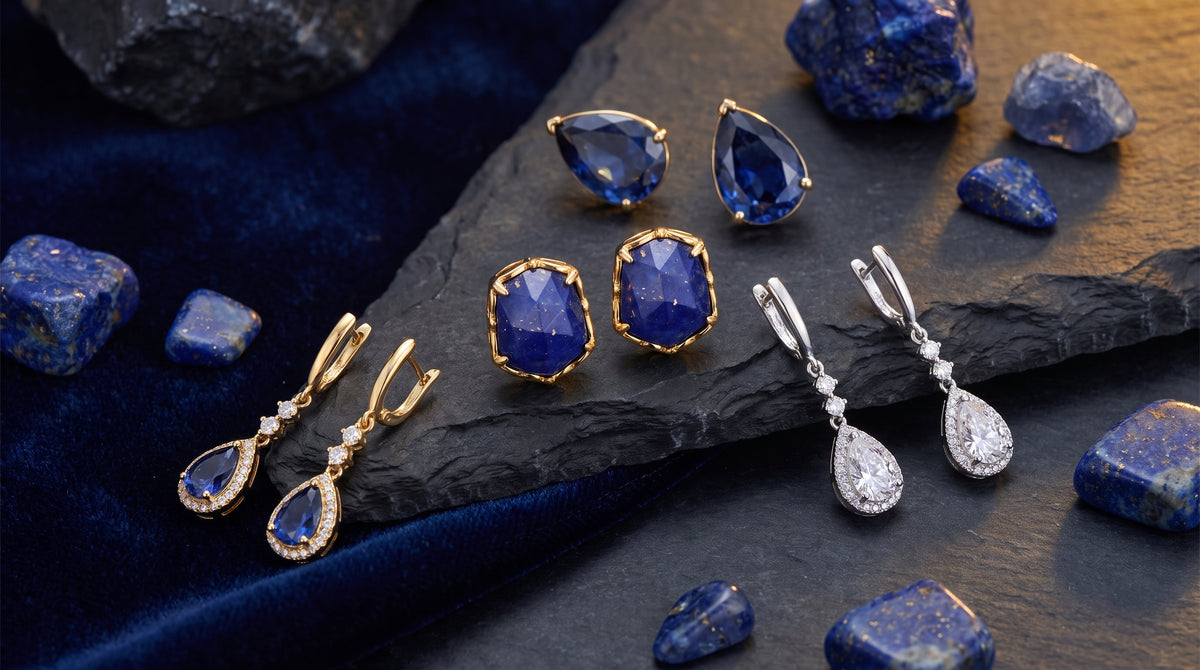
September is one of the few months where the answer to "which stone is it?" depends on which chart you happen to be holding. The American list maintained by Jewelers of America, standardized at a 1912 meeting, gives September exactly one stone: sapphire. Britain's National Association of Goldsmiths published its own list in 1937 and revised that chart in 2013, at which point September gained a second official stone, lapis lazuli, alongside sapphire. That editorial decision is the entire reason shoppers searching for September birthstone earrings keep running into two very different blues — one transparent and glassy, one opaque and velvety — and why a useful roundup has to handle both rather than pretending one doesn't exist.
This guide sorts out the birthstone question first, then gets into the part most product grids skip: what the stone in a pair of blue earrings actually is, how to read the wording on a listing, and which format and metal will genuinely suit the person wearing them.
What Are the 2 Birthstones for September?
Short answer: sapphire is the official one everywhere, and lapis lazuli is an alternate recognized in the British trade list and in a number of older and symbolic traditions. They are not equal in status, and any retailer implying otherwise is glossing over the history.
Sapphire: the official September birthstone
The Gemological Institute of America identifies sapphire as the birthstone for September and as the commemorative gem for the 5th and 45th wedding anniversaries. The American Gem Society is equally direct: asked what month sapphire belongs to, the answer is September, full stop. Birthstone reference sites that track modern and traditional lists side by side note something unusual about this month — September's stone did not change when the American list was standardized in 1912. Sapphire is both the traditional and the modern stone, unlike June or August, where extra options were added later.
Gemologically, sapphire is a variety of corundum, an aluminum oxide mineral. It occurs in nearly every color except red, because red corundum is classified separately as ruby. Pink, yellow, green, and the orange-pink padparadscha are all genuine sapphires. Even so, when jewelers say "the September birthstone," they almost always mean blue sapphire, and blue is the color most buyers expect in a September birthstone gift. Sapphire also sits at 9 on the Mohs hardness scale, second only to diamond among natural gems, which is a practical argument for earrings you intend to wear often rather than store in a drawer.
Symbolically, sapphire has long been associated with wisdom, sincerity, constancy, loyalty, truth, and protection, with a heavy presence in royal and religious jewelry. Those are traditional readings, not measurable effects — a sapphire earring symbolizes loyalty in the same way a wedding band does, through shared meaning rather than any property of the mineral.
Lapis lazuli: the alternate in British and symbolic traditions
Lapis lazuli is an opaque, deep royal blue stone, frequently flecked with brassy pyrite that reads like gold dust or scattered stars. Birthstone overview sites list it as September's alternative stone, and crystal and metaphysical references describe it as a September stone in older calendars and in the UK, while noting that modern American charts place lapis with December, often beside turquoise and tanzanite.
Its symbolic profile overlaps with sapphire's but comes from a different lineage: lapis was prized by Sumerian and Egyptian rulers and has been called the "stone of heaven," a symbol of royalty, honor, wisdom, and spiritual growth. Contemporary symbolic systems attach it to mental clarity, honest self-knowledge, and the pursuit of truth. Again, that is tradition and interpretation, not a claim about what a stone does to a wearer.
So which one should you actually buy?
If the earrings are a gift and you want them to be unambiguously correct, choose sapphire. If the recipient is in the UK, follows a symbolic or crystal-oriented tradition, or simply prefers opaque saturated color and bold geometric shapes to faceted sparkle, lapis lazuli is a legitimate and often more distinctive September choice. A short note on the gift card explaining that September carries two blues turns the ambiguity into part of the story rather than a mistake to explain away.
Natural, Heated, or Simulated: The Stone Question Most Listings Skip
The biggest gap between birthstone marketing and birthstone reality is stone description. "Sapphire earrings" can mean several quite different things, and the difference matters more than the setting style.
Heat treatment is normal; glass filling is not
Jewelry buying guides report that well over 90% of commercial sapphires are heat treated to improve color and clarity. This is a permanent, industry-accepted process, and heated stones are still natural sapphires. Untreated sapphires with strong natural color command a large premium and generally belong to investment-grade purchases rather than everyday fashion earrings.
What to avoid is a different category: glass-filled or fracture-filled sapphire, in which low-grade material is injected with lead glass to mask cracks. These stones are unstable under standard cleaning and can be damaged by a jeweler's torch during a simple repair. If a listing uses the words "composite," "filled," or "treated with glass," treat that as a durability warning, not a bargain.
Simulated and man-made stones are a valid option — if labeled
Plenty of birthstone jewelry uses lab-made or simulated stones chosen for color rather than mined gems. A pandora birthstone charm illustrates the point well: Pandora's September birthstone dangle charm is described as sterling silver with an openwork infinity braid set with a central blue man-made crystal and clear cubic zirconia — a birthstone in color and sentiment rather than in mineral species. That is a perfectly reasonable design decision; the problem only arises when the page never tells you.
Awareness Avenue signals this in its category naming: the September grouping is the September Birthstone – Simulated Sapphire collection, so a shopper who wants mined corundum should read the individual product description rather than assume. Simulated stones give you consistent, vivid blue at a size that would be impractical in natural sapphire, which is exactly why they dominate the birthstone gift market.
Questions worth asking about lapis
Lapis lazuli has its own quality spectrum. Solid natural lapis cabochons behave differently from reconstituted material or from doublets and triplets built on a backing layer. Product titles and handles that specify "natural lapis" are telling you something useful; where a listing is silent, ask. Lapis is also considerably softer than sapphire and is reported to fade with prolonged sun exposure, which affects how you store and wear it rather than whether you should buy it.
September Birthstone Earrings Worth Considering
The pieces below are drawn from the Awareness Avenue earrings collection, with the September-relevant styles first. Stone descriptions, metal options, and dimensions are listed on each product page; check those details against the framework above before you decide.
Teardrop Sapphire Earrings — the straightforward September choice
The Teardrop Sapphire Earrings take the most literal route to the brief: a blue teardrop silhouette, which is the shape most people picture when they think "sapphire earring." Teardrops are flattering because they add a vertical line without the weight of a long drop, and the pear outline reads as dressy even in a small size. Because these sit within the brand's September birthstone category, confirm the stone description on the product page so you know whether you are buying a simulated blue stone or a mined one — and set expectations accordingly if the earrings are a milestone gift.
The Royal Hex Lapis Lazuli Earrings — geometry for the alternate stone
Hexagonal framing suits lapis better than it suits transparent gems. Because lapis is opaque, it carries flat, hard-edged shapes well, and the pyrite flecking gives an otherwise simple outline something to look at up close. The Royal Hex Lapis Lazuli Earrings lean into that, and the finish you choose changes the mood considerably: cooler metal keeps the blue crisp and graphic, while a warmer tone pushes the stone toward the Egyptian-revival palette of blue and gold.


The Azure Pillar Lapis Earrings — a longer vertical line
Where the hexagon is compact, the Azure Pillar Lapis Earrings use an elongated bar shape. That vertical geometry is the same trick drop earrings use to lengthen the visual line of a round or oval face, but in a cleaner, more architectural form that works with tailoring and high necklines. This is the pair to consider if the recipient tends to wear structured clothing and finds faceted sparkle too formal for daytime.
The Azure Rhombus Lapis Lazuli Earrings — angular and modern
The Azure Rhombus Lapis Lazuli Earrings use a diamond-shaped outline that catches light along its edges rather than through the stone. Angular lapis reads as contemporary rather than heritage, which makes it an easy pick for someone who likes blue but does not want anything that resembles a traditional birthstone stud.
Metal-forward pairs to stack alongside a blue stone
Not every September gift has to contain the birthstone. Many people wear a birthstone piece in one ear stack position and something neutral elsewhere, or want a second everyday pair to rotate with. The Aethelra Teardrop in S925 sterling silver echoes the teardrop outline in a cooler, quieter register, while the Aethelra Teardrop in solid gold is the version to choose when the piece is meant to be kept rather than cycled through. The Alorian in sterling silver offers a softer oval, the Aurelienne Emerald Cut in 18K gold vermeil brings a step-cut silhouette that pairs neatly with the flat planes of lapis, and the Adalind marquise is available in both 18K gold vermeil and solid gold if you want the same shape at two different commitment levels. For longevity, the solid gold pieces are the ones least likely to need refinishing over time.
Choosing by Color, Metal, and Earring Format
Color does most of the work
In sapphire, color is the dominant value driver — guides put it at roughly half or more of what a stone is worth, and the most prized material shows a vivid, medium-dark blue. Origin shapes the palette: Ceylon (Sri Lankan) sapphire is known for bright cornflower blue, while Montana sapphire produces distinctive teal and greenish-blue tones that appeal to buyers who find classic royal blue too traditional. For earrings specifically, remember that stones sit near the face in variable light, so a slightly lighter, brighter blue often photographs and reads better day to day than a very dark stone that can look black indoors.
Lapis is judged differently. There is no transparency to assess; you are looking at evenness of the blue, how the pyrite is distributed, and whether any white calcite streaking is part of the character or a distraction. A matched pair matters more with lapis than with faceted stones, because two cabochons cut from different material can look noticeably mismatched when worn together.
Metal pairing
Earring guides lay out the pairings fairly consistently. Platinum is cool, bright, and hypoallergenic, and it flatters deep royal blue. 18k white gold gives a crisp, reflective surround that suits cornflower and Ceylon blues, though it needs periodic rhodium re-plating to stay bright. 14k yellow gold provides warm vintage contrast that brings out teal and greenish-blue stones and resists scratching well. 14k rose gold is soft and romantic but contains copper alloy, which can bother sensitive ears. Lapis is forgiving with all of these, but the blue-and-gold combination is the one with the deepest historical precedent.
Studs, drops, and huggies
Format decides how often the earrings get worn. Classic studs are the everyday default and survive sleeping, headphones, and hats. One useful proportion to know: a 4–5 mm round stone surrounded by a diamond halo of about 0.25 carats total weight produces a visual spread of roughly 10 mm, giving the impression of a much larger stone without the weight. Drop earrings lengthen the visual line and suit oval and round faces, and they are the natural home for lapis pillar and rhombus shapes. Huggies with interchangeable charms are the most flexible option if the wearer likes to change a stack seasonally. If the recipient has a curated lobe setup or sleeps in her earrings, it is worth reading our guide to flat back earrings for lobes before choosing a post style.
Caring for Sapphire and Lapis Lazuli Earrings
Sapphire's hardness of 9 makes it highly scratch-resistant and well suited to daily wear, but hardness is not toughness — a sharp knock or a lifted prong can still cost you a stone. A safe routine cleaning method: add a few drops of mild degreasing dish soap to warm water, soak the earrings for about 15 minutes, gently scrub the underside of the settings with a soft toothbrush, rinse under lukewarm water, and pat dry with a lint-free microfiber cloth. Skip harsh chemicals entirely.
Check the settings roughly every six months with a simple tug test: run a cotton swab over the prongs and see whether the cotton snags. Catching fibers usually means metal has lifted, which is the warning sign before a stone goes missing. Ultrasonic and steam cleaning are generally fine for untreated or standard heat-treated sapphire but are a genuine risk for fracture-filled stones, so when the treatment status is unknown, stay with soap and water.
Lapis needs gentler handling. It is softer than sapphire, dislikes abrasives and chemicals, and can fade with extended sun exposure, so store it away from windowsills and avoid wearing it for long sunny days at the beach. A soft dry cloth, or a barely damp one followed by immediate drying, is usually all it needs. Perfume, hairspray, and sunscreen should go on before the earrings, not after.
Building a September Set: Necklaces, Bracelets, and Charms
Earrings are often the first purchase in a longer birthstone project — a September birthstone necklace for a birthday, a september birthstone bracelet the following year, or a charm added to an existing chain. Charm systems are the most incremental route, and if that is the direction you are heading, our guide to birthstone charms for a bracelet covers how the formats differ and what to check for compatibility.
Two practical notes. First, mixing stone types across a set is common and looks fine: natural lapis earrings beside a simulated sapphire pendant is not a contradiction, as long as you know which is which. Second, if the set is meant to represent more than one person — a mother with two children born in different months, for example — the layout logic changes, and our guide to two-stone birthstone jewelry walks through pairing and ordering. For a broader view of formats and settings that get worn rather than stored, see our overview of birthstone jewelry for mom. You can also browse the full birthstone jewelry collection to see how the months line up against each other.
How September Compares to Other Months
September is unusually simple in the American system: one stone, unchanged since 1912. June is the opposite case. Pearl is the historically established June stone, moonstone was attached to the month in the 1912 list, and alexandrite was added in 1952, giving buyers three official options with no single color — soft white or cream, a pale blue sheen, and a dramatic green-to-red color change. June, August, and December are the only months with more than one officially recognized stone in that list, which is precisely why the September-plus-lapis question causes confusion: lapis arrives through a different national chart, not through the American one.
Shoppers comparing june birthstone earrings to September's single-stone simplicity will notice the difference immediately: three legitimate colors and structures to choose from for June, against one settled blue for September. If you are shopping across several birthdays, that structural difference is worth knowing, because it changes how much explaining a gift needs. Someone born in June may have a strong preference among three stones; someone born in September almost certainly expects blue. For a neighboring month with a single, very differently colored stone, our August birthstone (peridot) guide shows how a set can be built around a green rather than a blue.
Frequently Asked Questions
Is lapis lazuli really a September birthstone?
In the British trade list revised in 2013, yes — lapis sits beside sapphire for September. In the American list, September's stone is sapphire alone, and lapis appears under December. Both statements are accurate within their own systems, which is why you will see the question asked so often.
Do September birthstone earrings have to be blue?
Not technically. Sapphire occurs in pink, yellow, green, and padparadscha orange-pink, and all of those are genuine sapphires. But most jewelers and birthstone references treat blue sapphire as September's stone, so a non-blue sapphire gift benefits from a one-line explanation.
Are heat-treated sapphires still real sapphires?
Yes. Heat treatment is permanent, standard across the trade, and applied to the large majority of commercial sapphires. Untreated stones with strong natural color are rarer and priced accordingly. The treatment to avoid is glass or fracture filling, which affects durability.
What should I check before buying a pair as a gift?
Four things: the stone description on the product page (natural, lab-grown, or simulated), the metal and whether it is solid, plated, or vermeil, the post and back style for comfort and security, and the earring's overall drop length. Those four determine whether the pair gets worn weekly or once. If you want a quick comparison of what the brand currently carries, the best sellers and fine jewelry collections are the fastest way to see the range side by side.
What do September birthstone earrings symbolize?
Sapphire is traditionally linked to wisdom, loyalty, sincerity, truth, and protection, and lapis lazuli to royalty, honor, wisdom, and honest self-knowledge. Anyone researching september birthstone meaning will find these two threads repeated across gemological and symbolic sources alike. These are inherited symbolic associations rather than properties the stones exert on a wearer — which is exactly what makes them good gift language: the meaning comes from the giver, and the earrings carry it.

Leave a comment
This site is protected by hCaptcha and the hCaptcha Privacy Policy and Terms of Service apply.