


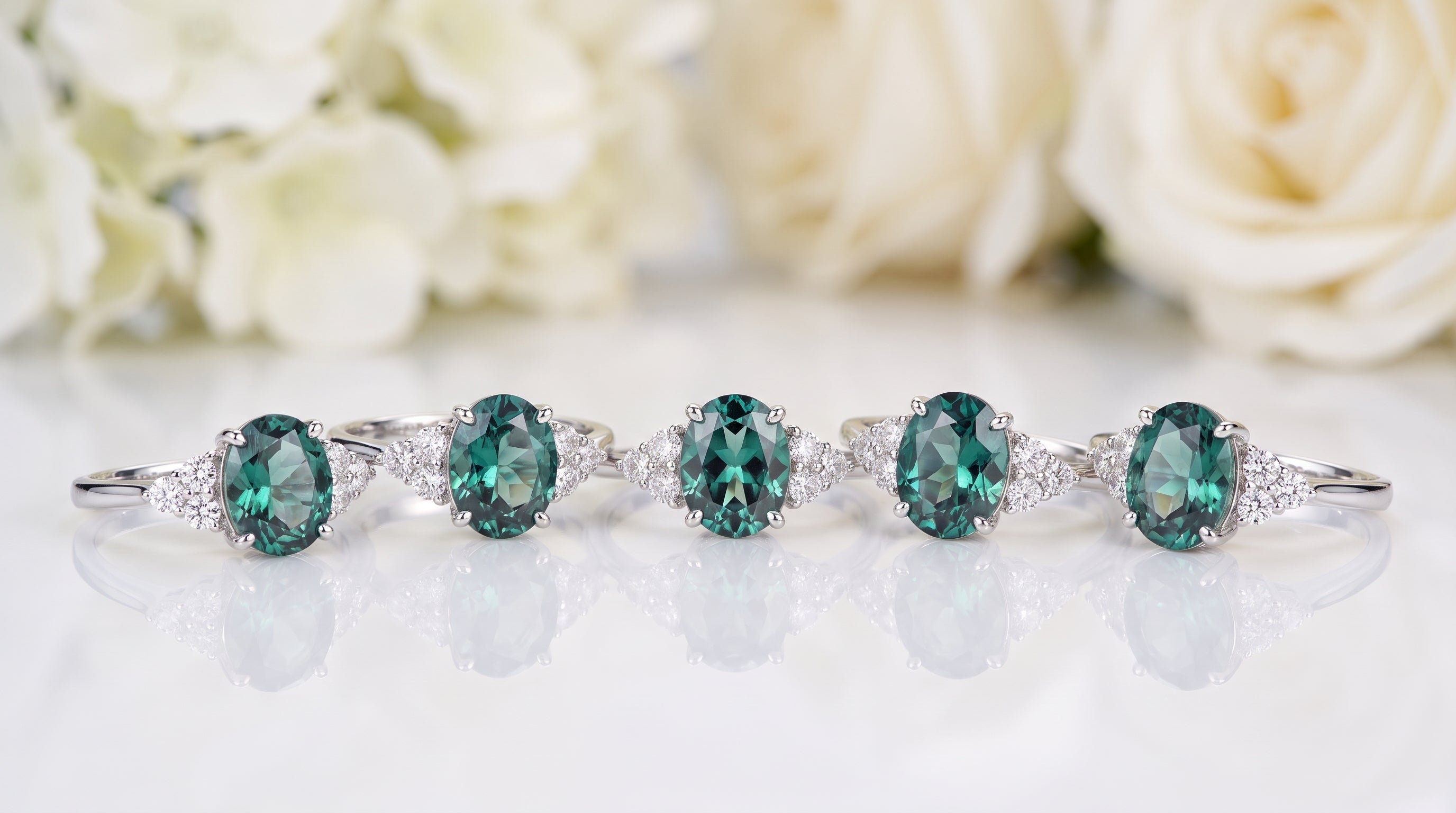
Search the phrase alexandrite ring and you land in two markets sharing one word. On one side sit specialist dealers selling natural chrysoberyl by the carat, priced by origin and backed by gem lab reports. On the other sit design-led jewelers selling color-change rings you can wear this week, sold by cut, carat presentation, and metal finish. In between are marketplace listings such as pre-owned USSR-era sterling silver rings described as "alexandrite" with no gemological paperwork at all. All three call the stone the same thing, and almost none of them explain the difference.
This guide fixes that. It covers what alexandrite actually is, how natural, lab-grown, and simulant stones differ, what genuinely drives price, how to judge color change with your own eyes, what to check before buying vintage or antique pieces, and how to care for a ring once it is on your hand. Where a claim comes from a retailer or a jeweler's forum rather than an independent laboratory, it is labeled as such, so you can weigh it accordingly.
What Alexandrite Actually Is (And Why the Word Appears at Every Price Point)
Alexandrite is a variety of the mineral chrysoberyl, and its famous color shift is attributed to chromium in the crystal structure. Gemstone retailers and jewelry brands describe it consistently on this point: it is chrysoberyl first, and the optical behavior follows from its chemistry rather than from any treatment or coating.
The color change you should expect to see
The shorthand used across the trade is "emerald by day, ruby by night." In practice, descriptions from multiple sellers converge on the same behavior: green to bluish green under daylight or fluorescent light, shifting toward red, purplish red, or violet under incandescent light or candlelight. The strength of that shift varies enormously from stone to stone. A fine example flips decisively between two clearly different hues; a weak one merely warms slightly, which is far less impressive in person than in a two-panel product photo.
Birthstone and symbolic associations
Alexandrite is widely treated as a modern June birthstone, and gemstone blogs also link it to the zodiac signs Gemini and Cancer, along with themes of balance, harmony, luck, and personal growth. These are cultural and traditional associations reported by sellers and gem blogs rather than tested properties, so treat them as meaning rather than mechanism. They do explain why alexandrite sells strongly as a June birthday gift, an anniversary piece, and an engagement stone for people who want something with a story attached. If that is your motivation, browse the June birthstone alexandrite jewelry range with that framing in mind.
Why the same word covers wildly different rings
Because "alexandrite" describes an optical effect that several materials can imitate, the label appears on rings across the entire price spectrum. A specialist retailer of natural Brazilian alexandrite and a fashion jeweler selling a color-change fashion ring can both legitimately use the word in their marketing, yet be selling completely different products. The single most useful habit a buyer can develop is to stop asking "is this alexandrite?" and start asking "is this natural chrysoberyl, lab-grown alexandrite, or a color-change simulant, and what documentation supports the answer?"
Natural, Lab-Grown, and Simulant: Three Rings, One Name
Natural alexandrite
Natural alexandrite sits at the top of the market and is genuinely scarce. Specialist retailers point to Hematita, Brazil, as a current source of mined material, while historic Russian material from the Ural Mountains is described as extremely rare, to the point that one natural-alexandrite specialist suggests a confirmed Russian stone backed by multiple gem lab reports could warrant a major auction house rather than a retail listing. That same specialist lists four value drivers: origin, size, clarity, and the quality of the color change. Large natural stones with a clean, decisive shift are the rarest combination, and price per carat climbs steeply as size increases at equal quality.
If natural chrysoberyl is your requirement, plan the purchase around documentation, not around photographs. Reports from recognized laboratories such as GIA or AGL are the standard route to confirming identity, and origin claims in particular are usually supported by more than one report. Our dedicated natural alexandrite engagement ring guide goes deeper on sourcing and paperwork for this tier.
Lab-grown alexandrite
Laboratory-grown alexandrite is not new. Jewelers discussing the material in trade forums note that synthetic alexandrite has been produced since roughly 1918, which has two consequences: modern lab-grown stones are a mature product category, and an old ring is not automatically a natural one. Contemporary lab-grown specialists market hand-cut alexandrite engagement rings with claims such as verified color precision, faceting quality, and a global lifetime warranty. Those are the brands' own marketing statements rather than independent assessments, so evaluate the warranty terms and disclosure language directly with the seller. The appeal is straightforward: chrysoberyl chemistry and color-change behavior without the scarcity premium of mined material. If that trade-off suits you, read our lab-grown alexandrite engagement ring guide.
Color-change simulants
Simulants imitate the effect without being chrysoberyl. This is where most buyer confusion lives, and the honest answer from the trade is unglamorous: visual inspection is not enough. A consumer jewelry advice site answering a reader whose ring shifted between pale blue, clear, green, and purple concluded that the only way to know is to have the ring analyzed by a qualified jeweler. Natural-alexandrite specialists make the same point from the other direction, noting that gemologists rely on refractive index measurement, microscopic examination, and other tests to separate alexandrite from look-alikes, with a laboratory report providing the definitive answer.
| Category | What it is | Typical evidence offered | Best suited to |
|---|---|---|---|
| Natural alexandrite | Mined chrysoberyl with chromium-driven color change | GIA/AGL-style lab reports; origin documentation | Collectors and buyers who need mined provenance |
| Lab-grown alexandrite | Laboratory-created chrysoberyl, a category produced for over a century | Brand disclosure, warranty terms, seller documentation | Engagement buyers who want the effect without rarity pricing |
| Color-change simulant | Other materials that mimic the shift | Usually seller description only | Fashion and gift buying where design leads |
Awareness Avenue's alexandrite rings are designed and sold as color-changing design pieces, described by cut, carat, and metal finish. If a documented mined origin is essential to your purchase, ask any seller — including us — for the specific disclosure and paperwork before you buy, rather than inferring origin from marketing wording such as "genuine."
How to Judge an Alexandrite Ring With Your Own Eyes
Test the color change under two real light sources
Photographs are the least reliable part of alexandrite shopping, because two images shot under different lighting can exaggerate a shift that is barely visible in life. Look at the ring under daylight or fluorescent light, then under an incandescent bulb or candlelight, and note whether the hue genuinely crosses from the green side to the red or purplish side. Modern LED household lighting varies in color temperature and can flatten the effect, so it is a poor single test.
Understand "percentage of color change" for what it is
One natural-alexandrite specialist publishes a working threshold, suggesting that anything above roughly a 30% color change is acceptable for real alexandrite and that weaker material is not worth investing in. Treat that as a vendor rule of thumb used by trained staff with controlled lighting, not as a measurement you can perform at a kitchen table. It is useful mainly as a mindset: the strength of the shift is a value driver, not a footnote.
Clarity, cut, and how carat weight actually looks
Clarity affects transparency and, in heavily included stones, structural resilience, which matters for a ring worn daily. Cut shape changes how much finger a stone appears to cover: elongated outlines such as pear and oval read longer on the hand, while a hexagon or round center reads more compact and geometric at the same stated carat weight. Decide whether you are optimizing for presence, for a clean silhouette, or for something that sits low enough to live under a glove or a keyboard.
The questions worth asking any seller
- Is the center stone natural chrysoberyl, laboratory-grown alexandrite, or a color-change simulant?
- Is there a laboratory report, and from which laboratory?
- What is the stated carat weight, cut shape, and measured millimeter size?
- What is the metal — solid gold, sterling silver, or vermeil over silver?
- What are the resizing and repair options for this specific setting?
Alexandrite Engagement Rings: Settings, Metals, and Everyday Practicality
Is alexandrite durable enough for daily wear?
A natural-alexandrite specialist describes real alexandrite as extremely hard and durable, and gem dealers publish care routines that assume regular wear rather than vault storage. The sensible reading is that alexandrite behaves like a robust colored gemstone: fine for everyday life when it is set well and treated sensibly, but still worth protecting from knocks, chemicals, and extreme heat. Stones with visible fractures or heavy inclusions deserve extra caution, especially around ultrasonic cleaning.
Setting styles that suit a color-change center
Because the whole point of alexandrite is a hue shift, settings that let light enter the stone from multiple angles show the effect best. A halo adds perceived scale and frames the center with contrast; a solitaire keeps attention entirely on the body color; a floral or vintage-inspired gallery softens the outline and reads as heirloom rather than contemporary. For a broader look at silhouette choices before you commit, our engagement ring styles guide compares the main setting families side by side.
Choosing a metal
Metal choice affects both cost and how the stone reads. White metals emphasize the cool green-blue daylight phase, while yellow and rose tones warm the setting and can flatter the evening red phase. Construction matters as much as color: solid gold, sterling silver, and gold vermeil over silver are different products with different long-term wear characteristics, so confirm which one you are buying. If you are weighing solid gold specifically, our 18k gold engagement ring buying guide covers the trade-offs.
Vintage and Antique Alexandrite Rings: What to Check Before You Bid
Searches for vintage and antique alexandrite rings mostly land on marketplace listings rather than editorial guidance, and those listings are written by thousands of independent sellers. A typical example is a pre-owned Soviet-era 875 sterling silver ring described as alexandrite, with weight and ring size given but no gemological data. That is not evidence of anything improper — it is simply the norm for secondhand platforms, and it puts the verification burden on you.
Age does not imply natural origin
Given that synthetic alexandrite has reportedly been produced since around 1918, a mid-century ring described as alexandrite may contain natural chrysoberyl, laboratory-grown material, or another color-change gem entirely. Style, patina, and hallmarking tell you about the mounting, not about the stone's origin. Where a seller states natural origin, ask what the claim is based on; where no claim is made, assume nothing and budget for an independent appraisal.
Assess the mounting, not just the stone
Older rings arrive with the wear of previous decades: thinned shanks, worn prongs, and settings that may need retipping before daily wear. Ask for close photographs of the prong tips and the underside of the head, and factor restoration into your total cost.
The vintage-inspired alternative
If what you actually love is the period look rather than the provenance, a new vintage-style ring removes the authenticity and condition risks entirely. The Calliopa pairs a 0.5ct round-cut color-changing center with a flower-design gallery for exactly this reason. For broader context on the aesthetic, see our vintage engagement ring guide.
Matching an Awareness Avenue Alexandrite Ring to Your Purpose
Our alexandrite rings are organized by silhouette and center-stone size rather than by rarity tier, which makes it easy to shop by how you plan to wear the ring. Every piece below is a color-changing alexandrite design; confirm metal and stone disclosure details on the individual product page before ordering.

| Design | Center stone | Best for |
|---|---|---|
| The Alvana | 1ct pear cut | An engagement ring with an elongated, romantic outline |
| The Aerina | 1.5ct pear cut, classic halo | Maximum presence and a traditional halo frame |
| The Gianna | 1ct hexagon cut, S925 sterling silver | Modern, geometric minimalism |
| The Ophelia | 1ct oval cut, S925 sterling silver | A softer classic shape for everyday wear |
| The Alexandria | 2ct oval cut | Statement scale for anniversaries and milestones |
| The Martha | 0.8ct round cut | Understated daily wear with metal-tone flexibility |
| The Amy | 0.5ct pear cut, stackable | Stacking alongside existing bands |
| June Alexandrite Birthstone Ring | Sterling silver birthstone design | June birthday gifting |
| The Alexandria Jewelry Set | Ring, necklace, and bracelet | A coordinated gift set |
You can compare the full lineup in the alexandrite rings collection or across the wider color-changing alexandrite jewelry collection.

Care, Cleaning, and Storage That Protects the Stone
Routine cleaning
Gem dealers recommend a simple method: lukewarm water in a small bowl with a few drops of mild dish soap or a cleaner formulated for colored gemstones. Soak the ring for a few minutes to loosen oils, then work gently around the stone and setting with a soft toothbrush, paying attention to the crevices behind the gem where residue collects. Rinse under lukewarm running water to remove soap film and pat dry with a soft, lint-free cloth rather than paper towels or rough fabric, which can scratch metal.
What to avoid
- Bleach, chlorine, and ammonia-based household cleaners, which can damage both the gemstone and the setting.
- Boiling water and extreme heat from hair dryers, ovens, or prolonged direct sunlight.
- Lotions, perfumes, and hairsprays applied while wearing the ring, since buildup dulls luster over time.
- Ultrasonic cleaning unless a jeweler has confirmed the stone is free of fractures and inclusions; for heirloom or high-value pieces, manual cleaning is the safer default.
- Sports, gardening, and housework with the ring on.
Storage and inspection
Store each piece separately in a soft pouch or a lined compartment so harder stones cannot scratch it, and wrap gold or platinum pieces in microfiber or anti-tarnish paper rather than sealed plastic bags, which trap moisture. Have prongs, settings, and the stone professionally inspected once or twice a year depending on how often you wear the ring, and travel with high-value pieces in a padded case in hand luggage.
Frequently Asked Questions
Can I tell at home whether my alexandrite ring is genuine?
Not conclusively. Consumer jewelry advisers and natural-alexandrite specialists agree that identification requires a qualified jeweler or a laboratory, using tools such as refractive index measurement and microscopic examination. A visible color change narrows the possibilities but does not prove chrysoberyl.
Is an alexandrite engagement ring practical?
Yes, with normal precautions. Alexandrite is described by specialists as hard and durable, and standard care guidance assumes everyday wear. Choose a secure setting, remove the ring for manual work and chemical exposure, and have the prongs checked periodically.
What about searches for natural alexandrite rings from major luxury houses?
Queries pairing alexandrite with prestige brand names are common, but we have no verified catalog information for such pieces and will not speculate about them. If a listing claims a luxury-house alexandrite ring, verify it with the brand directly and insist on original documentation before paying a brand premium.
Does a lower price mean the ring is not alexandrite?
Price signals which segment you are in rather than whether a seller is being honest. Fine natural chrysoberyl is scarce and priced accordingly; lab-grown and simulant color-change rings exist to make the look accessible. The relevant question is always disclosure: what is the stone, and what documentation supports the description?
Which alexandrite ring should I start with?
If the ring is an engagement ring, prioritize center-stone shape and setting security first, then metal. If it is a gift, a birthstone piece or a coordinated set removes sizing guesswork on the ring alone. Browse the full alexandrite ring range and shortlist by shape before you compare metals.

Leave a comment
This site is protected by hCaptcha and the hCaptcha Privacy Policy and Terms of Service apply.