


Search “birthstone jewelry bracelet” and the results page quietly hands you two different products under one phrase. Half the listings are ready-to-wear gemstone bracelets — station chains, oval-set lines, cuffs — where the stone simply happens to match a month. The other half are made-to-order keepsakes: charm bracelets with an engraved initial per child, or designs that accept a stone for every family member. Brook & York merchandises custom birthstone charm bracelets in gold and silver, The Vintage Pearl builds mother bracelets that can hold up to twenty birthstones, and Jewlr sells engraved birthstone bracelets configured stone by stone. Meanwhile, Kendra Scott and Blue Nile rank strongly with bracelets that are not customized at all.
Both are legitimate answers. They are not interchangeable, and buying the wrong one is the most common way this purchase goes sideways — someone orders a beautiful single-stone bracelet expecting three grandchildren's months to appear on it. This guide sorts the category by that fork first, then works month by month through the stones and the bracelet formats that actually carry them well.
Start With the Birthstone List You're Actually Using
Before comparing bracelets, settle which chart you are shopping from, because two respected sources do not agree on every month. Blue Nile's education content explains that although birthstones have ancient origins, the modern list was standardized in 1912 by the National Association of Jewelers. That standardized list is the one most retailers merchandise against, and it is the list this roundup follows.
The modern list, month by month
Blue Nile presents the modern assignments as: garnet for January, amethyst for February, aquamarine for March, diamond for April, emerald for May, pearl for June, ruby for July, peridot for August, sapphire for September, opal for October, citrine for November, and topaz for December. If you buy against this list, you will match what the majority of jewelers stock.
Where the modern and traditional charts diverge
The International Gem Society's birthstone chart shows both systems side by side, and the differences matter for a few months. January (garnet), February (amethyst), April (diamond), May (emerald), June (pearl), July (ruby), and September (sapphire) are identical in both. But March is aquamarine in the modern list and bloodstone traditionally; August is peridot and spinel in the modern list and sardonyx traditionally; October is tourmaline in IGS's modern column while opal is the traditional stone; November lists golden topaz and citrine as modern with topaz as traditional; and December is the widest split, with blue zircon, blue topaz, and tanzanite modern against turquoise and lapis lazuli traditionally.
Two practical consequences follow. First, if the recipient was born in October or December, ask which stone she already associates with her month — opal and tourmaline are both defensible for October, and both appear in mainstream retail. Second, when a bracelet listing names a stone that is not on the chart you expected, it is usually a modern-versus-traditional difference rather than an error. Our complete guide to birthstone jewelry walks through the same chart across necklaces, rings, and earrings if you are buying a matched set.
One boundary worth keeping: charts like these are conventions of jewelry commerce and tradition. Claims that a given stone delivers particular energies or healing properties — the kind of language that appears in brand copy from houses like Alex and Ani — are cultural narrative, not documented fact, and this guide treats them that way.
Four Bracelet Formats, and Who Each One Actually Suits
Stone choice is the easy half. Format determines whether the bracelet gets worn daily or lives in a drawer.
Station bracelets
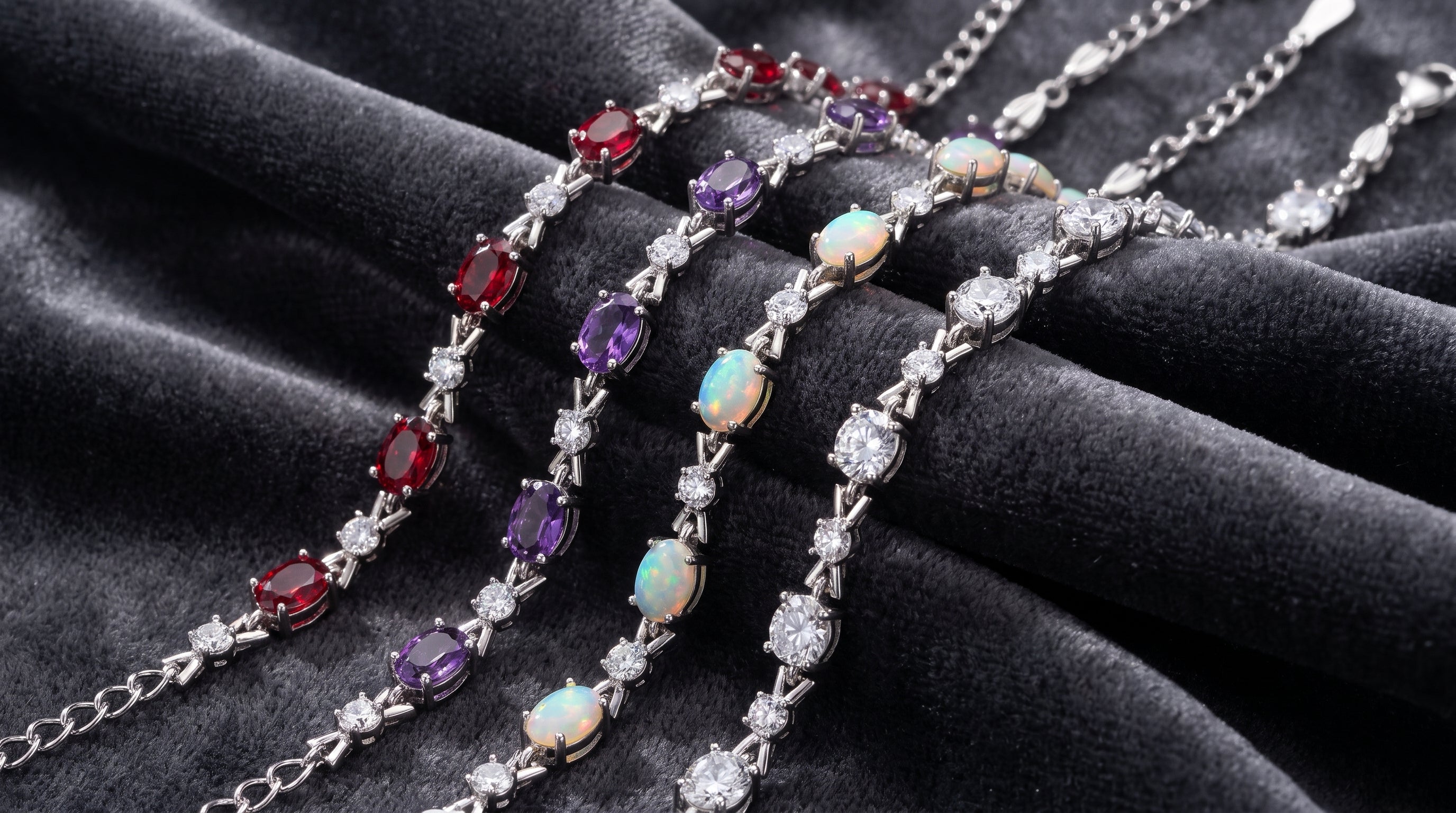
A station bracelet spaces individual bezel- or prong-set stones along a fine chain, with metal visible between each one. The look is light and stackable, which makes it the natural choice for someone who already wears a watch or a couple of thin chains. Because the stones are separated rather than crowded, a single color reads clearly — useful when the whole point is that the wearer's month is legible at a glance. Awareness Avenue's station designs, including the Quintara Station Amethyst Bracelet and the Kyriella Station Opal Bracelet, follow this construction.
Oval and continuous-line bracelets
Oval-set line bracelets run stone after stone with little metal showing, closer in feel to a tennis bracelet. They deliver more color and more sparkle per inch, and they photograph well, but they also sit heavier on a small wrist and read dressier. This is the format to choose when the bracelet is meant to be an occasion piece rather than an everyday layer.
Charm and multi-stone bracelets
If the brief is “one stone per child,” you want a charm or multi-stone build. Danique Jewelry pairs teardrop birthstone charms with gold initial charms; Atolea's custom birthstone bracelet lets a shopper choose from twelve stones representing different people; The Vintage Pearl accommodates up to twenty stones on a single mother bracelet. These are the honest answer to a search for a personalized birthstone bracelet or a custom birthstone bracelet with names attached. We cover selection criteria for this format in our guide to birthstone charms for a bracelet.
Symbolic and motif bracelets
A smaller niche combines a birthstone with a meaningful motif rather than a name. Awareness Avenue's Faithful Connection Birthstone Cross Bracelet sits here, joining a birthstone element to a cross design. This is a thin part of the market — very few of the pages competing for this keyword offer faith-linked birthstone bracelets at all — which makes it worth knowing about if the recipient's faith is as central to her identity as her birth month.
Awareness Avenue Birthstone Bracelets, Organized by Month
Everything below maps to the modern birthstone list described above. Where a stone is simulated rather than mined, it is stated outright.
February — amethyst
Amethyst is February in both the modern and traditional charts, so there is no ambiguity to manage. Two designs carry it. The Verona Oval Amethyst Bracelet uses the oval line construction for a denser run of purple, while the Quintara Station Amethyst Bracelet spaces the stones out on sterling silver for a quieter, more layerable effect. Practical tie-breaker: amethyst's purple sits comfortably against both cool silver and warm gold tones, so this is one of the safer months to buy for someone whose jewelry box you haven't seen.
March — aquamarine
The Melodia Station Bracelet in S925 sterling silver centers on aquamarine, the modern March stone. The same Melodia station design also appears in Awareness Avenue's solid gold line, offered in 10k, 14k, and 18k and described on that listing as using precision-cut A5 Grade simulated aquamarine stones. Aquamarine's pale blue-green is a low-contrast stone; on a station setting it reads as a soft shimmer rather than a statement, which suits people who say they “don't really wear jewelry.”
April — diamond
April is diamond in both charts, which historically made it the most expensive month to shop for. The April Diamond Birthstone Bracelet in S925 sterling silver is the one piece in this lineup named explicitly for its month, so there is no interpretation required by either the giver or the recipient. Awareness Avenue also groups its April pieces — rings, necklaces, and earrings included — so a bracelet can be matched into a set later.
July — ruby

Ruby is July in both systems. The Bellara Bracelet in S925 sterling silver uses simulated ruby in an oval line format; the solid gold Bellara listing, again offered in 10k, 14k, and 18k, describes precision-cut oval A5 Grade stones. Red is the highest-contrast birthstone color on the chart, so a July bracelet does more visual work than most — something to weigh if the recipient's wardrobe is mostly neutral. If you want to see the rest of the July assortment, it lives in the July simulated ruby collection.
October — opal
The Kyriella Station Opal Bracelet answers October under the widely merchandised modern list Blue Nile publishes, in which opal is October's stone. Note the caveat from earlier: IGS lists tourmaline as October's modern stone and opal as the traditional one. Either is defensible; opal is the one most October-born recipients will recognize.
Companion designs without a month attached

Three designs — the Vivara Oval Bracelet, the Aureliana Station, and the Etherea Station Bracelet, all in S925 sterling silver — are not tied to a specific birth month here, and we won't assign them one. Their job in a birthstone purchase is structural: they give a month-specific bracelet something to sit beside without competing with it. If you want the birthstone to be the focal point of a stack, a neutral second bracelet is usually more effective than a second colored stone.
Simulated vs. Natural Stones: The Trade-Off Nobody Explains
This is the single largest information gap in the current search results. Retailers on both sides of the line state their position and move on. Mama Bijoux, for instance, describes its custom birthstone bracelet as 14k solid gold with natural bezel-set birthstones. Awareness Avenue, on its solid gold Melodia and Bellara listings, describes precision-cut A5 Grade simulated stones. Almost nobody explains what a shopper gives up or gains by choosing one.
Here is the fair version. Simulated stones are manufactured, which means color and cut are consistent from piece to piece — a real advantage when you're buying two matching bracelets for two sisters, or replacing a piece years later. Natural stones vary; that variation is precisely what collectors value, and it is why natural-stone pieces usually sit at higher price points. “A5 Grade” is a supplier's descriptive grading term used in the product copy, not an independent gemological certification, and it should be read that way. What this guide will not tell you is that one is objectively better than the other, or that simulated stones wear identically to mined ones over decades — there is no testing behind such a claim, and any page that makes it confidently is guessing.
The decision rule that holds up: if the emotional weight of the gift rests on the stone being a genuine mined gem, buy natural and accept the cost. If the emotional weight rests on the month being represented in something she will wear weekly, simulated stones in a well-made setting do that job.
Buying a Birthstone Bracelet for Mom, and the Two-Stone Question
“Birthstone bracelet for mom” is a distinct search from the parent query, and it usually means a bracelet representing her children rather than herself. Be clear about which you are buying — some mothers want their own stone; many want their children's.
When you need two or more months on one wrist
If the requirement is a genuine 2 birthstone bracelet with two different months set into one piece, or a bracelet holding four stones for four children, the customization-first makers described above are the correct destination, and a single-stone station bracelet is not. Saying so plainly is more useful than pretending otherwise. Our two-birthstone bracelet gift guide and our guide to a personalized birthstone bracelet for mom both work through that format in detail.
The stacking alternative
There is a second approach that works when you like a particular bracelet's construction: buy two single-stone bracelets in the same design and wear them together, one per person. Two Melodia stations, or a Verona amethyst beside a Bellara ruby, read as a deliberate pair rather than a compromise. This is a styling strategy, not a built-in customization feature — the bracelets do not accept added stones — but it lets a mother of two add a third bracelet later without replacing anything. It also spreads the cost across occasions.
What the brand-name searches are really asking
Queries like “Kendra Scott birthstone necklace,” “birthstone bracelet Kendra Scott,” and “Kendra Scott birthstone ring” usually signal someone who wants a coordinated set across formats from a single house; that brand merchandises birthstone bracelets, necklaces, earrings, and rings from one hub, which is exactly why those searches convert there. “Custom birthstone necklace” and “custom birthstone bracelet” signal the engraving-and-configuration path instead. Knowing which of the two you're actually in prevents a lot of wasted browsing.
Metal, Sizing, and What to Check Before You Order
Sterling silver or solid gold
Awareness Avenue's bracelets in this roundup are S925 sterling silver, with the Melodia and Bellara designs additionally offered as solid gold in 10k, 14k, and 18k. The karat decision is mostly about color and budget: lower karats are paler and harder-wearing by nature of their alloy content; higher karats are richer in color. Sterling silver suits cool-toned stones like aquamarine and opal especially well. If solid metal is the priority, Awareness Avenue's solid gold pieces are grouped separately from the sterling silver assortment.
Durability and presentation deserve a real look
Brand recognition does not guarantee satisfaction on either count. On a major retailer's listing for a Kendra Scott Emma cuff bracelet, reviews averaged 3.68 out of 5 across 91 ratings, with recurring praise for the look alongside recurring concerns about durability and packaging. That pattern — the piece looks right, but the clasp or the box disappoints — is worth taking seriously when the bracelet is a milestone gift. Check clasp type, whether the listing shows the packaging, and whether the chain gauge looks proportionate to the stones.
A short pre-purchase checklist
- Confirm the month against the modern list, and ask the recipient's preference if her month is October, November, or December, where the traditional stone differs.
- Decide format before brand: station for daily layering, oval line for occasions, charm or multi-stone for family representation, motif for symbolic gifts.
- Read the stone description literally — “simulated” and “natural” are not synonyms, and neither is a defect.
- Match the metal to the stones and to what she already wears daily.
- If you need engraving, initials, or more than one month in a single piece, shop a customization-first maker rather than a ready-to-wear line.
Browse the full birthstone jewelry collection or the wider bracelet assortment once you have settled the month and the format — in that order, the shortlist usually collapses to two or three pieces very quickly.
Frequently Asked Questions
Can one bracelet hold more than one birth month?
Some can, but only if it is built for it. Multi-stone and charm designs from customization-focused jewelers are made to accept several stones — The Vintage Pearl accommodates up to twenty on a mother bracelet, and Atolea's custom bracelet lets you select from all twelve stones. Single-stone station and oval bracelets, including the Awareness Avenue designs above, do not add stones; layer two bracelets instead.
Are birthstone bracelets suitable for daily wear?
Format decides this more than material. Fine station chains with spaced stones are the least obtrusive under sleeves and beside a watch. Continuous oval-set lines carry more stones and more weight and tend to be reserved for occasions. Either way, remove jewelry before swimming, cleaning, or workouts, and store pieces separately so stones aren't scratched by other metal.
What if the recipient's month has more than one stone?
Pick the one she recognizes. August is peridot and spinel in the modern chart and sardonyx traditionally; November is golden topaz and citrine; December spans blue zircon, blue topaz, and tanzanite modern, with turquoise and lapis lazuli traditional. There is no wrong answer within those sets, only a more personal one.
Do simulated stones mean the bracelet isn't “real” jewelry?
No. The setting metal is what it says it is — S925 sterling silver, or solid gold at the stated karat. What changes is the stone's origin, which is why honest listings say “simulated” rather than leaving it vague. If a listing does not state stone origin at all, that omission is the thing to question.

Leave a comment
This site is protected by hCaptcha and the hCaptcha Privacy Policy and Terms of Service apply.