


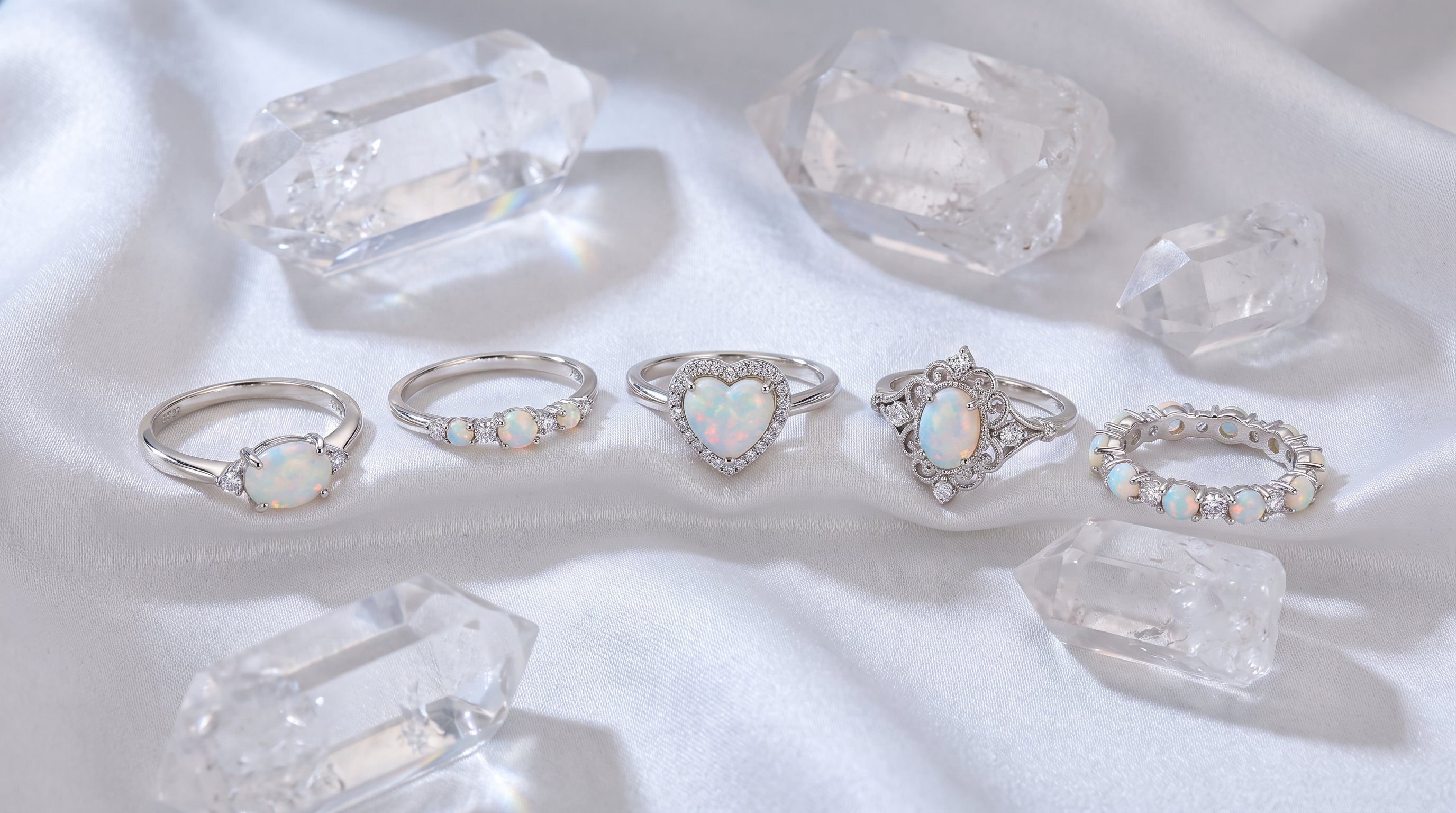
Search "birthstone rings white gold" and you are really asking two questions at once: which birth months you want represented, and which white metal will hold them for the next twenty years. Those questions pull in different directions. Stone count pushes you toward a single multi-stone band or a growing stack; metal choice pushes you toward solid gold, sterling silver, or plated designs at very different price tiers. This roundup separates the two decisions, shows how the major jewelers actually structure their birthstone and mother's ring assortments, and is transparent about which Awareness Avenue rings fit a white gold birthstone brief and which ones simply do not.
What a White Gold Birthstone Ring Is Supposed to Do
Most white gold birthstone rings sold today are, in retailer language, mother's rings or family rings. Blue Nile's mother's ring guide defines the category as personalized jewelry featuring birthstones that represent children, grandchildren, or other loved ones, with each gemstone corresponding to a family member's birth month. Zales frames its mothers and family rings the same way — as pieces that celebrate the bond of family — and Shane Co. invites shoppers to start with a 14k gold ring and add gemstones symbolizing each family member, listing diamonds, rubies, and sapphires among the options.
That framing matters because it changes the shopping criteria. You are not just buying a colored stone ring; you are buying a layout. The number of settings, the order of the stones, and whether more can be added later become as important as carat weight or finish. White gold is the neutral canvas most often chosen for that job because it lets several unrelated stone colors — a garnet next to a peridot next to an aquamarine — read as a deliberate set rather than a clash.
The traditional birthstone list to work from
Blue Nile's guide lists the traditional birthstones as follows. Use it to confirm which stones you actually need before you compare settings.
- January – garnet
- February – amethyst
- March – aquamarine
- April – diamond
- May – emerald
- June – pearl
- July – ruby
- August – peridot
- September – sapphire
- October – opal
- November – citrine
- December – topaz
A practical note: stones outside this list, such as tanzanite, are popular in fine jewelry but are not part of the traditional month mapping cited above. If a stone's month assignment matters to the recipient, verify it against the list rather than assuming a color match is close enough. Our birthstone jewelry collection is organized by stone, which makes that cross-check quick.
White Gold vs. the Other White Metals You'll Be Offered
Once you filter for a white metal, retailers present three very different products under one visual look, and the difference shows up in years two through ten of wear rather than on the product page.
Solid gold
Haverhill markets its personalized 14k gold birthstone rings as handcrafted in solid gold, and its Rosecliff birthstone ring is offered in 14k yellow or white gold. Slate & Tell's three-stone birthstone ring is likewise offered in sterling silver as well as 10K and 14K white, yellow, or rose gold. Solid gold is the specification to look for if the ring is meant to be worn daily and kept for decades; the gold content runs through the piece rather than sitting on the surface. White gold is typically finished with a bright white surface plating that a jeweler can refresh during routine service — a maintenance step, not a defect.
Sterling silver
Sterling silver dominates the entry tier of mother's rings. Kay's Birthstone Family & Mother's Ring, which holds two to four stones, is a sterling silver design, as is its two-stone mother's stackable band. Silver gives you the same cool tone at a far lower entry point, which is why it is the sensible choice for a first birthstone ring, a gift for a teen, or a piece worn occasionally.
Gold plate
Kay's mother's ring category lists gold, gold plate, and sterling silver as separate metal types, and Pandora's organically shaped stacking rings are sold as a set of two 14k gold-plated bands. Plating buys the color at the lowest cost; it is a surface layer, so it is the least suitable option for a ring you intend to wear every day for years. If you are weighing white metals for a keepsake piece rather than a fashion one, our comparison of platinum vs. white gold rings covers the durability and finish trade-offs in more detail.
On price, Blue Nile's guide is straightforward: mother's ring prices vary with metal type, the number of birthstones, and gemstone quality. That is the honest formula — every extra setting and every upgrade from a synthetic or semi-precious stone to a natural precious one moves the number.
Stone Count: Two Stones, Three Stones, or a Whole Family
Stone count is the single most consequential decision, because it locks in both the ring's proportions and its future flexibility.
Two-stone rings
Two stones read as a pair — two children, a couple, a parent and child. Kay sells this specifically as a stackable format, answering the demand for stackable birthstone rings for mother's with a band featuring two round colored birthstones of loved ones, built low enough to sit alongside other rings. When looking for birthstone rings for mom, 2 stones are the easiest to wear next to an existing wedding set because they add color without adding height. If you are deciding how to pair two months so the colors work together, our guide to choosing a birthstone ring 2 stones style walks through the combinations.
Three-stone rings
When shopping for birthstone rings for mom, 3 stones is the classic layout and the most common request after two. Slate & Tell's three-stone birthstone ring shows the standard linear treatment, available across silver and 10K/14K white, yellow, or rose gold. Alexis Russell's custom multi-birthstone keepsake ring takes the same count in a finer direction: three prong-set gemstones measuring 2 mm each, with customers choosing both the stones and their placement, and the brand stating that its diamonds and gemstones are ethically sourced and hand-selected for quality, character, and durability. Two millimeters is a useful benchmark — it is large enough to show color, small enough to keep a three-stone band slim. For a deeper look at layouts and stone order, see our complete buying guide for a birthstone ring 3 stones layout, or browse triple stone rings directly.
Four stones and beyond
Kay's Birthstone Family & Mother's Ring accommodates two to four stones in one band. Blue Nile notes that most mother's rings hold one to six birthstones or more depending on style and preference, with linear designs typically fitting three to five stones, and circular or stackable arrangements accommodating larger families across multiple rings. At the extreme end, Haverhill's Rosecliff ring can be configured with up to eleven genuine stones in a single 14k gold band. Beyond roughly five stones in a straight line, the ring starts to span the finger; that is the point at which most shoppers switch from one wide band to a stack.
Stackable Birthstone Rings: Building the Look Instead of Buying It Once
Stacking has become the default answer to the problem every family ring eventually faces — the family keeps growing. Rather than resetting a fixed band, you add another slim ring.
The formats on offer are consistent. Kay's two-stone stackable band is designed with a low profile specifically so it sits flush with other rings. Local Eclectic provides an option for gold stackable birthstone rings with its textured band, described as an ultra-slim solid gold band accented with birthstones for each month, made to be stacked and clipped together to celebrate multiple loved ones. Haverhill positions its Rosecliff design as a personalized birthstone stackable ring in 14k gold. Mint & Lily sells a stackable birthstones band ring whose page carries customer testimony praising its quality and perceived tarnish resistance — worth reading as customer opinion rather than a tested material property. As for stackable birthstone rings, Pandora contributes a set of two 14k gold-plated organically shaped stacking rings; the bands are the draw, not birthstones, so treat Pandora as a style reference rather than a birthstone source.
Four rules for a stack that still looks intentional at five rings
- Keep one metal dominant. Let white gold or silver carry the majority of the bands and use a warmer metal as a single accent, so the color story stays legible.
- Match profiles, not designs. Low, flat-profile bands stack without gaps; mixing a tall setting into the middle of a stack forces the rings apart.
- Cap stone size. Around 2 mm per stone, the size used in Alexis Russell's three-stone keepsake ring, is a reliable ceiling for rings meant to sit side by side.
- Leave room to grow. If you expect to add a stone for a future child or grandchild, an added band is far simpler than resetting a finished multi-stone ring. Our comparison of eternity bands vs. stackable rings explains how a plain band anchors a colored stack.
Where Awareness Avenue Rings Fit — and Where They Don't
Being straight about this is more useful than forcing a match. Our current ring lineup is not built as configurable multi-birthstone mother's rings with named settings per child, and none of the pieces below is listed as a white gold design. What we do have are individual gemstone and stacking rings that work as components of a birthstone stack, and pieces in solid gold and sterling silver for shoppers who want the tone without a plated finish. Confirm metal, stone, and size details on each product page before ordering.
For an October or gemstone-led stack
The Iridiana Stack Opal Ring is the most stack-native piece we carry, and opal is October on the traditional list. The Majesty Oval Opal Ring gives the same stone a larger oval presence for anyone who wants one statement ring rather than several slim ones, and the Adorise Opal Ring offers a third opal option to layer alongside it.
For December, and for stones outside the traditional list
The Amabel Natural Topaz Ring maps to December, the traditional topaz month. The Alysandra Tanzanite Ring is worth flagging honestly: tanzanite is a beautiful violet-blue stone, but it does not appear on the traditional month list quoted earlier, so choose it for the color and the person, not for month symbolism.
For the solid gold anchor of a stack
The Aeliana Eternity Ring in solid gold is the piece to reach for if you want a continuous, colorless band to sit above or below your colored birthstone rings — the role a plain eternity band plays in nearly every well-composed stack. More solid-metal options sit in our solid gold collection.
For trios and sentiment-led gifting in sterling silver
The Aliana Pear Trio in S925 sterling silver uses a three-stone arrangement, the same visual rhythm as a classic three-stone mother's ring, in a white metal at silver's price level. Our heart designs — the Adara Heart Ring, the Amantina Heart Ring, and the Amaryllis Heart Ring, all in S925 sterling silver — are sentiment-led rather than birthstone-led, and they stack neatly against a colored band when you want a non-gemstone break in the sequence.
If your brief is strictly a configurable multi-birthstone family ring in 14k white gold with a stone per child, the retailers described earlier — Haverhill, Slate & Tell, Kay, Zales, Shane Co. and Alexis Russell — are the ones publicly offering that exact specification. We would rather point you there than misdescribe what we sell.
Fit, Wear, and Planning for Later
Sizing, especially for stacks
Sizing is the most common source of returns on rings bought online, and jewelry sizing guides such as JewelryShopping's at-home tutorial exist precisely because most buyers have no measured size on hand. Two practical additions for birthstone stacks: measure the exact finger the stack will live on, since a knuckle that accommodates one slim band may resist three, and account for band width — wider bands generally feel tighter than narrow ones at the same nominal size.
Which finger
Blue Nile notes that mother's rings are traditionally worn on the ring finger of the right hand. Treat this as convention rather than rule; plenty of wearers keep a birthstone stack on the index or middle finger to leave the left hand for a wedding set.
Adding stones later
Guides in this category, including MothersFamilyRings' mother's ring guide, address whether stones can be added to an existing ring, which tells you how frequently families ask. The design implication is simple: a fixed multi-stone band commits you to a layout, while a stack lets you add a band per new arrival. If there is any chance the count will change, ask the retailer before purchase whether the specific setting can be altered, rather than assuming it can.
Reading durability claims carefully
Marketing pages in this space frequently carry customer statements about rings that "never tarnish." Mint & Lily's stackable band page is one example. These are customer opinions, not laboratory results, and they should not be generalized across brands or metals. The dependable signals are the ones stated as specifications: solid gold versus gold plate, karat, and whether stones are natural, lab-created, or simulated.
A Short Decision Path
- Confirm the months against the traditional list above, and note any stone that falls outside it.
- Pick the count and the format. Two or three stones in one band for a compact ring; a stack if the count may grow or exceeds about five.
- Choose the metal honestly. Solid 14k white gold for daily heirloom wear, sterling silver for accessible white-tone gifting, gold plate only for occasional wear.
- Check personalization scope. Kay's mother's rings can be customized with birthstones and engraving; Alexis Russell lets you specify stone placement. If stone order matters to you, confirm it is selectable.
- Measure before you order, and size for the finger and width you will actually wear.
Work through those five steps and "birthstone rings white gold" stops being a wall of near-identical product tiles and becomes a short list. Browse our fine jewelry and birthstone collections to see which stones are available before you commit to a layout.

Leave a comment
This site is protected by hCaptcha and the hCaptcha Privacy Policy and Terms of Service apply.