


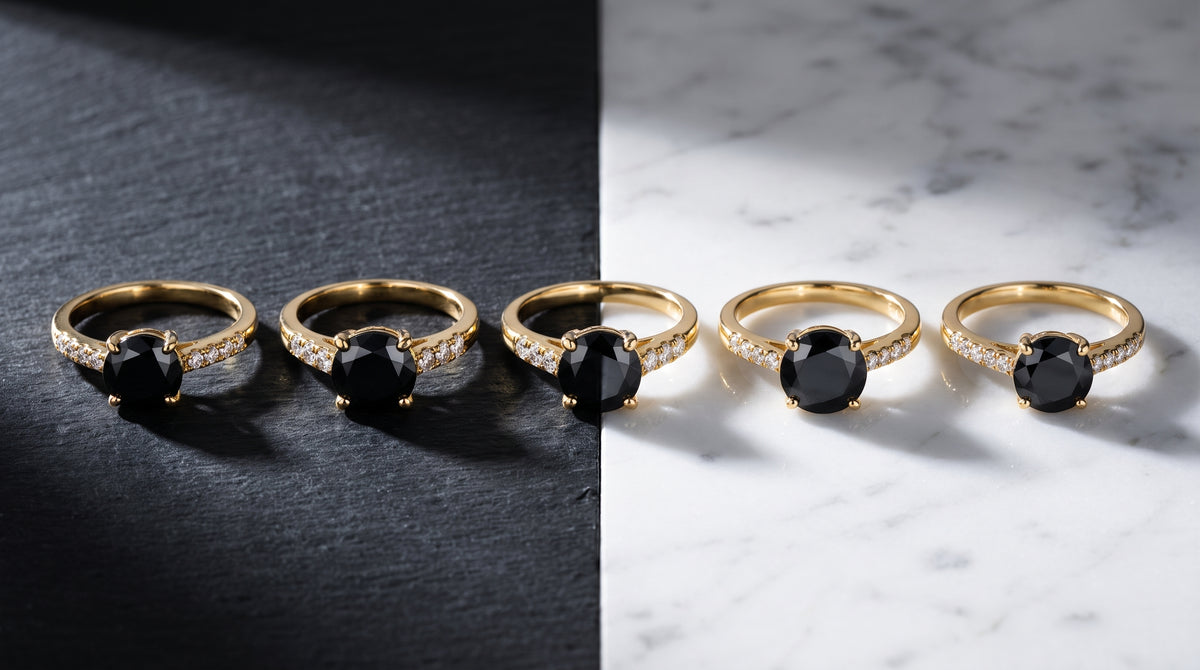
Photograph a black moissanite solitaire next to a treated black diamond solitaire and most people guess wrong about which is which. Put both under a bright lamp and the difference declares itself in about two seconds: light passes into the moissanite and comes back out as sharp, colored flashes, while the black diamond absorbs most of it and returns a darker, almost polished-metal shine from the surface of its facets. That single optical distinction — light transmitted and refracted versus light absorbed — drives nearly every other difference between these two stones, including how they photograph, how they age visually, how they are graded, and what they cost.
This guide separates three very different kinds of statements: verifiable gemological facts (composition, hardness, refractive index), consistent market patterns (moissanite generally costs far less than diamond), and vendor marketing claims that circulate widely but are not independently audited. Knowing which is which is the fastest way to make a confident choice between a black moissanite ring and a black diamond piece.
What Each Stone Actually Is
Black moissanite: silicon carbide, grown in a lab
Moissanite is not a type of diamond and it is not a "fake diamond." It is a distinct gemstone made of silicon carbide, a different compound with a different crystal structure and different optical behavior from diamond's crystallized carbon. The mineral was first identified by Henri Moissan in 1893 in material from the Canyon Diablo meteorite crater, where it was initially mistaken for diamond. Natural moissanite is vanishingly rare, so essentially all moissanite used in jewelry today — black included — is lab-grown.
Because black moissanite is created under controlled conditions, its color tends to be highly uniform across the stone, with few or no visible inclusions. Some buyers love that sleek, engineered evenness; others find it reads as "too perfect" compared with the organic irregularity of a natural black diamond. Exactly how black color is achieved varies by manufacturer — growth conditions, doping and post-growth treatments are all used — and specific processes are rarely disclosed in detail in retail materials, so it is honest to say the mechanism is not standardized across the market.
Black diamond: carbon, but not a fancy color in the usual sense
Black diamonds are diamonds — crystallized carbon scoring 10 on the Mohs scale — but their color comes from a different mechanism than pink, blue or yellow diamonds. Instead of trace elements or structural defects tinting an otherwise transparent stone, black diamonds owe their appearance to an extremely high density of inclusions, commonly graphite, that absorb light and make the stone opaque. Jewelry educators therefore describe them as not being "true fancy colored diamonds" in the same technical sense as other colored diamonds.
The market splits into two categories that shoppers often conflate. Natural black diamonds, including polycrystalline carbonado material, are formed with those inclusions already present and can show grey, white or brownish patches and minor surface pitting; perfectly even natural black stones are unusual. Treated black diamonds start as heavily included or off-color diamonds and are darkened through processes such as irradiation or high-temperature, high-pressure treatment. Treated stones are far more common at accessible price points and typically look more uniformly black. Lab-grown black diamonds also exist and share the physical and chemical properties of mined diamond.
How They Look: Sparkle, Depth, and Surface
Fire and brilliance
Moissanite has a higher refractive index than diamond — commonly cited at roughly 2.64 to 2.69 versus diamond's approximately 2.42 — and substantially higher dispersion, around 0.104 compared with diamond's roughly 0.044. Dispersion is what produces "fire," the rainbow flashes you see as the stone moves. In colorless stones this makes moissanite noticeably more prismatic than diamond, especially above one carat. In black stones, the dark body color mutes the effect, but faceted black moissanite still returns visible sparkle and colored glints along the crown and table edges. If your mental image of a black center stone is "inky, but alive," black moissanite is the material that delivers it.
Why black diamonds shine instead of sparkle
Opaque stones cannot refract light internally the way transparent ones do. Jewelers who specialize in black diamonds are explicit that genuine natural black diamonds do not shine by throwing light back the way white diamonds do; instead they present a subtle, marble-like surface luster. Guides to black diamond engagement rings repeat the point: they do not sparkle like white diamonds, and a black stone that flashes vividly is more likely to be treated or a simulant than a natural fancy black diamond. Treat this as a design feature rather than a defect. The appeal of black diamond is gravity, contrast and mystery — a stone that looks like a deep well rather than a chandelier.
What "peacock black moissanite" actually means
Search for black stones and you will quickly meet the phrase "peacock black moissanite" or "black peacock moissanite." On marketplace listings, sellers use it for very dark moissanite that shows iridescent blue, green or purple play across the facets, echoing peacock feathers. It is a stylistic and marketing term, not a recognized gemological category with defined parameters, and no standardized grading underpins it. If you buy a stone sold under that name, judge it on photographs and video of the actual piece under multiple lighting conditions, because two "peacock" stones from different sellers can look quite different.
Quick comparison
| Attribute | Black moissanite | Black diamond |
|---|---|---|
| Composition | Silicon carbide, lab-grown | Carbon; mined (natural or treated) or lab-grown |
| Mohs hardness | About 9.25 | 10 |
| Optical character | Transmits light; visible sparkle and fire | Opaque; absorbs light, subtle surface luster |
| Color uniformity | Typically very even | Natural stones often uneven; treated stones more uniform |
| Standard lab grading | Not graded on the diamond 4Cs by major labs | Clarity cannot be graded on the standard scale (opaque) |
| Typical price position | Well below diamond of comparable face-up size | Treated stones accessible; natural fancy black stones command more |
Durability, Toughness, and Daily Wear
Hardness in practical terms
Diamond sits at 10 on the Mohs scale, the hardest naturally occurring material. Moissanite, including black moissanite, is consistently cited at around 9.25. In everyday terms both are far above the hardness of dust, sand and most household surfaces, which is why both are considered appropriate for engagement rings worn daily. Diamond retains a theoretical edge in scratch resistance, but for normal wear the practical gap is small.
Toughness and the cleavage question
Hardness resists scratching; toughness resists chipping and breaking. Some moissanite retailers argue that because moissanite lacks cleavage planes, it resists breakage better than diamond, which has cleavage directions that can be vulnerable to a sharp blow. That is a reasonable structural argument and it appears repeatedly in vendor education, but it should be read as a claimed advantage rather than an independently verified universal rule, since real-world toughness also depends on cut, girdle thickness, existing inclusions and how securely the stone is set. Heavily included black diamonds, natural or treated, can be less forgiving of impact than a clean stone, though consumer sources rarely quantify this.
Both materials are also chemically and thermally stable enough for normal wear and standard bench work. Vendor content sometimes cites specific temperature thresholds for moissanite; without laboratory corroboration, treat exact numbers with caution and simply note that neither stone is troubled by ordinary household conditions.
Care and cleaning
Cleaning routines are effectively identical: warm water, a mild soap and a soft brush, rinsed and dried carefully, with harsh chemicals, abrasive cleaners and thermal shock avoided. Black stones of both types have one shared practical advantage — they camouflage everyday film and minor surface marks better than pale stones, which makes them relatively low-maintenance in appearance between cleanings. That said, sparkle in black moissanite still depends on clean facets, so a regular wash matters more than you might expect for a dark stone. No gem is indestructible; protect either stone from hard knocks and remove rings for heavy manual work.
Grading, Certification, and Telling the Two Apart
Why paperwork looks different for black stones
Transparent diamonds are graded on the traditional 4Cs by laboratories such as GIA, IGI and GCAL. Black diamonds break that system: because they are opaque, clarity cannot be assessed on the standard scale, and GIA does not issue conventional clarity grading reports for natural black diamonds. Color for black stones is handled descriptively rather than through the usual letter grades. Moissanite, meanwhile, is not a diamond and is not graded on the diamond 4Cs by the major diamond labs at all; sellers generally describe color and clarity in their own qualitative terms. For black moissanite specifically, there is no widely accepted standardized certificate — stones are usually sold on shape, size and visual quality.
The practical implication: if formal documentation is central to your decision, ask the seller exactly what report, if any, accompanies the stone, and what it covers. Do not assume that either black stone arrives with the kind of grading report a colorless diamond would carry.
Testing pitfalls
A common misconception is that a stone which passes a handheld thermal diamond tester must be diamond. Moissanite conducts heat well and frequently reads as diamond on basic thermal testers; distinguishing the two normally requires a moissanite-specific tester or expert examination. Black stones complicate this further, because heavy absorption and inclusions — hematite among them — can produce ambiguous readings even on specialized devices. Under magnification, a gemologist can look for doubling caused by moissanite's double refraction, which diamond does not show, but this is not a reliable at-home test on an opaque, dark stone. If identity genuinely matters to you, rely on the seller's disclosure and, where warranted, a professional appraisal rather than a gadget.
Price, Value, and How to Budget Realistically
What actually drives the numbers
Moissanite pricing is driven mainly by size, shape and quality tier set by the manufacturer or retailer. Diamond pricing is driven by rarity and the market's grading framework. That structural difference is why moissanite consistently sits well below diamond of comparable face-up size. Some moissanite brands, including those publishing online price calculators, cite savings in the region of 80–90% versus a comparable diamond; other sources quote much smaller gaps. These are vendor interpretations rather than audited market figures, so the defensible summary is simply that moissanite is substantially less expensive, often dramatically so, with the exact gap varying by brand, size and quality.
Within black diamonds, the category matters enormously. Treated black diamonds are widely available and comparatively accessible. Natural fancy black diamonds are rarer and generally command more per carat. A shopper comparing a black moissanite ring against "a black diamond ring" is often, in practice, comparing it against a treated stone or a cluster of small stones rather than a large natural fancy black diamond — a distinction most comparison articles skip entirely.
Using a moissanite price calculator sensibly
Several moissanite retailers offer a moissanite price calculator that estimates cost from carat weight, shape, cut quality and color. These tools are useful for orienting a budget, but they are brand-specific estimates built on that seller's own inventory and assumptions, and most are calibrated to colorless and near-colorless stones rather than black ones. Use them to understand how price scales with carat weight, then verify against the actual finished pieces you are considering. For a deeper look at how alternative stones stack up against lab-grown diamond costs, our breakdown of moissanite versus lab diamond pricing walks through the same logic in more detail.
Resale: the part most guides soften
Moissanite's resale value is materially lower than diamond's, and retailers who sell it are generally candid about that. It should be chosen for how it looks, how it wears and what it costs — not as an investment. Black diamonds occupy a middle ground: natural black diamonds are rarer than moissanite and many other black stones, which can support resale interest, but black diamond guides also note that resale value tends to be lower and more variable than for traditional white diamonds. Some diamond-focused retailers frame natural black diamonds as a strong investment; that is a brand claim, not corroborated data, and actual outcomes depend on quality, documentation, brand and market conditions. Neither stone deserves a value guarantee.
Ethics, Sourcing, and Transparency
Moissanite is routinely marketed as an ethical and eco-conscious choice because it is lab-created and requires no mining. The core fact — lab origin, no mining — is solid. The broader environmental conclusion depends on the energy sources and production practices of a specific facility, which consumers generally cannot verify, so it is more accurate to say moissanite avoids mining impacts than to claim it is universally the lowest-impact option available.
Black diamonds are predominantly mined, though lab-grown black diamonds offer the same physical and chemical properties with a different sourcing story. One under-discussed issue is documentation: lower-priced treated black diamonds often travel with less provenance paperwork than high-end colorless stones, simply because the grading infrastructure for opaque stones is limited. If sourcing transparency ranks high on your list, ask the seller directly what they can document about origin, treatment and lab status rather than relying on category-level assumptions. Our guide to choosing a moissanite engagement ring covers the questions worth asking before you commit.
Choosing by Piece: Rings, Necklaces, and Earrings
Black moissanite engagement rings
An engagement ring is the most demanding wear context in jewelry, and black moissanite handles it well: hardness around 9.25, sparkle that is intrinsic to the material rather than a coating, and a price position that allows a larger center stone than most black diamond budgets would permit. The design decision is really about tone. A round brilliant like The Katalina 1.5CT round cut black moissanite ring emphasizes movement and flash, while step-cut designs such as The Adelina Rae 2CT emerald cut or the larger Bella Jewel 3CT emerald cut trade some sparkle for long, mirror-like planes and a more architectural black. Softer, more romantic silhouettes are represented by pieces like The Opaline and The Camilla. If you want a wider survey of silhouettes before narrowing down, our roundup of striking black moissanite engagement rings is a useful next step, and the full moissanite engagement ring collection shows how black center stones sit alongside classic options.
Choose black diamond for an engagement ring instead if the opaque, non-sparkling look is the point — if you want a stone that reads as solid, matte-deep black rather than dark-but-lively — and if diamond identity itself carries meaning for you. Black diamond guides consistently tie the stone to symbolism of strength, sophistication and an unconventional love story, which is a legitimate reason to pay more for less sparkle.
Necklaces and earrings
Away from the ring finger, wear demands drop and the calculus shifts toward pure aesthetics. Both stones are more than durable enough for pendants and earrings, provided settings are secure and you keep them away from perfume and cosmetics before the piece is on. A black moissanite necklace makes an effective statement piece because its sparkle reads against skin and white metal at conversational distance. Black diamond earrings and pendants deliver contrast and weight without competing for attention — pieces such as the Midnight Tear black diamond trinity heart necklace and the Nocturnal Purity skull earrings show how black diamond suits narrative, statement-driven design rather than the maximum-sparkle brief. For more on how the same material can serve both a lifetime ring and a fashion-forward piece, see our discussion of moissanite's dual role in engagement and fashion jewelry.
So Which One Should You Buy?
Choose black moissanite if you want visible sparkle in a dark stone, a larger center stone for the money, a lab-created origin you can state plainly, and everyday durability that requires no special handling. Accept in exchange that it is not a diamond, that resale value is low, and that its color uniformity may look more engineered than organic.
Choose black diamond if opacity is the aesthetic you actually want, if diamond identity matters to you symbolically, or if you are drawn to the character of a natural stone with visible individuality. Accept in exchange that it will not sparkle like a white diamond, that clarity grading in the conventional sense is unavailable, that most accessible black diamonds are treated rather than naturally black, and that resale is less predictable than for colorless diamonds.
A useful tiebreaker: describe the finished look you want in one sentence without naming a material. If the sentence contains the word "flash," "glitter" or "catches the light," black moissanite is the more direct route. If it contains "deep," "matte," "solid" or "quiet," black diamond is. Both stones will survive decades of wear with sensible care. Whether you are choosing an engagement ring or exploring other black moissanite jewelry, the decision is really about which kind of darkness you want to wear.

Leave a comment
This site is protected by hCaptcha and the hCaptcha Privacy Policy and Terms of Service apply.