


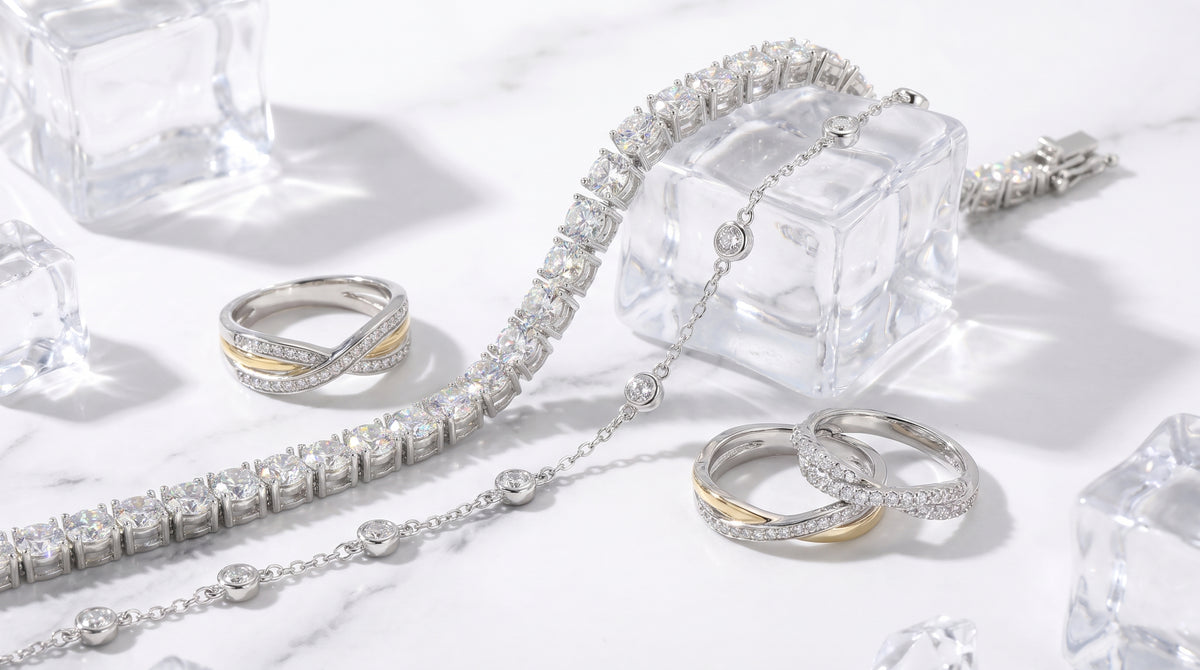
Search "cheap bracelets near me" and the results rarely look like a single neat list of nearby jewelry shops. What you get instead is a collision of four very different retail models that often sit within the same shopping center: a department store running percentage-off jewelry sales, a national chain jeweler with a separate clearance section, a big-box store selling plated fashion bracelets next to craft-aisle bead kits, and a fast-fashion chain selling bracelets in multipacks. Each one defines "cheap" differently, and that is the real reason the search feels confusing. A tennis bracelet marked down more than half off at a chain jeweler and a three-pack of chunky bracelets at a fast-fashion store both qualify as "on sale," but they are not remotely the same purchase.
This guide is built around the objections that actually stall the decision: that cheap means flimsy, that big discounts might be theater, that you need the piece today, that it should still mean something. Below, each one gets a direct answer plus the specific checks to run before you hand over a card — in store or online.
What "Cheap Bracelets Near Me" Actually Pulls Up
Understanding the four lanes saves a wasted drive. They are not interchangeable, and each one is strongest for a different buyer.
Department stores running jewelry sales
Macy's, for example, maintains a dedicated department for macy's bracelets on sale stocked with hundreds of items at once: mesh and chain link bracelets, bead stretch bracelets, cubic zirconia and lab-grown stone tennis bracelets, and gold-plated sterling silver styles, each shown with a current price and a percentage-off figure. The important nuance is that "deeply discounted" and "inexpensive" are not synonyms here. Plenty of pieces land at genuinely low prices—like $22 mesh bracelets at 80% off—but the headline markdowns, such as macy's 70 percent off jewelry sale bracelets, are often attached to lab-grown diamond tennis bracelets whose sale price (sometimes over $2,500) still sits well above what most people picture when they type the word "cheap".
Chain jewelers with clearance sections
When looking for kay jewelers bracelets on sale, you'll find the catalog split into general bracelets, women's bracelets, fashion bracelets, and a clearance section, and layered with recurring promotional tiers—discounts on select styles, on gold pieces under a set threshold, on online exclusives, and extra reductions on clearance and closeout items. The clearance bracelets are where items like a $239.99 lab-grown diamond tennis bracelet (60% off) or a $79.99 cultured pearl station bracelet turn up at their lowest, but again, "lowest" is relative to a mid-tier starting point, not to a fashion accessory.
Big-box stores
Walmart's fashion bracelets and charms category runs to well over a thousand products and mixes $17.99 925 sterling silver cross charm bracelets with gold-plated tennis bracelets set with cubic zirconia, most of them merchandised explicitly as gifts. This lane most closely matches the literal intent of the search: low absolute prices, a physical store you can reach today, and straightforward returns. Target adds a second angle in the craft aisle with items like a target bracelets kit. Their large clay bead kit, for instance, offers 12,240 beads in 48 colors for a sale price of $21.99 (down from $28.99) and includes over 1,500 accessories.
Fast fashion
H&M's women's jewelry section sells bracelets both individually and in multipacks — a $12.99 three-pack of chunky bracelets, for instance, alongside more elevated $59.99 two-pack designs from its studio line. Multipacks are the fastest route to a stacked look for one small outlay, which is why this lane wins for trend-driven buying.
There is a fifth lane that is not local at all: marketplaces. Amazon treats "cheap bracelets" as a recognized search category with tens of thousands of listings that can be sorted by price and filtered by review score. It solves for price and selection, not for holding the piece before you buy.
Objection 1: "Cheap Bracelets Always Look Cheap"
They don't have to — but the difference is almost never visible in a product photo. It sits in three specifications that inexpensive listings describe inconsistently.
Plated versus solid metal
Most low-cost bracelets that look like gold are plated: a thin gold layer over a base metal, over brass, or over sterling silver (which is usually described as vermeil when the base is silver). Plating is how a bracelet can look like fine jewelry at a fashion price, and it is a perfectly reasonable trade if you know you are making it. What you are buying is the finish, not the metal underneath, and finishes wear at the friction points — the underside of the clasp, the links that rest against a desk or a steering wheel. Solid metal behaves differently: it can scratch and dull, but it cannot wear through to a different color. Stainless steel sits in a useful middle: it isn't a precious metal, but it holds its color hard and shrugs off daily knocks.
The practical rule: if a listing says only "gold" with no karat mark and no mention of plating thickness, treat it as a fashion finish and price your expectations accordingly. If it says sterling silver or 925, you are buying an actual precious metal that will tarnish with exposure and polish back. For a deeper walk through what different karats and metals cost you in durability, our guide to 14k gold bracelets for women covers the trade-offs in detail.
Stones: cubic zirconia, lab-grown, moissanite, and pearls
Inexpensive sparkle at big-box and department stores is usually cubic zirconia. Lab-grown diamonds, lab-grown sapphires, and moissanite appear further up the price ladder — department-store and chain-jeweler sale racks lean on these heavily because they deliver carat weight at a fraction of mined-stone cost. Cultured pearls show up in station and wrap bracelet clearance. None of these is a red flag. The flag is a listing that shows a lot of stones and names none of them.
Beads and cord
Bead bracelets get judged unfairly. A well-made polymer clay bead kit isn't a lesser product, it's a different one — Target's large clay bead kits, for instance, ship with thousands of beads across dozens of colors plus more than a thousand accessories including lobster buckles, elastic cord, and alphabet beads, with the beads described by the manufacturer as non-toxic, colorfast, waterproof, and lightweight. Those are manufacturer claims rather than independently verified test results, but they point at the right questions to ask of any bead bracelet: will the color survive water, and is the stringing material elastic cord or a properly clasped chain?
If materials are the part of this that worries you most, we broke the subject down separately in cheap good quality jewelry.
Objection 2: "A 70% Markdown Has to Be a Good Deal"
Not automatically. Percentage-off framing is the core mechanic of department-store and chain-jeweler bracelet sales, and it works because the crossed-out number does the persuading. A lab-grown stone tennis bracelet at a steep markdown can still be a triple-digit purchase; a gold diamond bracelet at an even steeper markdown can still cost more than a used car payment. Meanwhile, a fast-fashion multipack rarely advertises a discount at all, because the absolute price already makes the argument.
Three checks keep you honest:
- Compare sideways, not vertically. Judge the current price against what a comparable piece — same metal, same stone type, similar weight — costs at two other retailers. Ignore the reference price entirely.
- Match the discount tier to the item. Chain jewelers run separate promotions for select styles, gold under a price ceiling, online exclusives, and clearance. The deepest reductions cluster on closeout inventory, which is also the inventory least likely to be restocked or size-swapped later.
- Price per wear, not price per tag. A bracelet you'll wear twice a year at a heavy discount is more expensive per wear than a plain chain you never take off. Our piece on building an everyday jewelry rotation makes that math concrete.
Objection 3: "I Need It Today, So Local Is the Only Option"
Sometimes that's exactly right. If the bracelet is for tonight, for a gift you forgot, or for a wrist you need to physically measure, no shipping speed competes with a store you can reach in fifteen minutes. Here's how to pick the right trip rather than driving to three places.
If you want the lowest possible price on a wearable bracelet
If you are searching for womens bracelets near me and want the lowest possible price, go to a big-box or fast-fashion store. Walmart's fashion bracelet and charm aisle covers plated tennis styles and sterling charm bracelets; H&M covers trend-led multipacks. Both give you in-person inspection and an easy return counter, which is the entire advantage of shopping near you.
If you want a project, not a purchase
Head for the craft aisle. A clay bead kit yields dozens of bracelets from one box, works as an activity as much as an accessory, and lets you spell names, initials, or dates with alphabet beads. Kits aimed at younger makers are explicitly age-targeted on the packaging, which is worth reading if you're buying for a child.
If you want something that reads as real jewelry
Department-store sale departments and chain-jeweler clearance sections are the strongest local options — sterling silver, plated sterling, lab-grown stones, cultured pearls. Expect to pay more than the fashion lanes even at the deepest markdown, and expect the stock to be whatever that store happens to have that day.
What you give up by staying local
Selection and consistency. A single store carries one buyer's picks in one set of sizes. If you want a specific style — say, a bezel-set station bracelet in a particular length — the odds of finding it on a shelf near you are low, and that's when ordering makes more sense than driving.
Objection 4: "Cheap Bracelets Break"
Most inexpensive bracelet failures are not metal failures. They are closure and fit failures, and both are checkable before you buy.
Know the clasp you're getting
Jewelry educators like Blue Nile categorize closures fairly consistently. A spring ring is the small round clasp with a spring-loaded opening used widely on chain bracelets. A box clasp gives a seamless look, with a tongue that slides into a box and releases when you press a raised tab. A safety box clasp adds a hidden safety bar and is the closure commonly used on diamond and gemstone tennis bracelets, because a tennis bracelet that opens is a tennis bracelet on the floor. Lobster claw clasps appear on many chain bracelets and on bead kits alike. Bangles use hinged closures. Pearl bracelets often use a fish hook clasp.
When you're looking at a cheap bracelet, open and close the clasp before purchase. A spring ring that feels gritty, or a lobster claw with a lazy spring, is the failure point. On a tennis-style bracelet, look specifically for a secondary safety catch — its presence tells you the maker respected the format.
Know the construction of the style
Guides from specialists like BARONS Jewelers note that the main formats behave differently on the wrist. Bangles are rigid, have no clasp, and slide over the hand, so they sit loose and are built for layering. Cuffs are rigid with an opening and are meant to sit close to the wrist. Tennis bracelets are continuous lines of similar-sized stones — a format whose name traces to a 1987 US Open incident involving Chris Evert — and they live or die on clasp security. Station bracelets are delicate chains punctuated by spaced stones or pearls, often held in half-bezel or full bezel settings, which is why they read as understated rather than showy. Chain link bracelets vary enormously in width and weight, and heavier links generally survive daily wear better than fine ones.
Get the length right
Wrap a strip of paper around your wrist, mark it, measure it flat, and add roughly half an inch for a comfortable drape on a chain or tennis style. A bracelet that is too tight abrades against the wrist bone; one that is too loose spins so the clasp rides on top and catches on sleeves. Rigid bangles need to clear the widest part of your hand, not your wrist.
Objection 5: "If It's Cheap, It Can't Mean Anything"
The market pushes this idea because sentiment is usually sold at a premium. High-end and heritage jewelers build their lines around craftsmanship and personal milestones. Tiffany & Co. anchors the luxury end with artisan-crafted precious metals, while James Avery markets charm bracelets for women (often starting around $89 to $140) as sterling silver pieces designed to feel personal from the first wear, marking new chapters or honoring traditions. Meanwhile, the genuinely cheap lanes market on affordability and craft rather than emotion.
That gap is an opportunity, not a verdict. Meaning in jewelry comes from specificity, not from spend:
- Charm bracelets built over time. A plain sterling or plated base bracelet plus one charm now and one charm per occasion later costs very little at any single moment and becomes a record of years. Big-box charm bracelets — including sterling silver symbolic styles — are designed to accept additions.
- Bead bracelets with actual words. Alphabet beads let you spell a name, a date, an inside joke, or a single word that only two people understand. Nothing at a higher price point does that more personally.
- Matched pairs. Two identical inexpensive bracelets, one on each of two wrists, is a stronger gesture than one expensive bracelet on one.
- Stacking. Three bracelets in different textures — a bangle, a fine chain, a bead strand — read as intentional style, and multipack pricing makes the set affordable in one go.
If you want a curated walk through styles that hold up without a large budget, our guide to affordable bracelets for women goes style by style.
Where Awareness Avenue Fits — And Where It Doesn't
Being direct about this matters more than a sales pitch. Awareness Avenue is an online jewelry brand. We do not operate retail counters, so if the non-negotiable part of your search is the phrase "near me" — you need the bracelet in hand today, or you want to try it on before deciding — a nearby big-box, fast-fashion, or department store is the correct answer, and you should take that trip.
It's also worth reading our review record honestly before you decide either way. Across third-party review sites, feedback on Awareness Avenue is mixed rather than uniform. A large share of reviewers describe smooth ordering, responsive support, and pieces that felt well made once they arrived. Other reviewers report longer-than-expected shipping windows, a smaller number of complaints about a piece tarnishing or showing wear sooner than hoped, and a few pointed questions about whether packages actually ship from the location stated on the site. None of that is unique to one small brand, but it's exactly the kind of thing a "near me" shopper is trying to avoid by staying local in the first place. If shipping speed and return flexibility matter to you as much as the piece itself, check the current reviews and the stated dispatch time before you order, the same way you'd check a clasp before choosing a bracelet in a store.
Where we do fit is the other half of this search: shoppers who use "cheap" to mean "I don't want to spend fine-jewelry money on a diamond tennis bracelet," and who care more about the style being right than about getting it this afternoon. Our bracelet range (which includes pieces like the Etherea Station Bracelet starting from $99.95) concentrates on two of the formats described above rather than on charms or beads:
- The Aris Tennis Bracelet in stainless steel — the continuous-line tennis format in a metal chosen for color stability and everyday resilience rather than precious-metal value.
- The Aris Tennis Bracelet in solid gold — the same silhouette in solid metal, for buyers at the opposite end of the budget conversation.
- The Sylvaine Station Bracelet in S925 sterling silver — the spaced-station format, which is the quieter, more layerable alternative to a full tennis line.

You can see the full range in our bracelets collection. What we won't tell you is that these compete on price with a fashion multipack, because they don't, and a guide that claimed otherwise would be useless to you.
A Five-Minute Decision Framework
Run these four questions in order and the choice usually makes itself.
1. Is there a deadline?
If you need it today, stop reading and go local. If you have a week or more, open up the online lanes, where selection is far wider.
2. How often will it be worn?
Daily wear argues for solid metal or stainless steel and a secure clasp, because plating wears at contact points. Occasional wear makes plated and fashion pieces a sound economic choice.
3. Is it a gift, and for whom?
For a child or teen, a bead kit often beats a finished bracelet — it's an activity with an output. For an adult, prioritize the correct length and a clasp they can fasten one-handed over any other feature.
4. Does it need to mean something?
If yes, choose a format that can be personalized or added to: a charm base, alphabet beads, or a piece tied to a specific date. If no, buy the trend and enjoy it as a trend.
Frequently Asked Questions
What's the cheapest place to buy bracelets in person?
Big-box and fast-fashion stores are the two most reliable in-person lanes for genuinely low prices — Walmart for plated tennis styles, sterling charm bracelets, and gift-framed pieces, and H&M for multipacks and trend designs. Department store sale departments carry inexpensive pieces too, but their headline markdowns are often on higher-ticket items.
Where can I find bead bracelets near me?
Two places, depending on what you want. Finished bead bracelets — stretch styles with stone or glass beads — appear in department store sale sections and big-box jewelry aisles. If you'd rather make them, the craft aisle at a big-box store carries clay bead kits that include the beads, elastic cord, lobster buckles, and alphabet beads in a single box.
Are Macy's and Kay bracelet sales worth waiting for?
Both retailers run bracelet sale and clearance sections on an ongoing basis rather than only at one point in the year, and both rotate promotional tiers across select styles, gold pieces, online exclusives, and closeout inventory. Because the discount structure is continuous, the more useful question is whether the specific piece you want is currently in a discounted tier — not whether to wait for a sale in general.
Will a cheap bracelet turn my skin green?
Discoloration typically comes from base metals reacting with skin, moisture, and lotions once a plated finish wears through. Sterling silver and stainless steel behave differently — silver tarnishes on the surface and can be polished, while stainless steel is highly color-stable. No retailer listing can promise you won't react to a given alloy, so if you have known sensitivities, buy solid metals you already know you tolerate and avoid unlabeled "gold-tone" pieces.
Is a tennis bracelet realistic on a small budget?
Yes, in the sense that the format is widely available with cubic zirconia, lab-grown stones, or moissanite in plated, stainless steel, and sterling silver settings. It is not realistic with mined diamonds in solid gold, where even heavy clearance discounts land far above a fashion budget. Decide which part of the tennis bracelet you want — the look of the continuous line, or the stone value — because at a low price you can have the first but not the second.
Is buying bracelets online safer than in a store?
Neither is inherently safer; they fail in different ways. Stores let you inspect the clasp, check the length, and return to a counter, but limit you to what's on the shelf. Online gives you far more selection and easy price comparison, but you're relying on listing accuracy, a stated return window, and shipping timelines. For online orders, read the returns policy and the stated dispatch time before checkout, and skim recent reviews for shipping-speed complaints — those details tell you more about the experience than the product photos do.
The Short Version
"Cheap bracelets near me" is really two searches wearing one phrase. If the priority is speed and the lowest possible outlay, a big-box or fast-fashion store within driving distance will beat anything else, and a craft-aisle bead kit will out-deliver a finished bracelet on both cost per piece and personal meaning. If the priority is a bracelet that looks like jewelry rather than an accessory, you're comparing department store and chain jeweler sale racks against online options — and there, the deciding factors are metal, stone type, clasp construction, and a brand's actual shipping and review record, not the size of the percentage on the tag. Check the clasp, measure the wrist, name the metal, read the recent reviews, and the price takes care of itself.


Leave a comment
This site is protected by hCaptcha and the hCaptcha Privacy Policy and Terms of Service apply.