


Ask three jewelers what a "custom" engagement ring costs and you'll get three answers that aren't even describing the same product. CustomMade's education page says most of its custom engagement rings run $1,000 or more. Alexis Russell says most of its custom rings land between $4,000 and $10,000, with simpler designs sometimes possible from around $2,000. MoissaniteCo lists finished moissanite engagement rings on its category page at price points such as $725 and $935. None of those figures is wrong. They're describing different levels of customization, different center stones, and different business models — and almost nobody explains the difference before quoting you a number.
That gap is the whole problem. "Custom" is used to mean a ring drawn from scratch in a design consultation, a ring you configure from a catalog of settings, and a ring that's simply made to order after you click buy. The price spread between those three is enormous, and so is the spread in timeline, risk, and how much can go wrong. This guide separates them, shows you which cost levers you actually control, and adds the ownership costs that pricing pages routinely skip.
The Three Things "Custom" Actually Means
Before you can compare costs, you need to know which product you're pricing. The market uses one word for three distinct experiences.
Fully bespoke: designed from scratch with a jeweler
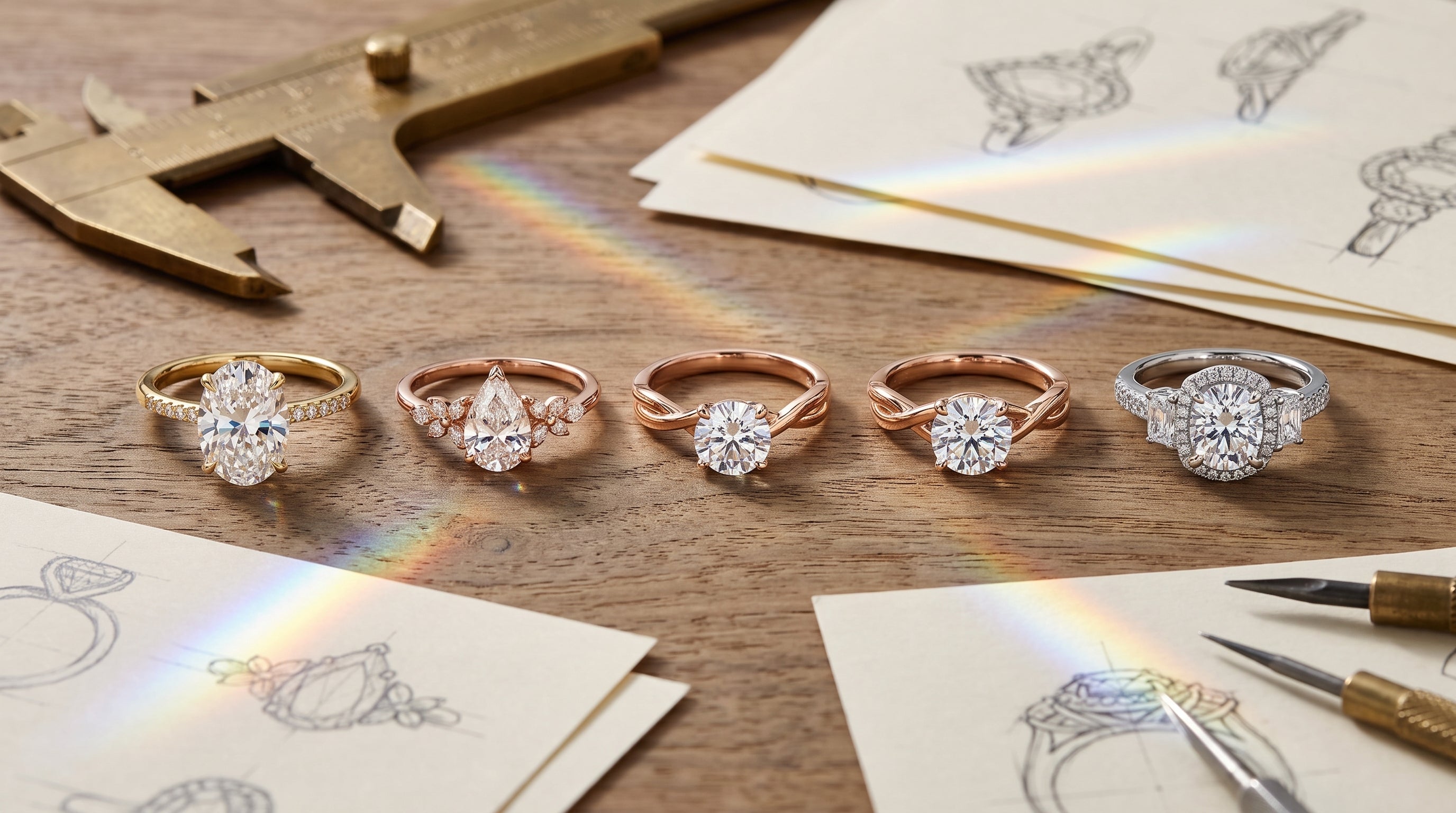
This is what most people picture. Haase Jewelry describes its process as beginning with a personalized design consultation covering ideas, preferences, and budget, followed by initial sketches or digital renderings that get iterated with the client, and finally a crafting phase in which artisans handcraft the ring — a phase that can itself take several weeks. Finks Jewelers describes a similar collaboration in which stone type and shape, metal, setting style, personal details, and sizing are all decided together, and notes that heirloom stones can be incorporated into the new design.
Bespoke gives you total control. It also gives you the longest timeline, the most decisions, and the most opportunities to make an expensive mistake. Finks puts typical completion at four to eight weeks, depending on design complexity and how busy the jeweler is; Engage Studio cites six to eight weeks as its average. Both note that intricate work — hand engraving, unusual stones, elaborate structures — pushes that longer.
Semi-custom: configuring within a design library
This is the modular middle. RockHer's "Build an Engagement Ring" experience lets you start from either a center stone or a setting, choosing among solitaire, halo, three-stone, and vintage-inspired families in platinum or gold, made to order in its Los Angeles atelier. Brilliant Earth's design-your-own flow works the same way: pick a diamond or a setting first, preview the pairing, then finalize online or with an expert.
You're combining pre-designed components rather than inventing a shape. The result is genuinely personal — your stone, your metal, your setting — without the blank-page process. It's usually faster and more predictable than bespoke, because the setting has already been engineered and proven.
Made-to-order: a fixed design, built for you
The third category gets called custom because nothing is pulled off a shelf — each piece is produced after the order, sometimes with a variable or two. Our own Celestine 2CT oval cut moissanite ring sits here: the design is set (a 2 carat oval moissanite center in a claw setting on a full eternity band, in 18K gold vermeil or platinum vermeil), each ring is individually handmade to order, and custom carat-size requests are accepted by email. The center stone is specified as D color with FL/IF clarity — the top of the diamond color and clarity scales.
Made-to-order is the lowest-friction path to a ring that isn't mass-stocked. You give up design authorship; you gain speed, price predictability, and the ability to see exactly what you're buying before you buy it.
Ready-made, for contrast
Engage Studio defines ready-made rings as pre-designed and often mass-produced pieces available in stores or online for immediate purchase — convenient, potentially cheaper through economies of scale, but with limited personalization. Worth naming, because a well-chosen ready-made ring genuinely is the right answer for some buyers, and no guide that pretends otherwise is being honest with you.
What Actually Drives the Price
Across the pricing guides published by custom studios, the same short list of variables comes up repeatedly. Understanding them means you can move a quote up or down deliberately instead of just hoping it lands in range.
1. The center stone — the single biggest lever
BR Diamonds states that a custom engagement ring's cost depends primarily on the diamond's cut, color, clarity, and carat weight, plus setting style and metal. Rustic & Main lists the center stone first among its cost factors. That's consistent across the category: for a diamond ring, the stone is usually the majority of the bill.
But the more consequential decision is stone type, not stone grade. Steinhardt's comparison of moissanite and lab-grown diamonds states that moissanite is typically the least expensive of the main options, because it's silicon carbide produced at scale specifically as a diamond alternative and is therefore priced as an alternative rather than on the diamond curve. Lab-grown diamonds, per the same source, are real diamonds that look and grade exactly like mined stones — with full 4C reports from labs such as IGI or GCAL, and premium tiers from GIA — at prices well under comparable mined stones. Moissanite, notably, is not graded on the diamond 4Cs at all; it uses a different framework.
Steinhardt also notes a visual difference worth knowing before you choose: moissanite has higher dispersion than diamond, which produces more colorful flashes of light. Some buyers specifically want that rainbow fire; others prefer diamond's whiter, more restrained return. Neither is a defect.
If certification matters to you, Liori Diamonds advises buyers who want assurance they're getting real, high-quality lab diamonds to confirm the stones are GIA certified. That's a decision criterion with cost implications — certified stones sit in a different pricing tier than uncertified ones.
2. Metal type and karat
CustomMade's pricing guide gives unusually specific numbers for settings alone, before any center stone: roughly $800–$1,200 for a 10K gold setting, $1,000–$1,700 for 14K, and $1,300–$2,400 for 18K. Higher karat means more pure gold, which means more money — a straightforward lever if you need to trim a budget.
The less obvious part is what each metal costs you after purchase. Bhindi's guide to custom ring mistakes lays out the practical trade-offs: white gold requires regular rhodium replating to keep its bright finish; rose gold can cause reactions in some wearers because of its copper content; yellow gold shows scratches more readily; platinum is strong and dense but more expensive; silver tarnishes and scratches easily; and titanium is light but difficult to resize. The cheapest metal on day one is not automatically the cheapest metal over ten years.
3. Ring weight and design complexity
Rustic & Main includes ring weight among its core cost factors — more metal volume simply costs more, which is why a chunky signet-style band prices differently from a delicate solitaire in the same karat. Complexity is the labor side of the same equation: intricate detailing, hand engraving, and unusual layouts all consume more bench hours. Finks similarly notes that hand engraving, rare stones, and sought-after designers lengthen timelines and raise prices.
4. The sales model itself
This is the factor buyers almost never account for. Engage Studio argues that ready-made rings carry retail markups, middlemen, and inventory overhead, while custom rings can be priced more directly against materials and labor — meaning custom is not automatically the more expensive route. Two rings with comparable materials and comparable complexity can land at meaningfully different prices depending on how they reach you. It's worth asking any jeweler what's actually in the number they quote.
Published Cost Ranges, Side by Side
Here's what the market's own published figures look like when you line them up. Every number below is attributed to the brand that published it — these are not market averages, and no single figure should be read as "what a custom ring costs."
| Source | What they publish | What it describes |
|---|---|---|
| CustomMade | Most custom engagement rings $1,000+; settings $800–$1,200 (10K), $1,000–$1,700 (14K), $1,300–$2,400 (18K) | Bespoke, diamond-oriented, setting cost isolated from stone |
| Alexis Russell | Most custom rings $4,000–$10,000; some designs from around $2,000 | Bespoke, designer-studio positioning |
| MoissaniteCo | Sample listings at $725 and $935 | Finished moissanite engagement rings, stone and setting included |
| Engage Studio | No figures; argues custom can undercut ready-made | Comparative framing rather than pricing |
Two things stand out. First, the diamond-centric bespoke studios cluster in the four figures and climb from there — CustomMade's floor and Alexis Russell's midpoint differ by a factor of several, largely reflecting positioning and stone selection. Second, the alternative-stone path operates in a different order of magnitude entirely: MoissaniteCo's listed examples are complete rings at prices below CustomMade's quoted range for an 18K gold setting on its own.
That comparison is the practical heart of this decision. If your budget is the binding constraint, changing stone type moves the number far more than any amount of design negotiation will.
The Costs That Don't Appear in the Quote
Most pricing guides stop at the purchase. Rustic & Main's article on hidden engagement ring costs is one of the few that doesn't, and it identifies the categories buyers most often forget.
Insurance
Rustic & Main flags ring insurance as a significant ongoing expense that many buyers simply leave out of their lifetime cost calculations. Premiums scale with the insured value, which means a higher-priced center stone carries a recurring cost, not just a one-time one. Factor it in at the budgeting stage, not after the fact.
Resizing — and the designs that can't be resized
Resizing is where custom design and long-term cost collide most sharply. Bhindi warns that rings with stones set all the way around the band can be difficult or impossible to resize, and that wide bands fit differently from thin ones — which makes getting the initial size right far more critical on a custom piece than on a plain band you can adjust later.
Policies vary by retailer and are worth reading before you buy. Greenwich St. Jewelers, for example, publishes that it offers one complimentary resizing within one year of purchase on complete engagement rings bought from the store, covering up to two sizes up or down, with larger adjustments potentially incurring charges or requiring a special order; specially ordered wedding bands are excluded from the complimentary sizing. That is Greenwich's policy specifically — not an industry standard — but it illustrates the shape of the question to ask. In a community discussion thread among ring shoppers, participants reported paying anywhere from roughly $50 to $400 for resizing depending on the ring and the extent of the change; treat that as anecdotal rather than a benchmark, but it confirms resizing isn't trivial.
The strategic point: an eternity band is a beautiful choice and a permanent sizing commitment. Know that going in.
Maintenance and repair
Rustic & Main lists tightening loose gemstones, re-tipping worn prongs, restoring intricate metalwork, and reshaping rings that have gone out of round among the recurring costs of ownership. Greenwich St. Jewelers similarly identifies restoring worn milgrain and engraving, replacing prongs or shanks, filling cracks or breaks in metal, and reshaping out-of-shape rings as services that may carry additional charges.
Design choices drive how often you'll need this work. Bhindi cautions that very thin bands and tiny prongs are prone to breakage, and that certain open settings trap dirt easily — a real concern if the wearer uses their hands heavily at work or in the gym. The most delicate design in the portfolio is not always the one that survives a decade of daily wear.
Warranty conditions
Read the fine print on who is allowed to touch the ring. Greenwich St. Jewelers states that repairs and alterations on its rings must be completed by its own store, and that using outside services voids the warranty. If you move, or if you'd rather use a convenient local bench jeweler, that clause has cost consequences. Ask about it before purchase, not after.
Matching a Path to Your Priorities
The right customization route depends on which constraint is tightest. Here's how the paths actually sort out.
If your timeline is short
Bespoke is the wrong choice. Finks puts typical custom completion at four to eight weeks and Engage Studio at six to eight, and both note that complexity extends it. If you have a date, you need either a ready-made ring or a made-to-order design whose production time you can confirm in advance. Building in buffer matters more than most people expect, because the design-iteration phase — sketches, renderings, revisions — happens before the clock on fabrication even starts.
If your budget is the binding constraint
Change the stone before you compromise the design. Per Steinhardt, moissanite is typically the least expensive of the main options and lab-grown diamonds sit well below comparable mined stones. MoissaniteCo's sub-$1,000 listings demonstrate what that looks like in a finished ring. Trimming karat from 18K to 14K also helps materially, per CustomMade's setting ranges. What tends not to help: shaving carat weight in tenths, or asking a bespoke studio to simplify a design that's already been drawn.
If uniqueness is what you're buying
Engage Studio makes the case directly: custom rings are one-of-a-kind, can reflect a couple's story in each design choice, and offer full creative control over shape, cut, setting, band thickness, and engraving — which is why they often become heirlooms. Finks adds the heirloom-stone angle, where an existing family stone is reset into a new design. If that emotional dimension is the actual goal, bespoke earns its premium and its timeline.
Engage Studio also names the cost of that freedom honestly: with every element open for discussion, decision fatigue is real. Bhindi's warnings reinforce it — buyers who prioritize aesthetics over durability, misjudge sizing, or set unrealistic budgets end up with rings that break, can't be resized, or require painful late-stage compromises. Bhindi's advice on budget is worth repeating: be honest upfront about what you can spend, so the designer can steer you toward feasible choices from the start rather than reverse-engineering a compromise at the end.
If you want a custom feel without the custom risk
This is the case for semi-custom and made-to-order. You see the finished design before you commit, the setting has already been proven in production, the price is fixed rather than estimated, and the timeline is a production schedule rather than a creative process. You don't get to author the shape — but you do get a ring nobody pulled from a display case.
For a deeper walkthrough of the collaborative route, our guide on how to create a custom engagement ring covers the step-by-step process, and twelve ways to personalize a ring covers the smaller touches — engraving, stone placement, band details — that add meaning without adding a bespoke price tag.
Questions to Ask Before You Commit
Whichever path you choose, the same short list of questions separates a smooth purchase from an expensive surprise. Finks recommends looking for jewelers who specialize in custom work, provide sketches or 3D models before production, use responsibly sourced stones, and are transparent about pricing and timelines. Build on that with these:
- Will I see a rendering or sketch before fabrication begins, and how many revisions are included? Haase describes iterating renderings with the client until the design is finalized — confirm that's part of your agreement, and confirm where the revision limit sits.
- Can this design be resized later, and by how much? Ask specifically about eternity bands, wide bands, and any setting with stones near the shank.
- What's included in the quoted price, and what's billed separately? Sizing, engraving, appraisal documents, and shipping are common line items.
- What's the realistic completion date, including design time? Not just fabrication weeks.
- What does the warranty cover, and does outside repair void it? Greenwich's policy is a reminder that this clause exists and matters.
- What certification comes with the stone? For lab-grown diamonds, Liori Diamonds points to GIA certification as the assurance marker. Moissanite is graded on a different framework, per Steinhardt, so ask what documentation the seller provides.
- How durable is this design for the wearer's actual life? Bhindi's point about thin bands, tiny prongs, and dirt-trapping settings deserves a direct conversation, especially for hands-on work.
Where Made-to-Order Moissanite Fits
Our own position in this landscape is specific, and worth stating plainly rather than dressing up as something broader. Awareness Avenue is not a bespoke CAD studio and does not run diamond-selection tools. What we make are individually handmade, made-to-order moissanite rings across a range of shapes, carat weights, and band styles.
The Celestine is representative: a 2 carat oval moissanite center in a claw setting, D color and FL/IF clarity, on a full eternity band of shared-prong stones, in 18K gold vermeil or platinum vermeil, available in US sizes 3 through 13 including half sizes. Each one is made after the order, and custom carat-size requests are accepted by email — that's the customization lever, not a blank-page redesign. Note the eternity band's implication for later resizing, per the durability discussion above: get the size right the first time.
Elsewhere in the range, the Opaline is a 2ct oval, the Adelina Rae a 2ct emerald cut, the Bella Jewel a 3ct emerald cut, and the Twisted Band a 1ct round on a twisted shank. The Althea and Bethany use blue moissanite for buyers who want color rather than colorless. The full moissanite engagement ring collection shows the range in one place.
Who this suits: buyers who want a ring made for them rather than stocked, who are open to moissanite as a primary stone, and who value a fixed price and a known design over creative authorship. Who it doesn't: buyers set on a mined or lab-grown diamond with a specific certificate, or on a shape nobody has made yet. For those, the bespoke studios and diamond marketplaces described earlier are genuinely the better fit, and there's no reason to pretend otherwise.
Putting It Together
The honest summary of the cost question is that "custom engagement ring" has no single price because it has no single meaning. A bespoke diamond ring from a designer studio and a made-to-order moissanite ring are separated by an order of magnitude in price and by two entirely different processes — and both get marketed with the same word.
What you can control, in rough order of impact: the stone type, the stone size and grade, the metal karat, the amount of metal in the ring, the complexity of the work, and the kind of business you buy from. What you should budget for beyond the quote: insurance premiums, the possibility of resizing (or the impossibility of it, on eternity designs), periodic prong and metalwork maintenance, and whatever your warranty's repair clause obliges you to do.
Decide which of the three customization paths you're actually shopping before you compare a single price. Then ask the questions above, in writing, before money changes hands. That sequence — path first, questions second, price third — is what keeps a custom ring from becoming a custom regret.
Related reading: our guide to choosing an ethical engagement ring goes deeper on stone sourcing, and how to choose an engagement ring band covers the durability and comfort trade-offs behind band width and profile.

Leave a comment
This site is protected by hCaptcha and the hCaptcha Privacy Policy and Terms of Service apply.