


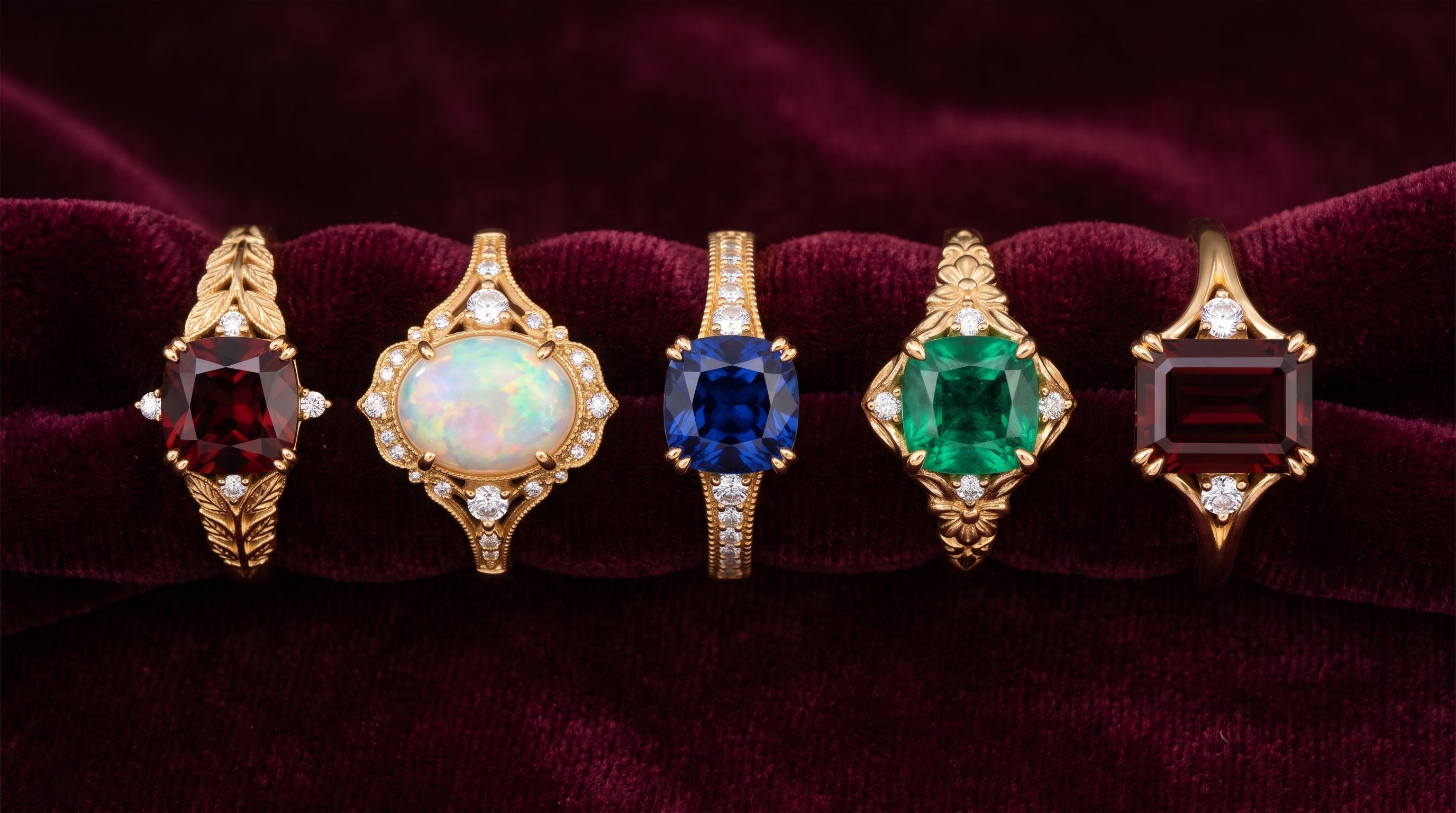
Three rings can all be sold under the phrase "gold birthstone ring," and their inner bands can read 585, 417, or 925. The first two are gold alloy all the way through. The third is sterling silver with gold on the surface. Nothing about the photograph will tell you which is which, and that single ambiguity is responsible for most of the disappointment shoppers report after buying a gold birthstone ring online. This guide sorts the metal question first, then the stone question, then the design question — because in that order, the decisions stop competing with each other.
What "Gold" Actually Means on a Birthstone Ring
Gold purity is expressed in a 24-part system: the karat number tells you how many of those 24 parts are pure gold, with the rest made up of alloy metals such as copper, silver, zinc, and sometimes nickel. That single mechanic explains almost everything else about how a ring behaves — its color, its scratch resistance, and its material cost.
Solid gold: 10k, 14k, and 18k
10k gold is 10 parts gold to 14 parts alloy, which works out to roughly 41.7% pure gold. 14k is 14 parts gold to 10 parts alloy, or about 58.3%. 18k is 18 parts gold to 6 parts alloy, or 75%. All three are real, solid gold alloys: the gold runs through the entire piece rather than sitting on the surface of a different metal. Hallmarks reflect this in parts per thousand — 417 for 10k, 585 for 14k, and 750 for 18k.
Gold vermeil: real gold, but not solid gold
Gold vermeil is a legally defined category in the United States. Under Federal Trade Commission guidance (16 CFR § 23.4), a piece can only be called vermeil if it has a sterling silver base (92.5% silver), a gold layer of at least 10 karat purity, and a gold thickness of at least 2.5 microns. The gold on a vermeil ring is genuine gold. The ring itself is not solid gold, because the core is silver — which is why vermeil pieces are usually stamped 925 or "VERMEIL," and why their scrap value reflects the silver rather than the plating, as the gold layer is too thin to recover economically.
Standard gold plating: the category to watch
Ordinary gold-plated jewelry is a different animal. It typically uses a base metal such as brass, copper, or a nickel alloy, with a gold layer commonly under 0.5 microns — a fraction of the vermeil minimum. It wears through faster, the base metal can tarnish, and it carries more risk for reactive skin. If a listing says only "gold" or "gold tone" without naming a karat or the word vermeil, treat it as plating until proven otherwise.
10k vs 14k vs 18k for a Birthstone Ring You'll Actually Wear
Most shoppers assume higher karat means tougher. The opposite is true for scratch resistance. Pure gold is soft; the alloy metals are what harden it. That makes 10k the hardest of the common jewelry karats and 18k the most easily marked, with 14k sitting in between — which is why 14k is so often described as the sweet spot for everyday rings.
Color
In yellow gold, 14k reads as a warm, saturated gold; 10k looks noticeably paler and more muted because there is simply less gold in it. In rose gold the pattern flips: 10k rose gold shows a more vivid pink thanks to its higher copper content, while 14k rose gold gives a softer, more balanced warmth. 18k yellow gives the richest, deepest tone of the three. If you are matching a birthstone's color — a deep red garnet, a cool blue sapphire — the karat you choose changes the backdrop as much as the setting style does.
Cost logic without guessing at prices
Gold prices move, so ignore any guide quoting a per-gram figure without a date. The durable comparison is the arithmetic of purity: 14k holds roughly 40% more pure gold per gram than 10k (58.3 vs 41.7), and 18k holds about 29% more than 14k (75 vs 58.3). Metal is only part of a finished ring's cost — stones, setting labor, and design matter too — but that ratio explains why a 10k version of the same style is consistently the least expensive solid gold option and why 18k commands the most.
Quick comparison
| Option | Gold content | Hallmark | Scratch resistance | Best for |
|---|---|---|---|---|
| 10k solid gold | ~41.7% throughout | 417 | Hardest of the three | Hard-wearing hands, paler yellow acceptable, vivid rose gold |
| 14k solid gold | ~58.3% throughout | 585 | Good; the common everyday standard | Daily-wear birthstone and mother's rings |
| 18k solid gold | 75% throughout | 750 | Softest; marks most easily | Richest color, lower-impact wear |
| Gold vermeil | Gold surface layer only, min. 2.5 microns at 10k+ over sterling silver | 925 / VERMEIL | More durable than plating; layer can wear over time | Gold look and gemstone color at accessible prices |
| Gold plated | Very thin gold over base metal, often under 0.5 microns | None required | Lowest | Short-term fashion wear only |
If you are searching specifically for "real gold" or "14k gold birthstone rings," the rows that satisfy that intent are the first three. Vermeil belongs in the conversation — it contains genuine gold and a precious-metal core — but it should never be presented as an equivalent to a solid gold alloy.
The Birthstone Decides the Setting, Not the Other Way Around
Gold karat controls how the band ages. The stone controls how the ring can be built and how often it can be worn. Hardness, measured on the Mohs scale, is the practical filter.
Hard stones (Mohs 8–10): safe for daily wear
Diamond (April), ruby (July), sapphire (September), and alexandrite (June) sit at the top of the scale and are generally safe for everyday ring wear. Because they resist abrasion well, they can be set in open prongs that let light in from the sides without exposing the stone to unacceptable risk. If you want a gold birthstone ring you never take off, start here.
Mid-range stones: protect them structurally
Stones of moderate hardness are best served by protective settings — a bezel that surrounds the girdle, or a halo that keeps the center stone slightly recessed — and by taking the ring off for high-impact activities such as gym sessions, gardening, or moving furniture. A protective setting is not a downgrade; on a birthstone ring it is often the design decision that lets you wear the stone you actually want.
Soft stones: opal, pearl, turquoise
Opal (October), pearl (June), and turquoise (December) are the classic soft birthstones. They are best treated as occasional-wear pieces, given gentle handling, and stored away from harder jewelry that can scratch them. This is the single most common mismatch in birthstone shopping: a mother with an October child wants an opal ring for daily wear, and the stone is simply not built for it. A protective setting, a low profile, or wearing the piece on a chain or as a stacking accent are all better answers than hoping for the best.
Cleaning without damage
- Hard stones (8–10): mild soap, warm water, and a soft brush. Ultrasonic cleaning is usually safe for stable, untreated stones in secure settings, but should be avoided if a stone has fractures, heavy inclusions, or certain treatments.
- Mid-range stones: skip ultrasonics and steam entirely; use mild soap and a soft cloth.
- Opals and pearls: do not soak them, and keep them away from harsh chemicals, perfume, and heat.
- Vermeil bands: the gold layer sits on the surface, so limit contact with cleaning products, chlorine, and abrasive cloths, and put the ring on after lotions and fragrance.
One Stone, Two Stones, or Three: Matching the Design to the Meaning
Stone count is where the emotional brief meets the engineering brief. More stones mean more prongs, more edges, and more places for wear to start — which is exactly why metal choice matters more as the count climbs.
Single-stone rings
A one-stone gold birthstone ring is the most versatile format: it can mark your own month, a partner's, or a child's, and it stacks cleanly with other rings later. Fine jewelers commonly present these in solid 14k with a single genuine gemstone, positioned as a modern heirloom rather than a seasonal fashion piece. Because there is only one stone, you can spend the budget on the metal, the stone quality, or both.
Two-stone designs
Two-stone rings usually encode two people — two children, twins, or a parent and child — and they are a staple of the customizable mother's ring category, where shoppers pick two birthstones and choose between sterling silver, 10k, and 14k gold. Bypass and intertwined bands are popular here because they let two different stone colors sit side by side without one dominating. If you are weighing which two months to pair and how to balance clashing stone colors, our guide to choosing a birthstone ring with 2 stones walks through the combinations in detail.
Three-stone and multi-stone mother's rings
Three-stone rings are the most requested mother's ring format, and the configurable versions on the market show how tight the engineering gets. One widely sold three-stone crossover style, for example, is listed with 1.7 mm main stones and 1.5 mm secondary stones, prong-set in a crisscross pattern, and offered in sterling silver as well as 10k and 14k yellow and white gold, with a choice between simulated and genuine stones. At those sizes, stone hardness and prong security matter more than carat weight, and a durable metal is not optional. For everyday mother's rings, established jewelers recommend durable metals such as 14k or 18k gold, or platinum. Our dedicated breakdown of 3-stone birthstone rings covers arrangement order, sizing, and what to do when a fourth child arrives, and the broader birthstone rings for mothers guide compares formats side by side.
One practical note on multi-stone rings: mixing a Mohs 9 sapphire with a Mohs 5–6 opal in the same band means the softer stone will show wear first, no matter how good the metal is. If a family's birth months include a soft stone, consider a bezel for that position specifically, or split the family across a ring and a pendant instead of forcing everything onto one band.
Where Gold Vermeil Birthstone Rings Fit — and Where They Don't
Awareness Avenue's gemstone rings are 18K gold vermeil rather than solid gold alloy, and it is worth being direct about what that means. Under the FTC definition, that construction gives you a sterling silver core with a genuine gold layer of at least 2.5 microns at 10k or higher purity — substantially more gold than standard plating, and a precious-metal base rather than brass. What it does not give you is the intrinsic gold value or the indefinite lifespan of a solid 10k, 14k, or 18k ring. The gold layer sits on the surface, and surfaces on rings take friction.
That makes vermeil a genuinely good fit for some birthstone shoppers and a poor fit for others.
- Good fit: you want a striking birthstone color and a warm gold look at an accessible price; you rotate several rings rather than wearing one every day; you are buying a first birthstone ring, a gift, or a stacking piece.
- Poor fit: you want a single ring worn daily for decades, resized as your hands change, and eventually passed down; you specifically searched for real, solid gold; you want a configurable multi-birthstone mother's ring.
Within the vermeil lineup, the stone does most of the birth-month work. The Red Dream emerald-cut garnet ring pairs a 5-carat lab-created garnet with lab diamond side stones on an 18K gold vermeil eternity band, is described by the brand as hypoallergenic, and comes in US sizes 3–13 — a natural pick for January. The Red Dream lab ruby version covers July with a stone that sits high on the hardness scale. For October, the Iridiana stack opal ring is built as a stacking piece, which is a sensible format for a soft stone: less bulk, less exposure, and the option to wear it alongside other bands rather than as the one ring taking every knock. December-adjacent shoppers drawn to deep blue can look at the Starscape lapis lazuli ring, keeping the same soft-stone caution in mind.
These are single-stone designs, not configurable two- or three-stone mother's rings. If you want two or three specific birthstones set in one band, that is a different product category and you should shop it as such. A workable middle path for vermeil: buy one single-stone ring per person and wear them stacked, which achieves the same symbolism with pieces you can add to over time. Browse the full birthstone jewelry collection to see which months are covered, or the solid gold pieces if intrinsic gold content is your priority.
A Decision Sequence That Prevents Regret
- Decide the wear pattern first. Daily and permanent, or occasional and rotated? Daily-and-permanent points to solid gold; occasional-and-rotated opens up vermeil.
- Check the birthstone's hardness. If it is soft, choose a protective setting, a low profile, or a different format before you choose the metal.
- Pick the karat for the job. 10k for maximum scratch resistance and the lowest solid gold cost, 14k for the balance most fine jewelers default to, 18k for the richest color if you accept softer metal.
- Set the stone count. One stone for versatility, two or three for family symbolism — and remember each added stone adds a wear point.
- Verify the hallmark before checkout. Look for 417, 585, or 750 for solid gold; 925 or VERMEIL indicates a silver core with gold on top.
- Match the size and setting to the hand. High-profile settings catch on fabric and doorframes; low-profile bezels and stacks do not.
If you are still comparing formats — ring versus pendant, one stone versus four — our broader birthstone ring buying guide lays out the trade-offs across stone counts and settings.
Frequently Asked Questions
Is gold vermeil real gold?
The gold layer is real gold, at least 10k purity and at least 2.5 microns thick under the FTC's definition. The ring as a whole is not solid gold, because the core is sterling silver. If your goal is intrinsic gold value, a solid 10k, 14k, or 18k ring is the category you want.
Is 10k or 14k better for a birthstone ring?
Neither is universally better. 10k is harder and more scratch-resistant with a paler yellow tone and a lower metal cost. 14k contains roughly 40% more pure gold per gram, shows a warmer color, and is the standard most fine jewelers use for everyday rings. For a multi-stone mother's ring worn daily, 14k or 18k gold and platinum are the metals commonly recommended.
Can I wear a birthstone ring every day?
Yes, if the stone is hard — diamond, ruby, sapphire, and alexandrite all handle daily wear — or if a mid-range stone is protected by a bezel or halo. Opal, pearl, and turquoise are better reserved for occasional wear with gentle care.
How long does a gold vermeil ring last?
There is no fixed answer, because it depends on how often the ring is worn, what it touches, and how it is cleaned. What is reliably true: vermeil's thicker gold layer and silver base make it more durable than standard gold plating, and less enduring than a solid gold alloy, where the gold cannot wear off because it goes all the way through.
Which birthstone rings work best as gifts for mom?
If she wears one ring constantly, buy solid gold in a hard stone and keep the profile low. If she likes to change her jewelry, a set of single-stone rings she can stack — one per child — gives the same meaning with more flexibility, and can be added to as the family grows.

Leave a comment
This site is protected by hCaptcha and the hCaptcha Privacy Policy and Terms of Service apply.