


Almost every mens chain necklace size chart converges on the same handful of numbers: 18, 20, 22, 24, and sometimes 30 inches. What those charts rarely admit is that these figures are retail conventions describing an average adult male frame, not a measured standard. That is why the same 20-inch chain can rest neatly on one man's collarbone and vanish under another man's shirt collar. So this guide does three things in order: it gives you the length chart and where each size actually lands, it shows you how to convert your own neck measurement into a length, and it covers the dimension most charts skip entirely — width in millimeters.
Men's chain necklace size chart: lengths, centimeters, and where they land
Across jewelry retailer and men's style guides, men's chains are typically sold in an 18–30 inch range, with 18–24 inches forming the everyday core of that range. The table below aggregates the placements those guides consistently describe for an average male build. Treat it as a visual approximation rather than a guarantee: neck circumference, height, chest depth, and pendant weight all shift where a chain settles.
| Length | Approx. cm | Where it lands on an average man | Best suited to |
|---|---|---|---|
| 18 in | 45 cm | Base of the neck, at or just above the collarbone | Slim necks, close-to-the-collar looks, thin chains worn under dress shirts |
| 20 in | 50 cm | At or just below the collarbone | The standard everyday length; works under or over a T-shirt |
| 22 in | 55 cm | A few inches below the collarbone, on the upper chest | Pendants, broader necks, a more visible and relaxed drape |
| 24 in | 60 cm | Mid-chest or upper sternum | Larger pendants and medallions, maximum visibility, bigger frames |
| 26–30 in | 66–76 cm | Lower chest toward the base of the sternum | Statement and streetwear looks, layering with shorter chains |
18 inches: the deliberately close fit
An 18-inch chain sits high — at the base of the neck, above or right at the collarbone. On men with slim necks it reads as a clean, minimal choice, and it is the length most likely to stay hidden beneath a buttoned collar. On thicker necks it can feel snug rather than intentional, which is the single biggest reason men return it. If you like the idea of this length, it is worth reading a dedicated breakdown of what an 18-inch men's chain looks like in practice before committing.
20 inches: the average necklace length for a man
If you only remember one number, remember this one. Retailer guides and men's jewelry blogs repeatedly describe 20 inches (roughly 50 cm) as the standard, most common men's chain length. A 20 inch chain on man typically falls at or just under the collarbone on an average frame. It is the safest default because it works both ways: tucked under a crew neck or dress shirt it is barely visible, and worn over a T-shirt it sits in the natural upper-chest window without needing a pendant to look finished.
22 inches: the pendant and drape length
A 22-inch chain typically falls a few inches lower than a 20, resting on the upper chest. That extra room is exactly what a pendant needs in order to hang clear of the collarbone and stay outside a shirt neckline instead of getting caught behind it. Guides also point to 22 inches as the more comfortable starting point for men with thicker necks or broader shoulders, where a 20 can feel like it is riding the throat.
24 inches and longer: intentional statement territory
At 24 inches a chain generally reaches mid-chest, and from 26 to 30 inches it drops toward the lower chest and base of the sternum. These lengths are chosen for visibility rather than versatility: they carry large medallions well, they read clearly over hoodies and heavier knits, and they are commonly worn by taller or broader men and in streetwear styling. They are also the lengths most likely to catch on clothing and zippers, so weigh convenience alongside the look. For a wider view of the decision, our guide to the best chain length for a man compares these options side by side.
How to measure your neck and turn it into a chain length
A chart is a starting point; a measurement is an answer. The method described across sizing guides takes about a minute.
- Wrap and read. Run a soft tape measure — or a piece of string you can mark and then lay flat against a ruler — around the base of your neck, where a chain would naturally sit. Note where the ends meet.
- Check the looseness. A widely used heuristic is that you should be able to slide two fingers between the tape and your neck. If the tape is flush against the skin, your reading will produce a chain that feels tight.
- Add your allowance. For men's everyday chains, guides recommend adding roughly 2–3 inches to your neck measurement. Add closer to 2 inches for a snug, high-sitting fit; add about 4 inches when you want the chain to clear the collarbone and drape.
- Add 2 inches for a pendant. Men's chain guides consistently advise sizing up by about 2 inches when a pendant is involved, which moves many pendant wearers from 20 inches to 22, or from 22 to 24 for larger pieces.
- Test the drop before you buy. Cut a piece of string to your candidate length, tie it into a loop, put it on in front of a mirror, and try it with the shirts you actually wear. This is the step that catches the two classic errors: a chain that disappears under a collar, and one that lands lower than you expected.
Worked example: a 15-inch neck plus a 3-inch allowance points to 18 inches for a close fit, or 20 inches once you add drape. A 17-inch neck plus 3 inches lands at 20 inches, and adding a pendant allowance pushes it to 22.
20 vs 22 inch chain on man: how to actually decide
This is the most common fork in the men's chain decision, and the guidance across sources is consistent enough to turn into rules.
Choose 20 inches if
- Your neck measures around 15–17 inches and you want the chain to sit at the collarbone.
- You wear collared shirts often and want the option of hiding the chain completely.
- You are buying a bare chain with no pendant, or a small, lightweight pendant.
- You prefer subtle jewelry and want one chain that suits both office and weekend wear.
Choose 22 inches if
- Your neck measures above roughly 17–18 inches, or your build is broad through the shoulders and chest.
- You plan to wear a medium or large pendant that needs clearance below the collarbone.
- You want the chain clearly visible over T-shirts, hoodies, and open collars.
- You dislike the sensation of anything sitting close to the throat.
Two quick scenarios make the difference concrete. An average-build man who mostly wears button-downs and wants a chain that reads as a detail, not a feature, is best served by 20 inches. A broader man who wears crew-neck tees and a pendant, and wants the piece seen, will almost always be happier at 22 — and possibly 24 if the pendant is substantial. If your instinct is already pulling toward the longer end, our 22-inch men's chain guide covers how that length behaves with different chain styles.
Necklace size chart mm: chain thickness and how it pairs with length
Length decides where a chain sits. Millimeter width decides how loud it is. Men's chain style guides break width into four practical bands and pair each with a length range, because a very wide chain at a short length crowds the neck, while a very fine chain at a long length can look lost against the chest.
| Width | Character | Typical use | Length range that suits it |
|---|---|---|---|
| 2–3 mm | Minimal and clean | Everyday wear, office settings, layering, lightweight pendants | 18–20 in for a subtle look; 20–22 in for a discreet pendant |
| 4–6 mm | Balanced and versatile | Daily wear that still reads as jewelry; dresses up and down | 20–22 in as the everyday sweet spot; 22–24 in for relaxed visibility |
| 6–8 mm | Bold and statement-led | Streetwear, evenings out, chains meant to be noticed | 22–24 in or longer, so the width has room to sit |
| 9 mm and up | Heavyweight focal point | Worn as the centerpiece of an outfit, not as a background detail | 24 in and up |
Two practical notes on width
First, weight scales fast. Men's jewelry guides note that a solid 5 mm Cuban link at 20 inches can land in the region of 45–50 grams, and that solid chains beyond 8 mm can exceed 80 grams — enough that a standard lobster clasp becomes the weak point and a heavier-duty clasp is preferable. Second, thicker is not automatically better; the bands above describe different purposes, not a quality ladder. A 2.5 mm rope and a 12 mm Cuban are solving completely different styling problems.
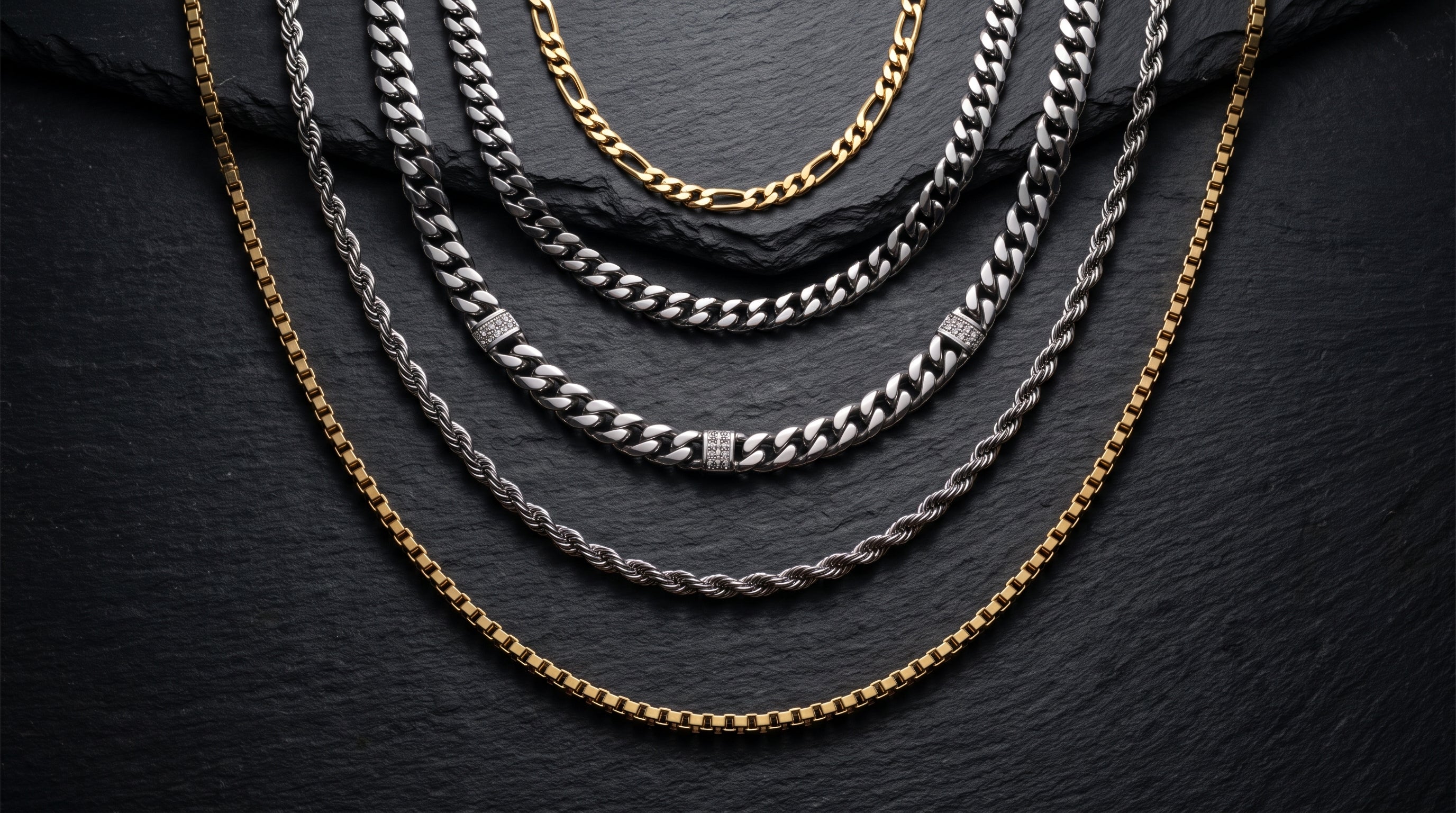
Chain construction also changes how a given width reads. Figaro and rope links show pattern and texture at modest widths, box and wheat links look denser and more solid, and Cuban links look wider than their millimeter number suggests because of how flat and tightly packed they sit. If you are browsing by width, Awareness Avenue's men's jewelry range lists millimeter sizes alongside each chain so you can match the band above to a style you like.
Plus-size and body-type adjustments to the standard chart
Standard charts assume an average frame, so the most useful thing a plus size necklace length chart can tell you is how to adjust those baselines. The adjustments below are drawn from sizing guides that address larger and non-average builds, and they are approximate rather than prescriptive.
| Situation | Adjustment | Practical result |
|---|---|---|
| Broader build or larger neck (men) | Size up 2–4 inches from the chart | 22–26 in for comfortable daily wear, especially worn over clothing |
| Neck circumference above about 18 inches | Start at the long end | 24–30 in for lower-chest placement and statement chains |
| Petite frame | Subtract about 2 inches | Prevents a chain from swamping a shorter torso |
| Tall frame | Add about 2 inches | Keeps the chain from riding too high on a longer torso |
| Fuller bust (women or gifting) | Shift length up or down deliberately | Avoid ending exactly at the bust line; land clearly above or below it |
One caveat worth stating plainly: adding inches for a larger frame restores the visual placement, but it also increases total chain weight. If you are sizing up into 24–26 inches, a mid-range 4–6 mm width will usually feel better through a full day than a 9 mm chain at the same length.
How men's lengths compare with women's necklace sizes
Men's and women's charts use different defaults, which matters if you are gifting a chain or buying a unisex piece in two sizes. The named categories below appear consistently across women's length guides.
| Name | Length | Typical placement |
|---|---|---|
| Collar | 13–15 in (33–38 cm) | High on the neck |
| Choker | 16–17 in (40–43 cm) | Base of the neck to just above the collarbone |
| Princess | 18 in (45–46 cm) | At the collarbone — the everyday standard |
| Matinee | 20–22 in (50–56 cm) | Between collarbone and bust |
| Opera | 28–32 in (71–81 cm) | On or below the bust |
| Rope / lariat | 36 in and up | Below the bust; often doubled or knotted |
The average necklace length for a woman — and what 16 inches looks like
For everyday pendants, the average necklace length for a woman is around 18 inches, the princess length that rests at the collarbone. A 16 inch necklace on woman sits higher, at the base of the neck or just above the collarbone, reading as a close collar or choker. On a petite frame it can drape loosely at the neck and reach the collarbone; on a fuller or plus-size frame the same 16 inches will feel distinctly snugger and more choker-like, which is the main reason a 2–4 inch size-up is recommended.
Why the two charts diverge
Put the numbers side by side and the gap is roughly two inches: women's everyday pendants center on 18 inches, while men's everyday chains center on 20. Larger average neck circumference explains part of it, and styling convention explains the rest — men's chains are more often worn as bare chains at collarbone level, while women's pendants are positioned to sit in an open neckline. If you are buying for a man and instinctively reaching for 18 inches because that is your own size, this is the moment to move up. For neckline-by-neckline styling on the women's side, see our guide on how to choose the perfect necklace length.
Sizing mistakes this chart is designed to prevent
- Buying by eye instead of by neck. Chains look longer laid flat on a table than they do worn. Always convert a neck measurement rather than judging from a product photo.
- Forgetting the pendant. A pendant added to a chain sized for bare wear typically ends up trapped at the collar. Build in the extra 2 inches from the start.
- Ignoring the tightness signal. If a chain leaves a mark or feels like it is resting on your throat, it is too short. Size up or use an extender rather than getting used to it.
- Mismatching width and length. A 9 mm chain at 18 inches crowds the neck; a 2 mm chain at 26 inches reads as almost nothing across a wide chest. Use the mm pairing table as a sanity check.
- Defaulting to one length for layering. Two chains at similar lengths tangle and compete. Choose lengths that land in visibly different zones — one at the collarbone, one on the chest — so each has its own space.
- Gifting blind with no fallback. If you cannot measure the recipient, 20 inches for a man and 18 inches for a woman are the widely recommended defaults, and an extender covers the margin of error.
Frequently asked sizing questions
What is the standard men's chain necklace size?
20 inches. It is described across retailer and men's style guides as the most common everyday men's chain length, sitting at or just below the collarbone on an average frame.
Is a 20-inch chain too short for a man?
Not usually — it is the standard. It becomes too short when your neck measures much above 17–18 inches, when you want a pendant to hang clear of the collarbone, or when you want the chain to be plainly visible over a T-shirt. In those cases 22 inches is the better first choice.
What is the best chain length for a man overall?
For a single versatile chain, 20 inches at 3–5 mm covers the most situations. If a pendant or a broader build is part of the picture, shift to 22 inches. For deliberately bold styling, 24 inches and up with a 6 mm or wider chain is the recognized statement zone.
How do I read a necklace size chart mm?
Millimeters describe the chain's width, not its length. Roughly, 2–3 mm is minimal, 4–6 mm is the versatile middle, 6–8 mm is bold, and 9 mm and above is a heavyweight focal piece. Pair narrower widths with shorter lengths and wider widths with longer lengths.
Should chain length change with the season or outfit?
It can. Shorter lengths of 18–20 inches sit well beneath collars and layers, which suits colder-weather and formal wear. Longer 22–24 inch chains show clearly against tees and open collars, which is why they read as the warmer-weather and casual choice. Owning one of each in different widths is a more flexible answer than trying to make a single chain do everything.
Putting the chart to work
The reliable sequence is short: measure your neck, add 2–3 inches for everyday wear or 4 for drape, add another 2 if a pendant is coming with it, then choose a width band that matches how visible you want the chain to be. Adjust up 2–4 inches for a broader frame, up or down about 2 inches for height, and test the final number with a string loop in front of the mirror before you buy. Do that and the chart stops being a set of averages and starts being your size.

Leave a comment
This site is protected by hCaptcha and the hCaptcha Privacy Policy and Terms of Service apply.