


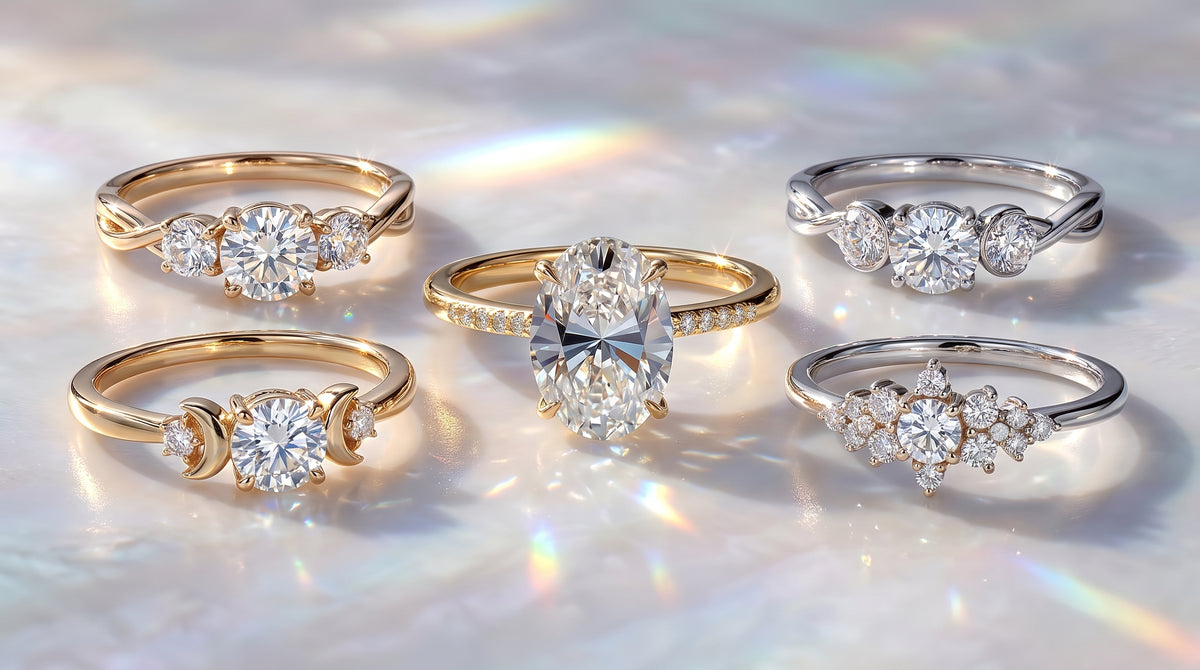
Search "real diamond rings for sale cheap" and the results page contradicts itself within the first screen. A mass-market chain like Zales filters natural diamond engagement rings down to a $100–$249 band. An online jeweler like Blue Nile runs an entire "engagement rings under $1,000" category. A lab-grown marketplace shows a full carat for a few hundred dollars. Meanwhile, an independent review of Costco's jewelry reported a one-carat round solitaire at roughly $4,300 at the time of that review, and Tiffany's engagement collection doesn't offer an under-$1,000 tier at all.
All of those pages can be truthful at once. They are simply selling very different things under the same word: diamond. This guide is for anyone comparing "diamond rings engagement" options across multiple retailers, or typing "real diamond rings engagement" hoping for both authenticity and affordability in one search. It unpacks exactly which lever each seller is pulling to hit a low number, what a cheap ring physically looks like at each price point, and where the genuine scams hide. It also states our position up front, because it matters for how you read the rest: Awareness Avenue sells moissanite engagement rings, not diamonds. We will explain the difference honestly rather than blur it.
What "Real" Actually Means Once You Start Shopping
Most people typing "real" into that search are guarding against one thing: being handed a stone that a jeweler would later call fake. But the market now contains three distinct categories, and only one of them is genuinely misleading when sold carelessly.
Natural diamonds
A natural diamond is crystallized carbon formed in the earth. It ranks 10 on the Mohs hardness scale, making it the hardest naturally occurring material, and its refractive index of about 2.42 with dispersion around 0.044 produces the mostly white, restrained sparkle people associate with a classic solitaire. Its cost is driven by rarity and by the four Cs: cut, color, clarity, and carat. This is the stone that resists being cheap, because price climbs steeply with carat weight.
Lab-grown diamonds are also real diamonds
This is the single most useful fact for a budget shopper. A lab-grown diamond has the same chemical composition, crystal structure, hardness, and optical behavior as a mined diamond. Jeweler education pages from Blue Nile and consumer guides from The Knot both describe the meaningful differences as origin and price, not authenticity. Lab-grown stones are graded against the same criteria and can carry reports from the same laboratories, such as GIA and IGI.
So when a retailer advertises a one-carat "real diamond" ring at a price that would have been impossible a decade ago, the stone is very often lab-grown, and that is a legitimate answer to your search, not a trick. It only becomes a trick when the seller hides it.
Moissanite and simulants are not diamonds
Moissanite is silicon carbide, not carbon. Natural moissanite is vanishingly rare and found in meteorite material, so effectively every moissanite in jewelry is lab-created. It is not a "fake diamond" in the sense of being a worthless imitation; it is its own gemstone with its own properties, including a refractive index of roughly 2.65 and dispersion near 0.104, which is about twice diamond's. That produces noticeably more colored fire. It ranks around 9.25 on the Mohs scale, which is hard enough for daily wear.
What it is not is a diamond. Blue Nile, The Knot, HowStuffWorks, and multiple retailer education pages all say this plainly. Cubic zirconia sits further down the same spectrum: softer, cheaper, and far more likely to dull with wear. If your non-negotiable is the word "diamond," neither belongs in your shortlist, and any site that implies otherwise has told you something important about itself.
The Four Levers That Make a Diamond Ring Cheap
Every genuinely inexpensive diamond ring is cheap for a reason you can identify in under a minute. There are only four levers, and reputable sellers pull them openly.
1. Shrink the stone
The most common lever. Independent buying guidance indicates that below roughly $1,000, a ready-set gold ring with a genuine diamond center typically carries something in the range of one-eighth to one-fifth of a carat, or uses many tiny accent diamonds to build visual mass. That is a real diamond ring, sold honestly. It simply will not look like the two-carat solitaires filling your social feed.
2. Trade away cut quality
A diamond's cut governs how much light it returns. Consumer-protection writing from Brilliance warns that steep "discounts" on natural diamonds frequently reflect poor cut grades rather than a bargain. The stone is authentic; it just sits flat and lifeless on the hand. This is the lever that produces the most buyer's remorse, because the compromise is invisible on a spec sheet that only lists carat weight.
3. Change the origin
Switching from mined to lab-grown is the lever that actually delivers size without faking anything. Marketplace and retailer data consistently show lab-grown stones priced below natural diamonds of comparable grade, but the size of that gap varies enormously depending on the seller, the specifications, and when you look. Clean Origin describes lab-grown as typically priced below mined stones of the same quality, while live-inventory comparisons at marketplaces like Rare Carat have shown far wider gaps on specific matched specs. Treat any single percentage you see quoted as marketing shorthand, not a rule, and compare two stones with identical cut, color, clarity, and carat before you believe a savings claim.
4. Discount the tag
Chain jewelers run frequent promotional pricing across engagement categories, including on certified lab-grown diamond styles with before-and-after prices displayed, and "real diamond rings on sale" banners are common around major shopping holidays. Discounting is normal retail behavior. The question to ask is whether the "before" price was ever the real price, and whether the specs justify either number.
What Your Budget Realistically Buys at the Retailers You're Searching
The secondary searches people run alongside this one, such as "zales diamond rings on sale," "diamond rings for sale costco," and "real diamond engagement rings tiffany," each describe a different strategy. Here is how they map to a tight budget.
Mass-market chains
Zales lists natural diamond engagement rings with price filters that begin around $100–$249 and climb past $5,000, alongside separate lab-grown diamond styles that are often promoted with visible markdowns. This is the easiest place to find something under $1,000 that is unambiguously a diamond. Expect small total carat weight in that band, and read the product detail page for whether the carat figure describes one center stone or the entire ring.
Warehouse clubs
Costco is a value play on larger natural stones, not a source of sub-$1,000 engagement rings. If you searched "costco diamond ring price" expecting a bargain-basement number, temper it: third-party review coverage reported a one-carat round solitaire at roughly $4,300 at the time of that review and noted that the selection is narrow and membership-gated, so you trade control over the four Cs for a simple, competitive package.
Luxury houses
Tiffany's engagement offering is built around brand, design, and craftsmanship, with entry pricing in the low four figures and signature styles running far higher. There is no "cheap" door here. If the Tiffany search is really about a specific silhouette rather than the hallmark inside the band, you can get that silhouette elsewhere for a fraction of the cost, but you cannot get the box.
Online jewelers and marketplaces
Blue Nile maintains a dedicated under-$1,000 engagement ring category, which tells you the $1,000 threshold is a recognized psychological line rather than an arbitrary one. Marketplaces like Rare Carat show natural and lab-grown inventory side by side with grading reports attached, which is the fastest way to see what a specific spec actually costs today rather than what a blog said it cost last year.
Red Flags: When a "Cheap Real Diamond Ring" Is Actually a Scam
Brilliance's guidance on deceptive affordable-diamond marketing identifies the patterns worth memorizing. Most bad purchases in this category involve at least one of the following.
- Vague stone language. Phrases like "diamond-quality," "diamond simulant," "created gem," or simply "stone" in the specification field. A legitimate seller writes "natural diamond," "lab-grown diamond," or "moissanite" without hedging.
- Impossible arithmetic. A three-carat "diamond" solitaire for a few hundred dollars is not a closeout. Published comparisons put three-carat natural diamonds in the five-figure range while three-carat moissanites sit in the low thousands. If the size and the price cannot both be true, the label is what's wrong.
- A lab-grown stone framed as a natural-diamond blowout. Selling lab-grown is fine. Selling it as a miraculous discount on a mined stone is the deception.
- No independent report. If nobody will name the grading laboratory, you have no verifiable claim about what the stone is or how well it was cut.
- No sourcing documentation. For mined stones, ask whether the seller complies with the Kimberley Process and can supply conflict-free documentation.
Why a handheld diamond tester isn't proof
This catches people out. Common thermal diamond testers can read moissanite as diamond, because the two share similar thermal behavior. A jeweler distinguishes them differently: under magnification, moissanite's double refraction makes facet edges appear doubled or slightly fuzzy, while a diamond's facet junctions stay crisp and single. Differences in luster, weight, and light behavior also give it away to a trained eye. For a shopper standing in daylight, the most practical tell is sparkle character. Diamonds throw predominantly white light; moissanite throws noticeably more rainbow flashes.
Your Objections, Answered Directly
"If it's cheap, will people think it's fake?"
Two separate anxieties live inside that question. The first is about being caught in a lie, which only happens if you claim something untrue. Nobody can accuse you of misrepresentation when you say "it's a lab-grown diamond" or "it's moissanite," and both answers are now completely ordinary in the engagement market. The second is aesthetic: will it read as cheap? A well-cut small diamond reads as tasteful. A poorly cut large one reads as dull. A moissanite reads as extremely sparkly, with more colored fire than a diamond of the same size, which is a property of the gem rather than evidence of a bargain.
"Doesn't a cheap ring mean a fragile ring?"
Not for the center stone. Diamond sits at 10 on the Mohs scale and moissanite at about 9.25, and both are widely described as suitable for daily wear. Cubic zirconia is the genuinely soft option that clouds and scuffs over time. The more realistic durability variable at low budgets is the setting and the metal, not the gem, so scrutinize prong construction and what the band is actually made of.
"What about resale value?"
Be realistic about this regardless of which stone you choose. Certified natural diamonds retain the most secondhand value of the three categories, and even they resell for meaningfully less than purchase price. Lab-grown diamonds return comparatively little on the secondary market, and that resale value has been under pressure as supply has expanded. Moissanite has effectively no resale market at all, because it is mass-produced and unlimited in supply. If you are buying an asset, an engagement ring is a poor one. If you are buying a symbol you will wear every day, choose on beauty, durability, and budget.
"Is buying a cheap diamond ethically questionable?"
It can be, which is why documentation matters. Consumer-protection writing in this category flags that unusually cheap mined stones deserve scrutiny of their sourcing chain. Lab-created stones sidestep that concern by construction: both lab-grown diamonds and moissanite are produced in controlled facilities rather than mined, which is one reason HowStuffWorks and similar explainers describe lab-created gems as a more socially and environmentally straightforward option than diamonds tied to conflict mining.
When Moissanite Is the Better Answer to the Same Wish
Here is the honest branch point. If the word "diamond" is the point, whether for tradition, family expectation, or resale, buy a diamond, and make it a lab-grown one if you want size for your budget. Certified lab-grown and natural inventory lives at marketplaces and chain jewelers, not here.
But a large share of people typing "real diamond rings for sale cheap" are describing an outcome, not a mineral: a big, brilliant center stone on a hand, at a price that doesn't wreck the wedding budget. Published comparisons repeatedly show moissanite delivering that outcome at a fraction of natural diamond cost and well below lab-grown diamond cost at equivalent visual size, with hardness that handles daily wear and more fire than diamond produces. That is the trade: you give up diamond identity and resale, and you gain size and sparkle per dollar.
Everything Awareness Avenue sells sits on that branch. Our catalog is moissanite, described as moissanite, in the silhouettes people are usually screenshotting when they start this search:
- The Opaline, a two-carat oval cut, for the elongated solitaire look that dominates engagement inspiration boards.
- The Celestine, another two-carat oval treatment for those comparing oval settings side by side.
- The Adelina Rae, a two-carat emerald cut, where the long step facets show off clarity rather than fire.
- The Twisted Band, a one-carat round cut for anyone who wants the classic proportion at a smaller scale.
- The Bella Jewel, a three-carat emerald cut, which is the size bracket where diamond pricing becomes prohibitive for most budgets.
If you want to browse the full range of shapes before deciding, the moissanite engagement rings collection groups them together. For a deeper walk through cut, setting, and stone selection, see our guide to choosing a moissanite engagement ring. If you are specifically weighing moissanite against lab-grown stones, our comparison of moissanite rings for couples drawn to the lab-grown diamond look lays out the trade-offs by shape, and the roundup of solitaire emerald cut moissanite rings is useful if step cuts are your preference.
A Five-Minute Verification Checklist
Run this before any purchase in this category, at any retailer, at any price.
- Find the stone type in writing. Natural diamond, lab-grown diamond, or moissanite. If the product page won't say, close the tab.
- Separate center carat from total carat weight. A "1 ctw" ring can be twenty small stones. This is the most common source of disappointment in sub-$1,000 diamond rings.
- Prioritize cut over carat for diamonds. Cut is what makes a small stone look alive. Color and clarity compromises are far easier to live with.
- Ask which laboratory graded it. GIA, IGI, AGS, or GCAL reports are the only reliable third-party confirmation of what you're buying.
- Request sourcing documentation for mined stones. Kimberley Process compliance and conflict-free paperwork should be available on request.
- Sanity-check the arithmetic. Compare the advertised size and price against what comparable stones cost at two other retailers on the same day.
- Read the return window. This matters more than any single spec, because it is the only thing that protects you if the ring looks different in person.
Frequently Asked Questions
Can you get a real diamond engagement ring under $1,000?
Yes, and major jewelers maintain entire categories for it. Chain retailers list natural diamond engagement rings starting in the low hundreds, and Blue Nile runs an under-$1,000 engagement ring collection. The honest caveat is scale: independent buying guidance indicates that ready-set gold rings with genuine diamond centers in that band usually carry stones around one-eighth to one-fifth of a carat, or build their look from accent diamonds. Larger center stones at those prices are typically moissanite.
Are lab-grown diamonds considered real diamonds?
Yes. They share the same chemical composition, crystal structure, and optical properties as mined diamonds and are graded by the same laboratories. The differences that matter are origin, price, and resale behavior.
Is moissanite a real diamond?
No. Moissanite is silicon carbide, a separate gemstone. It is not a worthless imitation, and it is exceptionally durable and brilliant, but it is not a diamond and should never be sold as one.
Why do some cheap diamonds look dull?
Almost always cut. A diamond with a weak cut grade leaks light instead of returning it, so the stone reads flat even though it is genuine. Discount listings frequently achieve their price through cut compromises that never appear in the headline carat figure.
Will a jeweler be able to tell moissanite from a diamond?
Yes. Under magnification, moissanite's double refraction makes facet edges look doubled, and jewelers also read differences in luster, weight, and light behavior. A basic thermal diamond tester is not reliable for this, since moissanite can register as diamond on those devices.
Which option holds value best?
Certified natural diamonds, followed at a distance by lab-grown diamonds, with moissanite having effectively no resale market. All three resell for less than you paid, so treat any engagement ring as a purchase rather than an investment.
The Short Version
"Real diamond rings for sale cheap" resolves into three honest outcomes and one dishonest one. You can buy a small or modestly graded natural diamond from a mainstream chain under $1,000. You can buy a lab-grown diamond, which is genuinely a diamond, and get far more carat for the same money. You can buy moissanite, which is not a diamond but delivers more fire and more size per dollar than either. Or you can buy something vaguely labeled from a seller whose arithmetic doesn't add up, which is the only outcome worth actively avoiding.
Decide which word in your search matters most, real or cheap, before you shop. If it's real, go find a graded lab-grown diamond and insist on the report. If it's the look, the size, and the sparkle within a budget you can defend, moissanite was always the straightest path there, and it's worth choosing for what it is rather than for what it resembles.

Leave a comment
This site is protected by hCaptcha and the hCaptcha Privacy Policy and Terms of Service apply.