


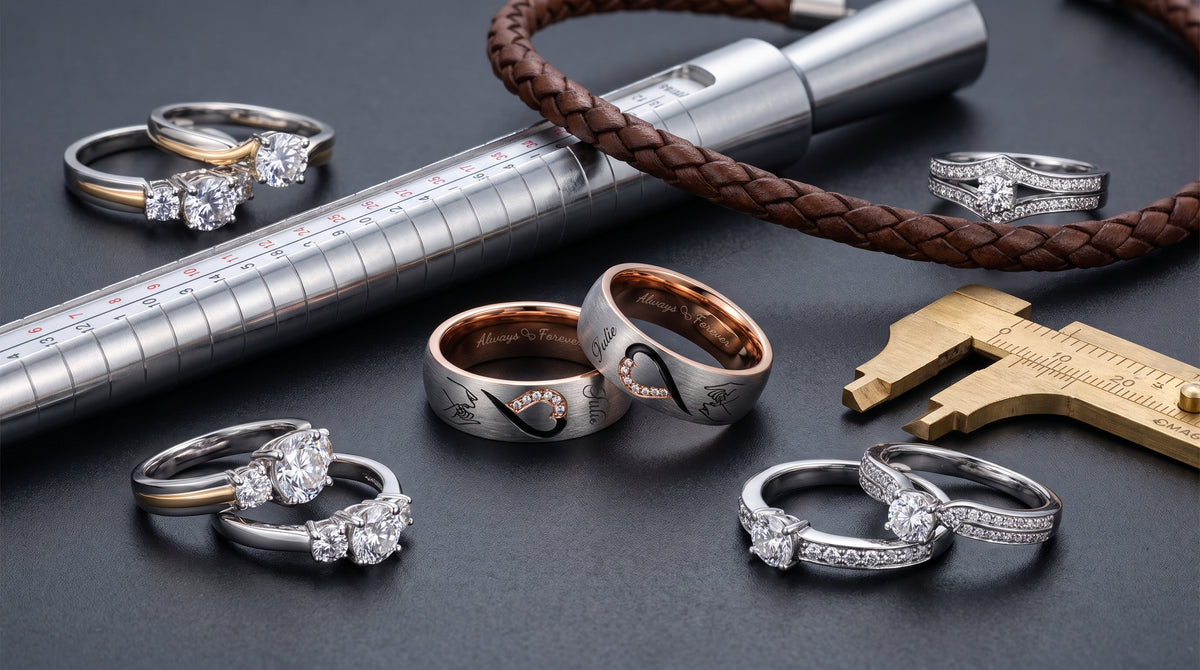
Every ring size calculator you'll find online does the same small piece of arithmetic: it takes one number you supply — a circumference or a diameter — and looks it up against a standardized chart. The tool is rarely the weak link. The number you feed it is. A strip of paper pulled a millimeter too tight, a printout scaled to 97% by a printer's "fit to page" default, or a measurement entered as diameter when the field expected circumference will all produce a confident-looking answer that is simply wrong. This guide is about getting the input right, reading the output correctly, and knowing when to trust a screen and when to trust a ruler.
What a Ring Size Calculator Actually Does
A ring size calculator is a digital tool that determines finger size by taking the circumference or diameter of a finger or an existing ring and converting it into a standardized size.[2] That's the whole mechanism. There's no magic in the conversion — it's a lookup table with some interpolation, sitting on top of one piece of geometry you learned in school.
The one formula behind every chart
Circumference equals pi times diameter: C = πd. In practice, sizing tools use 3.14 as the approximation. AiringSize's paper strip method instructs users to measure the length around the finger, then divide that circumference by 3.14 to get the diameter before matching it to a chart.[18] Run it once and the relationship stops being abstract:
- A 51.9 mm circumference ÷ 3.14 ≈ 16.5 mm diameter — a US size 6.[16]
- A 54.4 mm circumference corresponds to roughly 17.3 mm diameter — a US size 7.[11]
- A 62.1 mm circumference corresponds to about 19.8 mm diameter — a US size 10.[11][15]
Notice how tight the spacing is. Between a size 6 and a size 7, the inner diameter changes by well under a millimeter. That is why a slightly overtightened paper strip — which can easily cost you a millimeter or two of circumference — shifts the result by a full size or more.
Diameter or circumference? Get this wrong and nothing else matters
This is the single most common failure in home sizing, and it is documented directly on jeweler guides. JAXXON warns that many people confuse diameter — the straight-line distance across the inside of the ring — with circumference, the distance around the finger, and that mixing them up throws off the result significantly.[14]
The practical rule: before you type anything into a ring sizer tool online, look at the field label. If it says circumference, it wants the number from around your finger. If it says diameter, it wants the number across the inside of a ring you already own. If a calculator doesn't say which it wants, do a sanity check — adult finger circumferences typically land in the 47–70 mm range, while adult inner diameters land roughly in the 15–22 mm range. A number in the wrong band is a number in the wrong field.
How to Measure Ring Size at Home Without an App
The manual methods are still the baseline that every digital tool is trying to replicate. They're free, they need nothing but paper and a ruler, and they're what you should use to verify anything a screen tells you.
Method 1: The paper strip or string method
This is the approach Awareness Avenue's own ring size instructions describe, and it's echoed across the major sizing resources.[2][11][18]
- Cut a thin strip of non-elastic paper, or use a piece of string. Elastic material stretches under tension and will read small.[1]
- Wrap it around the base of the finger you intend to wear the ring on. Snug, not tight — Zales' sizing instructions specifically caution against wrapping the paper too tightly and advise aiming for a comfortable, snug fit.[8]
- Slide the loop up to your knuckle. This step matters more than any other. The ring has to pass over the knuckle to get on and off, so it must be sized large enough to clear it.[11]
- Mark where the strip overlaps itself.[2][11][16]
- Lay it flat and measure the marked length with a ruler. That length is your circumference.[16][18]
- Either enter that circumference into a calculator, or divide it by 3.14 for the diameter and read your size off a chart.[18]
Be aware of the limitation: the paper and string approach gives approximate results, as Shri Arthi's guide notes plainly.[1] It's a very good approximation when done carefully, but it is not a jeweler's steel mandrel.
Method 2: Measure a ring you already own
If you have a ring that fits the target finger well, this is usually the more reliable route because you're measuring a rigid object rather than compressible skin. Measure the inside diameter — the straight line across the inner edge of the band, not the outer edge — and enter that figure into a calculator or match it to a chart.[2][16][20] A US size 6 measures about 16.5 mm across the inside, for reference.[16]
Two cautions. Measuring a small circle with a standard ruler is genuinely fiddly; align the ruler's zero mark precisely with one inner edge and read the opposite inner edge at eye level to avoid parallax. And confirm which finger the borrowed ring is actually worn on — a ring from a middle finger is not a proxy for a ring finger.
Method 3: A printed ring sizer — and how to prove it's to scale
Printable sizers give you a wrap-around strip and a set of ring circles on one sheet. They work beautifully or not at all, and the difference comes down to scale. Every provider says the same thing: print at 100% scale, or "actual size," and avoid printer settings like "fit to page" that quietly shrink the page.[8][9][10]
Don't take the printer's word for it. TrueSizeRing's PDF builds in two verification devices: a 50 mm line that must measure exactly 50 mm against a ruler, and a box sized to a standard bank card (85.6 × 54 mm) that a real card should fill edge to edge.[10] Ringsize.online similarly instructs users to verify the printout against millimeter or inch scales, and offers a credit card check for anyone without a ruler handy.[9] If the reference line reads 48 mm instead of 50, your entire sheet is roughly 4% small — enough to hand you the wrong size — and you need to reprint before measuring anything.
Using a Ring Sizer on Your Phone: What Works and What to Verify
Phone-based sizing is where the category has moved, and it genuinely is convenient. It also carries assumptions that are easy to miss. There are three distinct approaches, and they are not equally dependable.
Placing a ring on the screen
This is the "actual ring size chart on screen" experience most people are looking for. You lay an existing ring flat on the display over a virtual ring image and adjust a slider until the on-screen circle matches the ring's inner circumference, then read off the diameter and corresponding size.[1] Shri Arthi's instructions add a useful detail: place the phone on a flat surface and center the ring on the image before adjusting.[1] Ringsizecalculator.com uses the same pattern, with a circle outline and a scroll bar to match against a physical ring, plus a country selector for different standards.[2] App-based sizers describe the same workflow, some with a two-point tap for finer precision.[4][5]
The hidden dependency here is display calibration. The on-screen circle is only correct if the tool knows your device's exact pixel density. Some apps state they auto-calibrate per device.[4] Since these calibration claims aren't independently verified in any source we can point to, treat the result as a reading to be confirmed, not a final answer.
Placing a finger on the screen
Instead of a ring, you rest the finger itself on the display and drag a slider until an outline matches your finger's width.[18] Perfect Corp's tool works this way, measuring finger width from screen contact without requiring any image upload.[20] Useful when you own no rings at all — but finger width measured flat against glass is not the same as circumference around a three-dimensional finger, so expect more variance here than with the ring-on-screen approach.
AI camera measurement
The newest approach uses the camera. AiringSize describes holding your hand up to the camera, with AI reading 21 hand landmarks to calculate a ring size in seconds.[18] Glamira's ring sizer app asks users to position a standard card alongside their hand against a contrasting backdrop, with good lighting and a sharp photo — the card serving as a known-size reference for scale.[19]
That card requirement is the tell. A camera has no inherent sense of scale, so it needs a reference object of known dimensions, or hand-landmark modeling, to infer real-world measurements. Lighting and background genuinely affect the outcome, which is why Glamira specifies both.[19]
The honest accuracy picture
Here is the piece most tool pages skip. AiringSize explicitly flags some of its methods as "quick estimate" with roughly ±1 size accuracy.[18] That's a refreshingly candid disclosure, and it's the right mental model for all fast digital methods.
So the working rule is simple: use two independent methods and see if they agree. Measure your finger with a paper strip, then measure an existing ring's inner diameter, then compare. If both point to the same size, you can order with real confidence. If they disagree by a full size, remeasure both before committing. No source in this space claims any tool is perfectly accurate or guaranteed to match a jeweler's physical mandrel, and you shouldn't assume it.
Reading a Ring Size Chart: Millimeters, Inches, and International Systems
Once you have a measurement, the chart does the rest. Ring size charts map standard sizes to inner diameter and inner circumference, and the numbers are broadly consistent across independent providers.[11][15][16] For the full US/UK/AU conversion table, see our detailed online ring sizer guide with printable chart.
Anchor points worth memorizing
- US 5 — about 15.7 mm diameter, 49.3 mm circumference[11]
- US 6 — about 16.5 mm diameter, 51.9 mm circumference[16]
- US 7 — about 17.3 mm diameter, 54.4 mm circumference[11]
- US 9 — about 19 mm diameter, 59.5 mm circumference (roughly 2.34 inches)[15]
- US 10 — about 19.8 mm diameter, 62.1 mm circumference (roughly 2.44 inches)[11][15]
Those five reference points let you eyeball whether a calculator's output is plausible before you act on it.
Working in inches
Inch-based measurements are common, especially among men's sizing searches, and they're where confusion peaks. Size.ly's conversion chart gives clear waypoints: 2.5 inches around the finger is approximately 63.5 mm, near a US size 10.5, while 2.75 inches is about 69.9 mm, near a US size 13.[15]
"What ring size is 3 inches?"
This one deserves its own answer because it's asked constantly and the honest reply is usually "check your measurement." A 3-inch circumference works out to roughly 76 mm, which is larger than standard US ring size charts typically list — closer to a US size 16–17.[14] Sizes that large are uncommon in off-the-shelf rings.[14]
Before accepting that, check the far more likely explanation: you may have measured diameter rather than circumference, a mix-up JAXXON flags directly.[14] A 3-inch diameter would be roughly 76 mm across the inside of a band — physically implausible for a finger ring by a wide margin. Remeasure. If 3 inches really is your circumference, you'll likely need to seek out extended sizing rather than assume a standard chart applies.
International systems
If you're buying from overseas, confirm which system a chart uses. Sizing tools commonly support US, UK, EU, and Japanese standards, and printable sizers often include calibrated versions for multiple systems on one sheet.[5][9][15][18][20] Size.ly's chart converts inch and millimeter circumferences to US, UK, French, and German sizes.[15] A US 7 and a UK size are entirely different numbering conventions describing the same physical band — always convert through millimeters, which are universal, rather than assuming the number on a foreign listing means what it means at home.
The Human Factors That Break Otherwise Good Measurements
Fingers are not fixed objects. A measurement taken at the wrong moment, in the wrong conditions, can be accurate and still give you a ring that doesn't fit the way you want it to.
Time of day and temperature
Fingers are largest later in the day. TrueSizeRing advises measuring in the afternoon when fingers are at their largest, and warns that cold fingers read small.[10] AiringSize recommends measuring at room temperature in the evening, noting fingers are slightly larger then and that this helps ensure an all-day comfortable fit.[18] The practical implication: a size taken on a cold morning may feel uncomfortably tight by dinner. If you've just come in from the cold or from a workout, wait until your hands have settled.
Knuckles
If your knuckle is noticeably wider than the base of your finger, a ring sized to the base won't go on, and a ring sized to the knuckle will rotate freely once it's past. This is why the instruction to slide your measuring loop up to the knuckle exists — the ring must clear it.[11] When your knuckle and base measurements differ significantly, take both and plan on a ring that clears the knuckle, then read the section below on managing the resulting play.
Swelling from health and life circumstances
Awareness Avenue's own sizing guidance notes that fingers can swell during pregnancy or while taking certain medications, and urges readers to account for these factors when measuring.[11] If you're measuring during a period of temporary swelling, you may end up with a ring that's roomy afterward. When that's a concern, it can be worth measuring on more than one day and noting the range.
When you land between two sizes
Round up. Awareness Avenue's instructions recommend choosing the larger size when your measurement falls between two chart values.[11] The reasoning is practical: a ring that's slightly loose can be padded, adjusted, or resized down, while a ring that won't pass your knuckle can't be worn at all. This matters most for fixed-size bands, where there's no give — something worth keeping in mind for matching sets like couples' ring sets, where both partners need an accurate number before ordering. Always check the individual product's own sizing information for the exact size range offered.
Ring Sizers for Loose Rings: What to Do When It Already Doesn't Fit
A significant share of ring sizing searches come from people who already own the ring. It spins, it slides toward the knuckle, or it feels like it might come off. This is a fit-management problem, not a measurement problem — though remeasuring is still the right first step.
Blue Nile's guidance on rings that spin makes the core point: the goal is to improve the fit at the base of the finger while still letting the ring slide over the knuckle.[13] The right solution depends on how much extra space exists, how complex the ring is, your budget, and whether you want the fix to be permanent.[13]
Temporary and reversible fixes
For small gaps, Blue Nile describes silicone ring size adjusters, ring guards, ring wraps, and jeweler's tape applied to the inside of the band.[13] These are low-commitment, inexpensive, and reversible — a sensible first move if you're unsure whether the looseness is seasonal or permanent, or if you want to wear the ring this weekend while you sort out a longer-term answer.
Permanent solutions
For a ring that's consistently loose, Blue Nile points to resizing as the straightforward answer, along with sizing beads, spring inserts, soldering stacked rings together, and adding a hinged shank.[13] Sizing beads and hinged shanks are particularly relevant to the knuckle problem, since they let a ring pass over a wide knuckle and then sit securely at the base.
When to involve a jeweler
Blue Nile recommends consulting a jeweler for pavé settings and high-value pieces.[13] The logic is structural: bands with stones set all the way around, or with delicate micro-set detail, can't simply be cut and rejoined without affecting the setting. If your ring has stones in the shank, get professional advice rather than attempting a fix.
The overarching lesson from that guidance is preventative — the best way to avoid rings spinning is to start with an accurate ring size and choose a setting appropriate to the wearer's lifestyle.[13] Which is precisely why the ten minutes you spend measuring carefully is worth more than any adjuster you buy later.
Sizing Someone Else's Ring Without Asking
Gift and proposal sizing has its own constraints: you can't measure the finger, so you have to work from objects and inference.
Borrow a ring they already wear
This is the most reliable secret method. Awareness Avenue's guidance is to find a ring your loved one wears on the target finger, measure the inside diameter or circumference, and match those measurements to a chart — choosing the larger size if the result falls between two.[11] Measure the inside diameter with a ruler, or trace the inner circle onto paper and measure the tracing if you can only borrow the ring briefly.
Confirm which finger the borrowed ring belongs on. A ring taken from their right middle finger tells you very little about their left ring finger.
When there's no ring to borrow
Fall back on the general principles: err larger rather than smaller,[11] and account for the knuckle. If you're choosing a design where both people need sizes — a matched set, for instance — it's often easier to size one person openly and treat the other as the surprise. For pieces where exact ring sizing is less critical, consider whether a bracelet-style gift such as a leather gift bracelet sidesteps the problem entirely; wrist measurements are generally more forgiving than ring sizes. Check each product's own sizing details before ordering either way.
A note on privacy with camera-based tools
If you're using an AI or camera sizer, be aware that any camera-based measurement involves some degree of image processing. Perfect Corp notes its screen-based tool doesn't require image uploads, and Glamira's approach uses a photo with a reference card.[19][20] If how your images are handled matters to you, read the tool's privacy policy before use — or simply use a printable sizer or paper strip, which involve no data at all.
A Repeatable Sizing Routine
Putting it together, here's a sequence that catches most errors:
- Pick your moment. Afternoon or evening, at room temperature, hands neither cold nor recently exerted.[10][18]
- Run method one. Non-elastic paper strip around the base of the finger, slid up to the knuckle, marked at the overlap, measured flat in millimeters.[11][16]
- Run method two. Measure the inner diameter of a ring that already fits that finger, or use a printable sizer verified at 100% scale with the 50 mm line or bank card check.[10][16]
- Convert deliberately. Circumference ÷ 3.14 = diameter.[18] Confirm your calculator's input field wants the unit you're giving it.[14]
- Compare. Agreement between methods means you're good. A full-size disagreement means remeasure, not average.
- Round up if between sizes.[11]
- Check the product's own sizing information before ordering, since size ranges and fit details vary by design.
Once you have a number you trust, the rest of the decision is about style rather than geometry — whether that means a band you'll stack over time, which we cover in our comparison of eternity bands and stackable rings, or a set you'll wear daily from the rings collection.
Frequently Asked Questions
Is an online ring size calculator free?
Free ring sizing tools are widely available online, including browser-based interactive sizers and downloadable printable sizer PDFs from jewelers and specialist sizing sites, none of which require a purchase to use.[3][8][9][10][17][18][20]
Can I measure my ring size on my phone without downloading an app?
Yes. Several web-based tools run in a mobile browser — you place a ring or a finger directly on the screen and adjust an on-screen outline, with no download needed.[2][18][20]
How accurate are ring sizer apps?
Treat them as estimates. AiringSize labels some of its quick methods as roughly ±1 size accurate,[18] and no source in this space documents independent validation of any app's precision. Cross-check with a manual measurement before ordering a fixed-size ring.
Why does my printed ring sizer give the wrong size?
Almost always a scale problem. The PDF must print at 100% or "actual size," not "fit to page."[8][9][10] Verify using the sheet's built-in reference — a 50 mm line should measure exactly 50 mm, and a bank card should fill its reference box edge to edge.[10]
Should I size up or down if I'm between sizes?
Size up. Awareness Avenue's guidance is to choose the larger size when a measurement falls between two chart values.[11] A slightly loose ring can be padded or resized; one that won't clear your knuckle can't be worn.
What can I do about a ring that spins on my finger?
For small gaps, silicone adjusters, ring guards, wraps, or jeweler's tape inside the band are reversible options. For persistent looseness, resizing, sizing beads, spring inserts, or a hinged shank are longer-term fixes — and pavé or high-value rings should go to a jeweler rather than a DIY solution.[13]
The Takeaway
A ring size calculator is only as good as the millimeter you hand it. Measure with non-elastic material at the right time of day, slide the loop over your knuckle, know whether you're reporting diameter or circumference, verify any printout against a ruler or a bank card, and confirm the answer with a second independent method. Round up when you're between sizes. Do that, and the difference between a ring that lives on your finger and one that lives in a drawer usually comes down to those ten careful minutes — not to which tool you happened to open.

Leave a comment
This site is protected by hCaptcha and the hCaptcha Privacy Policy and Terms of Service apply.