


The three digits stamped inside the band do more work than most shoppers realize. 925 is not a style name or a marketing flourish — it identifies an alloy of 92.5% silver and 7.5% copper. Pure silver is too soft and malleable to hold a center stone through years of daily wear, so the copper is there to add hardness and strength. Pair that alloy with a moissanite center stone and you get the combination behind this search: a ring that reads bright, white and brilliant on the hand while sitting far below the cost of a mined diamond in gold or platinum.
The catch is that most pages competing for this exact phrase are either bare product listings with no context, or moissanite explainers that quietly assume you are buying gold. Marketplace copy makes it worse — some listings describe moissanite as a “lab created diamond,” which is factually wrong and sets up the wrong expectations. This guide stays on the intersection you actually searched for: moissanite in 925 sterling silver, what that pairing does well, where it needs realistic expectations, and how to read a spec sheet before you commit.
What “925” and “Moissanite” Actually Mean on a Ring Tag
925 sterling silver is an alloy, not pure silver
Silver in its pure form is a soft, highly malleable precious metal. It is not suitable for a durable engagement ring on its own, which is why the sterling standard exists. At 92.5% silver and 7.5% copper, sterling silver is meaningfully harder and stronger than fine silver while keeping the bright white color buyers associate with the metal. It is also the most affordable of the common precious metal options for rings when compared with white gold, yellow gold and platinum — the single biggest reason it dominates entry and mid-range moissanite bridal listings.
What sterling silver is not is a hard metal by jewelry standards. Compared with gold and platinum, it scratches more readily, can bend under sustained pressure, and needs more frequent cleaning to stay bright. None of this rules it out for a proposal — sterling silver engagement rings are widely sold, worn and proposed with — but it does mean the ring is a maintained object rather than a set-and-forget one.
Moissanite is silicon carbide, and it is its own gemstone
Moissanite is a carbon silicate — chemically silicon carbide — whereas diamond is pure carbon. Modern moissanite used in engagement rings is lab-created, which is why it can be produced in essentially any size and shape a designer asks for, and why it is widely regarded as one of the more ethical, sustainable center-stone choices: there is no traditional mining step behind it.
Two optical facts matter for how a moissanite ring looks on the hand. First, moissanite has a higher refractive index and higher dispersion than diamond, so it returns more brilliance and noticeably more colored fire — those rainbow flashes under bright or direct light. Second, moissanite shows facet doubling from certain viewing angles, a telltale a trained eye can spot. It is also the only gemstone besides diamond that reads as diamond on a standard handheld diamond point tester, which is where a lot of consumer confusion begins.
The one listing claim you should reject outright
If a product page calls moissanite a “lab created diamond,” the copy is wrong. Lab-grown diamond is crystallized carbon and is chemically and optically diamond; moissanite is silicon carbide with a different sparkle signature. Both are lab-made, both are ethically appealing for the same reason, and both cost far less than mined diamond — but they are separate materials with different hardness, different fire, and different pricing tiers. A seller who blurs that line is either careless or hoping you will not ask. Treat it as a signal to scrutinize the rest of the listing.
Practically speaking: moissanite sits around 9.25 on the Mohs hardness scale, against diamond’s 10. That is high enough for everyday wear in a ring, and the stone is not your durability constraint in a silver setting — the metal is.
How Sterling Silver Behaves as an Engagement Ring Metal
Softness: what it looks like after a year of wear
Expect fine surface scratches and a softening of high-polish areas on a silver band worn daily, particularly on the palm side where the ring meets keys, steering wheels, gym equipment and countertops. This is cosmetic and correctable — a jeweler’s polish restores it — but it happens sooner and more visibly than on gold or platinum. Thin shanks and delicate open-gallery designs are the ones most likely to lose their round shape over time, because a softer alloy has less resistance to being squeezed.
Tarnish and why plating exists
The copper content that gives sterling its strength is also what allows tarnish to develop with exposure to air, moisture, lotions and perfumes. That is why so much of the sterling silver moissanite market is plated: rhodium plating over 925 produces a brighter, whiter, more platinum-like surface with better tarnish resistance, while gold plating (and heavier PVD gold plating, common on moissanite pendants and chains) gives silver a yellow- or white-gold look at a silver price. Plating is a finish, not a permanent layer — it wears at contact points and can be reapplied. When a listing says “18K gold over S925,” you are buying a silver ring with a gold-toned surface, and pricing should reflect that.
Skin sensitivity claims
Sterling silver settings are frequently marketed as lead-free, nickel-free and hypoallergenic, and nickel-free 925 is a common recommendation for people who react to costume metals. Treat those as seller claims to confirm rather than universal truths: ask what the plating is, what the alloy contains beyond copper, and whether the posts, prongs and any inner sleeve share the same composition.
When silver is the right call — and when it is not
Sterling silver makes strong sense if the budget is genuinely tight, if you want maximum visible carat weight for the money, if the ring is a proposal ring you may later reset or upgrade, or if the wearer likes changing styles rather than wearing one ring for decades. It makes less sense for someone with a physically demanding job, someone who never removes their rings, or someone who wants a heirloom-grade piece with no maintenance rhythm. If you are torn, our comparison of sterling silver versus white gold moissanite rings walks through the trade-offs side by side.
Reading the Stone Spec: Color, Clarity, Cut and Millimeters
Color grade: aim for D–E–F
Moissanite is graded on a colorless-to-tinted scale borrowed from diamond conventions. D–E–F stones are colorless to near-colorless and give the most diamond-like appearance, which matters more in silver than in yellow gold: a bright white metal will expose warmth in a lower-grade stone rather than disguise it. If a listing does not state a color grade at all, assume nothing and ask.
Clarity: what VVS actually buys you
High-clarity moissanite — VVS-grade stones in particular — is the norm in premium moissanite jewelry, from bridal sets to statement pendants, because inclusions interrupt light return and blunt the fire that makes moissanite worth choosing. Clarity language is also one of the easiest specs for a seller to overstate, so look for stated grades tied to a specific stone rather than blanket collection-level claims.
Millimeters beat “carat equivalent”
Carat is a weight measure, and moissanite is not the same density as diamond, so “1 carat” in moissanite marketing usually means “the visual size of a 1 carat diamond.” The reliable number is the millimeter measurement: a 6.5 mm round moissanite corresponds roughly to a 1 carat diamond in face-up size. Ask for millimeters on the length and width of fancy shapes too — an oval or marquise at the same stated carat equivalent can look considerably larger or narrower depending on its proportions. If you are weighing visual impact against budget, our breakdown of 1 carat versus 2 carat moissanite covers how size scales on the hand.
Cut and shape
Round brilliants extract the most fire from moissanite’s high dispersion and are the safest choice if you want maximum sparkle. Step cuts such as emerald show fewer rainbow flashes and more of the stone’s clarity and clean lines, which some buyers prefer precisely because the effect reads calmer and more diamond-like. Ovals, marquise and pear shapes maximize apparent size per unit of weight but concentrate wear on the points, which is a genuine consideration in a softer metal.
Setting Styles That Suit a 925 Sterling Silver Band
Setting choice is where silver’s softness should influence your decision rather than just your budget. A few patterns worth knowing:
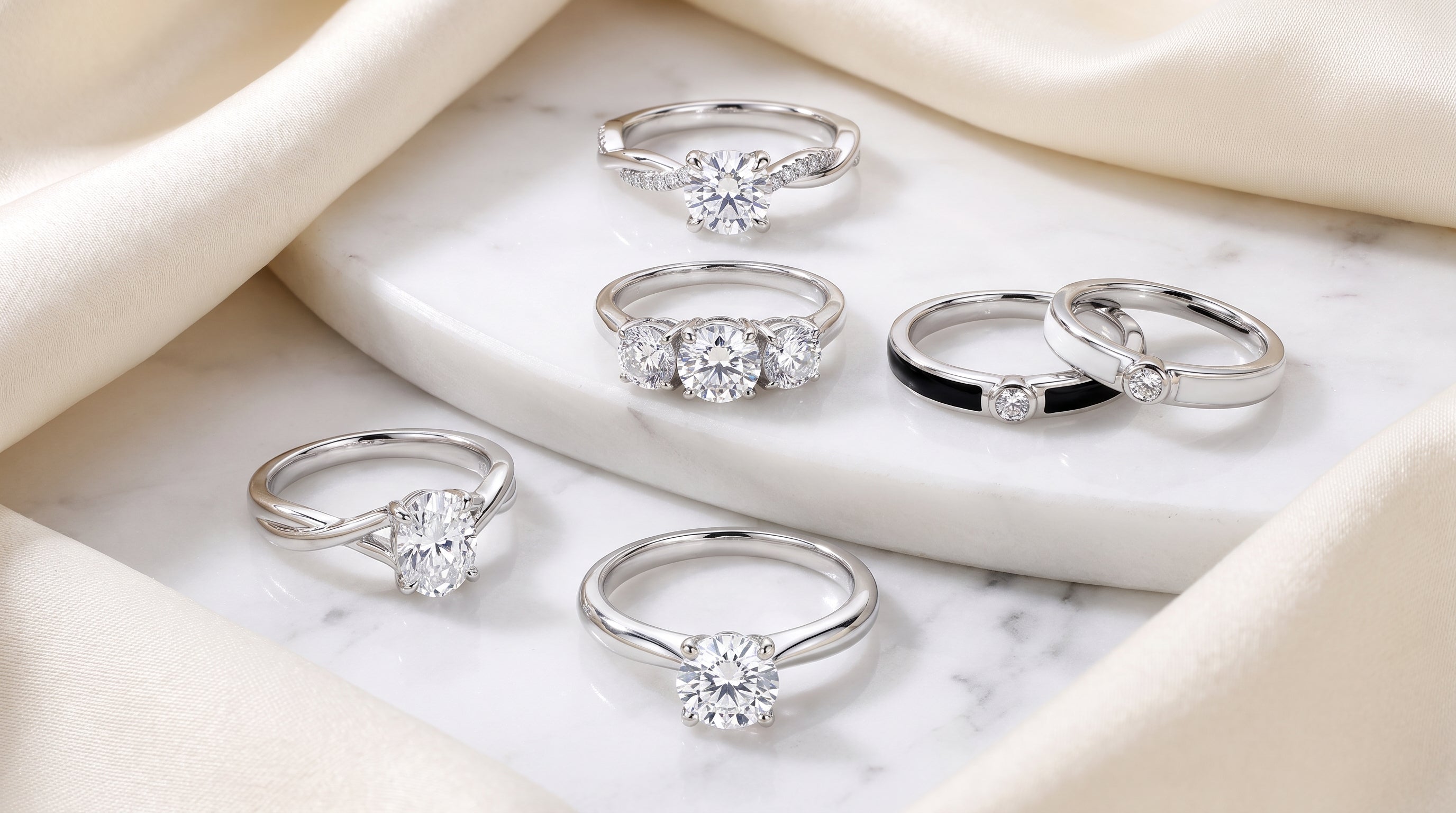
- Solitaires with a supported shank. A classic four- or six-prong solitaire on a band with reasonable thickness is the most forgiving structure in silver. The Opus pairs a round-cut solitaire with a pavé band in S925 sterling silver — a good template for the look most people picture when they search this term.
- Single-row pavé. Small accent stones widen the visual footprint without a bigger center stone. The Gleam is a single-row pavé design in S925 sterling silver. Pavé in any metal deserves a periodic prong check; in silver, make that a habit rather than an afterthought.
- Three-stone. A center stone flanked by two side stones reads traditional and spreads sparkle across the finger. The vintage three-stone round cut design is built on S925 sterling silver.
- Mixed-metal construction. Some designs use sterling silver with gold, such as The Isabella, a 1.5CT princess-cut ring specified as S925 sterling silver with 18K gold. This is the middle path if you want a gold tone without a solid gold budget.
- Sculptural bands. Twisted and bypass shanks — like the 1CT twisted band round cut and its oval-cut counterpart — add movement and hide small surface scratches better than a mirror-flat band, because the eye reads the texture rather than the finish.
- Statement sizes. Larger center stones such as the 2CT emerald cut or the 3CT marquise pavé solitaire are exactly where moissanite’s value proposition shows up most sharply, since stone cost is what makes big diamond centers prohibitive.
Whatever the style, confirm the metal, plating, stone millimeters, color grade and clarity on the individual product page before ordering — those specs vary by design, and a collection page cannot answer them for you. You can browse the full range of moissanite engagement rings or the adjustable sterling silver moissanite rings if sizing certainty is a concern.
Buying the Ring Now Versus Buying the Full Wedding Set
A large share of moissanite bridal inventory is sold as moissanite wedding sets: an engagement ring plus a matching band shaped to nest against it, either straight or curved to follow the center setting. Buying the set at once guarantees the two rings sit flush; buying the engagement ring alone leaves you free to choose the band later, at the cost of a possible gap or an imperfect contour.
Sterling silver adds a third option that gold buyers rarely consider: treat silver as a deliberate first stage. Propose with a silver moissanite ring, wear it through the engagement, then decide at the wedding whether to buy a matching silver band, pair it with a gold band, or reset the center stone into a harder metal. Silver’s low relative cost is what makes that sequence financially sensible rather than wasteful, and the upgrade path is a commonly cited reason people choose silver for a proposal in the first place.
If you do mix metals, plan it deliberately rather than by accident. A rhodium-plated silver engagement ring next to a white gold band will read as one continuous white metal to almost everyone; a warm yellow gold band against unplated silver will read as an intentional two-tone stack. What looks unresolved is an unplanned mismatch in tone — slightly different whites sitting side by side.
Coordinating Earrings, Pendants and Chains in Moissanite
Most people searching for a moissanite engagement ring end up buying a second moissanite piece within the year, and the decision criteria carry over almost unchanged. The rules of thumb:
Match the color grade, not just the metal
If your ring center is D–E–F, keep studs and pendants in the same range. A warmer stone next to a colorless one is more obvious across a face than across a hand, because earrings and a ring are rarely seen in the same glance while a pendant and studs often are.
Use millimeters for earrings too
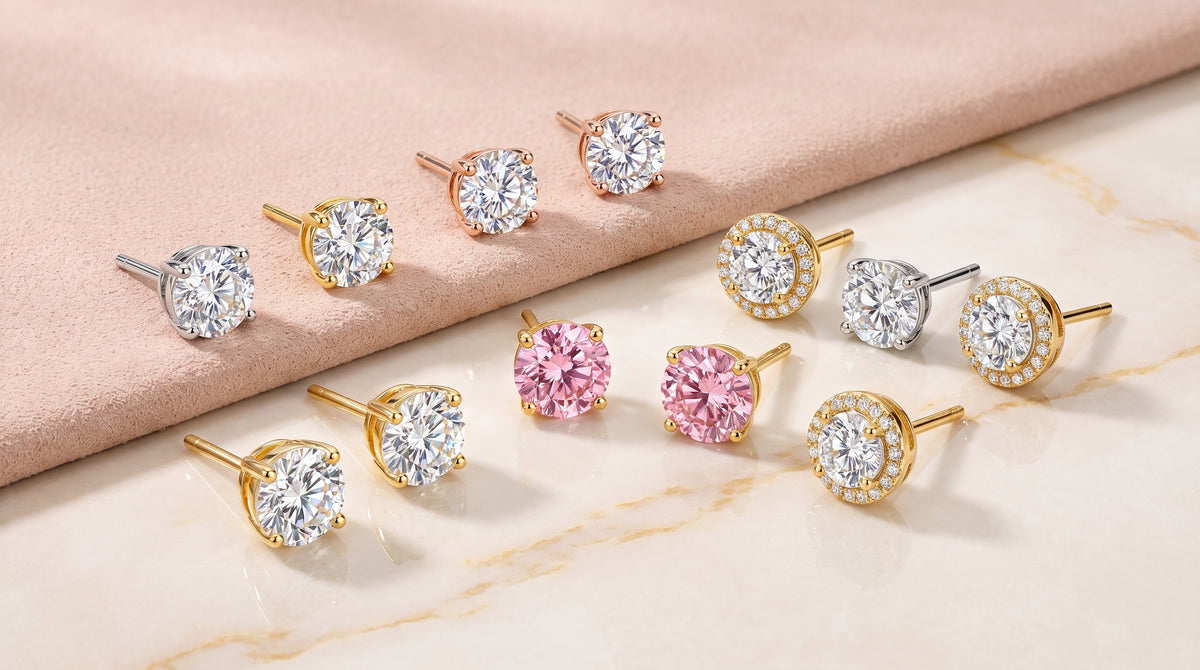
Stud sizing follows the same logic as center stones: 6.5 mm rounds deliver the classic look of 1 carat moissanite earrings per ear. Nickel-free 925 sterling silver and solid gold are the usual recommendations for stud settings worn daily, particularly for sensitive ears. Whether you prefer sterling silver moissanite earrings or moissanite earrings gold designs, our roundup of sterling silver moissanite earring styles covers shapes and settings in more depth.
Pendants and chains are a different durability question
When shopping for a moissanite chain and pendant, remember that pendants and chains take less abrasion than rings but more stress at the bail and clasp. A vvs moissanite pendant is the standard for high-sparkle pendant work, and 925 silver bases with gold plating are common in that category for the same cost reason they are common in rings. If you are commissioning a moissanite pendant custom design, the specs to lock down are stone grade, total stone count, plating type and chain gauge — our guide to a VVS moissanite custom pendant lays out the spec sheet to request.
Care Routine for a Sterling Silver Moissanite Ring
Silver rewards a small amount of consistent attention. A workable routine:
- Remove it for wet and abrasive tasks. Washing up, swimming, cleaning with household chemicals, gym sessions and gardening are where both scratching and tarnish acceleration happen.
- Clean gently and often. Warm water, a drop of mild dish soap and a soft brush around the setting removes the film that dulls light return. Dry thoroughly — trapped moisture is what tarnish feeds on.
- Be careful with polishing cloths on plated pieces. A silver polishing cloth is fine on unplated 925 but will gradually thin rhodium or gold plating. On plated rings, stick to soap and water and let a jeweler handle restoration.
- Store it dry and sealed. An anti-tarnish pouch or a small zip bag with the air pressed out slows tarnish dramatically compared with an open dish.
- Check the prongs. Every few months, run a fingernail around the setting and listen for rattle when you shake the ring near your ear. In a softer metal, catching a loose prong early is the difference between a small repair and a lost stone.
A Pre-Purchase Checklist
Before you order any 925 sterling silver moissanite engagement ring, get answers to these:
- Is the band solid 925 sterling silver, and is it plated? With what — rhodium, white gold, yellow gold?
- What is the center stone’s color grade and clarity grade, stated for that specific stone?
- What are the center stone’s millimeter dimensions, not just its carat equivalent?
- Are the accent stones moissanite, and are they graded, or are they unspecified?
- Does the listing describe moissanite accurately, or does it call it a diamond of any kind?
- Is there a matching band available now if you want a set later?
- What is the resizing situation — can the shank be sized, and does pavé coverage limit that?
A seller who answers all seven without hedging is one worth buying from. A listing that answers none of them is selling ambiguity, whatever the photography looks like. Moissanite in 925 sterling silver is a legitimate, well-supported engagement ring choice — a genuinely brilliant lab-created gemstone in a real precious metal alloy — provided you buy it with clear eyes about what silver asks of you in return.

Leave a comment
This site is protected by hCaptcha and the hCaptcha Privacy Policy and Terms of Service apply.