


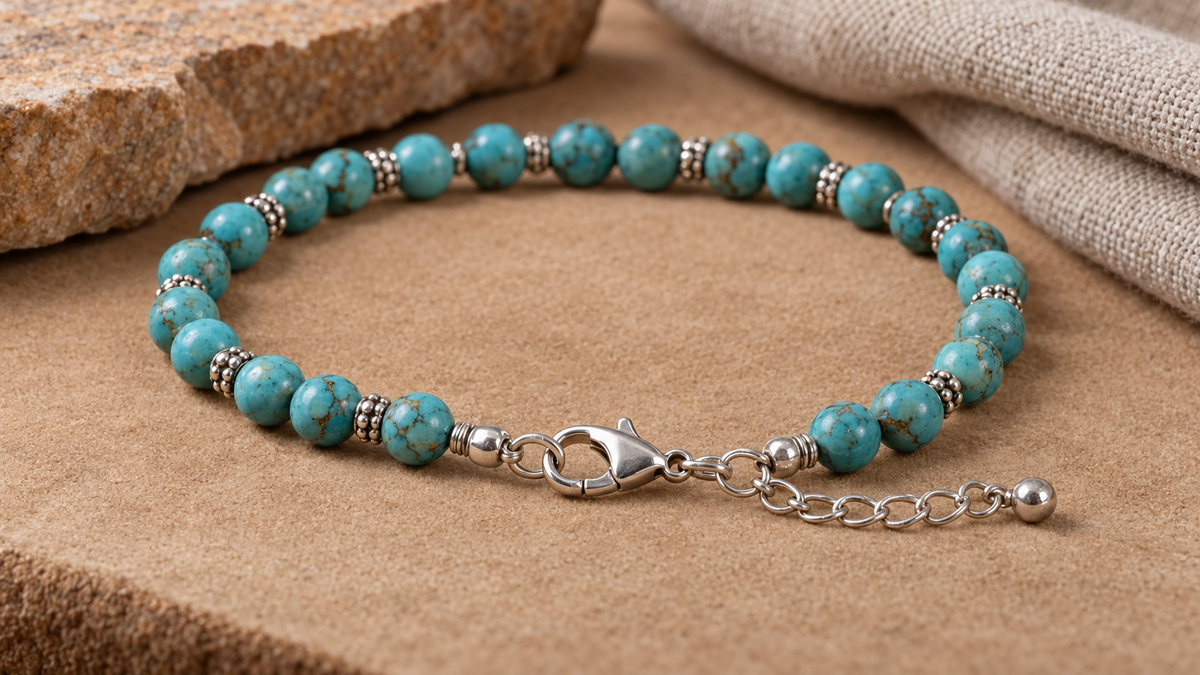
Two bracelets can carry the same label, "sterling silver turquoise bracelet," and still be very different purchases. One may hold stabilized turquoise in a micro-pavé star station on a fine chain. Another may string round turquoise beads between silver spheres, with a description that says "premium turquoise" but uses no treatment term. A third may be a rigid open-back cuff that has to be measured in a completely different way. This guide sorts out those differences before you buy. It covers how the bracelet is built, what the metal claim means, which stone treatments sellers should disclose, how to measure, and which origin claims need written proof.
This is a decision guide, not a catalog. To browse current inventory, use the Southwestern turquoise jewelry collection. The aim here is to help you read any listing, including ours, with the right questions in mind. Every Awareness Avenue detail below comes from the seller's own product descriptions and applies to the S925 sterling silver variant. None of it has been independently tested. Prices are left out because they depend on your currency and the variant you choose on the live product page.
What this guide covers, and what it deliberately does not
Searches around this topic split into several distinct shopping tasks:
- Modern sterling silver turquoise bracelets in chain, station and bead styles. The Awareness Avenue listings reviewed here belong to this group.
- Turquoise cuffs. None of the Awareness Avenue products reviewed here is an open-back cuff. The cuff-fitting section below is general guidance for shopping elsewhere, not a hidden recommendation.
- Men's turquoise bracelets. None of the reviewed listings is presented as a men's design. Anyone can wear any of them, but fit depends on the stated length range, so measure first.
- Native American, Navajo, vintage and antique bracelets. These need documented maker and age evidence. No reviewed Awareness Avenue product is documented as Native-made, vintage or antique, and none should be treated as a substitute for one.
Start with construction: chain, station, bead or cuff
Construction decides how a bracelet fastens, how it is measured and how the stones are exposed. That makes it a practical first filter.
Station and bar chains
A fine chain carries one or more set stones, and length is usually adjusted with a clasp and extender. Among the reviewed listings:
- The Paloma has three circular stations.
- The Estrella has a single star-cutout station.
- The Oasis Infinity centers an infinity symbol.
- The Escalante uses a channel-set turquoise bar.
Bead bracelets
Silver and stone beads are strung or linked into a continuous strand. The Marfa and the Rio pair round silver beads with turquoise. The Alamosa uses square silver beads with turquoise accents.
Two listings mix turquoise with other materials. The Desert Sky adds carnelian and black onyx, and the Amado adds freshwater pearls. Choose those two only if you want a multi-stone look rather than turquoise alone.
Cuffs and bangles
A cuff is open at the back, and a bangle is a closed ring. Neither has an extender, so fit depends entirely on the published dimensions. Seller terminology varies, so check the photos and dimensions as well as the product name.
What "sterling silver" on a listing should tell you
FTC consumer guidance defines sterling silver as 92.5% pure silver. It explains that a 925 mark means 925 parts per thousand silver (FTC). The FTC Jewelry Guides say "sterling" representations should not be used unless the product is at least 925/1,000ths silver (FTC Jewelry Guides). That gives the term a defined meaning, unlike "silver-tone."
Some limits are worth keeping in mind:
- A stamp is evidence, not an assay. A 925 mark or an "S925" description is the seller's representation. It does not mean anyone has independently tested the bracelet.
- Check which parts the claim covers. The Marfa listing, for example, describes "S925 Sterling Silver spacer beads." Ask whether the clasp, extender and stringing are also sterling.
-
Select the right variant, because the stones can change too.
- Every reviewed Awareness Avenue listing except Coastal Elegance offers "14K White Gold" and "18K White Gold" options alongside "S925 Sterling Silver." Those options are not sterling silver.
- Each of those descriptions includes a "Gold Upgrade Bonus" line. It says all 10K/14K/18K orders include an automatic upgrade to VVS Moissanite (Center & Accent stones).
- The stone details in this guide therefore describe the S925 variant only. Do not assume they carry over to a gold order.
- If you consider a gold option, confirm its exact metal construction and stones with the seller before you buy. For a sterling silver turquoise bracelet, choose the S925 variant.
- Read metal-performance claims as seller statements. Several listings call their silver hypoallergenic or nickel-free, or describe it as built for everyday endurance. These are first-party claims, not test results. The Oasis listing says the silver will never tarnish, while other listings say sterling develops a patina over time. Plan on occasional polishing.
Read the turquoise label before you judge the color
GIA states that turquoise is commonly treated to improve its stability or color (GIA).
The FTC lists dyeing, reconstitution and stabilization among turquoise treatments. It describes stabilization as introducing clear, colorless material into porous turquoise to toughen it and enhance its color. It also says sellers should disclose treatments that affect care, durability or value (FTC).
The AGTA enhancement brochure is a useful reference on common enhancements and the special care they can require (AGTA).
Terms to look for
- Stabilized turquoise: mined turquoise treated to improve stability. This is a disclosure term, not a quality grade.
- Dyed: color has been added.
- Reconstituted: the FTC lists reconstitution as a separate treatment from stabilization. Ask the seller to explain the material if you see this term.
- Untreated or natural: a significant claim that should be backed by documentation.
- Vague terms only: words like "premium" or "hand-selected" describe marketing, not treatment.
Several Awareness Avenue listings call their turquoise both "natural" and "professionally stabilized." Read that as natural, mined turquoise that has been stabilized, not as untreated stone.
Matrix and mine names
GIA notes that matrix can appear in several colors and that preferences for matrix patterns vary. It also says known origin may interest collectors, but quality is the primary pricing factor (GIA).
Matrix does not prove a stone is genuine, and an even blue does not prove it is fake. Photographs cannot settle either question; written disclosure can.
How the Awareness Avenue bracelets compare on paper
Each cell below reflects the seller's current product description for the S925 sterling silver variant. "Not stated in description" means only that the reviewed text did not specify the detail, so ask the seller before relying on it.
| Bracelet | Form | Turquoise wording | Stated stone size | Length (seller) | Clasp (seller) |
|---|---|---|---|---|---|
| Paloma | Three-station chain | Genuine stabilized turquoise | 10mm center cabochon, 5.7mm side accents | 6 in + 1.5 in extender; fits wrists up to 7.5 in | Lobster, soldered links |
| Estrella | Single star station, micro-pavé | Genuine stabilized turquoise | 8mm x 27mm station | 6 in + 1.5 in extender; up to 7.5 in | Not stated in description |
| Oasis Infinity | Infinity station chain, bezel and micro-pavé | Genuine stabilized turquoise | 5.8mm x 14.7mm focal | 6 in + 1.5 in extender | Not stated in description |
| Escalante | Bar chain, channel setting | Genuine stabilized turquoise | 2.5mm x 32.5mm bar | 6 in + 1.5 in extender; up to 7.5 in wrists | Lobster |
| Marfa | Round bead bracelet | Premium turquoise round beads | Not stated in description | 6.2 in + 1.6 in extender; up to 7.8 in | Not stated in description |
| Rio | Silver bead chain with turquoise beads | Turquoise beads | Not stated in description | 6.2 in + 1.6 in extender; up to 7.8 in | Not stated in description |
| Alamosa | Square silver bead bracelet | Natural turquoise accents | Not stated in description | 6.2 in + 1.6 in extender; up to 7.8 in | "Secure clasp" (type not named) |
| Desert Sky | Mixed-stone bead bracelet | Natural turquoise with carnelian and black onyx | Not stated in description | 6.2 in + 1.6 in extender; up to 7.8 in | Heavy-duty S925 lobster |
| Amado | Mixed-stone bead chain | Hand-selected natural turquoise with freshwater pearls | Not stated in description | 6.2 in + 1.6 in extender; up to 7.8 in | Lobster |
What the table shows.
- Station and bar chains: Paloma, Estrella, Oasis Infinity and Escalante are the only bracelets in the table that use a treatment term (stabilized) and state stone dimensions.
- Bead bracelets: they offer slightly longer stated ranges, but none uses a treatment term. Ask before ordering if stabilization status matters to you.
- Origin details: the reviewed descriptions for these nine bracelets do not state a mine, a manufacturing country or a named maker. Ask the seller if those details matter to you.
Why Coastal Elegance is not in the table
Coastal Elegance is described as having an S925 sterling silver base layered with platinum. It comes in one size of 8.3 inches (21cm). Its description refers to its stones both as "ethically-sourced diamonds" and as a "synthetic diamond," so the accent-stone identity is not clearly stated. It also does not identify the turquoise or its treatment.
For those reasons it cannot be compared fairly on the stone criteria this guide uses. Its platinum layering also makes it a different metal proposition from the plain sterling pieces.
Measuring for fit
Chain and bead bracelets
- Wrap a soft tape measure around your wrist just above the wrist bone. A paper strip also works: mark where it overlaps, then measure it flat.
- Compare that number with the bracelet's stated range. The reviewed listings run from a 6-inch or 6.2-inch base up to 7.5 or 7.8 inches with the extender fully used.
- If your wrist measures close to the top of a range, remember that a bracelet whose full length equals your wrist circumference has no slack. Several of these listings phrase the maximum as "fits wrists up to" a number, so ask how much ease that assumes before ordering.
- To check a bracelet you already own, unfasten it and lay it straight, then measure from end to end, including the clasp. Measuring a fastened bracelet across its loop gives roughly half its length, not the full length.
Men's sizing
None of the reviewed Awareness Avenue listings is marketed as a men's bracelet. This guide does not judge suitability by appearance. The useful question is the number: if your wrist measurement plus some comfortable ease goes beyond 7.5 or 7.8 inches, these stated ranges will not fit, whatever the style.
For broader silver jewelry guidance written for men, see our men's silver chain styles guide and our men's amethyst bracelet guide.
Cuffs, if you shop elsewhere
Some specialist cuff listings, such as SilverTribe's, give the inside circumference, the opening (gap) and the width. SilverTribe works out cuff fit from the inner circumference plus the opening (SilverTribe).
T.Skies advises that if a cuff is adjusted at all, pressure should go at the ends rather than across a stone (T.Skies). Only adjust a cuff if the maker says it is designed to be adjusted.
Native American, Navajo-style and vintage claims
Origin wording is a legal matter, not just a style choice. FTC guidance says post-1935 work marketed as Native American, Indian or the work of a named tribe must meet a maker-status rule. It must be made by an enrolled member of a federally or state-recognized tribe or by a certified non-member Indian artisan (FTC). The Indian Arts and Crafts Act prohibits false claims of Native or tribal authorship (U.S. Department of the Interior).
How to read the claim on a listing
- Southwestern-inspired or Navajo-style: describes the look only. Several Awareness Avenue bead listings use this language, including references to the "Navajo pearls" silhouette. No reviewed Awareness Avenue page names a Navajo maker or a tribal affiliation, so these bracelets should not be described as Navajo-made or Native American-made.
- Made by a named Navajo artist: ask for the artist's name, tribal affiliation and written documentation.
- Vintage or antique: expect date or period evidence, condition notes, repair history and provenance. An oxidized or "antique" finish, which the Estrella and Escalante listings describe, is a surface treatment and says nothing about age.
The Department of the Interior and the FTC both advise getting written proof. They also recommend having the material, maker and origin details recorded on your receipt (DOI consumer tips; FTC).
Marketplaces such as 1stDibs list vintage Navajo-attributed bracelets. Those attributions are supplied by the sellers and still need documentation.
Caring for turquoise and sterling silver
GIA recommends cleaning turquoise with warm, soapy water and advises against steam and ultrasonic cleaners (GIA care guide). It also advises keeping turquoise away from cosmetics, chemicals and high heat (GIA). For technical background on how resin-filled turquoise is identified, see GIA Gems & Gemology.
The seller's own care lines are not consistent:
- The Paloma, Estrella, Oasis Infinity and Escalante descriptions say to avoid wearing the bracelet in water and to keep lotions off the stone.
- The Marfa description calls its design "water-safe."
Follow the more cautious advice: take any turquoise bracelet off before swimming, bathing or applying lotion or perfume.
Sterling silver can develop a patina. The Rio listing says it can be polished with a soft cloth, and the Alamosa and Amado listings say the silver can be polished. Polish the silver only, and keep cleaning products away from the stones.
Returns and warranty before you order
Several product descriptions mention an "Awareness Avenue Lifetime Warranty." The current FAQ describes the warranty as covering eligible manufacturing and craftsmanship defects, not improper use, accidents or normal wear.
The FAQ also sets out three return categories (Awareness Avenue FAQ; made-to-order policy):
- Eligible stock items may be returned within 14 days after receipt.
- Regular made-to-order items are exchange-only.
- Customized made-to-order items are generally final sale unless defective or covered by the warranty.
The product pages reviewed here do not say which category each bracelet falls into. Confirm this before you buy, especially if you are near the edge of a size range. Check the shipping and delivery page for current shipping terms rather than relying on wording repeated on individual product pages.
Frequently asked questions
Is stabilized turquoise real turquoise?
Stabilization is a treatment applied to mined turquoise. The FTC describes it as introducing clear, colorless material into porous stone (FTC). That makes it different from reconstituted material or an imitation. It should be disclosed, but stabilization alone does not make a stone fake.
Does a 925 stamp prove the whole bracelet is sterling?
No. A stamp is the maker's or seller's representation. Ask which components are sterling, and keep the written description with your receipt.
Which Awareness Avenue bracelet has the most complete disclosure?
On the seller's stated details, Paloma and Escalante each list the metal, the stabilized treatment, stone dimensions, a lobster clasp and the wrist range. Estrella and Oasis Infinity also state treatment and stone size, but their descriptions do not name a clasp type. This compares disclosure completeness, not quality, and it applies to the S925 variant.
Can I wear these bracelets every day?
The seller describes several pieces as designed for daily wear, but that is a first-party claim, not a test result. Turquoise is sensitive to chemicals and heat (GIA). Taking the bracelet off for water, cleaning and cosmetics is the cautious approach.
Should I choose untreated turquoise?
Only if that matters to you and the seller can document it. Preferences vary, and GIA notes that quality, not origin alone, primarily drives price (GIA). For a broader look at reading sterling silver listings critically, see our honest sterling silver moissanite ring guide.

Leave a comment
This site is protected by hCaptcha and the hCaptcha Privacy Policy and Terms of Service apply.