


There is a moment most moissanite shoppers hit, usually around midnight, three tabs deep: one page insists moissanite is a brilliant, ethical, budget-freeing choice, and the next lists seven reasons never to buy it. Both pages are written by jewelers. Both are partly right. The disagreement is not really about the stone's properties, which are well documented and not in dispute, but about which trade-offs matter to which buyer.
So this article does not argue that moissanite is universally worth buying. It works through the objections one at a time, states plainly what the evidence supports, and tells you which objections are genuine dealbreakers and which are misunderstandings. By the end you should be able to place yourself clearly on one side of the line, and either buy with confidence or walk away without regret.
The Short Answer, Before the Objections
Moissanite is a real gemstone made of silicon carbide. It is not a diamond, and it is not a lab-grown diamond, which is a separate thing entirely: lab-grown diamonds are crystallized carbon and are genuinely diamonds, just grown above ground. Moissanite is a different material that happens to be cut and set to fill a similar role in jewelry.
Natural moissanite was first identified in 1893 by the French scientist Henri Moissan in a meteorite crater in Arizona, where it was initially mistaken for diamond until analysis revealed its silicon carbide composition. Natural deposits are so rare, and the crystals so small, that they are not a practical jewelry source. Effectively all moissanite sold today is grown in a laboratory.
On the measurable properties, moissanite is genuinely strong. It sits around 9.25 on the Mohs hardness scale, below diamond at 10, but above sapphire and ruby, which puts it among the hardest stones used in jewelry and well inside the range jewelers consider appropriate for daily wear. Its refractive index is roughly 2.64 to 2.69 against diamond's 2.417 to 2.419, and its dispersion, the measure of how strongly a stone splits light into spectral colors, is approximately 0.104 against diamond's 0.044. In plain language: slightly more brilliance, and more than double the rainbow fire.
On price, jewelers publishing comparisons consistently describe moissanite as costing a small fraction of a mined diamond of similar apparent size, with several placing it around a tenth of the cost, and also less than a lab-grown diamond, which typically sits between the two. Exact figures vary by brand, region, setting, and quality, so treat the direction as reliable and the specific numbers as illustrative rather than fixed.
So moissanite is worth buying if you want maximum visual presence, real everyday durability, and mining-free sourcing at a much lower price, and you are genuinely at peace with two things: it is not a diamond, and it has essentially no resale market. If either of those matters deeply to you or to the person wearing it, moissanite is the wrong purchase, and no amount of favorable optics data changes that.
Objection 1: "It's a Fake Diamond"
This is the objection that carries the most emotional weight and the least technical accuracy, so it is worth separating the two halves.
The technically accurate part: moissanite is used in the market as a diamond simulant, meaning it is cut and marketed to occupy the visual space a diamond would. Sources that press this point are right to do so, and right to warn that "lab-created" is a phrase consumers frequently misread as "lab-grown diamond." When comparing a moissanite vs diamond ring, if someone tells you a moissanite is a diamond, that is a misrepresentation.
The inaccurate part is the word "fake." A fake implies a counterfeit of something else with no identity of its own. Moissanite is a distinct mineral with its own composition, its own hardness rating, its own refractive index, and its own dispersion signature that a gemologist can identify in seconds. Silicon carbide is not a knockoff of carbon. It is a different material that happens to be beautiful.
The useful reframe is this: the question is not "real versus fake." It is "which stone do I want." Once you phrase it that way, the anxiety around the word deflates, because you are no longer defending a substitute. You are choosing a gem.
Where This Objection Is Still Valid
If the plan is to let someone believe they are receiving a diamond, the objection stands and you should not proceed. That is not a gemstone problem; it is a disclosure problem, and it tends to surface later in exactly the way you would fear. Almost every owner in bridal forums who reports being happy with moissanite reports being open about it.
Objection 2: "People Will Be Able to Tell"
Some people will. Most people will not. The honest answer sits between the two extremes you see online.
Jewelers who handle both stones daily describe high-quality moissanite as virtually indistinguishable from diamond to the untrained eye, while confirming that professionals can identify it readily using instruments measuring thermal and electrical conductivity. Under magnification, moissanite is doubly refractive, so facet junctions appear doubled, whereas diamond is singly refractive. That is a reliable identification method, and it requires a loupe and someone who knows what they are looking for.
The realistic circumstance in which a person spots it without tools is a side-by-side comparison against a diamond of similar size, or a large stone throwing conspicuous rainbow fire in bright light in front of someone who genuinely knows diamonds. Critics of moissanite emphasize exactly this scenario, and they are not wrong about it. What they tend to understate is how rarely that scenario occurs. Owners in bridal forums repeatedly report that coworkers, friends, and family assume their ring is a diamond and that nobody has ever raised the question unprompted.
So the accurate framing is: at conversational distance, quality moissanite reads as a bright, beautiful stone to almost everyone. A trained observer with reason to look closely can tell, particularly above a carat. Buy it because you like it, not because you expect it to pass an inspection.
The Disclosure Question
Bridal forums are full of the same debate: do you tell people, or say nothing? The pattern in those discussions is that the people who volunteer the information cheerfully report the least friction, while those who treat it as a secret report the most stress. Anyone who thinks less of your ring for being moissanite was probably going to price your diamond too. A short, unbothered "it's moissanite, I love how it sparkles" ends the conversation almost every time.
Objection 3: "It's Too Sparkly and Looks Artificial"
This is the most legitimate aesthetic objection, and it deserves to be taken seriously rather than dismissed as taste snobbery.
Moissanite's dispersion of roughly 0.104 is more than double diamond's 0.044. That is not marketing language; it is the reason moissanite throws visible rainbow flashes where a diamond returns predominantly white light with occasional colored sparks. In small stones the difference is subtle. Above roughly one carat, in direct sunlight or bright retail lighting, it becomes obvious and unmistakable.
Critics call this "too sparkly" and argue the intensity itself signals the stone is not a diamond. Enthusiasts call it fire and consider it the entire point. Both descriptions refer to the same optical behavior. There is no neutral position here, only preference.
How to Test Your Own Preference Before Buying
Cut and size are the two levers that control how loud the effect reads.
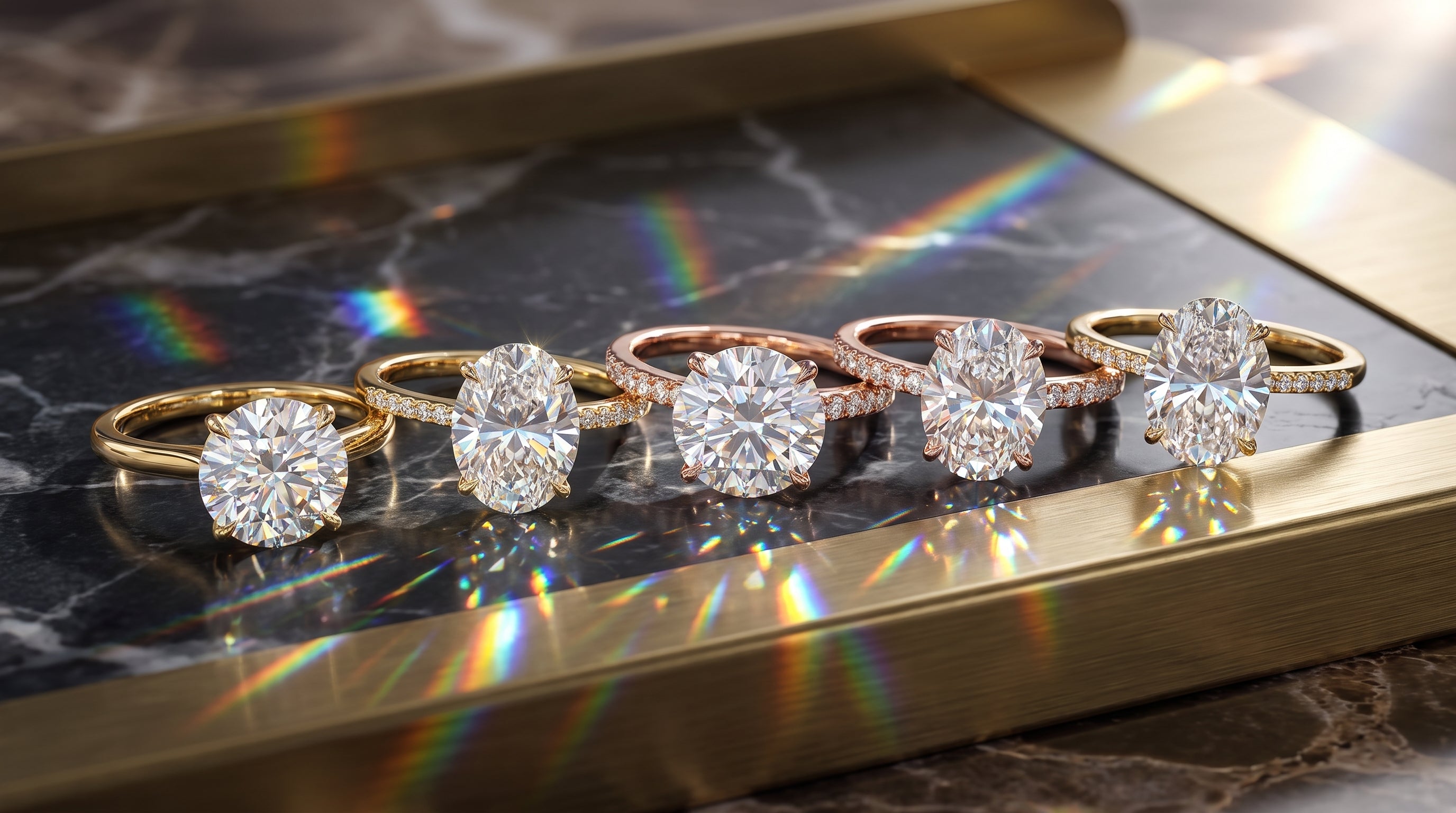
- Brilliant cuts amplify fire. Round and oval brilliants have the facet architecture that maximizes light dispersion, so they show the most rainbow. A round like the Twisted Band 1CT Round Cut Moissanite Ring at one carat keeps that fire lively but proportionate.
- Step cuts calm it down. Emerald cuts use long parallel facets that produce broad flashes rather than scattered spectral color, giving a more restrained, glassy look much closer to the classic diamond aesthetic. If the rainbow effect is your concern, this is the single most effective correction. Designs like The Adelina Rae and the three-carat Bella Jewel show how that plays out at larger sizes.
- Size multiplies whatever the cut does. A three-carat brilliant is a very different daily experience from a one-carat brilliant. If you love the fire, size is your friend; if you are unsure, restraint helps.
Our breakdown of moissanite vs lab diamond sparkle goes further into what these differences actually look like in practice, including how lighting conditions change the picture.
Objection 4: "It Will Get Cloudy, Scratched, or Turn Green"
Three separate fears bundled together, and they have three different answers.
Scratching
At around 9.25 on the Mohs scale, moissanite is harder than sapphire and ruby and highly resistant to scratching and abrasion. Diamond at 10 is technically harder, and over decades that gap may show in edge wear, but jewelers and retailers across the board treat moissanite as appropriate for engagement rings worn every day. In practical terms, the setting metal is usually more vulnerable than the stone.
Chipping
Here the honest answer is that published data is thin. Hardness measures scratch resistance, not impact resistance, and there is no large-scale field study comparing moissanite chipping rates to diamond. What can be said fairly: moissanite is tough and holds up well to normal wear, no gemstone is chip-proof, and exposed points and corners are the vulnerable geometry in any stone. If you work with your hands, favor a protective setting and a shape without sharp exposed corners, exactly as you would with a diamond.
Clouding and Color Change
Moissanite does not intrinsically cloud or turn green over time. Jeweler guidance is consistent that apparent clouding comes from surface film, lotion and cleaning-product residue, or metal oxidation in the setting, all of which clean off. Owner discussions add a useful detail: perceived cloudiness is sometimes tied to specific shapes, particularly marquise and pear, where double refraction is more visually apparent, and sometimes to low-quality stones that may not be genuine moissanite at all. Well-cut round, oval, and emerald stones consistently read as clear and bright.
Care requirements are modest: mild soap, warm water, a soft brush, roughly every few weeks, and avoid harsh chemicals that can attack the metal. That is standard fine jewelry care, not special handling.
Objection 5: "It Has No Resale Value"
This one is true, and it is the objection you should not talk yourself out of.
Moissanite carries minimal resale value. There is no established secondary market comparable to the one for diamonds, no standardized valuation framework, and no scarcity story to anchor a price, because production capacity is not constrained. Even moissanite retailers who are otherwise enthusiastic acknowledge this openly. If you buy a moissanite ring intending to recover value later, you will be disappointed.
What deserves equal honesty is the comparison. Retail diamonds also commonly resell for considerably less than their purchase price. Diamonds retain more value than moissanite in relative terms, and they have a functioning resale infrastructure, but an engagement ring bought at retail is not a financial instrument in either case. The realistic framing is not "investment versus non-investment." It is "a small residual value versus effectively none."
Which leads to the practical question: what is the money actually buying? With moissanite the answer is present-day experience, which is the part you interact with daily for decades. With a diamond you are also buying natural origin, a grading certificate from an independent lab, and a resale pathway. Those are real things with real value to some people. Decide honestly which column you weight more heavily, and do not let a marketing narrative decide for you in either direction. Our moissanite vs lab diamond price breakdown looks at how the middle option changes that calculation.
Objection 6: "Is It Genuinely More Ethical, or Just Marketed That Way?"
Partly genuine, partly overstated, and it is worth being precise about which is which.
What is well supported: moissanite for jewelry is grown in laboratories, so it involves no mining. That avoids the land disruption and the supply chain and labor risks associated with mined stones, and it makes origin traceable in a way mined material often is not. Those are concrete, defensible differences, and they are the honest reason many buyers choose it.
What is not supported: any specific quantified environmental advantage. Growing silicon carbide crystals consumes energy and resources. There is no independent, peer-reviewed lifecycle assessment in the available evidence comparing moissanite's footprint against mined diamonds or lab-grown diamonds, and no moissanite-specific sustainability certification standard. Even critical jewelers concede moissanite is conflict-free while correctly noting that lab production is not impact-free.
So the accurate claim is "mining-free and traceable," not "proven low-carbon." If a retailer offers you a precise percentage of emissions saved, ask where the number comes from. We would rather tell you the boundary of what is known than hand you a figure we cannot stand behind.
Objection 7: "Will a Jeweler Even Work on It?"
Mostly yes, occasionally no, and it is worth checking in advance rather than discovering it at resizing time.
Some traditionalist jewelers decline to work on synthetic or lab-created stones as a matter of policy or preference. Both moissanite retailers and moissanite-skeptical jewelers acknowledge this, and the standard advice from both camps is identical: find a local bench jeweler comfortable with moissanite before you buy, particularly if you anticipate resizing, prong retipping, or a future reset.
The counterweight is that moissanite is no longer niche. Large brands, independent jewelers, and specialist retailers all sell it, publish care guidance, and handle service work on it. A refusal is an inconvenience to plan around, not a structural obstacle. One phone call before you order resolves it.
Moissanite vs Diamond vs Lab Diamond: The Comparison That Actually Decides It
Most people asking whether moissanite is worth buying are really choosing between three options. Laid side by side, the differences resolve into a clean set of trade-offs.
Composition and Classification
Mined and lab-grown diamonds are both crystallized carbon and are both, unambiguously, diamonds; the lab-grown version shares the same crystal structure, hardness, and optical behavior as mined material. Moissanite is silicon carbide, a different mineral. "Lab-created" applies to both moissanite and lab-grown diamonds, which is precisely why the phrase causes so much confusion, and why it is worth reading product descriptions closely.
Hardness
Diamond and lab-grown diamond both sit at 10 on the Mohs scale. Moissanite sits around 9.25. All three are suitable for a ring worn every day. Diamond holds a genuine but modest theoretical edge in scratch resistance over a lifetime.
Sparkle Character
Diamonds and lab-grown diamonds share a refractive index of roughly 2.417 to 2.419 and produce balanced, predominantly white brilliance with moderate fire. Moissanite's higher refractive index and roughly double dispersion produce more colorful flashes and slightly higher overall brilliance, increasingly noticeable above a carat. This is the clearest visual dividing line between the options, and it is purely a matter of taste.
Color and Grading
Diamonds and lab-grown diamonds are graded on the familiar D–Z scale by independent laboratories, which produces consistent, portable documentation. Moissanite is usually sold with descriptive or approximate letter grades rather than full diamond-style certificates, with premium material typically offered in near-colorless ranges. Moissanite can show warm or faintly greenish undertones in certain lighting, and this becomes more apparent as carat weight increases. Buyers set on a very large center stone should weight this more heavily than buyers shopping around a carat.
Price and Resale
When evaluating moissanite rings vs diamond options, moissanite is consistently the least expensive of the three for a given apparent size, lab-grown diamond sits in the middle, and mined diamond is the most expensive. Resale runs in the opposite order, with moissanite at effectively nothing. Actual pricing varies by brand, market, and setting, so verify against current listings rather than relying on any published ratio.
If you want the full technical treatment, our complete moissanite vs diamond vs lab diamond guide expands each of these into detail.
Who Moissanite Is Genuinely Right For
Rather than pros and cons in the abstract, here is the sorting that the evidence supports.
Buy Moissanite If
You want the largest, most visually present stone your budget allows and are not willing to compromise on size. You actively like intense, colorful fire, or you have chosen a step cut that moderates it. You want mining-free, traceable sourcing and are content with "no mining" rather than a quantified environmental claim. You accept that the ring has no resale value and are comfortable treating it as a sentimental object rather than a stored asset. And, critically, you and your partner have both agreed to this, rather than one of you assuming the other will not mind.
Choose a Diamond or Lab-Grown Diamond If
Natural origin carries specific meaning for you, or diamond's cultural symbolism is central to what the ring represents. You prefer the whiter, more restrained brilliance and find rainbow fire distracting. You want independent laboratory grading documentation. You want the option of resale or trade-up, however imperfect. Or your partner has expressed, directly or indirectly, that a diamond matters to them, in which case the entire technical discussion is beside the point.
There is no clever argument that resolves the second list. Someone who attaches deep significance to a mined diamond will not be persuaded by dispersion figures, and attempting it is how people end up with rings that quietly disappoint. If you are not sure where your partner sits, ask before you buy. That conversation is far less awkward than the alternative.
Choosing a Moissanite Ring If You've Decided It's Worth It
Once you have cleared the objections, the remaining decisions are practical, and each one changes how the stone reads on the hand.
Match the Cut to the Sparkle You Want
This is the highest-leverage choice you will make. Oval and round brilliants maximize fire and read as lively and modern; the two-carat oval Opaline and Celestine both sit in that territory, with the elongated oval shape also creating a longer line on the finger. Emerald cuts trade fire for clarity of form and a more classical, understated presence. Round remains the most universally recognized silhouette.
Think Carefully About Carat
Because moissanite removes the steep price escalation that comes with diamond carat weight, it is easy to keep scaling up. Do it deliberately. A larger stone shows more fire and, at the top end, more chance of a visible warm undertone under some lighting. Two to two and a half carats, as in The Alina, is substantial without becoming a statement the wearer has to live up to daily. Three carats is a genuine statement. One carat, in a design like The Luna, is quietly wearable and the safest choice if the wearer is undecided.
Let the Metal Do Some Work
Metal tone influences perceived stone color. Warm metals like rose gold, as in The Luna in rose gold, harmonize with any faint warmth in the stone rather than contrasting against it, which is a useful strategy at larger carat weights. Cooler and neutral settings emphasize iciness. Our 18k gold engagement ring guide covers how metal choice affects both appearance and long-term durability.
Consider Whether It Needs to Be an Engagement Ring at All
Not every meaningful ring is a proposal. A promise ring such as The Celestine Gold Promise Ring, or a design worn simply because it is beautiful like The Mirabella, carries none of the symbolic freight that makes the moissanite debate so charged. This is also, incidentally, the lowest-risk way to find out whether you actually enjoy living with moissanite's fire before committing to it for an engagement ring.
You can browse the full range in our moissanite engagement rings collection, and the best-selling moissanite rings are a reasonable starting point if you want to see which shapes and sizes people gravitate toward.
A Note on Men's Rings
When shopping for moissanite rings men often find that the same hardness and sparkle characteristics apply to men's bands just as they do to women's rings. Men's designs typically use smaller accent stones set flush or channel-set into the band, which means the intense dispersion that dominates a two-carat solitaire reads as a subtle glint instead, and the "too sparkly" objection largely evaporates at that scale. Metal tone and band profile do most of the visual work. If that is your search, our guide to men's gold engagement rings is a better fit than a solitaire-focused collection.
The Question Behind the Question
"Is moissanite worth buying" is rarely a question about silicon carbide. It is usually a question about whether choosing it means settling, and whether anyone will hold that against you.
The evidence does not support the idea that moissanite is a compromise on performance. It is genuinely hard, genuinely brilliant, and genuinely holds up to daily wear. What it is not is a diamond, and it will never behave like one financially. Those are the two honest limits, and they are limits you either accept openly or you do not.
The buyers who report the least regret are the ones who chose moissanite deliberately, understood exactly what they were and were not getting, and made the decision together rather than presenting it as a surprise. The ones who report the most are the ones who chose it hoping nobody would notice. The stone performs identically in both cases. The difference is entirely in how the choice was made.
Decide which column you weight more heavily, have the conversation with your partner, and then buy without second-guessing it. That is what makes a ring feel worth it, and it is the one variable no gemological data can settle for you.

Leave a comment
This site is protected by hCaptcha and the hCaptcha Privacy Policy and Terms of Service apply.