


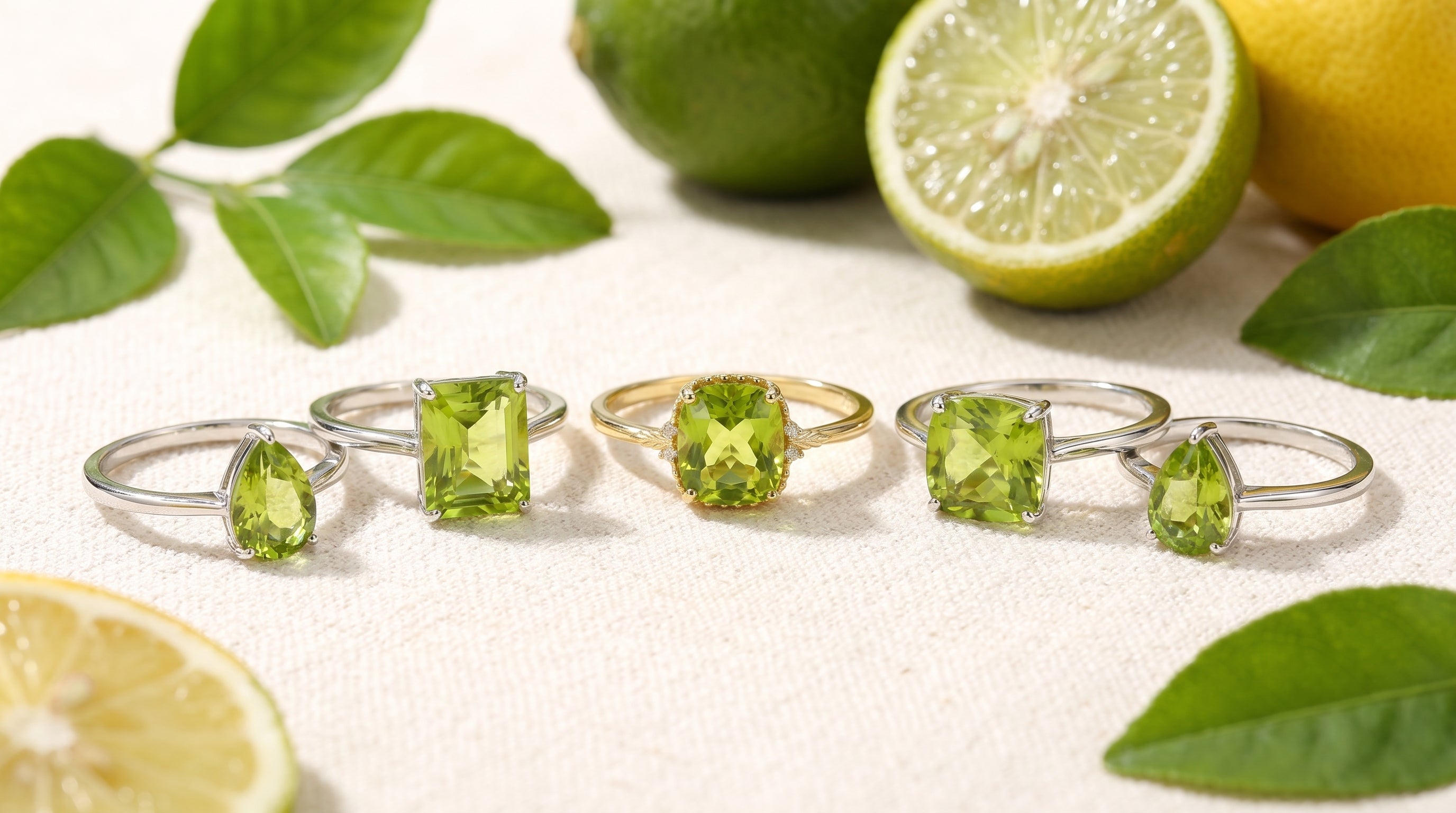
Run the search and you get two very different shopping worlds stacked on one page. Fine jewelers such as Haverhill and Ferkos list peridot rings set in solid 14K gold, Angara sorts its peridot rings by metal and by ring sizes running from 3 to 14, and Zales positions its designs as August birthday gifts. Directly beneath them sit marketplace listings for handmade 925 sterling silver peridot rings with optional 18K gold plating. Both sets of results use the same two words — “peridot ring” — for products that can differ enormously in stone type, metal construction, and expected lifespan.
What almost none of those category pages tell you outright is the single fact that determines what you are actually buying: whether the green stone is natural peridot, or a simulated stone chosen for its peridot-like color. Awareness Avenue is unusual in stating plainly that it keeps its natural peridot and simulated peridot collections separate, and in noting that not every retailer draws that line clearly. This guide starts there, then works through stone quality, metal choice, setting style, sizing, and care, so that whichever listing you click, you know what questions to ask before you check out.
Natural, Lab-Grown, or Simulated: The Question to Settle First
Peridot is the gem-quality variety of the mineral olivine. A natural peridot was formed geologically and then cut and polished. A simulated peridot is a different material selected because it mimics peridot's yellow-green look. Both can be beautiful in a ring; they are simply not the same purchase, and they carry different expectations around rarity, price, and care.
The wording used across listings is where confusion creeps in. Terms like “genuine peridot” appear widely in fine jewelry copy, but on its own that phrase does not tell you whether a stone is natural and untreated, and it certainly does not distinguish a mined gem from a simulant. Jeweler-authored guidance on peridot recommends buying from a jeweler who will confirm in writing that the stone is natural and untreated when that matters to you.
Why the distinction changes your expectations
If you want the traditional gemstone experience — a mined August birthstone with the small character marks that come with it — you should be shopping for natural peridot and asking for documentation. If what you love is the color and the design, and you want a bold, evenly colored stone in a ring you can wear without anxiety, a clearly labeled simulated peridot is a legitimate and honest choice. The problem is never simulated stones; the problem is simulated stones sold ambiguously.
Four questions worth asking before checkout
- Is the center stone natural peridot, lab-created, or simulated? Ask for the word in writing, not just “genuine.”
- Has the stone been treated in any way, and can the seller disclose that?
- What exactly is the metal — solid gold at a stated karat, sterling silver, or gold plating or vermeil over a silver base?
- Is any certification or documentation supplied with the ring?
A seller who answers all four clearly has told you more than most category pages will. If a listing dodges the first two questions while the price looks improbably low for the stone size shown, treat that as a signal to keep asking.
How to Judge a Peridot: Color, Clarity, Cut, and Carat
When you are comparing natural peridot rings across sellers, four attributes do most of the work. This is the standard framework used in jeweler education on the gem, and it is easy to apply from good product photography.
Color: the dominant factor
Peridot runs from yellow-green to olive green. The most prized stones show a pure green with minimal yellow or brown modifying tones, and those top colors tend to appear in larger stones. Brown is the tone to watch for; a peridot that reads muddy or olive-drab in daylight photos will look the same on your hand. Ask for an image in natural light rather than a lightbox alone, since strong studio lighting flatters almost any green.
Clarity: watch for lily pads
Aim for an eye-clean stone, meaning no inclusions obviously visible without magnification. Peridot has a characteristic inclusion nicknamed the “lily pad” — a disc-like feature that can dull sparkle when it sits under the table of the stone. Not every inclusion is a dealbreaker, but one that interrupts the light return of the center stone is worth avoiding in a ring you plan to wear often.
Cut: where the sparkle is won
Cut quality determines how much of that green actually comes back at you. Pear, oval, round, and cushion are the shapes you will see most often, and each behaves slightly differently: cushion and round cuts tend to read as broad and lively, while pear and oval elongate the finger. Look for even facets, a symmetrical outline, and no large dark window in the middle of the stone, which usually means the pavilion was cut too shallow to hold the light.
Carat weight: size versus practicality
Smaller peridots are more widely available and easier to accommodate in an everyday ring. Fine-quality stones above roughly ten carats are the rarity tier, and they command prices to match. For a ring intended for daily wear, a moderate center stone in a well-protected setting usually delivers more long-term satisfaction than the largest stone your budget allows in an exposed mounting.
Metal Choice: Gold, White Gold, 14K, Sterling Silver, and Vermeil
Metal is the second half of the decision, and it is where the search results diverge most sharply. Angara lists peridot rings in platinum, silver, and yellow, white, and rose gold. Haverhill builds its peridot collection specifically in solid 14K gold. Ferkos offers 14K gold peridot rings with diamond and gemstone accents. Etsy sellers work largely in 925 sterling silver, sometimes with 18K gold plating offered as a variant. Those are five genuinely different products.
Yellow gold
Warm yellow gold pushes peridot toward its golden-green side, which is why a peridot ring gold setting is so popular for August birthstone jewelry. It is the most forgiving choice if your stone leans yellow, because the metal absorbs that tone into the overall look rather than fighting it.
White gold
White gold does the opposite: its cool, bright surface makes green read as green. Angara markets its white gold peridot rings on exactly this contrast between the olive-green stone and the metal's cool brilliance, and offers them in solitaire, halo, infinity, and other styles. If your peridot has a slightly brownish cast, white metal will expose it, so scrutinize color photos more carefully when shopping for a peridot ring white gold design. Note that white gold is typically finished with rhodium plating, which is periodically renewed — a maintenance rhythm we cover in more depth in our comparison of sterling silver and white gold ring settings.
14K solid gold
Searches for “peridot ring 14k gold” usually signal one thing: the buyer wants solid gold, not plating. If that is you, look for the karat stamp stated explicitly in the product specification, and confirm that “gold” in the title is not shorthand for gold-plated or gold-filled. Retailers that specialize here, like Haverhill, put “solid 14K gold” directly in their collection naming, which is the level of clarity worth holding every seller to. If solid metal is your priority, browse Awareness Avenue's solid gold pieces and check each listing's stated karat.
Sterling silver and 18K gold vermeil
For buyers seeking a peridot ring silver option, sterling silver — marked 925 — is the backbone of the accessible end of the market, and its cool tone plays the same visual role as white gold. Gold vermeil is a related construction: a sterling silver base finished in gold. It gives you a gold appearance over a solid precious-metal core, and it is a common choice for birthstone jewelry meant to be worn and enjoyed rather than kept in a safe. The trade-off is that any gold surface layer will show wear at high-contact points over time, particularly on a ring band. Our guide to gold versus silver settings unpacks that trade-off in more detail, and if you are torn on tone, white gold versus rose gold is a useful companion read.

Settings and Styles That Suit a Peridot Center Stone
Peridot is not as hard as diamond, which means the setting is doing more than decoration — it is doing protection. This is the practical reasoning behind several style choices, and it is worth weighing against pure aesthetics.
Solitaire
A single stone on a plain band is the cleanest way to showcase color, and it lets a well-cut peridot do all the talking. It also leaves the girdle and corners of the stone the most exposed, so it suits occasional wear or a careful wearer better than a hands-on daily routine.
Halo and bezel
Halos surround the center stone with a frame of smaller accents, and bezels wrap the stone's edge in metal. Both make a modest center stone look larger and both physically shield the stone's most vulnerable edges. Given the care guidance around peridot's relative softness, a protective setting is a sensible inference for anyone buying a ring for regular wear, though it is a design judgment rather than a lab-tested durability rating.
Multi-stone, bypass, and row designs
Bypass bands, clusters, and row settings spread the visual weight across several smaller stones. That keeps the profile lower against the finger, which reduces snagging, and it produces a lot of green for the size. Milgrain detailing along the edges is a common finishing touch on this style and gives an heirloom feel without a raised silhouette.
Shaped stones: pear, heart, radiant
Marketplace searches for a peridot ring women frequently highlight fancy shapes, which is where designs get personal. Pear cuts elongate; heart cuts read overtly sentimental and suit gifting; radiant and cushion cuts maximize the broad face of the stone. Whatever the shape, check that pointed tips — the tip of a pear, the cleft of a heart — are covered by a prong or a V-tip, since those are the points most likely to take a knock.
Matching the Ring to How You Will Actually Wear It
The same peridot ring can be a brilliant or a frustrating purchase depending on the wearer's routine. A few honest scenarios:
- Everyday birthstone ring. Favor a moderate stone size, a protective or low-profile setting, and a metal you are happy to maintain. Plan to remove it for cleaning, gardening, and workouts.
- Engagement-style peridot ring. Peridot is offered as a colored alternative to diamond, and dedicated peridot engagement categories exist. It can absolutely work, provided the wearer accepts that a stone softer than diamond may show surface wear under years of constant contact and is willing to follow a care routine.
- Occasion and gift pieces. If the ring will be worn for birthdays, anniversaries, and evenings out, you can go bigger and more exposed with far less risk. This is where a dramatic pear or a wide halo earns its place.
Getting the size right when buying online
Ring sizes at larger retailers commonly span from 3 to 14, so the size you need almost certainly exists — the issue is measuring accurately. Use a printable size chart or a plastic sizer, measure at the end of the day when fingers are at their largest, and account for the width of the band, since wider bands wear tighter. Before ordering, confirm the seller's own resizing and returns terms directly with them; policies vary by retailer and by design, and a bezel or eternity-style band cannot always be resized.
Caring for a Peridot Ring So It Keeps Its Color
Peridot rewards a gentle routine. The standard jeweler guidance is straightforward: avoid harsh chemicals and acidic cleaners, clean with a soft cloth and mild soap, and store peridot jewelry separately so harder stones cannot scratch it. Because peridot is not as hard as diamond, contact with other jewelry in a shared box or pouch is one of the most common causes of dulled polish.
Three habits that make the biggest difference in practice:
- Take the ring off before household cleaning, swimming pools, and hand sanitizer.
- Put it on last when getting ready, after lotions, perfume, and hairspray.
- Give it its own soft pouch or a lined compartment rather than a communal tray.
If your ring is gold vermeil or plated, add one more rule: skip ultrasonic cleaners and abrasive polishing cloths, which can thin a surface layer. For any specific piece, follow the care instructions the maker supplies with it, since simulated stones and natural gems do not always respond identically to the same cleaning method.
Peridot Rings at Awareness Avenue — and Where They Fit
Awareness Avenue's peridot ring designs sit in a clearly defined part of this market: simulated peridot set in S925 sterling silver and 18K gold vermeil, grouped in a collection that names the stone type in its own title. That is deliberate. If you want a mined, certified natural peridot in a large carat weight and solid platinum or high-karat white gold, specialist fine jewelers listed earlier in this guide serve that niche better, and we would rather say so than overstate the fit.
What these designs do offer is consistent, saturated August-birthstone color across a range of shapes, in precious-metal bases, at a scale suited to real wear:
- The Azurina Cushion Ring in 18K gold vermeil — a cushion cut in a warm gold finish over a silver base. The Azurina cushion design is also offered in solid gold versions for buyers who want the metal to match the occasion.
- The August Peridot Birthstone Ring in S925 sterling silver — the most literal reading of the birthstone brief.
- The Elianise Cushion Ring and The Elianise Radiant Ring — two cuts of the same silhouette, cushion for softness, radiant for a crisper outline.
- The Caelisia Pear and The Peridore Pear — elongating pear shapes in sterling silver.
- The Elianelle Heart Ring — the sentimental option for a birthday or anniversary gift.
- The Mirabelle Bypass Ring and The Perisara Row, a round-cut simulated peridot design with milgrain detail — both lower-profile styles that spread color across the finger.
- The Aevis Cushion Ring — a cushion cut in sterling silver.
You can view them together in the August simulated peridot collection, or browse across months in the wider birthstone jewelry range. Buyers who prefer to compare gemstone rings across categories may also find our guide to buying a genuine ruby ring useful, since the authenticity questions run in parallel.

A Note on Peridot Symbolism
Retail copy frequently attaches meanings to peridot: one jeweler describes August's yellow-green birthstone as bringing peace to relationships by balancing the heart and mind, and another notes that peridot is astrologically associated with Leo. These are long-standing cultural and marketing traditions, and they are a genuine part of why people buy birthstone jewelry — a ring that means something is worth more to its wearer than one that does not. They are not, however, scientifically demonstrated effects, and they should not be the reason you overlook a dull stone or an unclear description. Buy the ring for its color, its construction, and the honesty of the listing; let the symbolism be the bonus.
Frequently Asked Questions
Is peridot tough enough for an everyday ring?
Yes, with realistic care. Peridot is not as hard as diamond, so it benefits from being removed during rough tasks, cleaned gently with mild soap and a soft cloth, and stored apart from harder stones. A protective setting style helps, too.
What is the difference between a gold peridot ring and a gold vermeil one?
A solid gold ring is gold alloy throughout at a stated karat, such as 10K, 14K, or 18K. Gold vermeil is a gold layer over a sterling silver base. Vermeil gives the gold look over a precious-metal core; solid gold will not wear through to another metal. Always check which one a listing is describing.
Does white gold or silver suit peridot better than yellow gold?
Neither is objectively better. Cool metals like white gold and sterling silver emphasize the green in the stone, while yellow gold blends with peridot's golden undertones for a warmer overall effect. If your peridot leans slightly brown, warm metal is more forgiving.
How can I tell if a peridot ring is a good value?
Line the stone attributes up against the description. A pure green, eye-clean, well-cut natural peridot in a larger size sits at the premium end; a small, yellowish, or included stone does not. Then confirm the metal is what the title implies. When those three things — stone type, stone quality, and metal — are all stated plainly, you can compare listings meaningfully.
Can a peridot ring work as an engagement ring?
It can, and peridot engagement styles are sold specifically for that purpose. Choose a setting that protects the stone, and go in knowing that a gem softer than diamond may need refinishing or more attentive care over years of daily wear.
The Short Version
Decide first whether you want natural or simulated peridot, and insist that the listing says which. Judge the stone on color above all, then clarity, cut, and size. Pick a metal you will be happy to maintain — solid gold with a stated karat if permanence matters most, sterling silver or gold vermeil if you want the color and the design at a scale you will actually wear. Choose a setting that matches your hands and your habits, measure your size properly, and confirm resizing terms with the seller before you order. Do that, and the search phrase “peridot ring for sale” stops being a wall of near-identical green thumbnails and becomes a short list you can compare with confidence.

Leave a comment
This site is protected by hCaptcha and the hCaptcha Privacy Policy and Terms of Service apply.