


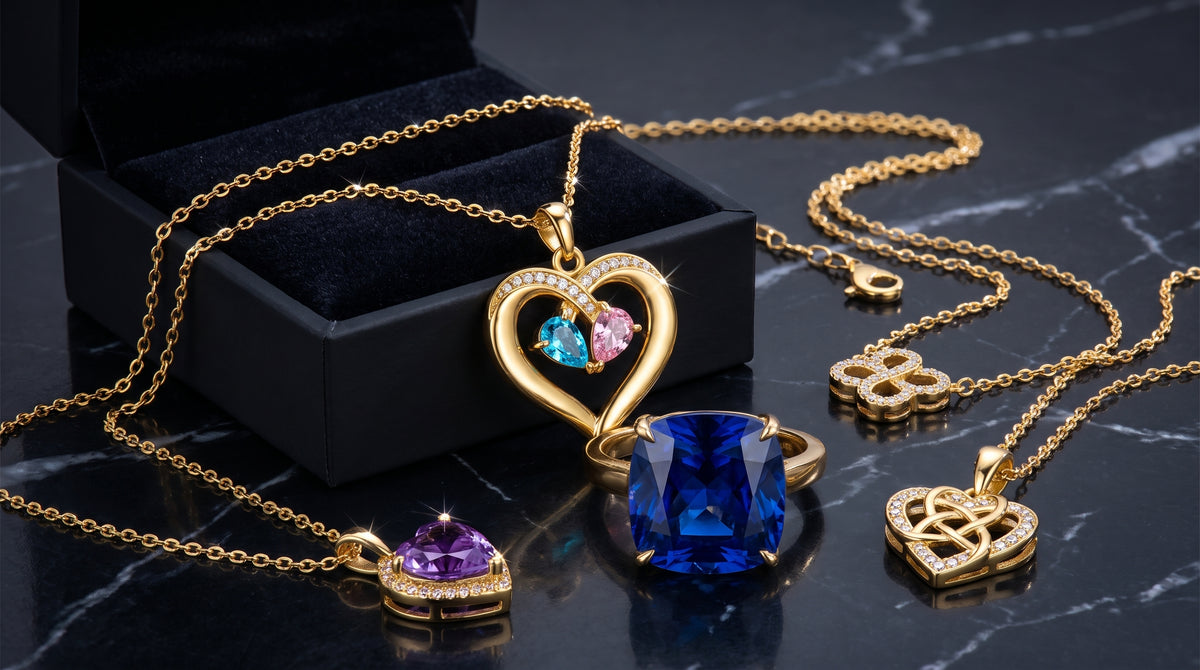
Two sapphire engagement rings can sit inches apart in the same Amazon results page and describe themselves in completely different languages. A GemsNY personalized bypass ring specifies a natural blue sapphire of roughly 5 mm, set in gold or platinum, with diamond accents. A Kobelli vintage-style sapphire and diamond ring, priced at $789 for one carat total weight in 14K white gold, describes the look in detail but says nothing about the stone's origin or treatment. A JewelryPalace halo styled after the Princess Diana ring names its metal precisely — 925 sterling silver with 14K gold plating — and positions itself as an engagement, anniversary, or promise ring. Three listings, three different levels of gemological disclosure, one checkout button.
That gap in disclosure — not the logo above the cart, and not even the price tag — is the real decision you are making when you search for a sapphire ring on Amazon. This comparison maps what the marketplace shows you against what heritage jewelers, large online retailers, configurable catalogs, and boutique color specialists show you, using the Gemological Institute of America's sapphire buyer's guide as the neutral yardstick that travels to every checkout, and noting the actual prices attached to specific rings along the way.
What You Actually See When You Search for a Sapphire Ring on Amazon
Amazon is not a jeweler. It is a venue where jewelers, private-label brands, and independent manufacturers list side by side, each writing its own product copy and setting its own price. That structural fact explains almost every practical difference between buying there and buying from a single-brand jeweler.
Three listing archetypes that keep appearing
- Traditional engagement rings from jewelry brands. The Kobelli vintage-style sapphire and diamond engagement ring in 14K white gold is built like a conventional engagement piece — precious metal, sapphire center, diamond accents, stated total carat weight — and is listed at $789.
- Independent jewelers using the marketplace as a second storefront. GemsNY, which also sells from its own site, lists a personalized natural blue sapphire engagement ring with diamonds in a bypass design, offered in gold or platinum. The word "natural" is doing real work here — it is a disclosure other listings may omit.
- Style-reference fashion and promise rings. The JewelryPalace halo ring explicitly invokes the Princess Diana and Kate Middleton look and is made of sterling silver with gold plating. It is marketed for engagements, anniversaries, and promises, which tells you the same design is being sold into several occasions at once.
Beyond individual products, an Amazon category search for sapphire jewelry for women returns results in the thousands and lets you sort by price, customer review, and sales rank. Breadth, filtering, and a $789 entry point for a solid-gold sapphire and diamond engagement ring are the marketplace's genuine advantages. What you do not get is a single editorial standard for how a sapphire must be described.
The marketplace variable: who is behind the listing
Because each seller writes its own specifications, two rings with identical headline specs can carry very different amounts of verifiable information. One may state that the sapphire is natural; another may be silent on natural versus laboratory-grown. One may state metal purity as 14K solid gold; another may state gold plating over sterling silver, which is a different product at a different durability level even if the photographs look similar and the prices land close together. Read the metal line, the stone line, and the price as three separate facts, not as a single impression.
The Quality Checklist That Travels to Any Checkout
GIA's sapphire buyer's guide is the one source in this landscape that is not selling rings, which makes it the right standard to apply to Amazon and to a Fifth Avenue counter alike. Its framework is straightforward, and it reorders the priorities most listings imply.
Color does most of the work
GIA identifies color as the most important quality factor for sapphire. The most highly valued blue sapphires are velvety blue to violetish blue in medium to medium-dark tones, with strong to vivid saturation that stays bright rather than going dark. Saturation should be as strong as possible without sacrificing brightness. Dark navy or midnight blues, and less-saturated colors such as grayish blue or straw yellow, are more affordable than vivid colors — which is useful context when a listing photo looks unusually inky or unusually pale, and helps explain why two rings at similar price points can look so different in hand.
Practically, this means product photography deserves skepticism on every channel. Studio lighting flatters saturation. Ask for a video or an image in diffuse daylight before you commit, wherever you are shopping. Our deeper walkthrough of how to judge sapphire color, cut, and treatment before you buy covers the visual cues in more detail.
Cut is the factor listings rarely mention
GIA calls cut one of the most important factors in a sapphire's appearance and advises buyers not to compromise on it. Cutters have to balance the best overall color, good proportions, and retained weight, while working around color zoning and pleochroism. A well-cut sapphire sparkles in a lively way and reflects light evenly across the gem; a poorly cut one looks dull and sells at a discount. Very few marketplace listings — or, for that matter, many jeweler product grids — describe cut quality at all. Carat weight, metal, and price are stated; symmetry and light return usually are not. That absence is a question, not a verdict.
Clarity and carat: realistic expectations for a center stone
Blue sapphires commonly contain inclusions; extremely high-clarity material is rare and valuable. Price drops when inclusions threaten durability, but not all inclusions are undesirable — GIA notes that some Kashmir sapphires contain tiny inclusions that create a prized velvety appearance. On size, GIA observes that blue sapphires range from very small to hundreds of carats, that large blue sapphires are more readily available than large rubies, and that most commercial-quality blue sapphires weigh less than 5.00 carats. For an engagement ring, that is reassuring: the sizes most couples want, and the sizes reflected in the $258-to-$3,800 examples below, sit comfortably inside the commercially available range.
Treatment and origin: the two questions that change value
GIA states that a large share of sapphire on the market — blue and fancy colors alike — has been treated to modify color, by heat or by lattice diffusion. Lattice-diffused sapphires often show vivid color but are less valuable than heated sapphires, and untreated stones are rarer and more prized. GIA's advice is direct: ask what treatment a stone has received, and get a lab report when you are in doubt.
It is worth understanding what such a report is and is not. GIA does not grade sapphire or other colored stones the way it grades diamonds. It issues Gemological Identification Reports that assess weight, measurements, shape, cutting style, and color, determine whether a stone is natural or laboratory-grown, identify detectable treatments, and — on request, when possible — offer an opinion on geographic origin. For exceptional gems, independent origin determination adds value: Kashmir commands the highest premium, with Myanmar (Burma), Sri Lanka, and Madagascar also producing top-quality material.
Amazon vs. the Jeweler Archetypes, Side by Side
The alternatives to a marketplace listing are not one thing. They fall into distinct archetypes, each trading a different currency: prestige, service, configurability, or color specialization — and each with its own price anchor.
| Channel | What you are buying from | Observed strengths and price examples | Usually must be requested |
|---|---|---|---|
| Amazon marketplace (Kobelli, GemsNY, JewelryPalace listings) | Independent sellers and brands listing side by side | Breadth; filtering by price, rating, and sales rank; classic blue sapphire, vintage, halo, and bypass designs in both solid-gold and plated options; the Kobelli vintage-style sapphire and diamond engagement ring is listed at $789 | Treatment type, origin, cut quality, lab documentation, natural vs. lab-grown when unstated |
| Heritage luxury (Tiffany & Co.) | A single brand with a deep sapphire taxonomy | Separate categories for sapphire rings, platinum sapphire rings, sapphire engagement rings, sapphire cocktail rings, and sapphire jewelry; signature designs such as the Tiffany Lock Small Ring in rose gold with pink sapphires, priced at $3,800 | Sapphire-specific treatment and origin details; the brand's published craftsmanship claims center on diamonds |
| Large online jewelers (Blue Nile, Brilliant Earth) | Curated catalogs with staffed support | Blue Nile lists pink sapphire engagement rings including a Riviera Pavé Pink Sapphire Eternity Ring in 18k rose gold at $1,025 and a double-row pear pink sapphire and diamond ring in platinum at $3,770, with phone support; Brilliant Earth offers virtual appointments, showrooms, live chat, and specialists available around the clock | Sapphire treatment and origin disclosure on individual stones |
| Configurable catalogs (Glamira) | Made-to-order designs with metal and stone options | Green sapphire engagement rings starting from $258, including the Alfreda design in 14K rose gold with a 0.25-carat green sapphire described with an "AA" grade, priced at $778 | What the seller's "AA" grade means, since colored-stone letter grades are seller-defined rather than issued by GIA |
| Boutique color specialists (Bonnot Paris) | A narrow, curated aesthetic | Teal sapphire engagement rings presented with detailed color narrative — neither quite blue nor quite green, shifting between peacock blue and forest green | Technical gem data and specific pricing behind the poetic descriptions |
| Design-led and educational sellers (Taylor & Hart, JFJCO) | Bespoke or advisory-first purchasing | Extensive guidance on sapphire color range, symbolism, and everyday durability; framing of sapphire as an alternative to the diamond solitaire | Independent verification of claims made in marketing copy |
What the price spread actually tells you
Lined up, the specific examples on record span roughly $258 to $3,800: Glamira's green sapphire designs start at $258, its Alfreda ring runs $778, the Amazon Kobelli vintage-style sapphire-and-diamond ring sits at $789, Blue Nile's pink sapphire pavé eternity band is $1,025, Blue Nile's pear-shaped pink sapphire and diamond ring in platinum is $3,770, and Tiffany's pink sapphire Lock ring is $3,800. These are individual products, not category averages, and prices on any page can change without notice — but the spread is real and it does not sort neatly by channel. Amazon's $789 example sits closer to Glamira's mid-tier configurable ring than to Tiffany's brand-name piece, which is a useful reminder that channel and price tier are not the same decision.
Reading the archetypes honestly
Tiffany's own copy states that it is the only jeweler to offer a triple excellent cut, the highest grade in the industry, on all round brilliant engagement diamonds — a claim about diamonds, made by the brand, and worth quoting rather than generalizing to its sapphires. Bonnot Paris writes that teal sapphire symbolizes balance, serenity, and the sincerity of love, and that its dual hue expresses the blending of two personalities; that is brand storytelling, not gemology, and it is genuinely useful for deciding whether a color speaks to you. Taylor & Hart notes that sapphires withstand everyday wear and that a well-cared-for sapphire ring should last a lifetime and pass down through generations. JFJCO points out that sapphire sits at 9 on the Mohs hardness scale, behind only diamond at 10, and assigns meanings by color — blue for love, commitment, fidelity, trust, and loyalty; green for fidelity and integrity; pink for love and forgiveness; violet for oneness and peace; yellow for wisdom and prosperity. JFJCO also argues that sapphire runs considerably cheaper than diamond, roughly half the price, which the $258-to-$3,800 spread above does not contradict but also does not independently confirm.
Color by Color: Where Each Sapphire Is Easiest to Find
Blue sapphire: the marketplace's strongest category
The Amazon listings visible in this category skew heavily toward blue sapphire — vintage sapphire engagement rings like the $789 Kobelli design, bypass settings, and royal-inspired halos. If you are searching for a classic blue sapphire ring engagement option, breadth of choice is genuinely on the marketplace's side. Use GIA's color language to narrow it: you are looking for a velvety blue to violetish blue in a medium to medium-dark tone with strong saturation, not something that photographs black or washes out to gray. If you are weighing blue sapphire against other blue center stones, our comparison of blue moissanite and aquamarine covers how those alternatives behave in daily wear.
Teal and green sapphire: specialist territory
Teal and green are where the specialist jewelers pull ahead on presentation. Glamira builds green sapphire engagement rings to order starting at $258, with named designs like the $778 Alfreda ring stating carat weight and grade; Bonnot Paris merchandises teal as a distinct category with detailed color description rather than burying it inside a general sapphire filter. On a marketplace, these colors exist but are harder to browse as a coherent set, and the color language in individual listings is rarely precise enough to tell a bluish teal from a forest green without a video.
Pink sapphire: curated catalogs do the sorting
Blue Nile maintains a dedicated pink sapphire engagement ring category including a $1,025 eternity band and a $3,770 pear-shaped design that pair pink sapphires with diamonds, and Tiffany uses pink sapphires inside signature collections such as the $3,800 Lock ring and matching pendants. When a color is merchandised as its own category, matching stones across a set — ring plus band, ring plus pendant — becomes considerably easier than assembling the same look from unrelated marketplace sellers.
Style Language: Vintage, Halo, Bypass, and Sapphire-and-Diamond
Style vocabulary is the one area where marketplace listings and jewelers speak the same language, which makes cross-channel comparison straightforward.
- Vintage-style. Milgrain, engraving, and period-inspired galleries. Widely available on Amazon at accessible prices such as $789; also the natural strength of bespoke studios, which can reproduce a specific heirloom rather than approximate an era.
- Halo. The Princess Diana silhouette — a blue sapphire encircled by diamonds — is the single most requested sapphire engagement design and appears at every price level and metal quality, from plated silver to solid gold and platinum. Check the metal line carefully, because the look is identical across very different constructions and price points.
- Bypass. Two shanks that cross rather than meet, as in the GemsNY personalized listing. It suits a sapphire-and-diamond pairing because it gives each stone its own line.
- Eternity and pavé. Blue Nile's $1,025 pink sapphire eternity band shows how sapphire works as a continuous color statement rather than a single center stone — a strong option for a wedding band or an anniversary ring.
- Sapphire and diamond. Nearly every channel offers this pairing, at price points from under $800 to well over $3,000. Ask whether the accent stones are natural diamonds, lab-grown diamonds, or simulants; the listing title rarely says.
If you are commissioning rather than buying off the shelf, the trade-offs in lead time, stone sourcing, and revisions are worth reading before you start: see our breakdown of custom engagement ring options and cost drivers. And sapphire is not a women's-jewelry-only stone — the same color and durability logic applies to men's sapphire rings, where heavier bands and bezel settings change the calculus.
Five Questions to Send Any Seller Before You Pay
These work equally well in an Amazon seller message, a Blue Nile phone call, a Brilliant Earth chat window, or a boutique email. They are drawn directly from GIA's buyer guidance.
- Is the sapphire natural or laboratory-grown? If the listing does not say, assume nothing. GIA identification reports exist precisely because this distinction is not always visible.
- What treatment has it received? Heat and lattice diffusion are both common. Lattice-diffused stones can look vivid while carrying less value than heated stones, and untreated material is rarer and more prized.
- Is there a lab report, and from whom? For a higher-value purchase, GIA recommends getting one. Ask to see the document, not a summary of it.
- Can you describe the cut quality, or send a video in daylight? Since cut is rarely written into listings, motion footage is the most reliable substitute — a well-cut sapphire returns light evenly across the face.
- What exactly is the metal? Solid 14K or 18K gold and platinum behave differently from gold-plated sterling silver over a lifetime of daily wear, and both appear in sapphire ring listings at overlapping price points.
If a seller answers all five clearly, channel matters far less than it seemed at the start. If a seller cannot answer question two, that is meaningful regardless of where the listing sits or what it costs.
Which Channel Fits Which Buyer
You want a classic blue sapphire halo and you are comfortable doing your own verification
The marketplace is a reasonable starting point. Breadth is real, sorting tools are useful, entry pricing like the $789 Kobelli ring is genuinely accessible, and both solid-gold and plated versions of the same silhouette are available. Bring the five questions above, and read metal, stone, and price as three separate claims.
You want a specific unusual color — teal, green, or a particular pink
Specialists who merchandise that color as its own category will save you hours and show you a more coherent range. Glamira's built-to-order green sapphire rings, starting at $258, and Bonnot Paris's teal category are examples of color being treated as the product rather than as a filter.
You want to be walked through the purchase
Brilliant Earth publicizes virtual appointments, showroom visits, live chat, and jewelry specialists available around the clock; Blue Nile publishes a customer service phone line alongside pink sapphire designs priced from $1,025 to $3,770. If the prospect of messaging an unfamiliar seller about lattice diffusion fills you with dread, pay for the conversation.
You are buying brand as much as stone
When evaluating a sapphire ring tiffany and co offers, their taxonomy — rings, platinum rings, engagement rings, cocktail rings, and broader sapphire jewelry — exists so that a piece reads instantly as part of a recognized design language, at a price point exemplified by the $3,800 Lock ring. That is a legitimate thing to buy, as long as you know it is what you are buying.
What This Comparison Deliberately Does Not Claim
Several things buyers want to know cannot be answered from publicly visible product and category pages, and it would be dishonest to guess at them. There is no published evidence here about how Amazon vets gemstone claims across its marketplace, nor about the average sapphire quality or average price of listings there beyond the specific examples cited. There is no cross-channel data on return windows, resizing services, warranties, or upgrade programs — verify those on the individual seller's or brand's own policy page before you buy, because they vary by seller even within Amazon. There is no verified comparison of treatment-disclosure practices between Amazon sellers and named jewelers; the sensible response is to ask every seller the same question rather than to assume one channel is more forthcoming. And colored-stone grades such as "AA" are defined by the seller using them, not by an independent laboratory, so ask what the letters mean in that specific catalog.
What the evidence does support is a clear conclusion: sapphire engagement rings are available across every channel from marketplace to heritage jeweler, spanning roughly $258 to $3,800 in the specific examples on record, in every color from classic velvety blue to teal, green, and pink, in vintage, halo, bypass, eternity, and sapphire-and-diamond designs. The variable that separates a good purchase from a regret is not the storefront and not the price tag. It is whether the seller will tell you, in writing, what the stone is, what was done to it, and what the metal actually contains.


Leave a comment
This site is protected by hCaptcha and the hCaptcha Privacy Policy and Terms of Service apply.