


The number in "14k gold" is a recipe, not a marketing flourish: 14 parts gold to 10 parts alloy metals such as copper, silver, and zinc, mixed specifically because pure 24k gold is too soft to survive daily wear on a hand. That single detail explains most of the confusion couples run into when they shop for his and hers wedding ring sets. Two listings can both say "gold," and one can be a solid 14k alloy ring while the other is a brass core dipped in a gold layer that typically accounts for less than 1% of the piece. The rings look nearly identical in a product photo. They will not look identical after two years of dishes, gym sessions, and car doors.
This guide is built around the decisions that actually change the outcome: the construction of the metal, the architecture of the set (two bands or a three-piece trio), how two different hands get sized correctly, and where price genuinely comes from. It also flags which popular selling points are verified material facts and which are vendor marketing claims you should treat as claims.
What "his and hers wedding ring sets" actually means
The phrase covers more than one product structure. At its simplest, a his and hers set is a pair of wedding rings designed for both partners in matching or coordinating styles, intended to be worn together as a visible symbol of commitment. The more useful definition, though, comes from how jewelers describe successful pairs: a set works when both rings share something specific — a stone, a metal finish, or a design detail — so the connection is visible without both partners wearing the same ring.
That distinction matters because "matching" is the single biggest source of buyer's remorse in this category. Couples often assume the rings must be identical, then discover that a 6 mm band that reads as elegant on one hand reads as bulky on the other, or that a high-polish finish one partner loves is exactly what the other partner scratches within a month.
Two-piece matching bands
The two-piece format is one band for each partner, usually sharing a profile, finish, metal tone, or stone type. Some jewelers build entire couples collections this way and encourage partners to pick their favorite band from men's and women's ranges, so the pair is coordinated rather than cloned. This format suits couples who are already engaged and only need ceremony rings, or who want the wedding bands to be their primary jewelry statement.
Three-piece trios
A trio set bundles an engagement ring and a matching wedding band for one partner with a coordinating band for the other, and jewelers commonly build these in 10k or 14k gold with diamond configurations that range from small accent stones to larger center stones. The appeal is that the engagement ring and its companion band are designed to sit flush together from the start, which removes the guesswork of finding a contour band later.
The complication is that a trio has three fit problems instead of two. Practical guidance from bridal jewelers on choosing three-piece sets consistently points the same direction: look past the first impression of sparkle and judge comfort, durability, and how the stack actually behaves in real life. If you are leaning toward this route, our companion piece on 3 piece his and hers wedding ring sets walks through the stacking and pairing logic in more detail.
Sets that coordinate through material, not shape
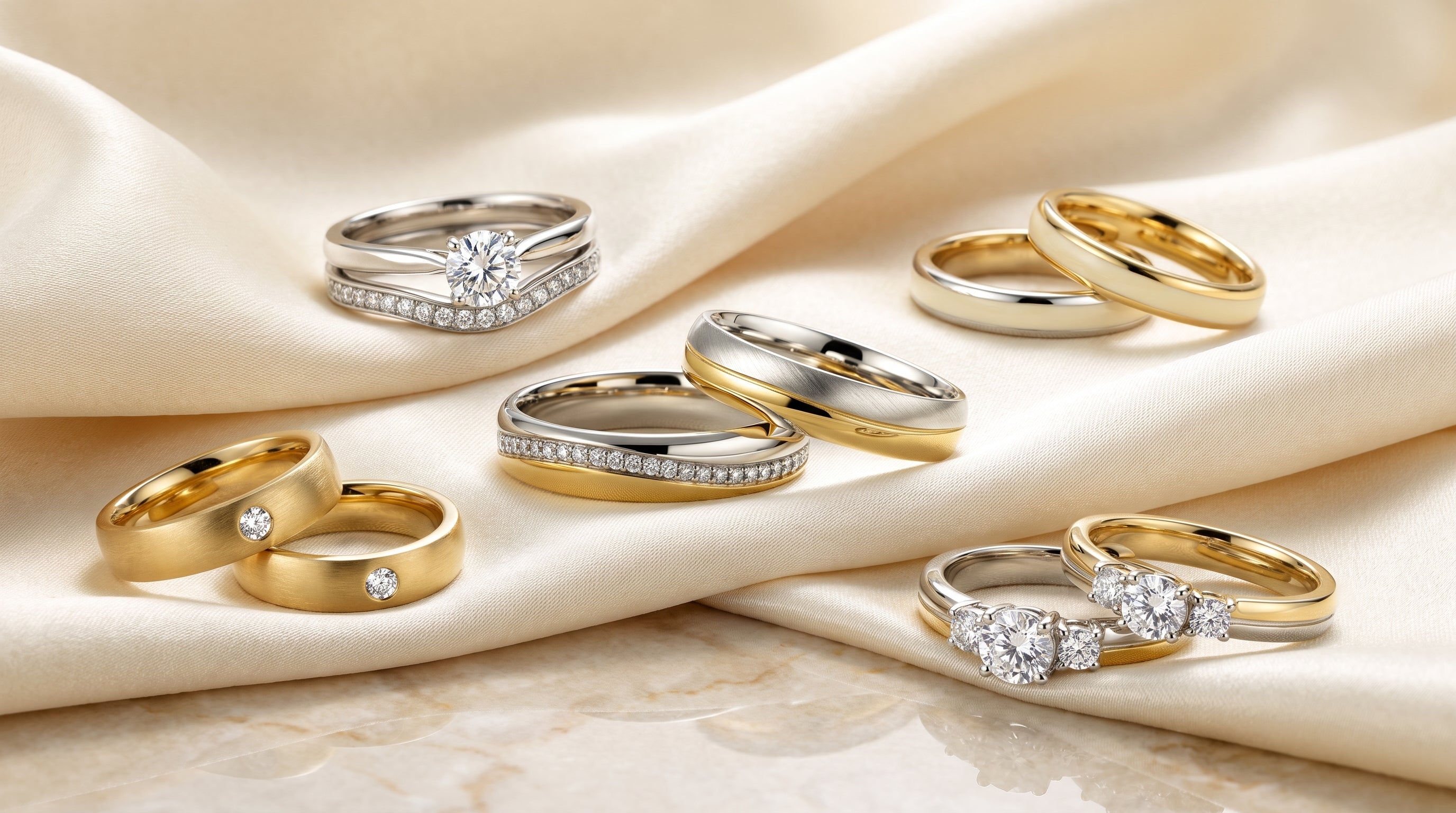
A third approach is to unify the rings through material or narrative instead of silhouette. Specialist makers build matching sets around unusual inlays such as meteorite, wood, or fossil material, and other designers use mixed metals so that a warm-tone and a cool-tone ring read as siblings rather than twins. Awareness Avenue's Curved Pavé Couples Rings, for example, are described as combining dual-metal harmony with a pavé moissanite curve — the shared curve and stone line do the matching work while each band keeps its own weight and presence.
What 14k gold is — and what it is not
The alloy, in plain terms
Solid gold jewelry is never pure gold, because pure gold is soft enough to deform under normal wear. In a 14k alloy, 14 of 24 parts are gold and the remaining 10 parts are other metals — copper, silver, and zinc are typical — and that alloying is precisely what increases durability while keeping a rich gold appearance. This is why 14k is such a common specification for wedding rings: it is the practical intersection of gold color, everyday toughness, and cost.
"Solid" in this context means the ring has no plating and no base-metal core. The alloy runs all the way through. That is the property that matters most for a ring you will wear every day for decades: there is no thin outer layer to wear off and no different metal waiting underneath to be exposed.
Solid gold vs plated, vermeil, and gold filled
Most of the price spread you see between two "gold" his and hers sets comes down to which of these four constructions is being sold.
| Construction | What it is | Everyday wear implications |
|---|---|---|
| Gold plated | An inexpensive base metal such as brass dipped in a thin gold layer; gold content is typically under 1% of the piece | Least expensive and lowest quality of the coated options; the layer can wear off and tarnish, exposing base metal that may irritate skin. Expected life is often measured in months to about a year depending on wear and care. |
| Gold vermeil | Same coated structure, but the base is sterling silver and the gold layer must be at least 0.5 microns thick | Higher quality and more hypoallergenic than standard plating because both metals are precious, but the gold can still wear through to reveal silver. |
| Gold filled | A thicker gold layer, at least 5% of the piece's weight, pressure-bonded to a base metal core | More durable and more tarnish-resistant than plated or vermeil, still less costly than solid gold, but the core is not gold. |
| Solid gold (e.g., 14k) | A gold alloy throughout, with no plating and no base-metal core | The most durable and long-lasting option for everyday pieces such as wedding and engagement rings; nothing can wear through to a different metal, and it holds value better over time. |
One nuance worth understanding: gold plated jewelry does contain real gold, which is why listings can technically call it real gold. The gold is simply a thin surface layer rather than the substance of the ring. If a set is being sold on the strength of the word "gold" without a karat mark or a construction description, that ambiguity is the thing to resolve before you buy.
How to verify what you are actually buying
- Look for an explicit karat specification (14k, 18k) rather than "gold," "gold tone," or "gold color."
- Look for the words solid gold and the absence of "plated," "vermeil," "filled," "overlay," or "bonded" anywhere in the description.
- Check whether the listing names a core metal. A tungsten, brass, stainless, or silver core means the gold is a surface, not the structure.
- Ask directly about alloy content if you have a known metal allergy — karat alone does not tell you which alloying metals were used.
- For matched pairs, confirm the karat and construction of both rings. Sets are sometimes mixed, especially where one ring carries stones and the other does not.
If you want to see how gold-specification sets compare side by side, our overview of gold wedding ring sets his and hers covers the same verification points applied to specific styles.
14k gold vs tungsten, titanium, silver, and hybrids
The hybrid gold-over-tungsten category
A notable middle path in the his and hers market is the gold-over-tungsten band: a tungsten core with a 14k gold exterior, marketed on the argument that the core supplies hardness while the gold supplies the look. Some brands advertise these as far stronger than solid gold — one describes its 14k yellow gold tungsten bands as ten times stronger than solid gold. Treat that as a manufacturer's marketing claim rather than an independently tested figure, and understand what the structure means in practice: the mechanical behavior of the ring is dominated by the tungsten core, not by the gold you can see. It is a different product from a solid 14k band, with different resizing and repair realities.
Alternative metals at the affordable end
Large retailers and marketplaces list his and hers sets in sterling silver, titanium, tungsten, and gold-tone finishes, frequently paired with cubic zirconia stones. These are legitimate choices for couples who prioritize scratch resistance or a low entry cost, and they are the reason searches for cheap his and hers wedding ring sets return so many gold-colored results. The trade-off is authenticity of material and long-term wear: a gold-tone finish over a base metal is not the same asset as a 14k alloy, and listing language such as "scratch proof" or "super strong" is seller copy rather than verified performance data.
Skin sensitivity and hypoallergenic questions
Pure 24k gold is naturally hypoallergenic, but whether a 14k or 18k gold ring is hypoallergenic depends on the specific alloy composition, since the alloying metals are what a sensitive wearer typically reacts to. That means "14k gold" alone is not a guarantee of comfort for someone with a known metal allergy, and it is fair to ask a jeweler what the alloy contains.
The clearer risk sits at the coated end of the spectrum. When a thin gold plating wears away, the base metal underneath — often brass — becomes exposed and can irritate skin. For sensitive wearers, solid gold and gold vermeil are the safer constructions, because in both cases the metal touching the finger is a precious metal rather than a cheap base alloy.
Sizing, comfort, and the two-hand problem
Size each partner separately, at the right time of day
Ring sizes are not transferable between partners and should never be estimated by comparison. Measure each hand on its own, and measure at the end of the day, when fingers are at their largest — fingers swell slightly with heat and physical activity, so a ring that slides on comfortably at 8 a.m. can feel tight by evening. If your two measurements disagree across separate days, take the larger reading rather than the smaller one.
Expect fit to be a process, not a single measurement
Experienced bridal jewelers advise shoppers not to assume they will land the perfect size on the first attempt, and to plan for the reality of resizing and long-term fit changes. This is worth building into your timeline, especially with trios, where an engagement ring and a contour band must sit together without gapping. It also affects material choice: solid gold can generally be worked on by a bench jeweler, whereas hard alternative metals and coated constructions usually cannot be resized in the same way.
Match the design to the life the ring will live
Comfort and durability deserve more weight than first-glance sparkle. Practical filters that separate a set you will still wear in ten years from one you will take off constantly include band width and profile, finish (a brushed or matte surface hides micro-scratches that a mirror polish advertises), stone height and setting security, and whether the ring's edges catch on gloves, equipment, or fabric. If you are unfamiliar with how settings affect security and snag risk, our guide to ring settings covers the mechanics behind flush, pavé, and bezel styles.
Coordinating two rings without making them identical
The most reliable way to design a set is to choose one shared element and then let everything else differ. Useful shared elements include:
- Metal tone. The simplest unifier. Both rings in the same karat and color read as a pair from across a room.
- Finish. A matching brushed, matte, or high-polish surface links two very different silhouettes.
- Stone type. A shared stone — diamond, moissanite, or otherwise — repeated at different scales on each band.
- A structural detail. A repeated curve, an inlay, a bevel, or a flush-set line running through both rings.
- Two-tone logic. Each ring uses both metals, but in reversed proportions, so the pair mirrors rather than duplicates.
Stone choice is its own decision. Diamonds and moissanite dominate the fine-jewelry tier, while cubic zirconia is common in the lower-priced sets sold through large retailers and marketplaces. If one partner's ring carries stones and the other's does not, the metal and finish have to carry the coordination.
Budget strategy: where "cheap" actually comes from
When a his and hers set is dramatically less expensive than a comparable-looking one, the savings almost always come from one of four levers: coated construction instead of solid alloy, an alternative base metal instead of gold, simulated stones instead of diamonds or moissanite, or a lower karat with less gold content by weight. None of these is inherently wrong — they are just different products, and knowing which lever you are pulling keeps expectations honest.
Sequencing beats compromising
A tactic worth considering: rather than buying two coated rings now, buy the ring that will take the hardest daily beating in solid gold first, and add the second in the same specification later. Solid gold's advantage compounds over time — it does not wear through to another metal, it can be polished and repaired, and it retains value better than coated pieces, which makes a higher up-front number easier to justify across a decade of wear. If you need to stay under a firm number today, our roundup of affordable wedding bands his and hers is a more targeted starting point.
Count the total cost, not the sticker
Coated rings carry replacement cost. Gold plated pieces may hold their finish for only months to about a year depending on wear and care, and re-plating is a recurring expense rather than a one-time repair. Gold filled sits higher on that scale, and solid gold removes the replating cycle entirely. Factor resizing, engraving, and eventual refinishing into whichever route you choose.
Awareness Avenue couples ring sets
Our couples ring sets are built as two-piece his and hers pairs rather than three-piece trios, with the coordination handled through shared curves, finishes, stone lines, and metal pairings. A few of the design directions available:
- The Curved Pavé Couples Rings — dual-metal harmony with a pavé moissanite curve carried across the pair, for couples who want the rings to echo each other through line and stone rather than through identical width.
- The Brushed Flush Couples Rings — a brushed surface with flush-set stones, the low-profile combination that tends to suit hands-on work and snag-sensitive routines.
- The Brushed Flush Couples Rings – Solid Gold — the same design language executed in solid gold, for couples who want the no-plating, no-base-metal construction described above. You can browse the wider solid gold pieces range alongside it.
- The Two-Tone Three-Stone Couples Rings and The Enamel Contrast Couples Rings — two takes on mirrored contrast, where the pair is unified by a repeated color or stone motif instead of a repeated silhouette.
For the exact metal specification, karat, and stone details of any individual style, check the specification section on that product page before ordering, and confirm both rings in the pair. The full band range sits in our wedding bands collection if one partner wants to build a coordinated pair from two separate designs.
A pre-purchase checklist
- Decide the architecture first: two coordinating bands, or a three-piece trio that includes the engagement ring.
- Set the construction standard before you fall for a design — solid 14k, or a specific coated or hybrid alternative you have chosen knowingly.
- Confirm karat and construction in writing for both rings, not just the headline ring.
- Measure both partners separately, at the end of the day, and take the larger reading if measurements conflict.
- Pick the shared design element that links the pair, and let the rest differ by hand.
- Pressure-test the design against daily life: width, finish, stone height, and edge profile.
- If either partner has a metal sensitivity, ask about alloy content rather than relying on the karat number alone.
- Confirm resizing options up front, since hard alternative metals and coated cores behave very differently from solid gold at the bench.
Frequently asked questions
Is 14k gold strong enough for a wedding ring worn every day?
Yes — that is essentially what the alloy exists for. Gold is alloyed with metals such as copper, silver, and zinc specifically to increase durability, because pure 24k gold is too soft for daily wear. Solid gold is widely regarded as the most durable and longest-lasting choice for everyday pieces like wedding and engagement rings.
Does a gold plated set count as a real gold set?
It contains real gold, but only as a thin surface layer that is typically under 1% of the piece. Over time that layer can wear away and tarnish, exposing the base metal underneath. It is a fair choice for a short-term or backup ring; it is a different proposition from a solid 14k band intended to last decades.
Do both rings in a his and hers set have to be the same karat?
No, but keeping the karat and color consistent is the easiest way to make two different silhouettes read as a matched pair, and it keeps wear characteristics similar across both rings. Where the karats differ, the shared design element becomes more important.
Are 14k gold rings hypoallergenic?
Pure gold is naturally hypoallergenic, but for 14k and 18k the answer depends on the alloy composition, since the added metals are what most sensitive wearers react to. If either partner has a known allergy, ask what is in the alloy. Coated rings pose a separate risk, because worn-through plating exposes base metal such as brass.
Should we buy a trio set or two separate bands?
Buy a trio if you want the engagement ring and its companion band engineered to sit flush from day one and you are shopping for all three rings at once. Buy two coordinating bands if the engagement ring already exists, if the partners want meaningfully different widths or finishes, or if you would rather spend the budget on metal quality than on a third ring.

Leave a comment
This site is protected by hCaptcha and the hCaptcha Privacy Policy and Terms of Service apply.