


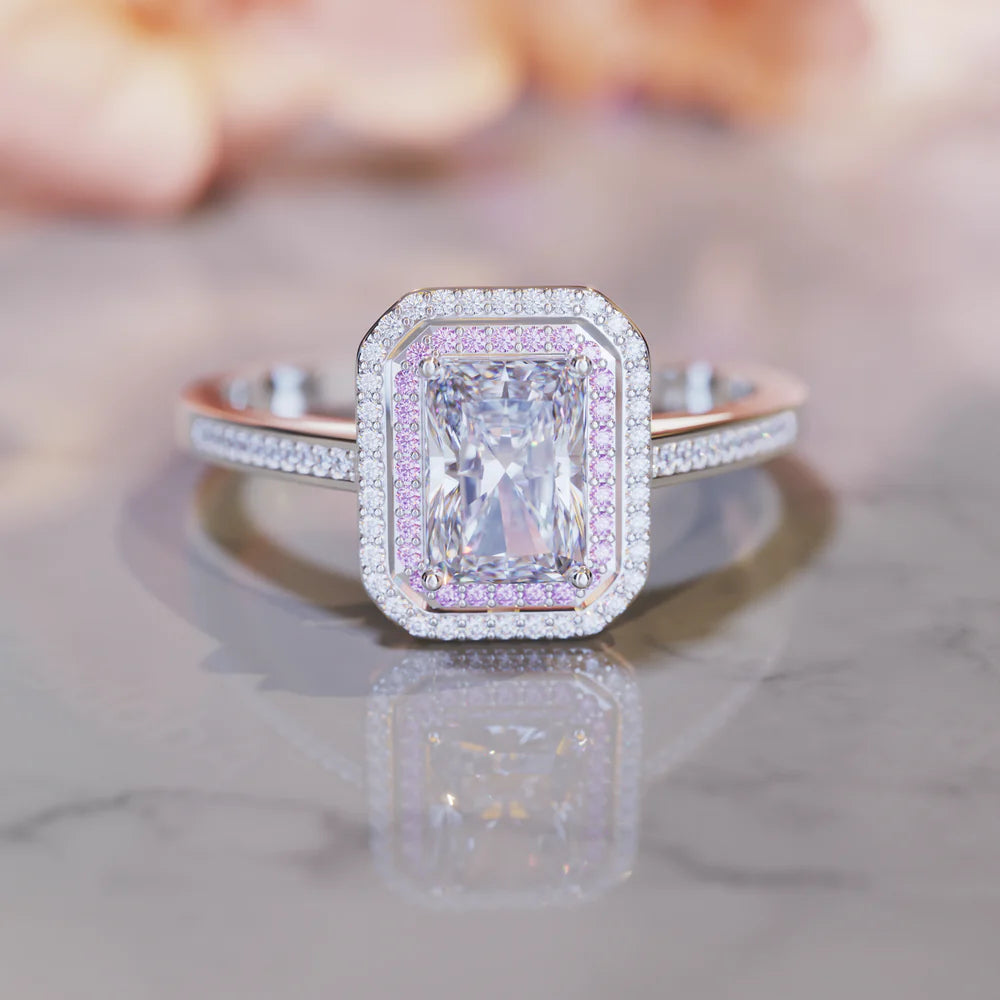
Moissanite vs Diamond: The Ultimate Comparison Guide for Buyers
When it comes to choosing a gemstone for rings, especially for engagement or promise rings, diamonds have traditionally taken center stage. But moissanite now gives buyers more fire than a diamond at a fraction of the price, and many are asking whether a diamond is worth it. This is the side-by-side guide: every number that matters, how to tell the two stones apart, and what each one means for your budget.
1. What is Moissanite, and How Does it Compare to Diamond?
Moissanite is a lab-grown gemstone originally discovered in meteorite fragments by Dr. Henri Moissan. Today, it’s synthetically produced to offer a brilliant alternative to diamonds. Diamonds, on the other hand, are naturally occurring stones formed over billions of years under extreme pressure deep within the Earth.
Key Differences
- Origin: Moissanite is lab-grown, while diamonds are either mined or lab-created.
- Composition: Moissanite is silicon carbide, first identified by Henri Moissan in 1893 in a meteorite crater in Arizona. Diamond is pure carbon. They are two different gemstones, not two versions of one.
2. Brilliance and Sparkle: Which Shines Brighter?
One of the biggest draws of moissanite is its exceptional brilliance. Moissanite has a higher refractive index (2.65-2.69 against diamond's 2.42), so it bends and returns more light, and more than double the dispersion (0.104 against 0.044), which is what throws that noticeable "fire".
Moissanite’s Sparkle
- Known for its rainbow-like sparkle, moissanite reflects more colorful light than diamonds. This brilliance is particularly noticeable in direct sunlight, where moissanite can outshine most diamonds.
Diamond’s Sparkle
- Diamonds offer a classic "white" sparkle, prized for its elegance and subtlety. In sheer dispersion, though, diamond's 0.044 is less than half of moissanite's 0.104.
Bottom Line: If you want a stone that truly catches the eye with its sparkle, moissanite wins clearly. But if you prefer a more subdued, classic look, diamonds might appeal more.
3. Durability: Which Gemstone Lasts Longer?
Durability is essential for gemstones intended for daily wear, like engagement rings. Here’s how moissanite and diamonds measure up in terms of strength.
- Diamond: With a hardness of 10 on the Mohs scale, diamonds are the hardest natural material on Earth. This makes them incredibly resistant to scratching and perfect for daily wear.
- Moissanite: Ranking at 9.25 on the Mohs scale, moissanite is also highly durable and suitable for everyday use. While slightly softer than diamonds, it’s still one of the hardest gemstones available.
Bottom Line: Both stones are highly durable, but diamonds are slightly harder. However, moissanite is durable enough to withstand daily wear without concerns about scratching.
4. Price: Which Offers Better Value?
When it comes to price, moissanite is the clear winner. A diamond's price climbs steeply with every step up in carat, color and clarity. Moissanite is grown, so a bigger, cleaner-looking stone costs a fraction of a comparable diamond, and most of what you pay goes into size, cut, metal and setting.
Price Comparison
- Diamond: The cost of a diamond depends on the 4 Cs (cut, color, clarity, and carat weight), and it climbs steeply as each one improves.
- Moissanite: The price mostly follows carat size, cut, metal and setting, so a larger, brighter-looking stone stays within reach.
Bottom Line: Moissanite provides high aesthetic value without the high cost. It’s an ideal choice for budget-conscious buyers who still want a beautiful, long-lasting gemstone.
5. How to Tell Moissanite and Diamond Apart
To the naked eye, at a normal distance, most people can't tell. Up close and with the right tools, the differences are clear.
- Fire: In sunlight, moissanite throws noticeably more rainbow flashes, thanks to dispersion of 0.104 against diamond's 0.044.
- Double refraction: Moissanite is doubly refractive. Under a loupe, especially in larger stones, you may see a soft doubling of the back facet edges. Diamond is singly refractive and shows no doubling.
- Testers: Basic thermal diamond testers can read moissanite as diamond because both conduct heat well. Testers that also measure electrical conductivity identify moissanite.
Bottom Line: In everyday life, moissanite reads as a brilliant, fiery stone that holds its own beside any diamond. Only a close look or a jeweler's tester tells the story.
6. Color and Clarity: Which Looks More Perfect?
Moissanite Color:
- Moissanite is generally near-colorless, though some stones may have slight yellow or gray undertones. High-quality moissanite is nearly indistinguishable from a diamond in terms of color.
Diamond Color:
- Diamonds are graded on a scale from D (colorless) to Z (noticeably yellow or brown). Colorless diamonds (D-F) are rare and expensive.
Clarity:
- Moissanite is lab-created, so it tends to be free of the natural imperfections (inclusions) found in diamonds.
- Diamonds, being natural, often contain inclusions, which are imperfections or "birthmarks."
Bottom Line: Moissanite typically offers a consistent, clear appearance, whereas diamond quality varies and can come at a higher price if you’re looking for a flawless appearance.
7. Investment Value: Does Either Hold Value Over Time?
Diamonds are often marketed as a valuable investment, but this is somewhat misleading. Diamonds lose significant resale value once purchased and are difficult to liquidate without a substantial loss.
Investment Reality:
- Diamonds: Retail markups mean a diamond typically resells for well below what you paid, and how far below varies widely by stone and market.
- Moissanite: Moissanite’s value is in the wearing rather than resale potential, as it typically doesn’t hold resale value in the same way as diamonds, but also doesn't lose its inherent value on purchase.
Bottom Line: Neither moissanite nor diamonds are great investment stones, but moissanite offers far better initial value without the high markup.
| Feature | Moissanite | Diamond |
|---|---|---|
| Brilliance | Refractive index 2.65-2.69; dispersion 0.104 (rainbow fire) | Refractive index 2.42; dispersion 0.044 (classic white sparkle) |
| Durability | 9.25 on Mohs scale | 10 on Mohs scale |
| Price | A fraction of a comparable diamond | High; varies by quality |
| Origin | Lab-grown silicon carbide | Pure carbon, mined or lab-grown |
Conclusion: Which One Should You Choose?
If you're looking for a beautiful, brilliant and affordable gemstone, moissanite delivers incredible value without compromising on appearance or durability: more fire than a diamond, 9.25 hardness, and a price that leaves room for the rest of your life. If tradition is what matters most, a classic diamond may still appeal to you. For most buyers comparing the numbers, moissanite is the smart choice.
Next step: if you're buying an engagement ring and planning the proposal, read our moissanite vs diamond engagement ring guide for men. To compare specific rings, plus lab diamond and cubic zirconia, see moissanite rings vs diamond rings.
Ready to explore moissanite options? Check out our best-selling moissanite rings collection and discover why so many are choosing moissanite over diamond today.

Leave a comment
This site is protected by hCaptcha and the hCaptcha Privacy Policy and Terms of Service apply.