


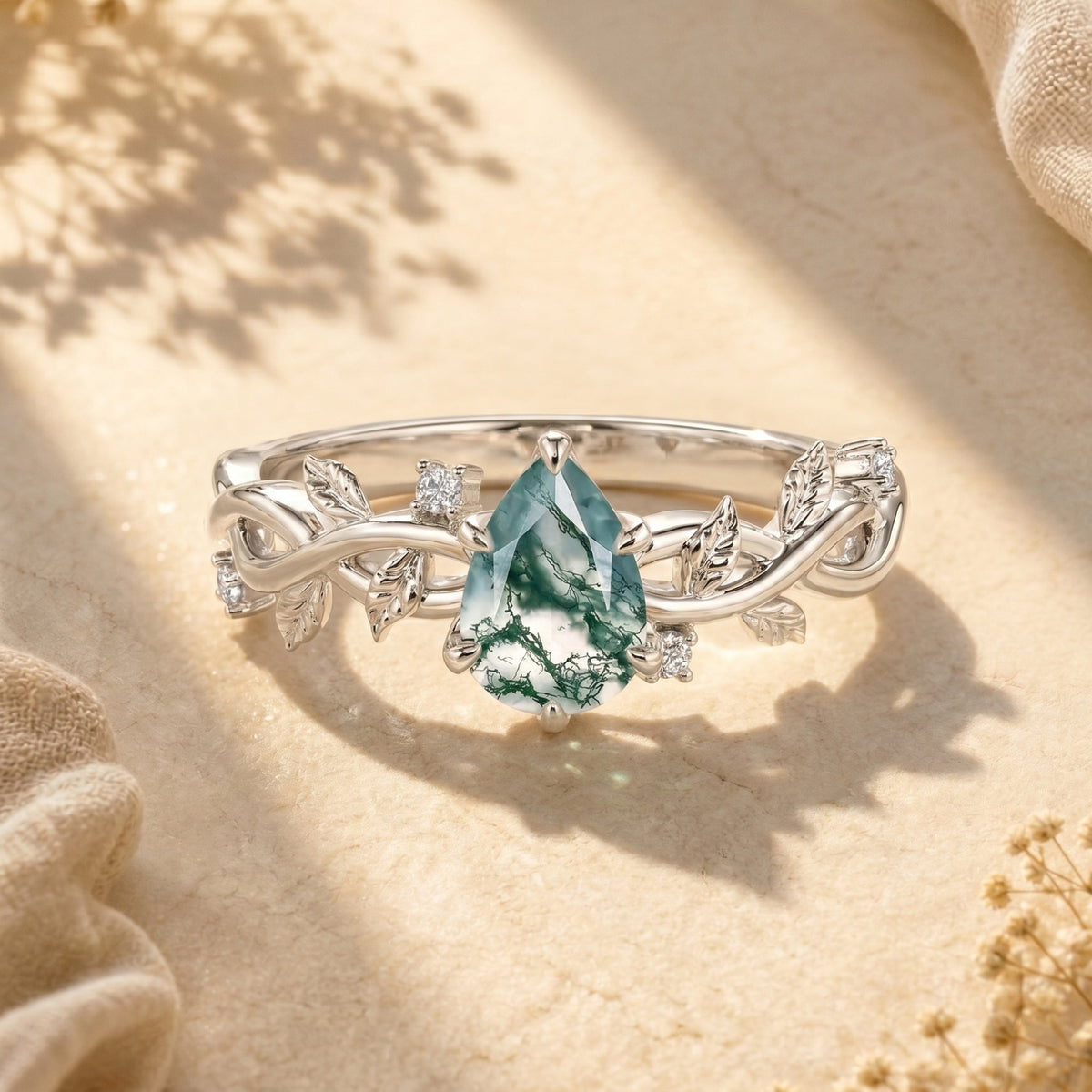
Type "moss agate ring men" into a search bar and you get a curious mismatch: page after page of bridal galleries, leaf-and-vine solitaires, and "for her" styling, with men's options surfacing only as a stray product listing. At least one retailer does catalog a men's moss agate wedding band in sterling silver, offered in widths such as 4 mm and 6 mm, which proves the category exists — but almost nothing explains the questions a man actually has before buying. Will a semi-precious stone survive a toolbox, a barbell, or a kitchen shift? Does a stone full of green filaments read as masculine on a wider band? Is the symbolism meaningful or marketing? This guide answers those questions using the gemological facts that are actually documented, and flags clearly where the evidence stops.
What Moss Agate Actually Is (and Why the Name Is Slightly Wrong)
Moss agate is a variety of chalcedony — a microcrystalline form of quartz made of silicon dioxide (SiO₂). What sets it apart is not color banding but inclusions: opaque, dark mineral growths, typically manganese and iron oxides (sometimes chlorite or similar minerals), that spread through a clear, milky-white, or grayish body in branching, fern-like shapes.
Here is the detail most product pages skip: those "plants" are not plants. The dendritic patterns are entirely inorganic mineral growth that diffused along cracks and crystal boundaries during formation. They only look like moss, ferns, or tree branches. For the same reason, moss agate is not a true agate in the strict gemological sense, because true agates are defined by concentric banding and moss agate generally has none. The name stuck historically, not scientifically. Some educational sources also note an older alias, "mocha stone," named after an ancient deposit near Mocha, Yemen.
Where it comes from
Moss agate forms in cavities and fissures of volcanic, metamorphic, and sedimentary rock, and much of the commercial supply is weathered out of volcanic rock and recovered from alluvial deposits. Documented sources include India, Brazil, Uruguay, central Europe, the United States, Australia, and Russia. Montana material is distinctive enough to be named for its origin: Montana moss agate often shows red tones from iron oxide alongside dark manganese-oxide dendrites.
How to read a stone before you buy it
Because the inclusions are the whole point, two rings cut from the same rough can look nothing alike — no two stones are identical. When comparing stones, look at three things. First, pattern density: sparse dendrites against a clear body read graphic and modern; dense, dark growth reads almost like a landscape or a storm. Second, body transparency, which ranges from near-transparent to translucent and determines how much light moves behind the pattern. Third, whether any dendrite reaches the surface, which is common and expected in this material rather than a defect. Stuller's jeweler guidance classifies moss agate as a Type III gemstone, meaning inclusions are expected and are part of its identity — the opposite of how a diamond is graded.
Durability: Can a Man Wear Moss Agate Every Day?
This is the make-or-break question, and the answer is a qualified yes.
What a Mohs hardness of 6.5–7 means in practice
Multiple gemological and jeweler sources place moss agate at roughly 6.5 to 7 on the Mohs scale, with a specific gravity around 2.58–2.62 and a refractive index near 1.54–1.55 — standard quartz-family numbers. The International Gem Society treats 6.5–7 as the critical threshold range for engagement ring stones: workable for daily wear, but not bulletproof. One jeweler framing puts it usefully — moss agate is slightly harder than a steel nail, so it is not "soft" in any meaningful sense.
What it is not is diamond (10) or sapphire (9). The Mohs scale is ordinal, not linear, and the gap between 7 and 10 is enormous. Everyday airborne dust contains quartz at hardness 7, which means moss agate can be dulled over time by the same grit that leaves a sapphire untouched. A moss agate band exposed to hard wear is susceptible to surface scratching, dulling, or chipping along thin edges. The International Gem Society explicitly recommends removing the ring before activities that could cause impact.
There is an honest limit to the evidence here: no published source tests moss agate specifically under men's wear patterns — heavier hands, wider bands, tool contact, gym work. What follows is applied gemology, not measured data on men's rings.
Settings that protect the stone
Setting choice matters more than hardness for a ring that takes real impact. Three approaches reduce risk meaningfully:
- Bezel settings. A continuous metal rim around the stone absorbs edge strikes that would otherwise land on the gem. For a man's ring worn through manual work, this is the most defensible choice.
- Flush or gypsy settings. The stone sits level with the band surface, so there is no raised profile to catch on a doorframe, rope, or handlebar.
- Channel or inlay bands. A strip of moss agate set between metal walls keeps the gem below the highest point of the ring, letting metal take the abuse.
Prong-set cabochons and tall solitaire profiles are the opposite: beautiful, more exposed, and better suited to occasions than to construction sites. If you want a raised center stone, our guides on moss agate settings and durability and simple, minimalist moss agate designs walk through the structural trade-offs in more depth.
When to take the ring off
Practical rules that follow from the material's properties rather than from marketing: remove the ring for weightlifting and barbell work, for anything involving hammers, wrenches, or ladders, for rock climbing, and before using abrasive cleaners or solvents. Avoid storing it loose against harder stones — a diamond or sapphire sharing a drawer will scratch moss agate, not the other way around. None of this is unique to moss agate; it is simply more consequential at 6.5–7 than at 9 or 10.
Men's Moss Agate Ring Styles That Actually Read Masculine
The most common objection to moss agate on a man's hand is aesthetic, not technical: the dominant design language in this category is leaves, vines, twisted twig bands, and filigree, drawn straight from nature-inspired bridal collections. Those motifs are not inherently gendered, but they are heavily coded by how they are currently marketed.
Width and proportion
The one documented men's listing in this category offers widths such as 4 mm and 6 mm, providing specific options depending on individual sizing preferences. Wider bands change what the stone can do: a 6 mm band can carry a long rectangular or elongated hexagonal section of moss agate that reads as a landscape strip rather than a gemstone "set piece." Narrower 4 mm bands suit a single compact cabochon or a slim inlay line. Because moss agate's visual interest is pattern rather than sparkle, larger surface area generally serves it better than height.
Cut and surface
Moss agate is commonly cut as cabochons — typically in the 4–8 mm range for ring use, with 6 mm a frequent choice — and also appears in faceted shapes including round, oval, pear, kite, and hexagon. For men's rings, flat-top cabochons and faceted hexagons tend to look architectural rather than ornamental, while high-domed ovals read softer. A matte or brushed metal finish alongside a polished stone is another way to shift the overall character without touching the gem.
Metals and contrast
Moss agate pairs with sterling silver, white gold, yellow gold, rose gold, and platinum across the market. Cooler metals emphasize the green and gray in the dendrites; yellow and rose golds warm the milky body and pick up any red iron staining in Montana-type material. Darkened or oxidized silver detailing increases contrast with a pale stone body, which is a straightforward route to a more rugged look.
Vintage and nature-inspired, minus the florals
Vintage and art deco framing is everywhere in this category, and it translates well to men's rings when the ornament is geometric rather than botanical: stepped shoulders, milgrain edges, engraved chevrons, or a simple engraved border instead of carved leaves. If you like the heritage feel, our vintage moss agate buying guide covers how those design cues are executed.
What a Moss Agate Ring Means
Symbolism is a legitimate reason to choose this stone, provided it is described honestly as tradition and belief rather than fact.
Across gem education sites, jeweler blogs, and editorial coverage, moss agate is consistently associated with growth, renewal, new beginnings, harmony with nature, and abundance. It has historically been called the "Gardener's Stone," and sources report a tradition of farmers carrying it as a talisman for a good harvest. In modern metaphysical writing it is frequently linked to the heart chakra and emotional balance. The International Gem Society notes that the plant-like look of the inclusions leads many people to associate the stone with a healthy ecosystem and natural balance.
Those are widely repeated cultural associations, not demonstrated effects, and no source promises outcomes. What can be said plainly is that the imagery fits certain commitments well: a stone whose defining feature is slow, branching growth reads naturally as a symbol of something built over time rather than something bought for status. If you want the full history and the honest caveats, we cover it in depth in moss agate ring meaning.
There is no survey data on how men specifically perceive this symbolism, and anyone claiming otherwise is guessing. Treat it as a personal fit question, not a demographic one.
Engagement Rings, Wedding Bands, Promise Rings, and Matched Sets
Moss agate appears across every relational ring category: engagement rings, wedding bands, promise rings, anniversary rings, and everyday fashion rings. Retail collections include hexagon-cut moss agate wedding ring sets, pear-center designs with curved twig bands and moissanite accents, and double curved band enhancers — but the stone is almost always on the woman's ring in those sets, with the men's band defaulting to plain metal.
That default is a choice, not a rule. Three configurations work for couples who want the stone on both hands:
- Shared material, different format. A faceted or cabochon center on one ring, a flush-set or inlay strip of moss agate on the other. The stone connects the rings; the construction suits each wearer.
- Shared rough. Asking a jeweler whether both stones can be cut from the same piece of material produces visually related patterns — a meaningful detail given that no two moss agate stones are alike.
- Stone on his, metal on hers. A deliberate inversion that is rarely shown but perfectly viable.
If you are choosing between commitment formats before you choose a stone, promise ring vs. engagement ring is a useful starting point, and our complete moss agate engagement ring guide covers center-stone selection in detail.
Price and Value: What to Expect
Moss agate is a semi-precious gemstone, and every major source in this category — gem education sites, jeweler blogs, and wedding editorial alike — positions it as a lower-cost alternative to diamond for engagement and wedding rings. That relative positioning is consistent and well supported.
Specific figures are another matter. Published estimates vary widely by metal, stone size, and craftsmanship, and the dated price averages circulating in this niche are too old to quote responsibly. What you can rely on structurally is where the money goes: in a moss agate ring, the stone is usually a small share of the total, and the setting metal plus the labor carry most of the cost. A solid gold or platinum band will dominate the price regardless of which moss agate sits in it; a sterling silver band keeps the total far lower.
The practical implication for men's rings is useful. Because the gem itself is not the cost driver, upgrading to a protective bezel, a thicker band, or a more durable metal is often a better use of budget than buying a larger stone. Spend on the structure that keeps the stone intact.
Care: A Routine That Will Not Damage the Stone
Care guidance for moss agate is unusually consistent across jeweler and gemological sources, and the warnings matter more than the cleaning method.
Do this
- Clean with lukewarm water, mild dish soap, and a soft-bristle brush or soft cloth.
- Rinse and dry thoroughly, paying attention to the gap around a bezel or inlay where soap collects.
- Clean regularly — weekly is a commonly recommended cadence for chalcedony — so grit never builds into an abrasive film.
- Store the ring separately from harder gemstones.
Avoid this
- Ultrasonic cleaners. Mechanical agitation can propagate existing fractures and shatter inclusions in a Type III stone.
- Steam cleaning. Heat and pressure can penetrate surface-reaching dendrites and features.
- Abrasive polishing compounds and harsh chemicals, which can alter the stone's surface and appearance.
If a jeweler offers to drop your ring in the ultrasonic tank during a routine check, say no and explain why. Plenty of bench professionals know this; not all counter staff do.
A Buyer's Checklist for Men's Moss Agate Rings
- Match the setting to your hands. Manual work, lifting, or trades? Bezel, flush, or inlay. Desk work and occasional wear? A raised cabochon is reasonable.
- Choose width before stone size. Pick the band width you will actually wear daily, then select a stone shape proportioned to it.
- Look at the actual stone, not a stock photo. Because every piece of moss agate is different, the specific stone you receive is the product. Ask for photos of the exact stone where possible.
- Confirm the gem is natural moss agate and ask what the body color and dendrite colors are, rather than relying on edited imagery.
- Check resizing implications. Inlay and channel-set bands are harder to resize than plain shanks; get sizing right at purchase.
- Plan the care routine before you buy, and confirm the seller's cleaning guidance matches the no-ultrasonic, no-steam standard.
Where Awareness Avenue fits
Our moss agate pieces — including The Nimue Moss Agate Ring, the natural moss agate oval solitaire in S925 sterling silver, and a natural moss agate V-cut solitaire ring set — are solitaire-style designs, not bands marketed specifically as men's rings. We would rather say that plainly than claim otherwise. If you like the stone and the silhouette suits you, check the available sizes and band dimensions on each product page before ordering, and consider how exposed the center stone is relative to how you work and train. You can browse the wider ring collection to compare profiles.
Frequently Asked Questions
Is moss agate hard enough for a men's wedding band?
At roughly 6.5–7 on the Mohs scale, moss agate is in the moderately hard range considered workable for daily-wear jewelry with sensible care. It will scratch more readily than diamond or sapphire, so a protective setting and the habit of removing the ring for heavy work make a real difference.
Does moss agate contain actual moss?
No. The moss-like patterns are inorganic mineral inclusions — commonly manganese and iron oxides, sometimes chlorite — that grew in branching forms inside the quartz.
Will my ring look like the photo?
Not exactly, and that is inherent to the material. Inclusion patterns are unique to each stone, which is precisely why jewelers favor moss agate for one-of-a-kind rings.
Can moss agate be worn in water?
Brief contact with water is not the concern; harsh chemicals, abrasives, and mechanical cleaning systems are. Chlorinated pools, solvents, and cleaning products are worth avoiding, and the ring should be dried properly afterward.
Is moss agate a good alternative to a plain metal band?
It depends on what you want from the ring. A plain precious-metal band is the more impact-tolerant option. Moss agate trades a measure of that toughness for a gem that is visually unique, carries a long-standing association with growth and nature, and generally costs less than a comparable diamond ring. If the stone is set to be protected and the ring comes off for the roughest tasks, that trade is a reasonable one.


Leave a comment
This site is protected by hCaptcha and the hCaptcha Privacy Policy and Terms of Service apply.