


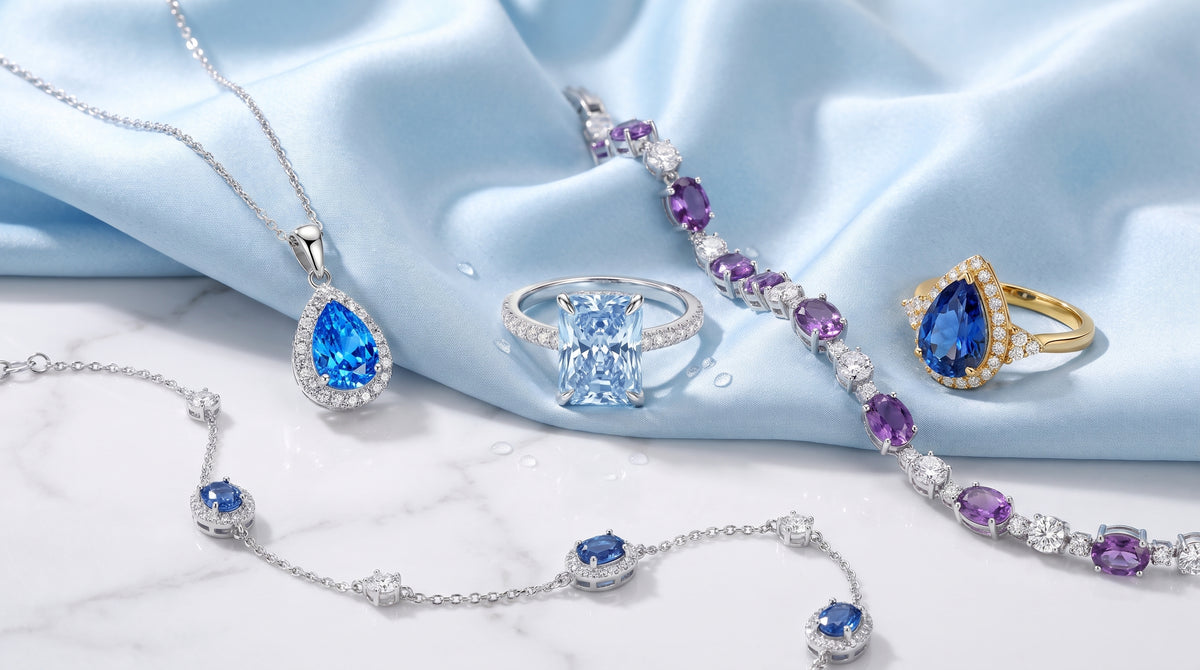
A diamond is bought from a grading report; a sapphire is bought with your eyes, then verified on paper. That single difference explains most of the confusion shoppers run into. In diamonds, clarity under magnification drives price. In sapphire, the Gemological Institute of America's buyer's guide puts color first, tolerates inclusions that would be penalized in a colorless stone, and flags treatment disclosure as the question most buyers forget to ask. This guide follows that order of priority, then applies it to the four things people actually shop for under the phrase "sapphire jewelry": engagement rings, men's bands, everyday pieces for women, and September birthstone gifts.
First, Decide Which Kind of "Sapphire" You're Buying
The word covers three very different products, and price, durability, and resale all hinge on which one is in the setting.
Natural sapphire (corundum)
Gemologically, sapphire is a variety of corundum, aluminum oxide, with a trigonal crystal structure and a hardness of 9 on the Mohs scale, placing it among the hardest stones used in jewelry. Reference sources define sapphire as every gem variety of corundum except red; red corundum is ruby. So sapphire legitimately appears in blue, pink, yellow, purple, and other "fancy" colors, even though dictionaries and everyday language treat it as a bright-to-deep blue stone, to the point that "sapphire" doubles as an adjective for intense blue.
Treated natural sapphire
Most sapphire sold today has been enhanced. GIA notes that a large share of sapphires, both blue and fancy colors, are treated to alter color, either by traditional heat or by lattice diffusion, and that lattice-diffusion stones often show vivid color but are less valuable than heat-treated ones. Retail buying guides go further and advise assuming a blue sapphire has been heated unless a laboratory report states there's no evidence of heat. Specialist education pages describe heat treatment as a centuries-old, widely accepted process that produces stable color and clarity improvements and makes attractive sapphire affordable. Treatment is not a defect; undisclosed treatment is.
Simulated sapphire
Simulated stones are made to look like sapphire at accessible price points, and they are common in birthstone jewelry. Our own September birthstone simulated sapphire collection is labeled exactly that way for a reason: the pieces are designed around sapphire's blue and its September symbolism, not sold as natural corundum. That distinction matters because the hardness and wear characteristics described throughout this guide apply to natural sapphire, and should not be assumed for a simulant unless the seller states the material. Awareness Avenue backs its jewelry with a lifetime guarantee covering potential defects in materials or workmanship; that is a manufacturing assurance, not a gemological claim about a stone's scratch resistance.
Quick rule: if you want heirloom or investment potential, buy natural and ask for documentation. If you want symbolism, color, and wearability at an accessible price, a clearly disclosed simulant is an honest choice. Problems only start when a listing blurs the two.
The Four Quality Factors, Ranked for Sapphire
Color: roughly 80% of the decision
Every authority in this category agrees color drives sapphire value. GIA describes the most highly valued blue sapphires as velvety blue to violetish blue, in medium to medium-dark tones, with saturation as strong as possible without darkening so much that brightness suffers. Retail guides translate this into the trade nickname "cornflower blue" and warn about the two failure modes at either extreme: pale, watery stones that look washed out, and near-black navy stones that read as dark rather than blue under normal lighting. Both are cheaper for a reason.
Practical test: look at the stone face-up, away from the spotlights over a display case, and see whether the blue stays saturated in ambient room light. Compare candidates side by side rather than sequentially, because memory for color is unreliable.
Clarity: eye-clean, not loupe-clean
Blue sapphires commonly contain inclusions; stones with extremely high clarity are rare and valuable. But because sapphire's body color is strong, trade guides point out that inclusions and slight haziness distract the eye far less than they would in a colorless gem. The working standard is to reject inclusions you can see unaided, or anything that produces a visible cloudy zone, and to stop short of grading sapphire under magnification the way you would a diamond. One genuine exception: GIA notes price drops when inclusions threaten durability, because a fracture reaching the surface creates a weak point. Ask specifically about that.
Cut: where color is either built or lost
Sapphire isn't cut to a single standardized ideal. Cutters balance overall face-up color, proportions, and weight retention, while working around color zoning (bands of differing color intensity) and pleochroism (different colors visible in different crystal directions). The consumer-level test is simple: a well-cut sapphire returns light evenly across the whole stone, with no dull, dead, or washed-out windows in the center. Beware of stones cut deep to preserve carat weight; they often look smaller and darker than their weight suggests. Oval and cushion shapes dominate partly because they suit the shape of sapphire rough, while oval, pear, and emerald cuts are frequently cited for sapphire engagement rings.
Carat: sapphire is denser than diamond
Blue sapphire occurs from tiny accent sizes up to hundreds of carats, and large blue sapphires are more available than large rubies, though most commercial-quality goods weigh under about five carats. Crucially, sapphire is denser than diamond, so it packs more weight into less spread. Comparative data puts a one-carat round diamond at roughly 6.5 mm across and a one-carat sapphire nearer 6.0 mm, meaning you'd look at approximately 1.2 carats of sapphire to match the face-up presence of a one-carat diamond. Budget for millimeters, not carats.
Sapphire vs. Diamond for Engagement Rings
This is the comparison most sapphire shoppers are actually running, so it deserves a straight answer rather than a sales pitch in either direction.
Durability: effectively a tie for real life
Diamond is 10 on the Mohs scale, sapphire 9. Comparative engagement ring guides repeatedly stress that both are far harder than the materials encountered in daily life, that normal wear will not visibly scratch either stone, and that both will last a lifetime of daily wear with proper care. Some sources argue sapphire resists chipping better than diamond thanks to its crystal structure, pointing to its use in watch crystals and scientific instruments as practical evidence. One consistent caveat from retail guides: sapphire is more durable than the precious metal holding it, so prongs and bands, not the stone, are what need periodic inspection.
Brilliance: diamond wins, and it isn't close
Diamond's refractive index of about 2.417 and its high dispersion produce the white sparkle and rainbow fire that modern cuts are engineered to maximize. Sapphire's refractive index sits near 1.76–1.77, giving lower brilliance and minimal fire; its beauty comes from saturated body color and luster rather than flash. If someone's mental image of an engagement ring is scintillation across a dim restaurant, sapphire will not replicate that. If their image is a deep, unmistakable color, diamond can't replicate that.
Cost and resale
Fine sapphire generally costs less per carat than a comparable natural diamond, which is why sapphire buyers often get noticeably more size and color impact for the same budget. The gap narrows sharply at the top of the market, where exceptional saturation and prized origins command premiums that can exceed ordinary diamond pricing. On resale, diamond benefits from standardized grading and a larger secondary trade; sapphire's resale market is smaller and less standardized, and both categories typically resell for a fraction of the original purchase price. Buy sapphire because you want the stone, not as a liquidity strategy, with the narrow exception of documented, untreated, origin-specific material.
Settings that suit sapphire
Halo and three-stone designs recur constantly in sapphire engagement ring guidance, because a bright diamond surround adds the sparkle sapphire doesn't generate on its own while framing the color. Sapphire also works in the reverse role: major retailers sell sapphire sidestone settings where blue accents flank a diamond center. Because sapphire is genuinely durable in exposed prongs, setting choice can be driven by looks rather than by fear of chipping.
Men's Sapphire Rings and Wedding Bands
Sapphire has a legitimate, long-established place in men's wedding jewelry. Retailers marketing men's sapphire wedding rings ground the pitch in symbolism: sapphire has long stood for wisdom, loyalty, and faithfulness, which reads naturally on a marriage band. The gemological case is equally strong, since a hardness of 9 and good impact resistance suit a ring worn through manual work, the gym, and daily knocks.
What to prioritize in a men's design
- Stone protection over stone size. Bezels, flush or gypsy settings, and recessed channels keep the girdle below the metal surface, which protects the setting rather than the sapphire.
- Tone over sparkle. Darker, ink-blue sapphires that would be discounted in an engagement ring often look intentional and masculine against yellow gold or oxidized silver.
- Metal wear. Since the metal is the softer component, heavier band profiles hold up better than thin, sharp-edged ones.
Vintage and vintage-inspired men's rings
Genuine period men's sapphire rings—signet forms, gold mountings, classic step cuts—circulate mostly through auction houses and specialist vintage dealers rather than mainstream retail, and published guidance on that niche is thin compared with vintage engagement rings. If you're shopping true vintage, treat treatment status and stone condition as open questions until a report says otherwise. If you want the look without the hunt, a modern band cut in a classic silhouette delivers the same aesthetic with known materials. Our deeper walkthrough of stone, band, and fit choices lives in the guide to men's sapphire rings.
Sapphire Jewelry for Women: Rings, Pendants, and Bracelets
Beyond bridal, sapphire earns its keep because it survives everyday wear. Buying guides describe it as excellent for rings worn daily and note that the main risks are losing a ring at the beach or pool and wearing down metal, not damaging the gem.
Matching the piece to the wear pattern
Rings take the most abuse, so favor protective settings and check prongs a couple of times a year. Pendants and earrings take almost none, which is where you can push for a larger, more open setting or a more delicate chain. Bracelets sit between the two: station and bezel-set formats like The Etherea Station Bracelet in S925 sterling silver spread the stones and keep each one seated in metal, which tends to wear better than high-set clusters on a wrist.
Coordinating color and metal
Blue reads coolest against white metals and most vintage-leaning against yellow gold, which is why the same stone can look contemporary or heirloom depending only on the mounting. If you're building a set rather than buying one piece, keep saturation consistent across items; mismatched tones of blue are far more noticeable side by side than a small difference in carat weight. For a longer treatment of shades, metals, and coordinated sets, see our guide to sapphire jewelry for women, and browse the wider fine jewelry collection for pieces that pair with a blue center stone.
September Birthstone Sapphire Jewelry and Meaning
Sapphire is the traditional birthstone for September, and the symbolism attached to it is unusually dense. Historical and meaning-focused sources connect blue sapphire to the heavens, purity, and divine law, describing it as a guardian of innocence and a stone associated with wisdom, truth, justice, serenity, and inner peace. Medieval accounts even claim kings wore sapphires for protection from harm and envy. The name itself traces to Latin saphirus and Greek sapheiros, both meaning blue, though linguists note the ancient Greek term likely referred originally to lapis lazuli.
For relationship gifts, the durable thread across sources is fidelity: blue sapphire is described as the symbol of truth, faithfulness, and the soul, and giving one is framed as a promise to be true. That is the same symbolic engine behind sapphire engagement rings and men's bands, applied to a gift that doesn't require a proposal.
Choosing birthstone pieces sensibly
Birthstone jewelry is the one segment where simulants are routine, so read the product description rather than the collection title. If a listing says simulated, take the symbolism and the color at face value and judge the piece on its metal, construction, and guarantee. Sterling silver designs such as The Azurea Radiant Ring are built for this use case: a wearable blue-stone ring tied to September rather than a natural-gem investment. If the recipient prefers gold tones, our breakdown of the September birthstone ring in gold covers vermeil and solid gold options, and the sapphire birthstone gift guide for mom works through gifting decisions stone-first.
Verification: The Questions That Actually Protect You
Because treatment and origin can move price dramatically and cannot be judged by eye, documentation is the buyer's real leverage. GIA advises asking what treatment a stone has undergone and obtaining a laboratory report when in doubt; specialist educators make the same recommendation, noting that distinguishing unheated from heated material relies on microscopic inclusion evidence that trained gemologists read, not on surface impressions. Auction-level guidance treats untreated natural sapphire as the top of the hierarchy precisely because it is scarce—described as roughly one percent of the market—and therefore most likely to hold or build value.
Ask these before paying
- Is the stone natural corundum, or a simulant? Get it in writing.
- If natural: heated, unheated, or lattice-diffused? Vivid diffusion-treated color is worth less than equivalent heated color.
- Is there an independent laboratory report, and does it address treatment (and origin, if origin is part of the price)?
- Do any inclusions reach the surface or otherwise affect durability?
- What does the seller's guarantee actually cover—manufacturing defects, or stone performance?
A "no heat" or premium-origin claim without a report is marketing, not a specification. Conversely, a clearly disclosed heat-treated stone with even, velvety color is a sound purchase; stability is one of the reasons heat treatment became standard practice.
Care, Wear, and Long-Term Ownership
Care guidance for natural sapphire is refreshingly undemanding. Trade guides recommend cleaning with mild dish soap and a soft brush, paying attention to the back of the stone where dust collects and dulls the color, and note that ultrasonic cleaners are generally safe for sapphire jewelry. The stated risk in removing rings at the beach or pool is loss, not damage.
A realistic maintenance routine
- Wash gently every few weeks; a filmed-over pavilion mutes saturation faster than any scratch will.
- Inspect prongs and bezel edges twice a year, since the metal is the weak link, not the gem.
- Remove rings for heavy lifting, demolition-grade tasks, and anywhere they can slip off.
- For simulated stones and plated or vermeil finishes, follow the manufacturer's care instructions instead of applying natural-sapphire assumptions; ultrasonic safety and chemical tolerance depend on the specific material and finish.
A Short Decision Framework
Use whichever line matches your priority:
- Maximum sparkle and standardized resale: buy diamond, and consider sapphire sidestones for color.
- Maximum color and size per dollar, with near-equal daily durability: buy a fine heat-treated natural sapphire, eye-clean, cut for even light return.
- Heirloom or value-retention ambitions: buy untreated natural sapphire with a laboratory report, and expect to pay for the paperwork as much as the stone.
- A meaningful September gift or a color you'll wear constantly without worry: buy a clearly disclosed simulated sapphire piece and spend your budget on the metal, the setting, and the guarantee.
Whichever path you take, the sequence stays the same. Judge color face-up in ordinary light, confirm the stone is eye-clean and structurally sound, check that the cut lights up across its whole surface, convert carats into millimeters, and get the material and treatment status in writing. Sapphire rewards that order of operations better than almost any other gem, because the thing you fell for—the blue—is also the thing that carries the value.

Leave a comment
This site is protected by hCaptcha and the hCaptcha Privacy Policy and Terms of Service apply.