


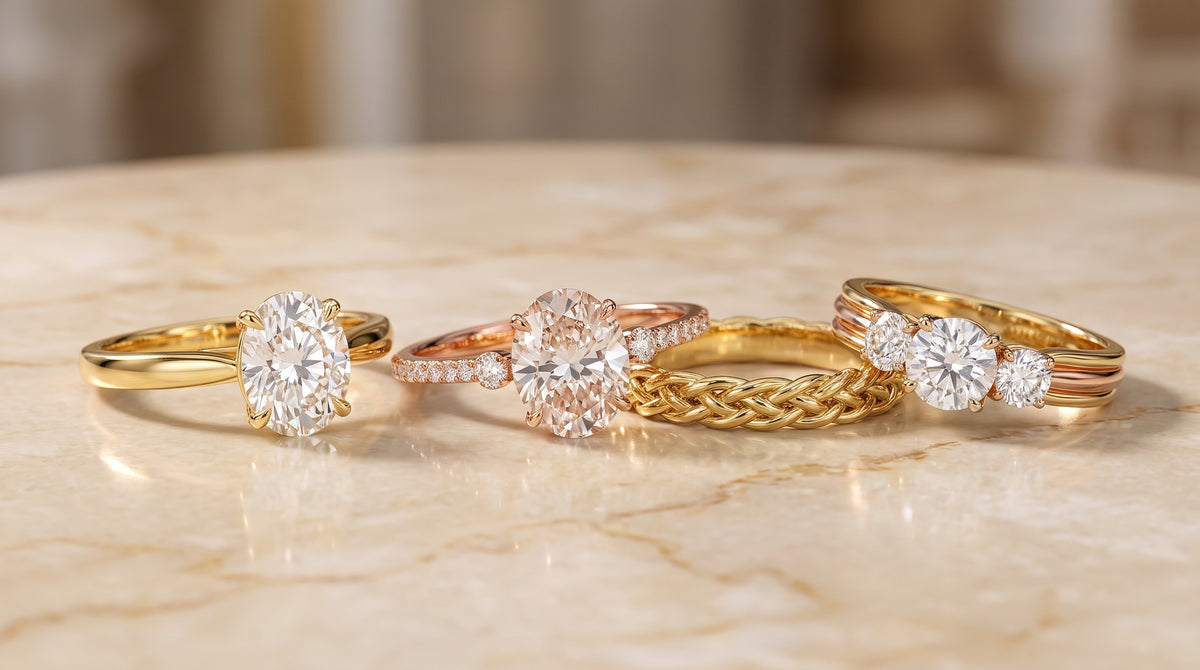
If you are typing "14k yellow gold moissanite ring" into a search bar, you have already made two of the three hard decisions. You have chosen the stone, and you have chosen the metal. What remains is the part most category pages handle badly: deciding which specific ring, in which cut, at which carat weight, and confirming that the "solid gold" in a product title is actually the yellow gold you pictured rather than white or rose.
That last point matters more than it sounds. Plenty of listings across the market, including some at Awareness Avenue, describe a band as "solid gold" or "14K solid gold" without naming the color in the written specification. The color is usually visible in the product imagery and selectable at checkout, but the text alone does not always confirm it. This roundup is written with that gap in mind: everything below is either general gemological fact drawn from published comparisons of moissanite and diamond, or a specification stated on a product page. Where a detail is not documented, this guide says so rather than filling the space with a guess.
Why Yellow Gold Changes How a Moissanite Reads on the Hand
Moissanite is lab-grown silicon carbide. The mineral was first identified in a meteor crater by Henri Moissan in 1893 and was initially mistaken for diamond before analysis confirmed it was silicon carbide. Virtually all moissanite used in jewelry today is grown in a laboratory, typically by high-pressure high-temperature (HPHT) or chemical vapor deposition (CVD) processes. It is not cubic zirconia and not a glass simulant; it is a distinct gemstone with its own optical signature.
That signature is the reason metal color deserves thought. Moissanite's refractive index sits between roughly 2.65 and 2.69, compared with about 2.42 for diamond, and its dispersion is approximately 0.104 against diamond's 0.044. Dispersion is the property that splits white light into spectral colors, so moissanite throws more than twice the colored "fire" of a diamond of comparable size and cut. In direct sun or under spot lighting, that reads as vivid rainbow flashes rather than the whiter, more restrained scintillation most people associate with diamond.
The warm-metal effect
Jewelers have long observed that a warm metal reflects into a transparent stone's pavilion and lower facets, which is why a stone can pick up a hint of its setting's tone. With moissanite, which is now widely produced in colorless and near-colorless grades, a yellow gold basket can soften the icy quality some buyers find too clinical, and it tends to flatter the colored flashes that moissanite already produces. If you specifically want the stone to read as cold and white, a white metal is the safer route, and our comparison of yellow gold versus white gold rings walks through that decision in more depth.
Treat this as an aesthetic preference, not a technical rule. The published optical data covers refractive index, dispersion, and hardness; it does not quantify metal-to-stone color interaction. The practical advice from comparison guides is consistent and worth following: look at stones in more than one lighting condition before committing, because daylight, warm indoor bulbs, and cool office lighting each flatter different things.
Why 14k rather than 18k
14k gold is the alloy standard most engagement rings are built in, and moissanite rings are offered in the same mainstream gold specifications as diamond rings rather than being relegated to alternative metals. Brilliant Earth lists a moissanite ring in 14K yellow gold; Moissanite Outlet lists an elongated oval moissanite halo in 14K yellow gold; Amazon listings carry 14K metal stamps with moissanite gem type. The point is that a 14k yellow gold moissanite ring is a conventional fine-jewelry construction, not a workaround.
One caution: this guide will not state alloy percentages. Karat marking conventions are general jewelry knowledge, but exact alloy composition varies by manufacturer, and no source here documents the specific mix used in any ring discussed. If exact composition matters to you, ask the maker directly. If you are weighing karat rather than color, our 18k gold engagement ring guide covers the higher-karat side of the same trade-off.
The Roundup: Awareness Avenue Moissanite Rings in Solid Gold
Below are rings worth shortlisting if you want a moissanite center stone in solid gold. Each entry states what the product page documents and flags what you need to confirm on the page itself, specifically the gold color, since "solid gold" in a title does not on its own establish yellow, white, or rose.
The Nova Elise — the most fully documented option
The Nova Elise is the ring in this lineup with the most complete published specification, which is why it leads the list. The product page describes an emerald-cut moissanite center stone at 2CT, a classic claw setting, and additional moissanites set along the band. Stone clarity is listed as FL/IF and color grade as D, and the stones are described as ethical high-grade moissanite. Band material options include 18K gold vermeil and 14K solid gold, and each piece is individually handcrafted with comfort-fit sizing.
Who it suits: anyone drawn to the architectural, step-cut look. An emerald cut has long open facets rather than the many small facets of a brilliant cut, so it produces broad flashes of light rather than a dense sparkle field. That is worth knowing given moissanite's high dispersion: the emerald cut tempers the rainbow effect into wider, more deliberate flashes, which is often the right answer for buyers who love moissanite's brightness but find round brilliants in moissanite too busy. Pavé stones along the band add back a layer of fine sparkle.
What to confirm: the written specification names 14K solid gold as a band option but does not name the gold color in text. Check the color selector and imagery on the product page to confirm yellow gold before ordering. If an emerald cut at two carats is the direction you are heading, our breakdown of the 4 carat emerald cut comparison between diamond and moissanite shows how the same shape behaves as size scales up.
The Luna — Solid Gold and Rose Gold
The Luna in solid gold and The Luna in rose gold are the same design offered in different metal treatments, which makes them a useful pair for anyone still torn between warm-metal options. The rose gold version confirms its metal color in the product name; the solid gold version does not specify color in its title, so verify the color selection on the page.
Who it suits: buyers who want a single silhouette available across warm metal tones and would like to compare them side by side before choosing. Center stone type, carat weight, and other specifications should be read directly from each product page rather than assumed from the collection they sit in. If you are still choosing between metal families, white gold versus rose gold covers the third path.
The Celestine — the value-led solid gold entry
The Celestine is positioned by name as an accessibly priced engagement ring in solid gold. No price is quoted here, because prices change and should be read live on the product page rather than trusted from an article.
Who it suits: shoppers whose main reason for choosing moissanite is the cost structure. This is the rational motivation: comparison guides consistently place a one-carat moissanite stone in roughly the $300 to $600 range, against approximately $1,000 to $2,500 for a lab-grown diamond and about $3,000 to $6,000 for a natural diamond of comparable size. Choosing a moissanite gold ring is how you keep genuine precious-metal construction while redirecting the bulk of the savings elsewhere. Confirm gold color and stone specifications on the page.
The Liana — Solid Gold
The Liana in solid gold is the warm-metal counterpart to a design we have profiled separately in white gold. If you want to understand the design's proportions and character before committing to a metal, our spotlight on The Liana 14k white gold moissanite ring covers the same silhouette in a cooler tone, which makes it easy to judge how much the metal alone changes the impression.
Who it suits: buyers who already like the design in white gold but suspect warm metal is more their register. Verify the solid gold color option on the product page.
The Bella Jewel — Solid Gold
The Bella Jewel in solid gold rounds out the solid gold engagement selection. As with the others, its title confirms solid gold construction rather than plating, but not the color. Read the stone and metal specifications on the page before ordering.
Couples and stacking sets
If you are shopping for a coordinated pair rather than a single engagement ring, four sets are worth reviewing. The Curved Moissanite Couples Rings name moissanite directly in the product title. The Curved Pavé Couples Rings use a curved profile designed to sit flush against a center-stone ring. The Two-Tone Three-Stone Couples Rings combine two metal tones in one design, which is a practical answer if the two people involved prefer different metals. The Enamel Contrast Couples Rings introduce a color element for buyers who want something less conventional.
Metal colors, karats, and stone specifications for these sets should be read on their individual pages. For broader guidance on pairing bands with an engagement ring, or if you are looking for a white gold moissanite wedding set, see our guides to his and hers wedding ring sets in 14k gold and moissanite engagement ring sets.
To browse the full range of gold moissanite engagement rings rather than this shortlist, the moissanite engagement rings collection and the wider rings collection let you filter by what is currently available.
How to Verify You Are Actually Getting 14k Yellow Gold
This is the single most useful thing an article on this keyword can give you, because the gap between what a product title says and what you receive is where disappointment happens.
Distinguish solid gold from vermeil
Several Awareness Avenue rings, The Nova Elise among them, offer a choice between 18K gold vermeil and 14K solid gold. These are fundamentally different constructions. Vermeil is a gold layer over a base metal; solid gold is gold alloy throughout. They carry different prices and different long-term wear behavior. If you searched for a 14k yellow gold moissanite ring, the solid gold option is what you want, and you need to actively select it rather than assume the default.
Confirm the color, not just the karat
A specification that reads "14K solid gold" tells you the karat and the construction but not whether the alloy is yellow, white, or rose. Look for a color swatch or variant selector, and compare it against the product photography. If the page offers multiple colors, the images shown may default to one of them, so check which variant the photo represents.
Read the stone specification separately from the metal
A ring titled "Solid Gold" tells you about the band. It does not by itself tell you the center stone material, cut, or carat weight. Where a page publishes those figures, as The Nova Elise does with its 2CT emerald cut, FL/IF clarity, and D color grade, you have a firm basis for comparison. Where it does not, ask before ordering. Do not infer a stone type from the collection a ring appears in.
Understand how moissanite is graded
Moissanite is seldom graded by the independent laboratories that certify diamonds under the 4Cs. Producers and brands typically issue their own authenticity documentation and use their own quality tiers. This is not a red flag, but it does mean that a D color grade or FL/IF clarity claim on a moissanite is a brand specification rather than a third-party lab report, and comparisons across brands are less standardized than they are for diamonds. Ask what documentation accompanies the stone.
Durability, Care, and What Daily Wear Actually Does
Moissanite rates approximately 9.25 on the Mohs hardness scale, against diamond's 10. That places it above sapphire and ruby and far above cubic zirconia, and comparison sources consistently describe it as able to withstand surface scratching, pressure, and friction in ordinary daily wear. For an engagement ring worn every day for decades, that is the relevant threshold.
There is a structural nuance worth knowing. Diamond's crystal structure includes cleavage planes along which it can split under a sharp impact. Moissanite lacks these planes. One retailer, MWring, argues from this that moissanite can resist certain everyday knocks better than diamond, while also acknowledging that moissanite can still chip if struck hard enough, particularly in cuts with exposed points such as princess or marquise. That is a brand's interpretation rather than independently verified consensus, so treat it as a reasonable argument rather than settled fact. What both sides agree on is practical: remove the ring for heavy physical work.
Cloudiness and cleaning
Comparison sources report that moissanite holds its color and clarity over time and that apparent dullness is almost always surface buildup of oils, lotion, or soap residue rather than any change within the stone. Routine cleaning restores full sparkle. One caveat that applies to gold settings specifically: store rings so that harder stones cannot rub against softer metal, since a diamond loose in the same pouch can scratch a gold band.
What about the gold itself
Gold alloys used in rings are softer than the stones they hold, so over years of wear a band will pick up fine surface marks regardless of color. That is normal and is what periodic professional polishing addresses. If you want a fuller comparison of how metals behave against moissanite over time, see our guide to moissanite in gold versus silver settings.
Moissanite vs Diamond in the Same 14k Yellow Gold Setting
Most people arriving at this keyword have already leaned toward moissanite, but the objections rarely disappear entirely. Here are the four that come up most, with what the published evidence supports.
"Is moissanite fake?"
No. Moissanite is silicon carbide, a distinct mineral with its own crystal structure and optical properties, not an imitation of diamond in the way cubic zirconia is. The honest framing is that moissanite and diamond are two different gemstones with different strengths, not a real one and a counterfeit one. Comparison sources are consistent that most people cannot reliably tell them apart by eye in ordinary lighting, and that definitive identification requires magnification to observe moissanite's double refraction, which shows as doubled facet junctions, or a dual-mode tester. Older thermal-only diamond testers can read moissanite as diamond, which is precisely why they are no longer sufficient. What you should not take from this is a promise that nobody will ever notice; the accurate claim is that casual visual identification is unreliable, not impossible.
"Will it look too flashy?"
Possibly, depending on your taste and the cut you choose. Moissanite's 0.104 dispersion produces noticeably more colored fire than diamond's 0.044, which several sources describe as a rainbow or disco-ball effect in bright light. Designers quoted in editorial coverage describe moissanite as refracting light more brilliantly and throwing more saturated flashes that project further than diamond's. Some buyers choose moissanite specifically for this; others find it too much. Step cuts such as emerald temper the effect; round brilliants amplify it. Moissanite is also doubly refractive, which can produce a subtle doubling or slight haze when larger stones are viewed from certain angles, whereas diamond is singly refractive and keeps crisper facet lines.
"What about resale?"
Be clear-eyed here. Published comparisons consistently describe moissanite's resale value as negligible, largely because it is mass-produced with effectively unlimited supply. Lab-grown diamonds retain modest and, by several accounts, declining value. Natural diamonds hold the most meaningful secondary value, though still well below original retail. The correct conclusion is not that moissanite is a bad purchase but that it is jewelry rather than an asset. Buy it to wear and enjoy. If heirloom resale value is a genuine requirement, a natural diamond is the honest answer even at the higher cost.
"Am I compromising?"
That depends entirely on what you are optimizing for. Moissanite's lab-grown origin means no mining, which removes the supply-chain concerns historically associated with mined diamonds, and this is a primary motivation for many buyers rather than a consolation. On cost, the gap is large and widens with size: a one-carat moissanite is often around a tenth the price of a comparable natural diamond, which is what makes a two-carat center stone in solid gold achievable on a budget that would otherwise buy a much smaller diamond. What you give up is diamond's traditional status signaling and its resale profile. That is a values trade, not a quality one.
Matching Cut and Setting to a Yellow Gold Band
Step cuts
Emerald and similar step cuts use long parallel facets that produce wide, glassy flashes rather than dense sparkle. In moissanite, this reads as refined rather than frenetic, which is why The Nova Elise's emerald cut works well for buyers who want presence without the full rainbow effect. Step cuts also show the stone's transparency more openly, which makes stone quality more visible and puts more weight on a high color grade.
Brilliant cuts
Round and oval brilliants maximize light return and therefore maximize moissanite's dispersion. Pair them with yellow gold if you want an unmistakably lively, warm-toned ring. Ovals also give more visible spread per carat than rounds, which is a practical consideration when face-up size matters to you.
Settings and bands
Claw or prong settings lift the stone so light enters from more angles, which supports maximum sparkle. Halos and pavé bands add a field of small stones that catch light continuously, which suits anyone who wants movement across the whole ring rather than one focal flash. Comfort-fit bands, which The Nova Elise specifies, round the interior for easier daily wear.
Carat and face-up size
Because moissanite's price scales far more gently with size than diamond's, buyers routinely go larger than they would with a diamond budget. That is a legitimate advantage, but size interacts with moissanite's double refraction, which becomes easier to notice in bigger stones. If you are going above two carats, view the stone in person or request detailed video before deciding.
A Practical Shortlisting Sequence
Work through these in order and the decision resolves quickly.
1. Fix the metal. Confirm you want warm yellow rather than white or rose. If you are undecided, compare the same design across metals, as The Luna allows.
2. Fix the construction. Choose solid gold over vermeil if longevity is the priority, and select the 14K solid gold variant explicitly.
3. Choose the cut. Step cut for restraint, brilliant cut for maximum fire. This choice affects the ring's character more than carat weight does.
4. Set carat by face-up appearance, not the number. Ask for on-hand photography or video at the size you are considering.
5. Verify the specification in writing. Confirm stone type, cut, carat, clarity and color grade, gold karat, and gold color before you order, and ask what authenticity documentation accompanies the moissanite.
6. View in multiple lighting conditions if you can. Daylight, warm indoor light, and cool light each show moissanite differently. This is the most consistent piece of advice across comparison guides, and it is the step most often skipped.
If you would rather read a broader treatment of the category before narrowing down, our 14k gold moissanite ring buying guide covers the full karat and color landscape, and the solid gold moissanite engagement rings roundup extends the shortlist above.
The Short Version
A 14k yellow gold moissanite ring is a conventional fine-jewelry construction: a lab-grown silicon carbide stone, hardness around 9.25 and dispersion around 0.104, set in the same gold standard used for diamond engagement rings. It will throw more colored fire than a diamond, cost a fraction of one at the same size, carry essentially no resale value, and hold up to daily wear provided you treat it like any fine ring and take it off for rough work.
Among the Awareness Avenue rings reviewed here, The Nova Elise is the one whose specification is published in full: a 2CT emerald-cut ethical high-grade moissanite with FL/IF clarity and D color grade, claw set with moissanites along a comfort-fit band, available in 14K solid gold or 18K gold vermeil. The other solid gold designs are strong candidates, but confirm gold color and stone details on each product page rather than inferring them from a title. That one habit, checking the specification rather than trusting the name, is what separates a ring you are happy with from one that arrives in the wrong color of gold.

Leave a comment
This site is protected by hCaptcha and the hCaptcha Privacy Policy and Terms of Service apply.