


Search for 24K gold bracelets for women and you get two very different products side by side on the same results page. One is a heavy bangle stamped 999, sold by specialists such as SK Jewellery and Chow Sang Sang, where the entire piece is roughly 99.9% gold. The other is a lightweight bangle described as "24K gold plated," often over copper or another base metal, with the plating claim doing the heavy lifting in the title. Both use the same two characters in their listing. Only one of them is pure gold, and neither behaves on the wrist the way most shoppers expect.
That gap is the real problem behind this search. Purity and wearability pull in opposite directions in gold, and a bracelet is the single worst place to ignore that fact, because a wrist collides with desks, door frames, steering wheels and laptop edges all day. This guide explains what 24K actually is, when a pure gold bracelet makes sense for a woman (and when it does not), how 18K, 14K and 10K compare, and how to read hallmarks so you know exactly what you are buying.
What "24K" Means on a Bracelet
Karat is a purity measure expressed in parts per 24. A 24-karat piece means all 24 parts are gold, with no alloy metals added. Jewelry educators including Brilliant Earth, Luxe Digital, Whiteflash and The Diamond Pro put pure gold at roughly 99.7% to 99.9% gold content, which is why it is also sold under fineness terms such as 999 or 999.9 gold.
Two properties follow from that purity, and they explain almost everything about how 24K bracelets behave.
Color and chemistry
Without copper, silver, zinc, nickel or palladium diluting it, 24K gold shows an intense, saturated yellow with a distinctive luster that lower karats cannot quite reproduce. It is also chemically inert: sweat, water and most skincare products will not corrode it or dull the metal, and because there are effectively no alloy metals present, it carries the lowest risk of alloy-related skin reactions of any gold. Individual skin responses still vary, so anyone with known metal sensitivities should confirm the full material composition with the jeweler before buying.
Softness
The trade-off is mechanical. Pure gold is markedly softer than alloyed gold. The Diamond Pro describes 24K as bending and scratching easily and rarely appropriate for rings worn daily; Brilliant Earth states plainly that 24K is extremely soft, easily damaged and not suitable for daily wear; Whiteflash points buyers toward investment bars and occasional display pieces rather than high-contact jewelry. Bracelet-specific guidance is blunter still: USA Jewels' bracelet education describes 22K to 24K gold as very soft and not recommended for bracelets meant for everyday use.
Fineness marks you will actually see
Solid gold is stamped by purity. Expect 999 for 24K, 750 for 18K, 585 for 14K and 417 for 10K, alongside karat stamps such as 18K or 14K. Marks reading GP (gold plated), GEP (gold electroplated) or GF (gold filled) indicate a surface layer of gold over a different core metal, not solid gold throughout. In India, BIS hallmarking is used to verify fineness, with a fineness number such as 999 for 24K plus assaying center and jeweler identification marks.
Can a Woman Wear a 24K Gold Bracelet Every Day?
The honest answer is: sometimes, with the right design and realistic expectations. The sources that appear for this query do not fully agree, and the disagreement is informative.
The cautious camp — Brilliant Earth, Whiteflash, The Diamond Pro, USA Jewels — treats 24K as unsuitable for daily-wear bracelets and steers buyers to 14K or 18K. The more permissive view comes from specialist gold educator Yincity Gold, which argues a 24K bracelet can be worn every day provided it is well built and handled with awareness. Its reasoning is specific rather than promotional: because pure gold is chemically inert, water, sweat and cosmetics are not the threat; mechanical contact is. Its recommendations are thicker links, a strong clasp and substantial mass, suggesting pieces around 50 grams or more for genuine everyday durability, while avoiding heavy manual work, construction and trades entirely.
Those two positions are compatible once you separate the failure mode. A 24K bracelet will not tarnish, corrode or turn your wrist green. It will pick up scratches, it can dent against a hard edge, and a thin or hollow pure-gold link can deform or pull out of round. Bracelets and rings simply take far more impact than necklaces or earrings, which is why karat choice matters more for wrist jewelry than for anything else in a collection.
Occasion wear is where 24K is strongest
In East Asian and South Asian markets, 24K bracelets are often bought as cultural and ceremonial pieces rather than as daily fashion. Chow Sang Sang sells 24K gold bracelets as gifts, including designs pairing pure gold charms with red cord; Indian buying guidance frames 24K as tied to prosperity, blessings and good fortune, with hallmark verification treated as a core part of the purchase. Used that way — worn for weddings, festivals, milestone birthdays and family occasions, then stored properly — the softness objection largely disappears, because the piece is not spending eight hours a day against a desk.
Design features that help pure gold survive
- Solid construction, not hollow. Hollow links dent more easily and are harder for a jeweler to repair cleanly.
- Thicker links. Open-link and Cuban-style bracelets with real cross-section hold their shape better than fine, delicate chains in pure gold.
- A serious clasp. Heavier bracelets deserve a box clasp with a safety catch; a spring ring is the weakest common option and is a poor match for weight.
- Rounded, smooth edges. Well-finished edges reduce snagging on clothing, which is a common cause of bent links.
24K vs 18K vs 14K vs 10K: A Bracelet-Focused Comparison
The table below consolidates purity and durability guidance from Brilliant Earth, Luxe Digital, Whiteflash and USA Jewels, framed specifically around bracelets rather than rings or chains.
| Karat | Gold content | Color | Durability on the wrist | Best bracelet use |
|---|---|---|---|---|
| 24K (999) | ~99.7–99.9% | Intense, saturated yellow; highest luster | Softest; scratches, dents and deforms most readily | Ceremonial, gifting and cultural pieces; occasional statement wear; daily wear only in thick, heavy, well-clasped designs |
| 18K (750) | 75% gold, 25% alloy | Deep, rich yellow; luxury character | Strong enough for regular wear with care; scratches more easily than 14K | Fine and heirloom-grade bracelets, office and social wear, stone-set designs |
| 14K (585) | 58.3% gold, 41.7% alloy | Warm yellow, slightly softer in tone than 18K | Good hardness and wear resistance for high-contact pieces | The widely recommended everyday choice for chains, bangles and charm bracelets |
| 10K (417) | 41.7% gold, 58.3% alloy | Lighter, more muted gold tone | Hardest and most scratch resistant of the common alloys | Budget-conscious and high-activity wear; least hypoallergenic due to alloy content |
Read across the table and the consensus is clear. 14K is repeatedly named the everyday sweet spot for bracelets — Treasured & Co. recommends a solid 14K bracelet as the best choice for daily wear, and USA Jewels calls 14K the most popular bracelet metal because it resists bending and scratching without giving up warm color. 18K is positioned as the luxury standard where gold content and depth of color matter and the piece will be treated with some care. 24K sits outside that everyday bracket by design, not by snobbery.
If you arrived here wanting maximum purity but you actually need a bracelet you never take off, the practical answer is a solid 14K or 18K piece. Our guide to 14k gold bracelets for women covers that alloy in detail, and if you want a rigid rather than flexible silhouette, see the breakdown of 14k gold bangles.
Sizing, Width and Weight — for Women and for Men
Fit decides whether a bracelet gets worn or put in a drawer, and it matters more in high-purity gold because a loose bracelet swings further and hits more things.
Women's sizing
Most women's bracelets fall between 7 and 7.5 inches, with India-focused guidance citing a standard range of 6.5 to 7.5 inches. Measure your wrist with a flexible tape, snug but not tight, then add roughly half an inch to one inch depending on how loose you want the drape; around 0.5 inches is a common comfort allowance. A 6-inch wrist typically wears a 6.5 to 7-inch bracelet. Rigid bangles cannot be resized after the fact, so measure before ordering and size up if you fall between sizes.
Men's sizing
For the related searches around gold bracelets for men, most men's bracelets run 8 to 9 inches, with 8 to 8.5 inches treated as the standard range and roughly three quarters of an inch added beyond the wrist measurement for comfort. Typical size bands run small at 7.5–8 inches, medium at 8–8.5, large at 8.5–9 and extra large at 9–9.5. When measurement is not possible, guides suggest erring slightly larger rather than tighter. India-focused guidance places men's bracelets at 7.5 to 8.5 inches, so confirm the maker's own size chart. For high-purity men's pieces specifically, our 22k gold bracelet guide for men covers the same softness trade-offs one karat step down.
Width and weight
Width sets the personality of the piece. Roughly 3–5 mm reads subtle and everyday-friendly, 6–8 mm makes a visible statement, and 9 mm and above is deliberately bold. Men's guidance narrows this further: 4–5 mm for understated, professional wear and 8–10 mm for statement pieces. On weight, everyday women's bracelets in solid 14K are often suggested in the 3 to 10 gram range — light enough to forget, heavy enough to feel real. That figure is worth holding next to the 50-gram-plus recommendation for durable everyday 24K, because it shows how much more metal pure gold needs to survive the same routine.
How to Tell Solid 24K From 24K Plated
This is the single most useful skill for this search, because marketplace listings put solid and plated pieces in the same grid with near-identical titles.
- Read the stamp, not the title. Solid gold carries a karat or fineness mark — 999, 750, 585, 417 — usually near or inside the clasp. GP, GEP and GF indicate plating or filling.
- Check the fine print for base metals. Listings that mention copper, brass, stainless steel or alloy cores in the specifications are plated, regardless of how prominently "24K" appears in the title.
- Weigh it in your hand. Solid gold is dense. A large bangle that feels light is almost certainly hollow or plated.
- Use the magnet test as a screen. Gold is not magnetic. Attraction to a magnet points to a ferrous core, though a non-magnetic result alone does not prove purity.
- Apply price realism. Solid gold is priced primarily by weight against the prevailing gold rate, and 24K carries the highest cost per gram of any karat. A heavy "solid 24K" bracelet offered far below what its gram weight would imply deserves skepticism. Check the current gold rate per gram yourself and remember that making charges — reported in Indian market guidance as anywhere from roughly 8% to 25% of the gold value — sit on top of the metal cost.
- Ask for certification where it exists. BIS hallmarking in India, with its fineness number, assaying center mark and jeweler identification mark, is designed for exactly this verification. Unmarked pieces sold suspiciously cheaply are a warning sign.
- Request independent testing for significant purchases. A jeweler can confirm purity with acid or XRF testing.
What Cartier's 18K Bracelets Teach About Gold Engineering
Cartier is not a 24K house, and that is the point. Its Love bracelets are built in 18K yellow, white and rose gold, with the classic model at about 6.1 mm wide and the small model at about 3.6 mm, secured by a fastening system of two functional screws and a hinge. Diamond-set versions add pavé stones. The brand supplies a screwdriver and advises that fastening is easier with a second pair of hands, precisely to avoid scratching the metal during handling.
Cartier's care guidance is equally instructive for anyone considering high-karat gold. It recommends removing jewelry before washing hands, applying cosmetic products, playing sports, or swimming, and warns that chlorine and seawater can damage metal and stones. It advises storing pieces individually. Most tellingly, it cautions that polishing removes a fine layer of metal and should therefore be used sparingly across a piece's lifetime, and suggests having a Love bracelet cleaned and its screws checked roughly once a year. If a 75% gold alloy engineered by a house with that level of resourcing still warrants that much caution, the case for treating a 99.9% gold bracelet gently writes itself. Readers comparing luxury silhouettes will find more context in our roundup of Cartier men's bracelet alternatives.
Caring for a Gold Bracelet, Pure or Alloyed
The routine is simple and nearly identical across karats; what changes is how much mechanical caution the metal needs.
Cleaning
Warm water with a drop of mild dish soap handles most buildup. Soak for around 15 to 20 minutes to loosen skin oils and lotion, work gently with a soft toothbrush, rinse under running water, and dry with a soft cloth. Delicate designs and gemstone-set pieces are safer cleaned by a professional than in an ultrasonic machine at home.
What to avoid
Keep gold bracelets away from chlorine, saltwater, bleach and ammonia-based cleaners. Take bracelets off before heavy physical work or gym sessions. Skip abrasive polishing cloths on higher-karat pieces — the softer the metal, the more readily a compound leaves fine scratches. A non-abrasive microfiber cloth plus occasional professional cleaning is the safer default.
Storage
Store each bracelet separately in a soft pouch or a lined compartment so harder pieces cannot scratch softer gold. For 24K especially, individual storage is not optional housekeeping — it is the main defense against the scratches that pure gold accumulates fastest.
Where Awareness Avenue Fits — and Where It Doesn't
To be direct: Awareness Avenue does not offer a 24K gold collection. Our solid gold jewelry is organized around 14K and 18K gold, including white gold options, and the brand's ethos pairs recycled gold, silver and platinum with simulated, ethically sourced or lab-grown stones. If your goal is specifically a 999-stamped pure gold bangle for ceremonial or cultural use, a high-purity specialist is the right place to shop, and the hallmark checks above will serve you well there.
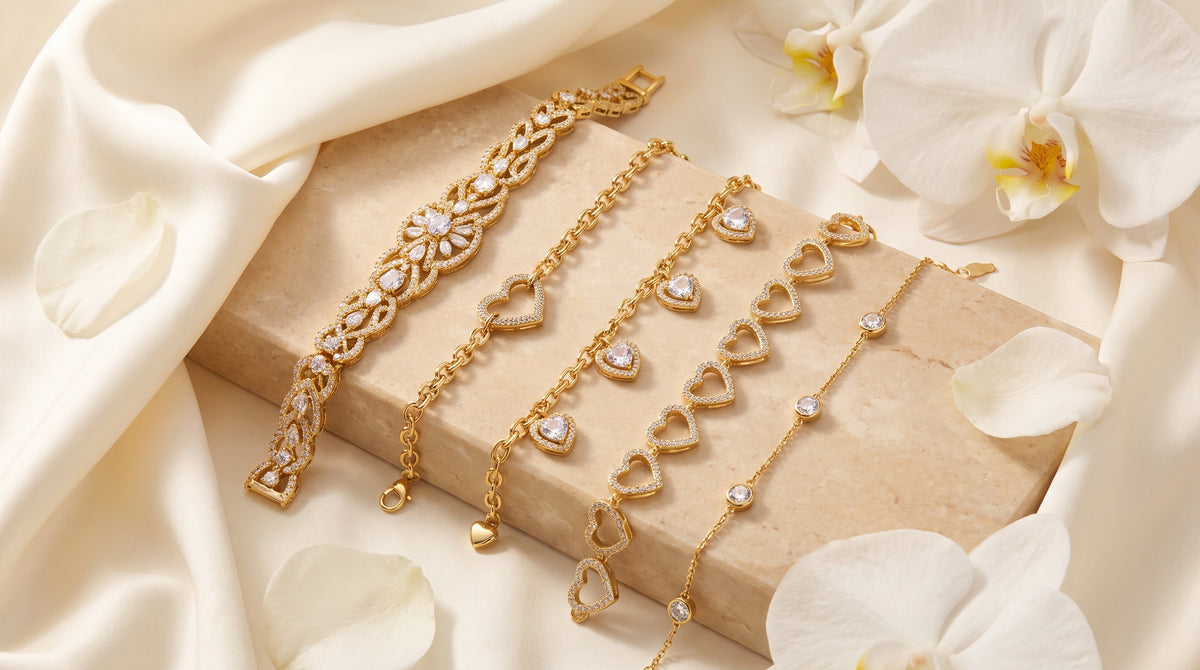
If, on the other hand, you came to this search wanting real gold that holds its shape through daily wear, that is exactly the bracket our solid gold pieces are built for. Station bracelets such as the Melodia, Nerienne, Aderyn, Aetheris and Alizara are listed as solid gold; check each product page for its specific karat, length options and specifications before ordering. Motif-led designs including the Four Heart Charms Link Bracelet, the Interlinked Hearts Chain Bracelet, the Diamond Heart Hook Clasp Bracelet and the Petite Gold Heart Link Bracelet sit in the heart bracelets range, while The Adelaide Bracelet and the wider bracelets collection cover the rest.
Two honest caveats apply to any bracelet, ours included. Confirm karat and materials on the product page rather than assuming from a collection name, and follow the general care guidance above — remove gold bracelets before chlorinated pools, saltwater and heavy physical work regardless of karat.
Choosing the Right Karat for Your Wrist
Work through five questions and the decision usually resolves itself.
1. How often will it actually be worn?
Daily, through work and errands, points to solid 14K, or 18K if you want deeper color and will take it off for the gym. Reserved for occasions, ceremonies and gifting, and stored between wears, opens the door to 24K.
2. What does the piece need to mean?
Where purity itself carries cultural or symbolic weight, 24K is not an inefficient choice — it is the point. Where the meaning lives in the design, a motif or a stone, the alloy is free to be chosen for durability instead.
3. How is it built?
Solid beats hollow on the wrist, every time, in every karat. Link thickness and clasp type matter more for longevity than a single karat step.
4. What are you willing to maintain?
If you will store the piece individually, keep it away from chemicals and accept a patina of fine scratches as part of pure gold's character, 24K can work. If you want to put a bracelet on and forget about it, choose the harder alloy.
5. Can you verify what you are buying?
No karat is worth anything if the stamp is a marketing flourish. Hallmark, weight, magnet screen and price-per-gram realism take two minutes and rule out the majority of mismatches between listing title and actual metal.
Pure gold earns its reputation honestly: nothing matches 999 for color, inertness and symbolic weight. It simply asks for a different kind of ownership than a bracelet you wear from Monday to Monday. Decide which of those two things you want first, and the karat follows.

Leave a comment
This site is protected by hCaptcha and the hCaptcha Privacy Policy and Terms of Service apply.