


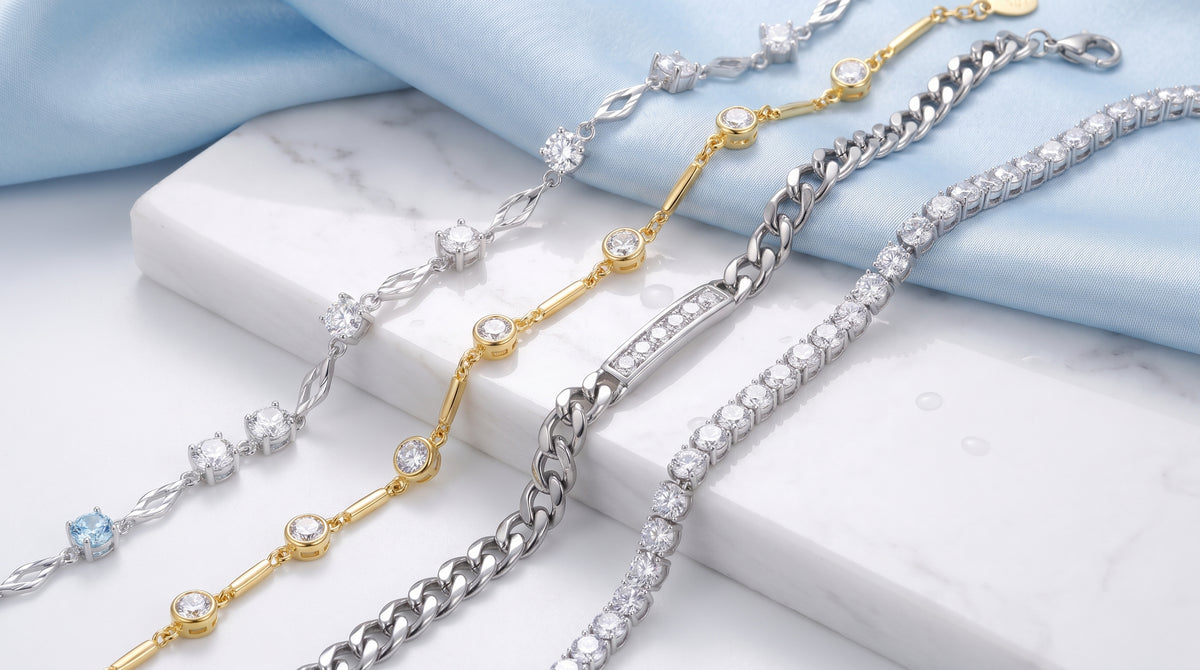
Open the bracelet section of almost any large jewelry retailer and you'll notice that "affordable" has already been defined for you. Macy's runs a bracelet gift guide filtered to $100 and under. Kay Outlet frames its women's bracelet assortment as a place to shop and save. Independent labels such as Boho Betty, Emmis Jewelry, and Uncommon James keep entire collections under $50. Those two cutoffs — under $50 and under $100 — are the practical boundaries most shoppers work within, and they matter more than any adjective, because each tier forces a different trade-off between metal, stone, and construction.
What retail filters don't tell you is which bracelet styles are worth buying at those tiers, which ones only look right in a more expensive material, and how to spot the difference before the package arrives. That is the gap this guide fills. Below: what your money actually buys inside a bracelet, ten style categories ranked by how well they survive a tight budget, how meaning gets built into beads and charms, where to shop at each tier, and a vetting checklist for both the piece and the seller.
What "Affordable" Actually Means in Bracelet Shopping
The two cutoffs that structure the market
Price filters aren't arbitrary. The under-$50 band is where retailers concentrate beaded designs, stretch bracelets, plated chains, and personalized pieces — Emmis Jewelry's hand-stamped stretch birthstone bracelets and Uncommon James's beaded sets are typical of the tier. The under-$100 band, which Macy's uses as a dedicated gift threshold, opens up sterling silver, stainless steel with set stones, and slimmer chain designs. Above $100 you start paying for gold content, heavier link weights, and larger or better-cut stones. For reference on the far end of the scale, a single medium link bracelet in yellow gold at Tiffany & Co. sits in the low four figures — a useful reminder that "affordable" is a relative bracket, not a quality verdict.
Where the money actually goes
In any bracelet, cost is driven by three things: the metal, the stones, and the construction. Metal is usually the largest lever — solid gold carries a raw material cost that plating and sterling silver do not, which is why the same design can appear at wildly different prices depending on the finish. Stones are the second lever: lab-grown diamonds, moissanite, and cubic zirconia are the standard ways designers deliver the look of a diamond line bracelet without diamond pricing, and 2026 trend coverage from fashion blogs has repeatedly flagged lab-grown stone tennis bracelets as the affordability workaround of the moment. Construction — clasp quality, link soldering, the security of stone settings — is the least visible lever and the one most likely to decide whether a bracelet lasts a season or several years.
The practical implication: if your budget is fixed, pick one place to spend. A slim solid gold chain in a simple design will generally outlast a heavily embellished plated piece at the same price, while a stainless steel or sterling silver design lets you put your money into the stone work and the finish instead. Our guide to 14k gold bracelets for women breaks down how karat, link style, and weight interact if you're weighing whether to stretch above the $100 tier.
10 Affordable Bracelet Styles for Women, and Who Each One Suits
These are grouped by how the bracelet behaves in real life — not by trend ranking. Several correspond directly to the styles that 2026 bracelet roundups identify as current: stacking, sculptural cuffs, charm bracelets, tennis bracelets, beaded designs, mixed metals, and colorful enamel.
1. Station bracelets — the most forgiving everyday choice
A station bracelet spaces small elements at intervals along a fine chain, so it reads as detailed without bulk. That spacing is exactly why it works on a budget: fewer stones or components than a fully set design, but the visual rhythm still registers across a room. Station styles also sit flat under a sleeve and layer cleanly with a watch. The Etherea Station Bracelet in S925 sterling silver and the Melodia Station Bracelet in sterling silver are examples of the format; the Melodia in solid gold shows how the same architecture moves up a tier when the metal changes.

Best for: daily wear, office dress codes, and anyone who wants one bracelet to do everything.
2. Tennis bracelets with lab-grown or simulated stones
The tennis bracelet is the clearest example of trend meeting budget. Fashion coverage for 2026 lists it among the most-wanted styles, and the reason it's accessible now is stone sourcing: lab-grown diamonds, moissanite, and cubic zirconia reproduce the continuous line of light without mined-diamond pricing. What still separates a good one from a poor one is the setting — prongs should sit level, the line should articulate smoothly, and the clasp should have a safety catch. The Aris Tennis Bracelet in stainless steel and the Calysto Tennis Bracelet in stainless steel sit in the everyday-metal category, while the Aris in solid gold is the heirloom-tier version of the same silhouette. Check the product page for the specific stone type before you buy — that detail changes both the price and the care routine.
Best for: evening wear, gifts with occasion weight, and stacking against a plain chain.
3. Stainless steel chains — the workhorse tier
Stainless steel is the quiet hero of affordable jewelry: it holds polish well, it isn't a plated surface that can wear through, and it handles hand washing and typing far better than delicate plate. A steel chain like the Adalira Bracelet is the piece you don't take off, which is a different job from the piece you save for occasions.
Best for: hands-on jobs, travel, and anyone who has previously worn through a plated bracelet.
4. Beaded bracelets with natural stone
Beaded designs have moved well beyond festival jewelry. Trend writers covering 2026 describe beaded bracelets with meaning as firmly in, particularly with natural stone — obsidian, lava stone, moonstone, freshwater pearl — and with vivid gemstone colors. Beads are also the most reliable way to stay under $50 while still getting real material rather than plating, which is why boutique labels build whole sets in this format.
Best for: texture in a stack, color, and gifts where the material itself carries the story.
5. Charm bracelets you curate slowly
Charm bracelets are having a documented moment: one 2026 trend roundup, citing Marie Claire UK, reported a 136% jump in charm bracelet searches at Net-A-Porter heading into the year, with Pandora named as the dominant brand in the category. The budget logic is unusual here — the base bracelet is a modest purchase, and the collection grows one charm at a time. Current styling advice leans toward curation over accumulation: a few charms that mark specific events read more deliberate than a crowded chain.
Best for: milestone gifting, and buyers who want the purchase to continue over years.
6. Sculptural cuffs
Bold, curved cuffs worn solo are one of the two dominant modes described in 2026 trend coverage (the other being delicate pieces worn in multiples). Cuffs are budget-friendly in silver or silver-tone metal because a strong shape does the work that stones would otherwise do — and several trend writers note that rising gold prices have pushed sculptural silver into the spotlight.
Best for: statement dressing; less practical for keyboard-heavy days.
7. Mixed-metal stacks
The old rule against mixing gold and silver has been retired by current styling guidance, which treats intentional mixed metals as a trend in its own right. Practically, this is good news for a limited budget: you can add to a stack over time without matching a metal you bought two years ago.
Best for: building a wrist look gradually rather than buying a matched set at once.
8. Heart motifs
A heart is the most legible symbol in jewelry — no explanation required when it's handed over. It also scales across tiers: the Caelia Heart in S925 sterling silver and the Caelia Heart in solid gold are the same motif at two very different material commitments. If you're shopping for a friend rather than a partner, our roundup of jewelry gifts for a best friend covers how motif choice changes the message.
Best for: anniversaries, birthdays, and first jewelry gifts.
9. Halo and celestial designs
A halo setting rings a center element with smaller stones, which makes the center read larger and adds sparkle at a lower stone cost than a single big stone. The Celestia Halo in S925 sterling silver is an example of the construction on a bracelet rather than a ring. If you want to understand what the motif has meant across different traditions before you buy, our explainer on the heart with halo symbol covers the interpretations honestly.
Best for: maximum visual impact per dollar of stone.
10. Birthstone and personalized pieces
Personalization is the cheapest kind of meaning to add: a birthstone, an initial, or a stamped date converts a generic bracelet into a specific one. Boutique retailers routinely list hand-stamped birthstone stretch bracelets in the under-$50 band, and you can browse stone-by-month options in our birthstone jewelry collection.
Best for: mothers, graduations, and gifts where you want the recipient's own detail included.
Bracelets With Meaning Behind It: How Symbolism Actually Works
Meaning built into the material
Beaded bracelets with meaning usually draw on associations attached to particular stones — moonstone, lava stone, obsidian, pearl — and to color. It's worth being clear-eyed here: these associations come from cultural, spiritual, and folk traditions, and they are not scientifically validated properties. That doesn't make them worthless; it makes them personal. A bracelet chosen because a stone's story matters to the wearer carries meaning regardless of whether the stone "does" anything.
Meaning built into the object
Charms, engraving, and welded clasp-free bracelets put meaning into the structure rather than the material. Welded "permanent" bracelets — chains closed on the wrist so they can't be removed — are described in current trend coverage as symbols of friendship or commitment precisely because of that permanence. Charm bracelets do the opposite: they stay open-ended, collecting evidence of a life as it happens.
Meaning built into the giving
The least discussed source of meaning is the framing you supply. A modest beaded bracelet given with a note explaining why you chose that stone or that color will outperform a more expensive piece handed over without context. If you're buying for a milestone, write the reason down; it costs nothing and it's the part the recipient remembers.
Where to Shop at Each Price Tier
Department stores and outlets
Macy's is the default starting point for many shoppers, and for good reason: it carries a wide bracelet department, a dedicated sale section, and a gift guide filtered to $100 and under. Searches like "bracelets for women Macy's", "Macy's bracelets on sale", and "Macy's gold bracelets on sale" are effectively requests for that discount filter. The strength is breadth and familiar brand names; the weakness is that a catalog running to thousands of items offers little guidance on which pieces are actually current or well made. Kay Jewelers frames its bracelets around stacking, gifting, and solo wear and carries diamond-accented tennis styles; Kay Outlet applies the same brand context at outlet pricing.
Boutique and independent labels
Smaller labels tend to win on aesthetic specificity rather than selection size. Boho Betty concentrates on layered bohemian designs under $50; Uncommon James lists beaded bracelet sets in its under-$50 gifts; Emmis Jewelry specializes in personalized sterling silver and gold-filled stamped pieces. If you already know the look you want, a boutique gets you there faster than a department store search.
Direct-to-consumer jewelry brands
Buying direct usually means a tighter, more curated range and clearer material labeling, with the trade-off that you can't see the piece in person. At Awareness Avenue, you can browse the full bracelets collection, filter to the jewelry under $100 collection if you're working to that threshold, see which designs are moving in best sellers, or move up to solid gold pieces when the occasion justifies it.
How to Build an Everyday Stack That Survives Daily Wear
Start with the anchor, then add
Buy the piece you'll wear every day first — usually a station bracelet, a slim chain, or a steel design — and treat everything after that as an addition. Stacks that are assembled all at once tend to look like a set; stacks built over time look like a person.
Mind the fit before the finish
A bracelet that spins, slides over the hand, or digs into the wrist bone will be abandoned no matter how good it looks. Measure your wrist with a tape or a strip of paper and compare against the listed length, then add roughly half an inch for a comfortable everyday drape and less for a tennis bracelet you want to sit snug. Sizing is also the single most common reason for returns and exchanges, so check the seller's exchange terms on the product or policy page before ordering.
Protect the finish you paid for
Put bracelets on last and take them off first — after lotion, perfume, and sunscreen, before swimming, showering, cleaning, or the gym. Chlorine and household cleaners are hard on plated surfaces and on any glued setting. Store pieces separately rather than loose in a dish, since harder stones scratch softer metals. A soft cloth and a gentle wipe after wear does most of the maintenance work on silver and steel.
Know which trends are actually wearable daily
Not every current style is an everyday style. Thin stackable chains, station bracelets, slim tennis lines, and small beaded strands are built for constant wear. Oversized sculptural cuffs, supersized bead designs, and bold enamel statements are weekend and event pieces — buy them knowing that, and you won't be disappointed by how rarely they come out.
How to Vet an Affordable Bracelet Before You Buy
Read the material label literally
"S925 sterling silver", "stainless steel", and "solid gold" are specific claims. "Gold tone", "gold finish", and "gold color" are not — they describe appearance, not composition. If a listing doesn't state the metal and, for plated items, the base metal underneath, treat that as missing information rather than a minor omission. The same goes for stones: "lab-grown diamond", "moissanite", and "cubic zirconia" are different products with different hardness, sparkle, and price, and a listing that just says "stone" is telling you less than you need.
Assume nothing about sensitivity or tarnish
No honest seller can promise that a bracelet will never tarnish or that it will suit every skin. Sterling silver naturally develops tarnish over time and is cleaned rather than prevented; plating thickness varies enormously between manufacturers and is rarely disclosed. If you have a known metal sensitivity, look for an explicit statement of composition on the product page and contact the seller if it isn't there.
Vet the seller, not just the product
For online-only jewelry, the seller is half the purchase. A useful method: read the one-star and two-star reviews first, because they tell you what goes wrong and how often; check whether the company replies to negative reviews at all, which indicates whether problems get handled; look at the recommendation rate rather than the headline average; and confirm there is a working contact channel before you order a gift with a deadline. Mixed review profiles are normal in this category — what matters is whether the complaints cluster around something you'd consider a dealbreaker, such as delivery timing on a dated gift. Awareness Avenue is a useful illustration of how to read this kind of profile honestly: it carries a Trustpilot rating of roughly 4.1 out of 5 from about 1,000 reviews and a recommendation rate near 76% on Reviews.io. Positive reviewers repeatedly mention well-made pieces and sentimental, meaningful gifts, alongside customer service that resolved sizing issues quickly; other reviewers describe delivery delays and slow communication. That combination — strong but imperfect — is normal for this category, and it's exactly what you should look for and weigh before ordering, rather than trusting a single average score.
Check the timeline before a dated gift
If the bracelet is for a birthday or anniversary, confirm the stated processing and shipping windows on the seller's own policy pages rather than assuming, and build in slack. Delivery timing is the most frequent source of disappointment in online jewelry buying, and it is entirely avoidable by ordering earlier than feels necessary.
Frequently Asked Questions
What is a reasonable budget for everyday bracelets for women?
For everyday bracelets for women, the under-$100 tier is where most everyday-suitable options sit — sterling silver, stainless steel, and slim chain or station designs. Under $50 you'll find beaded, stretch, and personalized pieces in real materials, plus plated chains. Above $100 you're generally paying for gold content or better stones, which matters most if you intend to wear the piece daily for years.
Are cheap bracelets worth buying, or will they fall apart?
Price and durability correlate loosely, not perfectly. The failure points on inexpensive bracelets are usually the clasp, glued settings, and worn plating — not the design. Choosing a solid metal such as sterling silver or stainless steel over a thin plate, and a design with soldered links and a secure clasp, does more for longevity than spending more on a flashier piece.
Which trending bracelets for ladies are worth buying right now?
Trend coverage published for 2026 consistently names the same clusters among trending bracelets for ladies: stacked thin bracelets, sculptural cuffs worn solo, mixed metals, curated charm bracelets, tennis bracelets using lab-grown or simulated stones, beaded designs in natural stone, and colorful enamel. Emerald green appears repeatedly as a breakout stone color. These are editorial forecasts rather than sales data, so treat them as direction, not instruction.
What makes a beaded bracelet "meaningful"?
Usually one of three things: the stone and its traditional associations, a color tied to a cause or a person, or an added element such as a birthstone or stamped initial. None of these are objective properties of the object — the meaning comes from the association, which is why the same bracelet can be deeply significant to one wearer and decorative to another.
Silver, stainless steel, or gold for a first bracelet?
Stainless steel if it will be worn constantly and roughly. Sterling silver if you want a softer, more traditional look and don't mind occasional polishing. Solid gold if you're buying for a milestone and want the piece to hold up over decades — in which case a simpler design in a good metal beats an elaborate design in a cheaper one.
The short version: decide your tier first, then pick the one lever — metal, stone, or shape — you want your money to go into. A sterling silver station bracelet, a steel chain, a stone-set tennis line, or a beaded strand chosen for its material will each carry a look far past its price, provided the composition is stated plainly and the fit is right. Start with the piece you'd wear tomorrow, and let the stack build itself from there.

Leave a comment
This site is protected by hCaptcha and the hCaptcha Privacy Policy and Terms of Service apply.