


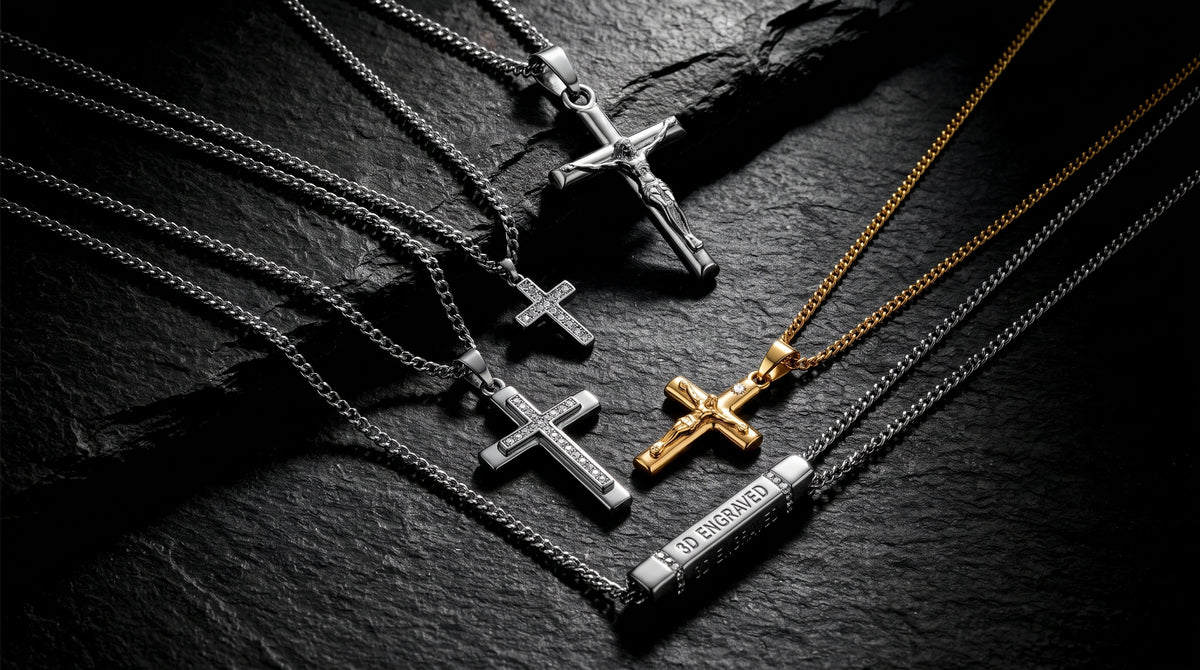
A pendant changes the arithmetic. A bare 20-inch chain lands neatly at the collarbone on an average adult man — that is the length most jewelers describe as standard — but hang a cross, dog tag, or engraved bar from it and the weight pulls the chain down while the pendant itself adds visible height at the front. The result is a piece that sits closer to the hollow of the throat than most men expect, disappears under a crew neck, and rides against the collar of a buttoned shirt. That is why the honest answer to finding the best chain length for a man with pendant is almost never the same number as the answer to finding the best chain length for a man.
This guide separates the two questions. It covers where each standard length actually falls on a male frame in inches and centimeters, a measuring method you can do with a shoelace, how pendant height and weight change the recommendation, the practical difference between 20 and 22 inches, adjustments for tall men and thicker necks, and the mechanical care details — gauge, bail opening, clasp — that decide whether the chain survives years of wear.
The short answer, and when it does not apply
Across mainstream jeweler sizing guides, two figures repeat with unusual consistency:
- 20 inches is described as the average everyday chain length for men, sitting at or just below the collarbone. Retailers and brand guides including REEDS, Warren James, Brilliant Earth, GLD, VRAI, and H. Samuel all place it there.
- 22–24 inches is the range repeatedly recommended once a pendant is involved, because it moves the pendant off the throat and onto the upper or mid chest.
If you want a single default: 22 inches is often the best chain length for men with pendant. It is widely described as the standard for men's cross pendants, placing the cross roughly a couple of inches below the collarbone over the sternum, and one men's sizing guide calls it the “no-regrets” pick precisely because it rarely reads as too tight or too long.
The exceptions are real, though, and they are why a chart alone will not settle this:
- Small, flat pendants worn mostly under a shirt often look better at 20 inches, where the piece sits just below the collarbone and stays discreet.
- Large or heavy pendants, and pendants worn over tees, sweaters, and hoodies, generally want 24 inches for visual balance and mechanical slack.
- A slim neck and a minimal pendant can carry 20 inches comfortably; a neck over about 16 inches in circumference makes an 18-inch chain feel snug, and that snugness only worsens when a pendant pulls it forward.
Where each length lands on a man (inches and centimeters)
Placement descriptions vary slightly by retailer, but the pattern is stable. The centimeter equivalents below follow the conversions used in UK and international sizing guides.
| Length | Metric | Where it sits on a typical man | Pendant verdict |
|---|---|---|---|
| 18 in | 45–46 cm | Base of the neck or the throat | Only for slim necks and very small pendants |
| 20 in | 50–51 cm | At or just below the collarbone, around the first and second shirt buttons | Works for small, light, flat pendants |
| 22 in | 55–56 cm | A few inches below the collarbone, upper chest | The default for everyday pendants |
| 24 in | 60 cm | Mid-chest, over or just above the sternum | Larger, heavier, statement pendants |
| 30 in | ~76 cm | Lower chest | Deliberate statement or layering length |
18 inches
Jeweler guides place an 18-inch chain at the base of the neck on a man, and describe it as suited to smaller-than-average necks. On a larger neck it reads tight, closer to a choker than a necklace. With a pendant attached, that tightness becomes a real comfort issue, since the pendant pulls the chain forward and down against the front of the throat. If you like this length for its discretion, read our dedicated 18-inch men's chain buying guide before pairing it with anything substantial.
20 inches
When observing a 20 inch chain on man, this is the reference point. It sits on the collarbone for an average frame — one measurement-focused guide puts it just below the collarbone at the top of the sternum for a 15–16 inch neck, roughly two to three inches under the throat hollow. It is the most versatile length for wearing both under and over a shirt. For pendants, it is a deliberate choice rather than a default: it places the piece high and close to the collar, which looks intentional with an open collar and cramped with a crew neck.
22 inches
A few inches below the collarbone on the upper chest. This is the length most often named as the universal standard for men's cross pendants, and the one brand guides point to when they say a pendant needs “room to hang naturally” instead of bunching near the neck. It stays comfortable on average and larger necks and photographs well over a t-shirt.
24 inches
Mid-chest, at or just above the sternum. Guides recommend it for dog tags, medallions, and bolder crosses, and for taller or broader builds where 22 inches can look proportionally short. It also lets a pendant sit outside a hoodie or heavier jacket rather than being swallowed by the neckline.
For a broader breakdown that also covers chain width in millimeters, see our men's chain necklace size chart.
How to measure yourself in about three minutes
Charts assume an average frame. Measuring removes the guesswork, and you do not need jewelry tools.
Step 1: Get your neck circumference
Wrap a soft tape measure snugly around the base of your neck, where a shirt collar sits, and note the number. No tape? Use a shoelace or a phone charging cable: hold one end at the back of your neck, bring it around to where you want the chain to rest, pinch the point where the ends meet, then lay it flat against a ruler. Most jeweler guides work from an average adult male neck of roughly 15–16 inches, and cite an average men's collar size of about 16 inches.
Step 2: Apply the neck-plus formula
Take your neck measurement and add inches according to where you want the pendant to land:
| Add to neck measurement | Resulting placement |
|---|---|
| +2 in | Close-fitting, choker-style at the neck base |
| +4 in | Collarbone / top of the sternum |
| +6 in | Mid chest |
| +8 in | Pendant centered on the chest |
A 16-inch neck plus 6 inches lands on 22 — which is exactly why 22 inches keeps appearing as the pendant default. Other guides phrase the same rule more loosely as adding two to three inches to your neck measurement for a comfortable fit, or two inches for a choker and four for a standard necklace. They converge on the same range.
Step 3: Test it against a chain you already own
Lay an existing necklace that hangs correctly flat on a table and measure it end to end, clasp included. Then do the wear test that most guides skip: put the chain on with the actual shirts you wear. A length that looks right bare can vanish under a crew neck or fight with a polo placket. If you wear collared shirts daily, check how the chain behaves with the top button open and closed.
Match the chain to the pendant, not just to your neck
This is the part most length charts leave out, and it is where poor pairings actually fail.
Pendant height
A pendant adds its own drop below the chain's resting point. A rough working framework from men's sizing guides:
- Small pendants (around a quarter inch tall or less): 18–20 inches.
- Medium pendants (roughly half an inch to an inch): 20–22 inches, so the piece clears the collarbone.
- Large pendants (over an inch): 22–24 inches, to keep the chain from being pulled tight and to preserve visual balance.
One cross-necklace guide names a specific combination as its everyday all-rounder: a cross between 1 and 1.75 inches tall on a 20-inch chain, on the logic that it works with an open collar and still wears under a shirt. Move to 22 inches and the same cross reads as a mid-chest piece instead.
Pendant weight and chain gauge
Men's chains commonly run 2.0–4.0 mm in gauge. Pendant-focused guidance maps weight to diameter roughly like this: pendants under about 3 g can hang on delicate chains under 1.0 mm; pendants of about 3–8 g suit standard chains around 1.1–1.4 mm; anything over about 8 g calls for a reinforced chain of at least roughly 1.5 mm. A kitchen or jeweler's scale settles this in seconds.
The blunt version of the rule, from a cross-pendant buying guide, is that the chain should weigh more than the pendant — ideally 1.5 to 2.5 times as much. A heavy pendant on a thin chain wears the links and the bail prematurely and can snap. A small pendant on an oversized chain looks borrowed.
Bail opening
The bail is the loop the chain passes through. Guidance for men's pendants is that the bail's internal opening should be at least 1.5 mm wider than the chain's diameter so the pendant swings freely instead of grinding in one spot. If a pendant sticks or sits crooked on the chain, that is a fit problem, not a length problem.
Why a heavy pendant can mean sizing down, not up
Counterintuitively, one brand guide advises choosing a chain one size shorter than usual with a heavy pendant, because the added weight drags the chain lower than its nominal length suggests. Read that alongside the sizing-up advice and the resolution is simple: size up for pendant height and bulk, and be aware that pendant weight already lowers the effective drop. If your pendant is both tall and heavy, buy 22 rather than 24 and check the drop before committing.
20 vs 22 inch chain on man: how to decide
These are the two lengths most men actually choose between, and the difference on the body is about two inches of drop — enough to move a pendant from the base of the throat to the upper chest.
| Factor | Choose 20 in | Choose 22 in |
|---|---|---|
| Neck circumference | Around 15–16 in or less | Around 16 in or more |
| Pendant size | Small to medium, flat profile | Medium to large, or dimensional |
| How you wear it | Often under a shirt; visible with an open collar | Usually over a tee or knit |
| Look | Higher, tighter, more discreet | Relaxed, clearly chest-level |
| Build | Slimmer frames, shorter torsos | Average to broader builds, taller frames |
A useful way to think about it: 20 inches positions a cross near the throat, which works well framed by an unbuttoned collar; 22 inches places the same cross over the sternum, which is what most people picture when they imagine a men's pendant necklace. If you are buying a gift and cannot measure the recipient, 22 inches is the lower-risk choice.
Adjusting for height, neck thickness, and build
What is the best chain length for a tall man?
Both 22 and 24 inches are recommended for men around six feet and above, and guides reserve 24 inches specifically for taller or broader builds wanting a statement pendant. The reason is proportion: on a longer torso, a 20-inch chain sits visually higher and the pendant can look like it belongs to a smaller frame.
Thicker necks
Chain length is consumed by circumference before it ever becomes drop. Men with thicker necks are advised to move to 22 inches or more for comfort, while thinner necks carry 18–20 inches easily. Above roughly a 16-inch neck, an 18-inch chain starts to feel snug — and a pendant makes that more noticeable, since the weight sits against the front of the throat rather than the chest. Reasoning from the neck-plus formula, a man with a neck well above average (around 18 inches or more) should expect 24 inches to behave the way 22 inches does on an average frame; this is an extension of the published rules rather than a figure those guides state directly, so verify it with the string test before buying.
Shorter or slimmer frames
A 24-inch chain on a shorter torso can put a pendant lower than intended and increase swing. Twenty to 22 inches usually keeps the proportions tighter. If you are between sizes, an adjustable chain with an extender solves the problem without committing.
Styling by outfit and collar
Chain length is really a function of necklines, and this is where the wear test pays off.
- Open-collar dress shirt: 20–22 inches frames the pendant in the collar opening. Longer chains tend to slide out of the shirt and swing.
- Crew-neck t-shirt: 22 inches clears the neckline; 20 inches can leave a pendant half-hidden by the collar band.
- V-neck or henley: 20–22 inches sits inside the V; 24 inches drops below it onto the chest.
- Hoodie or jacket: 24 inches keeps a larger pendant visible outside the layer rather than buried.
- Buttoned formal shirt or suit: a shorter pendant chain, 20–22 inches, stays flat under the fabric and avoids visible bulk. This is a styling judgment rather than a documented rule, but it follows directly from where each length falls relative to shirt buttons.
Care: making a pendant chain last
Length is not only an aesthetic decision — it changes the loads on the chain.
Avoid the short-chain-heavy-pendant trap
Very short chains, around 16 inches, are recommended only for very light pendants of a few grams or less. Beyond that, the chain pulls the pendant upward, concentrating stress on the solder joint at the bail and increasing pressure at the back of the neck. A longer chain distributes the weight more evenly and lets the pendant hang rather than lever.
Clasps deserve attention on longer chains
Longer chains swing more and carry more mass. Pendant-sizing guidance suggests that for chains of 22 inches or longer, a twin-trigger or hidden box clasp rated to at least 15 lb tensile strength — referencing ASTM F2923 — is the more secure choice than a small spring ring. If a clasp feels loose in the hand, it will not improve with wear.
A simple inspection habit
Once a month, run the chain through your fingers and check three points: the bail (look for a thinning groove where the chain rides), the links either side of the pendant, and the clasp spring. Catching a worn bail is far cheaper than replacing a lost pendant.
When to take it off
Longer chains with heavier pendants move more during activity, which increases impact at the bail and clasp. Removing a pendant necklace for contact sports, heavy lifting, and sleep is a sensible precaution that follows from the same mechanical logic those guides apply to weight and gauge. Store it hanging or flat rather than coiled in a pocket, where links can kink.
Common questions
Is a 20-inch chain too short for a man with a pendant?
No — 20 inches is the most commonly worn men's length and sits right at the collarbone. It is simply higher than many men expect once a pendant is added. For a small, flat pendant, or if you like the piece framed by an open collar, it works well. For a medium or large pendant meant to read at chest level, 22 inches is the better fit.
What is the average necklace length for a man?
Twenty inches, falling at or just below the collarbone on an average frame. That is the figure used across retailer and brand sizing guides as the men's default.
What is the average necklace length for a woman?
Eighteen inches, generally sitting at the collarbone on an average adult female frame, with most women's necklaces falling in a 16–20 inch band. Useful to know if you are buying matching or coordinated pendants — the same pendant will sit noticeably higher on an 18-inch chain than on a 22-inch one.
Is there a men's chain length chart cm in this guide?
Yes — see the length table above, which lists both units. The practical conversions to remember are 20 in ≈ 50 cm, 22 in ≈ 56 cm, and 24 in ≈ 60 cm.
Putting it together
Measure your neck, add four inches for collarbone placement or six to eight for a chest-level pendant, then sanity-check the result against the pendant itself: its height sets how much extra drop you need, its weight sets the minimum chain gauge and can pull the chain lower than its nominal length, and its bail has to be wide enough for the chain to move freely. For most men that process lands on 22 inches, with 20 inches for small pendants worn close to the collar and 24 inches for bigger pieces or taller frames.
Awareness Avenue's cross and bar designs — including engraved bar pendants and layered cross styles in our men's jewelry collection — are exactly the pendant archetypes these rules were written for, and our men's cross necklace guide covers how those designs are styled. Chain lengths and materials vary by piece, so check the individual product page for the exact length supplied and compare it against the measurement you calculated here before ordering.

Leave a comment
This site is protected by hCaptcha and the hCaptcha Privacy Policy and Terms of Service apply.