


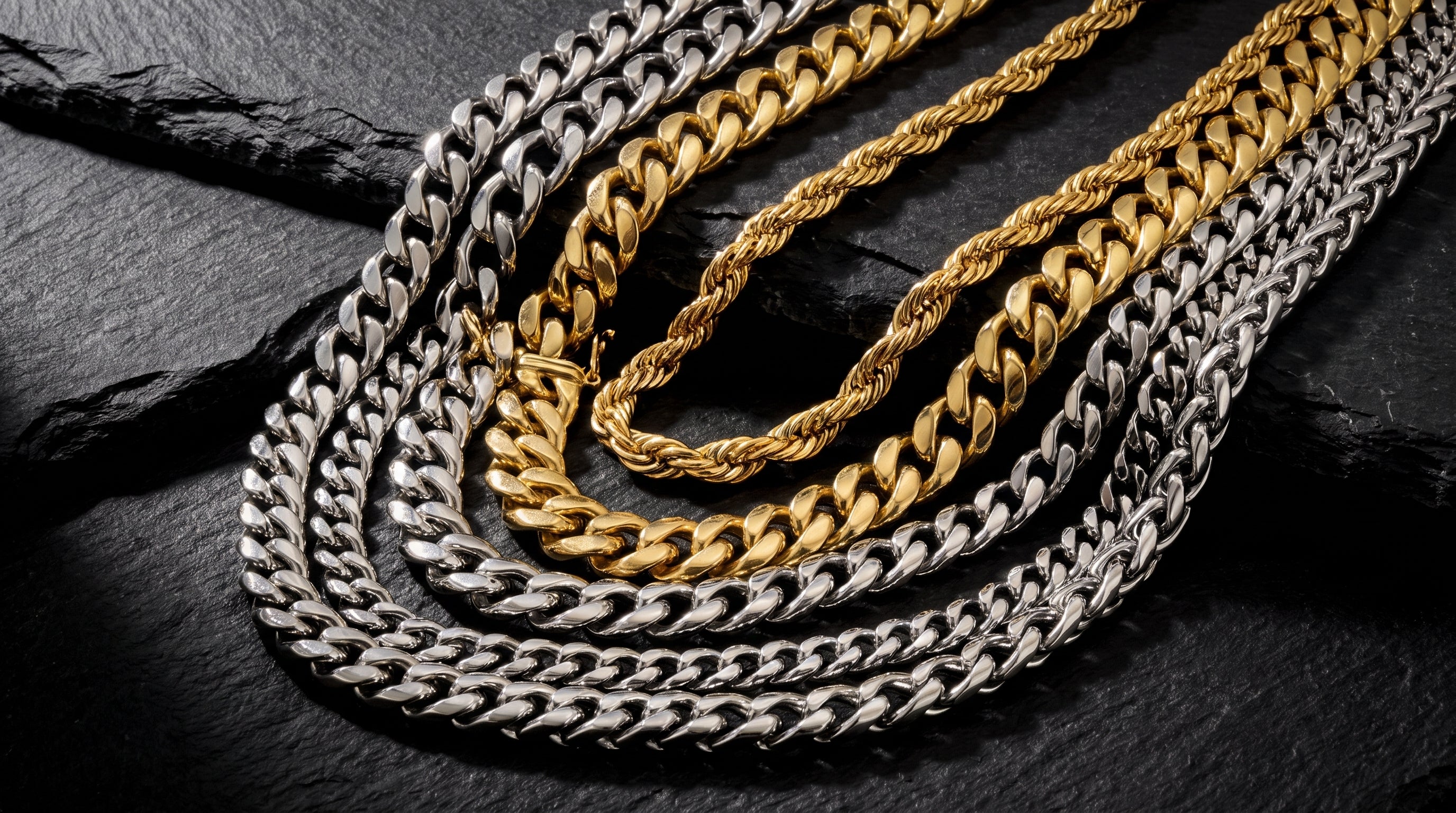
A 6 mm Cuban link and a 12 mm Cuban link are the same design, but they are not the same purchase. One disappears under a collar and reads as jewelry; the other sits on top of a T-shirt and reads as a statement. Almost every disappointing chain order comes down to that gap — the design was right, the numbers were wrong, or the metal behaved differently than expected once it met sweat, showers and a pool. This guide works through the four decisions that actually determine whether you wear a chain daily or leave it in a drawer: length, width, metal, and link style — then adds the maintenance reality that most product pages skip.
Start with the two numbers: inches and millimeters
Length controls where the chain lands on your body. Width controls how loudly it speaks. Get both right and the link style becomes a matter of taste rather than a gamble.
Length: where each inch actually falls
Necklace length guidance for men is unusually consistent across jewelers. On an average male neck, an 18-inch chain sits at the base of the neck, 20 inches reaches the collarbone (the most commonly cited length for men of average build), 22 inches falls a few inches below the collarbone, and 24 inches lands just above the sternum. Fink's Jewelers describes 20–24 inches as the standard range for men's chain necklaces, with 24 inches typically falling mid-chest — the length that works best when the chain is meant to be seen over a shirt rather than under one.
Styling guides tend to group those numbers into three brackets: shorter chains around 16–20 inches sit high on the neck and pair well with crew-neck tees and collared shirts; medium lengths of roughly 22–24 inches fall toward mid-chest and cover both casual and semi-formal outfits; and lengths of 26 inches or more hang below the chest for deliberately bold looks, often with a larger pendant.
The reliable way to choose is to measure rather than guess. Wrap a soft tape measure around your neck, note the measurement, then add roughly two inches for a close, collar-hugging fit and four or more inches if you want the chain to drop toward the chest or carry a pendant. Height, neck circumference and build all shift how a given length reads: the same 22-inch chain sits differently on a 15-inch neck than on an 18-inch one.
Width: fine, balanced, bold, heavy
Width is quoted in millimeters and moves in surprisingly visible increments. A widely used breakdown runs like this:
- 1–2 mm: fine and delicate; best for small, lightweight pendants or a barely-there look under clothing.
- 3 mm: medium-thick; noticeable on its own without dominating, and a common everyday choice.
- 4–5 mm: statement territory and a popular band for men's chains; substantial enough to carry medium or larger pendants.
- 6 mm and above: heavy-duty; chosen for bold solo wear or to balance a large pendant.
Jaxxon's width guidance overlaps with this, treating 4–6 mm as the medium band that balances subtlety and presence — which is why so many men land there for a first "real" chain. Rope chains are commonly offered anywhere from about 2 mm to 7 mm, so the same style can be sized from discreet to unmistakable.
Pairing the two (and adding a pendant)
Width and length should be chosen together. A 2 mm chain at 24 inches can look thin and lost on a broad chest, while a 10 mm chain at 18 inches can feel constricting and crowded at the collar. As a starting point: 3–4 mm at 20–22 inches is the most flexible everyday configuration for most men; 6 mm and up generally wants 22–24 inches so the extra bulk has room to sit.
If a pendant is involved, weight matters more than looks. Heavier pendants belong on thicker chains — commonly 4–5 mm or more — because the stress concentrates at the bail and the links closest to it. Very fine chains are best reserved for small, light charms. If pendants are your main goal, our breakdown of men's necklace styles covers pendant-and-chain pairing in more detail.
Metals: gold, sterling silver and stainless steel compared
Most of the men's chain results you'll browse assume solid gold or sterling silver. Stainless steel is the third mainstream option and is judged by different criteria, so it helps to know what each metal is actually optimizing for.
Gold: what the karat number means
Karat is a purity measure, not a quality grade. 14k gold contains about 58.3 percent pure gold, 18k contains 75 percent, and 22k sits around 91.7 percent, with the remainder made up of alloy metals such as copper, silver, zinc or palladium. Those alloys do real work: because 14k has a higher alloy content, it is harder and more scratch-resistant than 18k, which is why comparisons of the two generally conclude that 14k is the more practical choice for a chain worn every day, while 18k is framed as a special-occasion or purity-first option. Higher karats look richer and yellower; they also mark more easily.
If you buy solid gold, hallmarks are your primary protection. Look for a "14k" or "585" stamp for 14k, or "18k" or "750" for 18k, usually on the clasp or a small tag, and treat the absence of any purity stamp — or a seller unwilling to supply documentation — as a red flag worth walking away from. If you're specifically shopping that tier, our guide to 14k gold chains for men goes deeper on karat trade-offs.
Sterling silver: classic look, more upkeep
Silver is the traditional middle path. Jewelers position sterling silver men's chains as versatile and comparatively easy to clean, suited to both casual and dressier wear, and available across nearly every link style — Cuban, curb, Figaro, rope and more. The trade-off is tarnish: silver reacts with its environment and needs periodic polishing to keep its brightness, which is a small but recurring chore rather than a one-time purchase decision. For style-by-style comparisons in that metal, see our roundup of men's silver chain styles.
Stainless steel: what it does well, and where it stops
Stainless steel is the material behind a large share of contemporary men's chains, including Awareness Avenue's, and it is chosen for behavior rather than bullion. As Artizan Joyeria's overview of stainless steel jewelry explains, stainless steel does not rust as long as its chromium-rich surface layer stays intact and does not oxidize the way bronze or brass does, so it holds color rather than shifting over time. It resists scratching and damage better than softer metals, does not tarnish easily, and needs far less polishing and buffing than silver, gold or platinum. High-quality stainless alloys are also described as hypoallergenic and biocompatible, and the metal is infinitely recyclable with a near-total recovery rate.
The honest limitations matter just as much. The same source notes that stainless steel jewelry does not appreciate in value, can be dented by heavy or sharp impacts, is difficult to resize, is hard to repolish once it picks up deep scratches, and can be damaged by harsh chemicals — chlorine in particular. Some stainless alloys also contain nickel, which can irritate very sensitive skin, so "stainless steel" alone is not a blanket allergy guarantee; alloy and finish quality vary between makers.
Reading the label before you buy
Terminology is where shoppers get caught out, so translate it deliberately:
- Solid gold — the alloy runs through the whole piece and carries a karat hallmark (14k/585, 18k/750).
- Gold-plated or gold-filled — a gold layer applied over a base metal; the karat refers to the layer, not the body of the chain.
- Gold-tone or gold-color stainless steel — steel finished in a gold color. There is no karat to quote and none should be implied.
Awareness Avenue's chains are stainless steel, offered in silver-tone and gold-tone finishes; the Origin Link Set, for example, is a stainless steel set that includes a 4 mm gold rope chain in stainless steel. That's a deliberate positioning: everyday durability and low upkeep rather than metal value. If you want a chain that doubles as a store of value, solid gold is the category to shop, and this guide's job is to say so plainly rather than blur the line.
Chain styles decoded
Link architecture changes how a chain drapes, how it catches light, whether it plays well with a pendant, and how it survives a normal week.
Bold, structured links: Cuban and curb
The Cuban link — round or oval links interlocking in a uniform, seamless run — is the archetypal bold men's chain: substantial, sturdy-looking and frequently recommended for daily wear because the construction is strong and flexible. Curb chains use a related idea with flatter links designed to lie flush against the skin, which can feel more comfortable under a collar and tangle less with clothing. In stainless steel these read heavy without wearing heavy on the neck; Awareness Avenue's Foundation Cuban sits at the deliberately maximal end of the width scale at 12 mm.
Textured and light-catching: rope, wheat and Franco
Rope chains are built from twisted strands of links spiraling around each other, producing a three-dimensional surface that throws light back from multiple angles — which is why even a slim rope reads as bright. They layer well and are widely described in the trade as among the more resilient designs, though that is industry consensus and design logic rather than a published strength test. Wheat chains use intertwined links resembling stalks of wheat for a finer, more intricate texture. Franco chains use V-shaped links woven tightly into a smooth, flat, high-shine surface; the weave gives them flexibility and strength, and their detail is intricate enough that many people wear them solo rather than under a pendant. If rope is your direction, our gold rope chain guide covers width and finish choices; in stainless steel, the 4 mm Golden Rope Chain sits squarely in the versatile medium band, while the 6 mm Wheat Chain offers texture with more presence.
Patterned and geometric: Figaro, box and cable
Figaro chains repeat a rhythm of three short links followed by one elongated link, giving a patterned look that works alone or frames a pendant nicely. Box chains use square links that form a smooth, geometric profile and sit neatly under clothing. Cable chains — uniform round or oval links — are the plainest and most pendant-friendly of the group, which is why they're the default under most charms and medallions. A 2 mm cable-style piece like the Connell Chain is the minimalist end of the spectrum: visible up close, invisible from across a room.
One caution worth stating: none of the widely cited sources publish comparative tensile or fatigue testing across link types. Durability claims — including "strongest chain" claims — reflect construction principles and long-standing trade experience, not lab data. Manufacturing quality, solder joints and how you treat the chain matter at least as much as the pattern name.
Matching the chain to your wardrobe and your week
Neckline is the fastest filter. Higher crew necks favor shorter chains that sit above the fabric line — roughly 18–20 inches — because a longer chain simply disappears. Open collars and henleys suit 20–22 inches, where the chain shows in the V without needing to be thick. Over a T-shirt or a knit, 22–24 inches keeps the chain visible against the chest, which is where wider links justify themselves.
Layering works best when you vary two things at once: stagger the lengths by at least two inches so the chains don't rub and compete, and contrast texture — a flat, smooth link beside a twisted rope reads as intentional, while two near-identical chains read as an accident. Sets built around this idea, like the Originator Set, remove the guesswork; the standalone Originator Chain at 8 mm is the single-piece version of the same look.
Then apply a lifestyle filter. If you shower, train, swim or work with your hands while wearing jewelry, prioritize scratch resistance and low upkeep over metal purity. If the chain is a milestone purchase you'll wear on occasions and hand down, karat, hallmark and craftsmanship deserve the weight. Many people end up owning both for exactly this reason.
Buying checks that prevent regret
- Confirm the material in writing. A gold-colored chain is not a gold chain. Product copy should state solid gold with a karat, plated/filled, or stainless steel with a finish color.
- Look for the hallmark on precious metals. 585/14k and 750/18k stamps are the standard purity marks; missing marks warrant questions or independent testing.
- Check the clasp. Clasp type is a genuine durability factor, not a detail — it's the component that gets opened, closed and stressed daily, and heavier chains need clasps scaled to them.
- Match width to pendant weight. Under-specifying width is the most common cause of a broken link near the bail.
- Read the return and exchange terms before ordering. Length is the variable most often misjudged, and an easy exchange path is worth more than a marginal saving.
Care and maintenance by metal
The baseline routine is the same across metals: clean gently with warm water, mild soap and a soft cloth; keep chains away from chlorine, bleach and household cleaning products; take them off before swimming or cleaning; avoid spraying cologne or applying lotion while wearing them; and store each chain separately in a pouch or a lined box so links don't scratch or tangle against other pieces.
Beyond that, the metals diverge. Sterling silver tarnishes over time and needs periodic polishing to stay bright. Gold does not tarnish the way silver does, but higher-karat gold is softer and picks up scratches and small deformations more readily, and heavier daily wear can gradually stress links and solder points. Stainless steel resists tarnish, corrosion and scratching and typically needs nothing more than a monthly wipe-down — more often if it gets visibly dirty — but its surface is genuinely vulnerable to harsh chemicals, and deep scratches are difficult to polish out because the metal is so hard. In practice, that makes chlorinated pools and hot tubs the single most avoidable hazard for a steel chain.
Shortlisting by use case
To convert all of the above into a decision, work backward from how the chain will live:
- Everyday, low-maintenance, worn under and over shirts: a 3–4 mm chain at 20–22 inches in stainless steel. Versatile enough for work and weekends, and forgiving about showers and gym bags.
- Visible statement over a tee: 6 mm and up at 22–24 inches in a structured link such as Cuban or Franco.
- Minimalist, close to the neck: 1–2 mm at 18–20 inches — see the Connell Chain in gold-tone or its silver-tone counterpart.
- Pendant carrier: at least 4–5 mm in a smooth, pendant-friendly link like box or cable; the Boxed In Chain and Boxer Chain sit in this territory.
- Long-term value as a priority: solid gold with a verified hallmark, choosing 14k over 18k if it will be worn daily.
You can browse the full stainless steel range in the men's jewelry collection, and if you're still deciding between link patterns, our men's chain link necklace guide compares the shapes side by side.
Frequently asked questions
What length chain should most men buy?
Twenty to 24 inches covers the majority of men, with 20 inches reaching the collarbone on an average neck and 24 inches falling around mid-chest. Measure your neck with a soft tape and add two to four inches depending on whether you want a close fit or a chest-level drop.
How thick should a men's chain be?
Three millimeters is a safe everyday width; 4–5 mm reads as a statement while remaining wearable; 6 mm and above is deliberately bold. Fine 1–2 mm chains are for minimal looks and small pendants.
Is stainless steel a downgrade from gold or silver?
It's a different trade. Stainless steel typically outperforms both on scratch resistance, tarnish resistance and maintenance effort, and it doesn't require the periodic polishing sterling silver does. What it doesn't offer is intrinsic metal value — stainless steel jewelry is not expected to appreciate. If your priority is daily durability and look, it competes directly; if your priority is bullion value, it doesn't.
Will a stainless steel chain irritate sensitive skin?
High-quality stainless steel is generally described as hypoallergenic and biocompatible, which is a large part of its appeal. However, some stainless alloys contain nickel, which can affect very sensitive wearers, so it's worth confirming the specifics with any seller if you have a known metal allergy.
Can women wear chains marketed to men?
Yes — link styles such as cable, rope, Figaro, box and wheat are not inherently gendered, and styling guides routinely show them across audiences. The practical difference is default sizing: men's categories cluster around longer lengths and wider millimeter ranges, so adjusting length and width to the wearer's neck, height and intended look matters more than the label on the category page.
Which chain style lasts longest for daily wear?
Structured, flexible designs such as Cuban, curb and rope are the ones most often recommended for everyday wear because they resist kinking and handle movement well. Treat that as informed industry consensus rather than measured fact — no widely available source publishes comparative strength testing across link types, and build quality varies by maker.

Leave a comment
This site is protected by hCaptcha and the hCaptcha Privacy Policy and Terms of Service apply.