


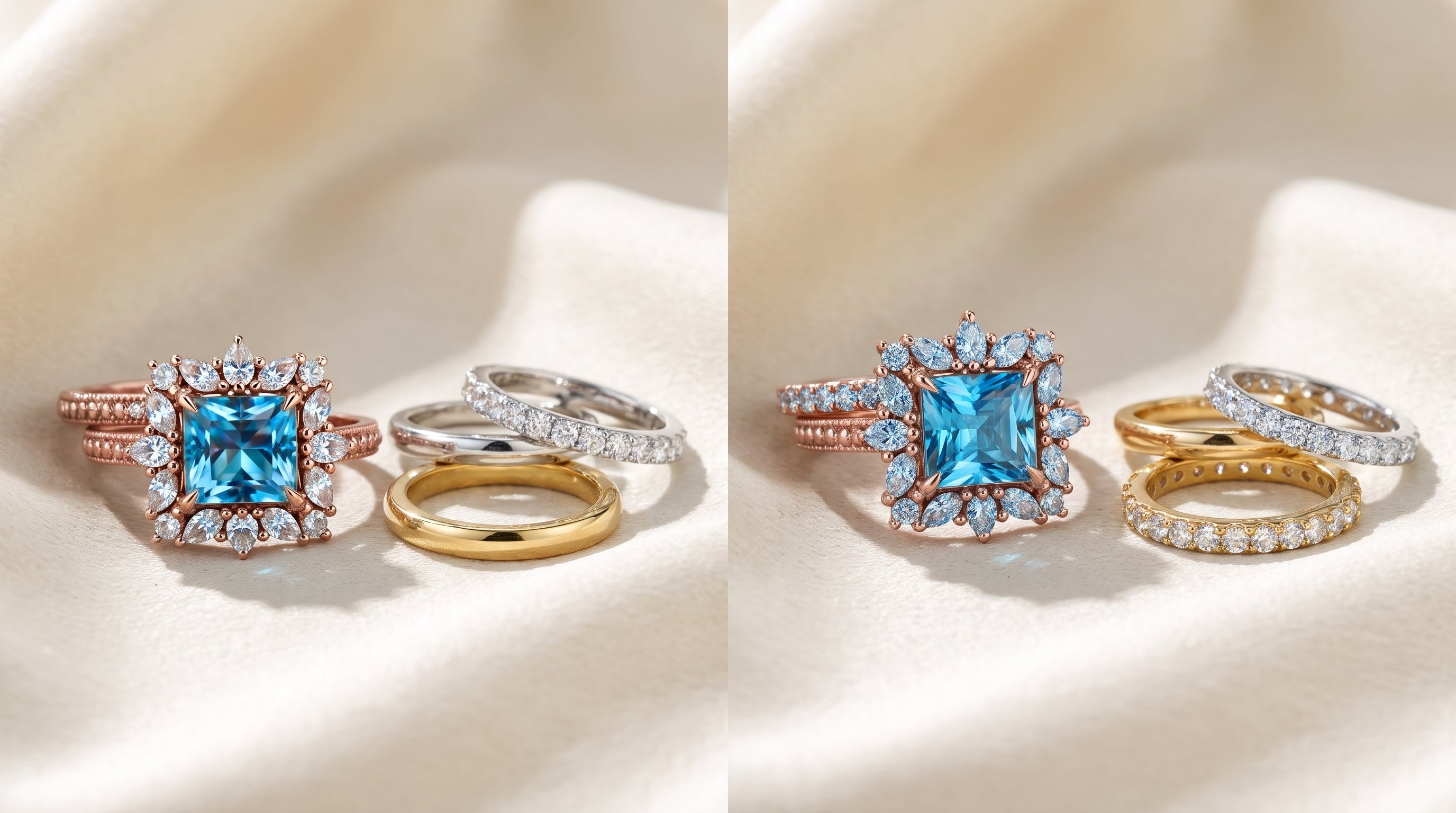
Set a 6.5 mm round moissanite beside a 6.5 mm round cubic zirconia in matching four-prong settings and, at arm's length in a lamp-lit room, most people see the same thing twice: a bright white stone. The differences only appear when things move. Rock your hand and the moissanite throws broad, saturated flashes of red, green, and blue; the cubic zirconia answers with quicker, whiter, glassier sparkle. Pick both up and the CZ feels heavier for its size. Come back to the same two rings after a few years of daily wear and the gap has widened again, this time in a way no lighting can flatter.
That is the honest version of a side-by-side comparison: three separate contrasts (how they behave in light, how they feel, and how they age) rather than one simple verdict. This guide works through each, adds the measurable properties behind what your eye is picking up, and then places both stones next to natural and lab-grown diamonds so you can see the whole ladder at once.
What you actually see when the two stones sit side by side
Both moissanite and cubic zirconia were engineered to do the same job: return a lot of light to the eye at a fraction of the cost of a diamond. They do it with different optical hardware, and that is why they read differently in motion.
Fire versus white brilliance
Moissanite is silicon carbide, and its refractive index sits at roughly 2.65 to 2.69, above diamond's 2.417 to 2.419. Its dispersion, the property responsible for splitting white light into spectral colors, is reported at about 0.104 against diamond's 0.044 — which is why moissanite is routinely described as showing more than twice the fire of a diamond. Cubic zirconia sits below both. One jeweler's comparison puts moissanite's refractive index about 25% above CZ's and its dispersion about 58% higher, which lines up with what you observe: moissanite's flashes are larger, slower, and far more colorful, while CZ's are smaller, faster, and predominantly white.
Neither behavior is objectively "better." If you want a stone that announces itself across a room, moissanite's rainbow fire is the point. If you want the quieter, more conventionally diamond-like look — bright white flashes with restrained color — CZ is closer to that target, and so is a diamond. This is also the single most useful thing to know before buying: the reason some people describe moissanite as looking "too sparkly" is not quality, it is dispersion. If you want to see how that plays out under the harshest lighting of all, our breakdown of diamond vs moissanite in sunlight covers the same effect in direct sun, which is a crucial part of any moissanite vs diamond side by side evaluation.
Double refraction and the loupe test
Moissanite is doubly refractive: light entering the stone splits into two rays. Cubic zirconia is singly refractive, as is diamond. Under magnification, that difference shows up as apparent doubling of facet junctions when you look through a moissanite at an angle. In everyday viewing it simply amplifies the sense of movement and fire; under a loupe it is one of the fastest ways a jeweler separates the two.
Color, tint, and the effect of size
Modern moissanite is grown to near-colorless and colorless ranges comparable to fine diamond color grades, though some stones show a faint gray or warm undertone in particular lighting, and that undertone becomes easier to notice as stones get larger. Cubic zirconia is normally produced colorless, but it is also manufactured in a wide palette of colors, which is why so much fashion jewelry uses it for pinks, blues, and greens.
Size matters for another reason. Below roughly half a carat, the fire difference between the two is subtle in most lighting. Above about a carat, moissanite's dispersion becomes conspicuous — the flashes are big enough to read as distinct colors rather than general sparkle. If you are shopping for a statement center stone, view both at your intended size, not at sample-tray size.
Weight in the hand
Cubic zirconia is denser than moissanite, so a CZ cut to the same millimeter dimensions is noticeably heavier. Loose in the palm, or in a pair of otherwise identical rings, that heft is detectable. It is also why carat weight is a poor way to compare these stones with each other or with diamond; always compare millimeter measurements instead, because that is what governs how big the stone looks on the finger.
The side-by-side spec sheet
| Property | Moissanite | Cubic zirconia | Diamond (natural or lab-grown) |
|---|---|---|---|
| Composition | Silicon carbide | Synthetic zirconium dioxide | Pure carbon |
| Origin today | Almost entirely lab-grown; first identified in meteorite material | Entirely lab-made; developed as a diamond substitute in the 1970s | Mined, or grown in a lab with identical chemical, physical, and optical properties |
| Mohs hardness | About 9.25 | About 8 to 8.5 | 10 |
| Refractive index | About 2.65–2.69 | Lower than moissanite (reported roughly 25% lower) | About 2.417–2.419 |
| Dispersion (fire) | About 0.104 | Lower than moissanite (reported roughly 58% lower) | About 0.044 |
| Refraction type | Doubly refractive | Singly refractive | Singly refractive |
| Feel | Lighter for its size | Denser and heavier for its size | — |
| Resale expectation | Sells for a fraction of retail | Little to no resale value; the metal is usually worth more | Natural diamonds retain the largest share of retail among these options |
Two caveats on the table. The Knoop and toughness figures some jewelers publish (moissanite around 3,000 versus CZ around 1,370 on the Knoop scale, and chipping resistance several times higher for moissanite) come from trade testing rather than a single standardized public dataset, so treat them as directional rather than precise. And every optical value here assumes a well-cut stone; a poorly proportioned moissanite will underperform a well-cut CZ.
Durability: how each stone looks in year one, year five, and year ten
This is where side-by-side comparison stops being about photographs and starts being about ownership.
Hardness and toughness are different things
Hardness describes resistance to scratching; toughness describes resistance to chipping and breaking. Moissanite scores about 9.25 on the Mohs scale, second only to diamond at 10 and above sapphire and ruby, which is why it is consistently recommended for daily-wear engagement and wedding rings. Cubic zirconia's roughly 8 to 8.5 is respectable for a synthetic, but it sits below the everyday abrasives that quietly attack rings — grit, dust, and the countless small contacts with countertops and door handles. Trade toughness comparisons put moissanite well ahead of CZ on chipping resistance too, which matters most at exposed girdles and pointed cuts such as pear, marquise, and princess. For the diamond side of that equation, see our detailed look at moissanite vs diamond hardness.
Why cubic zirconia goes cloudy — and what can be fixed
Cubic zirconia does not tarnish or rust; it is not a metal. Cloudiness comes from two very different sources, and only one of them is reversible. The first is film: soap, hand cream, sunscreen, hairspray, and skin oils build up on the pavilion facets and stop light from re-entering the stone, so the sparkle looks flat and milky. A gentle clean with warm water, mild soap, and a soft brush usually restores it. The second is micro-scratching. Because CZ is softer, the facet surfaces accumulate fine abrasion that scatters light instead of reflecting it, and no cleaning routine will undo that. Older, more porous CZ had a worse reputation on this front; modern higher-grade material is less porous and does not change color, but the scratching mechanism remains.
Moissanite is subject to the same film buildup — every gemstone is — but its greater hardness means it resists the permanent surface abrasion that dulls CZ, so routine cleaning genuinely returns it to how it looked new. Practically, that is the difference between a stone you maintain and a stone you eventually replace. Sources across the trade describe CZ as wearing out faster and losing shine over time, while moissanite is described as holding its brilliance under normal wear.
Heat, repairs, and resizing
Cubic zirconia is sensitive to heat, and some bench jewelers are reluctant to perform torch work — sizing, prong retipping, shank repairs — with CZ still set, because of the risk of damaging the stone. Moissanite is a silicon carbide, the same family of material used industrially as an abrasive, and is described as both heat- and acid-resistant, which makes routine bench work less fraught. If you expect to resize a ring over the years, or you are buying an eternity band that cannot easily be sized later without stone removal, that difference is worth weighing.
Setting style and metal choice change the stakes
The harder the stone's life, the more the durability gap matters. A slim eternity band or a full pavé shank puts many small stones at finger-edge height where they meet keys, handrails, and gym equipment daily. A bezel-set pendant or a cocktail ring worn a dozen times a year does not. Softer metals show their own wear — prongs thin, plating rubs at contact points — so a stone that stays bright inside a setting that needs periodic attention is the combination that ages well. That reasoning is why moissanite tends to be the sensible choice for pieces intended to be worn every day, such as the styles in our moissanite engagement ring collection, and CZ tends to make more sense for occasional, trend-led, or travel pieces.
Cost and long-term value
When evaluating a moissanite vs diamond ring, the price ladder is the least controversial part of this comparison, even if published figures vary widely between retailers. Cubic zirconia is by a wide margin the cheapest of the materials discussed here, priced per carat at a small fraction of moissanite. Moissanite sits well above CZ but well below diamond for a stone of comparable size and quality. Lab-grown diamonds generally cost more than moissanite and less than comparable natural diamonds, and natural diamonds sit at the top. Because published price bands shift with size, cut quality, color grade, and seller, treat those relationships as the reliable part and any specific dollar figure you find as a snapshot rather than a rule. Our moissanite vs lab diamond price breakdown goes deeper on the middle rungs of that ladder, but the overall moissanite vs diamond price gap remains the most significant.
Resale is a separate question from price, and it disappoints most first-time buyers. Cubic zirconia has little to no resale value; in a fine metal setting, the gold or silver is typically worth more than the stone. Moissanite resells for a fraction of what was paid, so its financial merit is entirely upfront: you spend less to get a large, durable, brilliant stone. Natural diamonds retain a larger share of retail than either, though they too drop sharply the moment they leave the store. If value retention is your primary criterion, none of the diamond alternatives are the answer. If maximizing wearable beauty per dollar spent is the criterion, moissanite is the strongest compromise between the two extremes.
Where diamonds, lab diamonds, and zircon fit in the same lineup
Most people searching for a moissanite vs cubic zirconia vs diamond comparison are really building a mental ranking of every diamond alternative at once, so it helps to be precise about categories.
Evaluating moissanite vs diamond vs cubic zirconia requires understanding that a lab-grown diamond is a real diamond: same chemical composition, same crystal structure, same optical behavior, same Mohs 10 hardness, graded on the same criteria, differing only in origin. Moissanite is a different gemstone that happens to resemble diamond — brighter in fire, slightly softer, dramatically less expensive. Cubic zirconia is an imitation: a synthetic material designed to mimic diamond's look without sharing its properties. That is a hierarchy of what the stone is, not a hierarchy of taste, but it explains the price and resale patterns above. Our full three-way guide to moissanite vs diamond vs lab diamond maps those trade-offs in detail.
Zircon is a further source of confusion, mostly because the name sounds like zirconia. They are not the same material, and if that pairing is on your shortlist, we compare all three in our guide to moissanite vs zircon and cubic zirconia.
How to tell them apart yourself
Side-by-side viewing plus a few simple checks will separate these stones in most situations, though nothing at home substitutes for buying from a seller who discloses the material in writing.
The fog test
Breathe on the stones to fog them. Diamond disperses heat quickly and clears almost immediately; cubic zirconia holds the fog noticeably longer. Moissanite also conducts heat well, so this test separates CZ from diamond and moissanite rather than moissanite from diamond.
The dot test
Draw a small dot on paper, place the loose stone table-down over it, and look through. The dot is typically visible through a cubic zirconia but not through a diamond. This works only for unmounted stones with an open pavilion.
Motion, magnification, and UV
In motion, colored flashes point toward moissanite; predominantly white flashes point toward CZ or diamond. Under magnification, moissanite's double refraction can show as doubled facet lines. Under ultraviolet light, moissanite may show a faint yellow or green fluorescence.
What testers can and cannot do
Standard diamond testers measure thermal conductivity, and moissanite conducts heat well enough that it commonly registers as diamond on those devices. Separating moissanite from diamond reliably requires a tester that also measures electrical conductivity, or a gemologist with a refractometer and a microscope. Cubic zirconia, by contrast, is easily flagged by a basic thermal tester.
Which one should you choose?
Match the stone to the job rather than looking for a universal winner.
If it is an engagement ring or daily-wear band
Moissanite is the stronger choice. Its hardness and toughness are close enough to diamond's to survive years of unthinking daily contact, it cleans back to new, and it tolerates the heat of routine bench work. The only question is whether you like its fire; if you find the rainbow flashes distracting at large sizes, consider a smaller center stone, a step cut such as emerald or Asscher which reads calmer than a brilliant cut, or a lab-grown diamond instead.
If it is a fashion, trend, or travel piece
Cubic zirconia earns its place. It is the least expensive way to test a silhouette you are not sure about, it comes in colors moissanite does not commonly offer, and a stone that eventually dulls matters far less in a piece you wear a few times a season. Buy CZ knowing you are buying a look for now, not a stone for decades, and clean it gently and often.
If ethics and sourcing drive the decision
Moissanite in jewelry today is essentially all lab-grown, which means no mining, and lab-grown diamonds share that advantage. Cubic zirconia is also entirely lab-made, so the honest framing is that all three avoid mined-stone supply chains; moissanite's ethical advantage is clearest when compared with mined diamond, not with CZ.
If you want something to hand down
Prioritize durability and disclosure over resale math. A moissanite in a well-built setting will still be bright in decades; a CZ almost certainly will not. If financial value retention is genuinely central, a certified natural diamond remains the only option among these that meaningfully holds a share of its retail price — and even then, expect a substantial drop the moment it is bought.
Care routines that keep the comparison fair
Whichever stone you choose, most "my ring lost its sparkle" complaints are film, not damage. Soak in warm water with a drop of mild dish soap, brush gently behind the stone with a soft toothbrush where lotion and soap collect, rinse, and dry with a lint-free cloth. Take rings off for gardening, gym sessions, and cleaning with harsh chemicals. Avoid strong liquid silver dips on plated settings, and never try to "bake" cloudiness out of CZ jewelry — heat can discolor or fracture the stone. Moissanite generally tolerates professional ultrasonic and steam cleaning, but follow the seller's guidance for the specific setting, since delicate pavé and plated finishes have their own limits.
Seen side by side on day one, moissanite and cubic zirconia are closer than most shoppers expect. Seen side by side after a few years of real wear, they are not close at all — and that, more than any single specification, is what the comparison is really measuring.


Leave a comment
This site is protected by hCaptcha and the hCaptcha Privacy Policy and Terms of Service apply.