


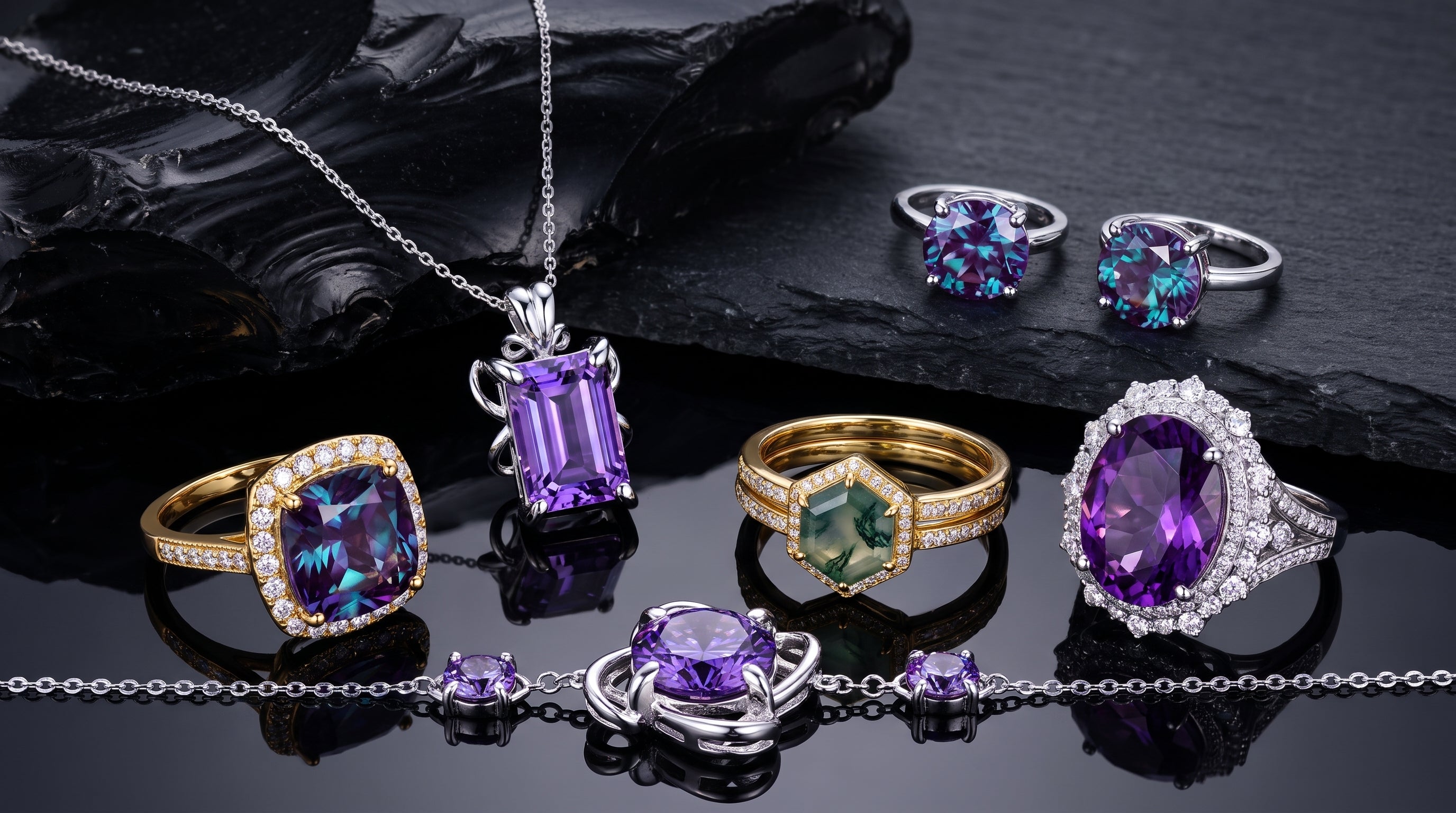
The difference between a natural alexandrite ring and a very convincing lookalike is almost never visible across a jewelry counter. It comes down to a refractometer reading, a specific gravity measurement, and a laboratory report that names the species as chrysoberyl rather than corundum, spinel, or laboratory-grown material. The Gemological Institute of America (GIA) lists natural alexandrite's refractive index at 1.746 to 1.755, birefringence at 0.008 to 0.010, specific gravity near 3.73, and hardness at 8.5 on the Mohs scale. Mark Henry Jewelry's guide to alexandrite differences notes that corundum simulants read 1.762 to 1.770 and spinel simulants sit around 1.73 and are singly refractive. Those few decimal places, not the drama of the color change, are what your money is actually buying.
This guide is written for shoppers who typed the word "natural" on purpose. It covers what that word certifies, the four factors that set price, how to verify a stone before you pay, and how the engagement, vintage, Russian-origin, and brand-heritage versions of this search differ in practice.
What "natural" is actually promising in an alexandrite ring
Alexandrite is the rare color-change variety of the mineral chrysoberyl, with the chemical composition BeAl₂O₄, according to GIA. Chromium in the crystal lattice creates an absorption band that causes the stone to read bluish green in daylight and purplish red under incandescent light, the behavior behind the old trade phrase "emerald by day, ruby by night" repeated by Safiya Jewels and Do Amore. GIA also notes that alexandrite is strongly pleochroic, showing different colors along different crystallographic directions, which is why cutting and orientation matter as much as rough quality. It is one of the June birthstones.
Because the mineral itself can be grown in a laboratory, "alexandrite" alone does not tell you where a stone formed. When you are shopping, you will meet three distinct categories, and reputable sellers label which one they are selling.
The three categories you will encounter
- Natural alexandrite: earth-formed chrysoberyl. Safiya Jewels explains that it requires aluminum and beryllium to combine with elements such as titanium, iron, and chromium under specific geological conditions, a coincidence that rarely occurs. Do Amore states that natural alexandrite is rarer than diamond for this reason.
- Lab-grown alexandrite: the same beryllium aluminum oxide composition produced under controlled conditions. Diamondere describes its stones as certified lab-grown with physical and chemical properties identical to mined counterparts; Safiya notes lab-created material tends to be cleaner and more uniform in its color change because it is produced in bulk.
- Simulants: entirely different materials sold under the alexandrite name. Do Amore warns that many simulants either fail to change color or change to the wrong colors, and Mark Henry identifies color-change corundum and spinel as common substitutes distinguishable by refractive index.
A natural alexandrite ring, strictly defined, is a ring set with earth-mined chrysoberyl that displays a genuine daylight-to-incandescent color change. Everything else in this guide follows from that definition.
The four value drivers behind a natural alexandrite ring's price
Safiya Jewels identifies origin, size, clarity, and color change as the factors that determine an alexandrite's value. They do not carry equal weight.
Color-change quality comes first
The International Gem Society calls vivid color change the reason alexandrite is one of the world's most coveted stones. GIA describes fine material as green to bluish green in daylight and red to purplish red in incandescent light. Do Amore adds the practical grading test: in a top stone the transformation is complete, with no green muddying the red or red bleeding into the green. Weak, partial, or off-hue changes drop value sharply even when the stone is large and clean. Ask to see the ring under three light sources before deciding: daylight or a daylight-balanced lamp, ordinary warm indoor light, and candlelight or an incandescent bulb.
Size behaves differently than it does with diamonds
Safiya notes that alexandrite prices increase with size for comparable quality, and the step is steep rather than linear because larger gem-quality rough is disproportionately scarce. This is why a small natural alexandrite center stone can cost more than a much larger stone of nearly any other colored gem, and why sub-carat natural centers are common in genuine rings.
Clarity is judged on a curve
GIA notes that fine alexandrite has relatively few inclusions, while Safiya's educational material classifies naturally formed alexandrite among Type II clarity stones, meaning some inclusions are expected. Mark Henry goes further, stating that real alexandrite is typically cloudy and rarely larger than one carat. These positions are not identical, and you should treat them as market heuristics rather than rules: a flawless, very large stone offered cheaply is a warning sign, but visible inclusions are not proof of natural origin either. Aligned needle inclusions can occasionally produce a cat's-eye effect, which GIA notes is rare in this species.
Origin adds a premium and a documentation burden
Russian material from the historic Ural deposits carries the strongest collector association; Do Amore states those deposits are exhausted. GIA documents alexandrite from other sources, and material from Brazil, Sri Lanka, and East Africa circulates in the trade. Origin, however, is a separate laboratory opinion from an identification report. If a seller markets a stone as Russian, ask which laboratory issued the origin determination.
On price, the useful takeaway is relative rather than absolute. Published comparisons from specialist jewelers consistently place fine natural alexandrite an order of magnitude above lab-grown stones of the same carat weight, with natural material at and above one carat reaching into five figures per carat at retail. Individual figures quoted on retailer sites are examples tied to specific stones and specific moments, not market benchmarks, so verify current pricing directly with the seller and against a second quote before committing.
How to verify a natural alexandrite ring before you pay
Safiya Jewels advises sending a stone to a reputable gem lab such as GIA or AGL as the definitive way to confirm authenticity, and notes that gemologists identify stones through tests including refractive index measurement and microscopic examination. Do Amore's guidance for engagement buyers is the same: purchase a certified stone, because certification is what separates natural from lab-grown and from simulant material.
What the paperwork should say
A useful report names the species and variety (chrysoberyl, alexandrite), states whether the material is natural or laboratory-grown, describes the color change, and lists measurements and weight that you can match to the stone in the ring. Estate specialists do provide this: Heritage Estate Jewelry lists alexandrite rings with GIA report references, and Torgsyn Jewelry describes a 14K gold ring with a 2.67-carat oval natural Russian alexandrite center accompanied by an AGL certificate noting a light tone and a color change from light green to purple. Those listings are the standard to hold other sellers to.
Red flags worth walking away from
- No color change at all, or a change into hues outside the green-to-red family (Do Amore).
- A large, perfectly clean stone at a low price with no information about where it was mined (Mark Henry).
- "Alexandrite" used without the words natural or lab-created anywhere on the page.
- An appraisal from the selling jeweler offered in place of an independent laboratory report.
- Antique framing used as proof of authenticity. Do Amore specifically warns that some older rings were set with simulants, so age alone guarantees nothing.
Questions to send a seller before you buy
- Is the center stone natural, laboratory-grown, or a simulant, and which laboratory confirmed it?
- May I see the full report, not just a report number?
- What is the carat weight of the center stone, and does the report weight match?
- Do you have images or video of the stone under daylight and under incandescent light?
- If origin is claimed, who issued the origin opinion?
- What is the return window if an independent gemologist disagrees with the description?
For a longer walkthrough of vetting live listings, see our companion guide to real alexandrite rings for sale.
Matching your search to the right kind of ring
Natural alexandrite engagement rings
Alexandrite's hardness of 8.5, documented by GIA and echoed by Giliarto and Do Amore, places it above most colored gems and just under ruby and sapphire, which makes it a defensible choice for daily wear when set protectively. Retailers lean into the symbolism as well: Giliarto frames the color change as transformation and duality, and Do Amore positions a natural stone as a once-in-a-lifetime gift precisely because of its scarcity. For center-stone selection, budget sequencing, and setting choices specific to a proposal, our dedicated guide to the natural alexandrite engagement ring goes deeper than a general roundup can.
Vintage and antique alexandrite rings
Estate dealers and marketplaces are where genuinely old pieces surface. Heritage Estate Jewelry lists antique and vintage alexandrite rings, including pavé-set diamond designs with GIA references, while 1stDibs aggregates vintage alexandrite engagement rings from independent dealers worldwide, with documentation quality varying by dealer. Separately, houses such as Capucinne offer vintage-inspired designs, which are new rings in a historical style rather than period pieces. Both are legitimate purchases, but they answer different questions, and only one of them involves provenance. If you are still weighing the two aesthetics, our comparison of vintage versus modern engagement rings is a useful detour. For those specifically seeking natural alexandrite rings vintage in origin, verifying the era and the stone's natural status are two separate steps. A true vintage alexandrite engagement ring should come with independent lab documentation for the center stone.
Vintage Russian alexandrite rings
This is the highest-risk subcategory because the origin claim carries the premium and is the hardest thing to verify. The Torgsyn listing described above shows what an adequately documented Russian piece looks like: a stated carat weight, a named cut, an explicit description of the color change, and an AGL certificate. Treat "Russian alexandrite" without a laboratory origin opinion as a style description rather than a fact.
Searches for natural alexandrite rings Tiffany and other luxury houses
Shoppers entering queries like "natural alexandrite rings Tiffany" will find that Tiffany & Co.'s gemstone education page describes a legacy of acquiring rare and unusual gemstones and names alexandrite among the legacy stones that exemplify color, rarity, and beauty. What that page does not do is present a dedicated natural alexandrite ring product line. Search results for brand-plus-alexandrite queries therefore tend to surface heritage context rather than shoppable inventory, and a resale listing described as "Tiffany alexandrite" should be treated as two separate claims to verify: the maker and the stone.
Where natural alexandrite rings are actually sold
The market splits into three channels, and knowing which one you are on prevents most disappointments.
Natural-first specialists. GemsNY states that the alexandrites in its rings are authentic and never lab-created or synthetic, and that they are certified by well-respected gem labs. TheAlexandrite.com presents a natural alexandrite ring collection with specific carat weights and correspondingly high prices. Safiya Jewels runs separate natural and lab-created collections and publishes educational pages explaining the difference, which is a good sign of category discipline.
Estate dealers and marketplaces. Heritage Estate Jewelry, Torgsyn Jewelry, and 1stDibs cover the vintage, antique, and Russian-origin end. Individual item descriptions carry the weight here, since inventory is one-of-one and documentation is not standardized across dealers.
Lab-grown-first jewelers. Diamondere is explicit that its alexandrite rings use certified lab-grown stones while noting that natural alexandrite is extremely rare and expensive. Giliarto handcrafts lab-grown alexandrite engagement rings in 14K gold. Neither is misrepresenting anything; the risk is a shopper skimming a page and assuming "alexandrite" means mined.
Natural, lab-grown, or a different stone entirely?
Choose natural if origin and rarity are part of the meaning you want the ring to carry, you can accept a smaller center stone for the budget, and you are prepared to insist on laboratory documentation. Choose lab-grown if you want a larger, cleaner stone with dependable color-change performance at a fraction of the outlay, and you are comfortable with a stone described honestly as created rather than mined; our guide to lab-grown alexandrite engagement rings covers that path in detail. Choose a different gem if what you actually love is the color story rather than the species, since a well-cut natural stone in another variety will usually deliver more visual presence per dollar than a marginal alexandrite.
Setting, orientation, and living with the stone
Two design decisions determine how much of the color change you will actually see. The first is orientation. Because GIA describes alexandrite as strongly pleochroic, the face-up color depends on how the cutter oriented the crystal, so ask the seller how the stone reads in each light before the setting is finalized. The second is the surrounding design: bright white accent stones and open galleries let more light into the pavilion, while heavy bezels and dark backings can flatten the shift. At 8.5 on the Mohs scale the stone tolerates daily wear well, but it is not immune to hard knocks or abrasion, so a protective setting and off-finger storage during rough tasks are sensible. Keep the laboratory report with your insurance appraisal; for a documented natural stone, that paperwork is a meaningful part of the asset.
Alexandrite-inspired designs at Awareness Avenue
Awareness Avenue's alexandrite-themed pieces, including The Daphne Alexandrite Earrings and the wider June birthstone alexandrite collection, are designed around the color-change look rather than sold as certified earth-mined chrysoberyl; check the individual product page for the stone details on any piece you are considering. If you prefer a natural stone with visible character in a ring, the Natural Moss Agate Hexagon Ring Set and the broader moss agate rings take a different route to one-of-a-kind: no two agate slices are alike, and the pattern rather than the light source supplies the drama. For a full natural alexandrite center stone with laboratory documentation, the specialist and estate channels described above remain the right place to shop.
Frequently asked questions
Is natural alexandrite really rarer than diamond?
Do Amore states that natural alexandrite is rarer than diamonds because the elements needed to form it seldom occur together, and that deposits are few. GIA independently describes fine alexandrite as exceptionally rare and valuable.
Can I tell natural from lab-grown by eye?
Safiya suggests trained eyes can often distinguish them by clarity and by the uniformity of the color change, since lab material is produced in bulk. That is a gemologist's skill, not a shopper's. GIA's property ranges exist precisely because instrument testing is the reliable method, so treat visual impressions as a prompt to ask for a report, never as a substitute for one.
Is alexandrite durable enough for an engagement ring?
At 8.5 Mohs per GIA, yes, with the usual care given to any colored stone worn daily.
Does buying vintage guarantee a natural stone?
No. Do Amore explicitly warns that some antique rings were set with simulants, so age is not authentication.
Which laboratories do sellers of natural alexandrite cite?
GIA and AGL are the two named across the specialist and estate listings reviewed here, including GIA report references at Heritage Estate Jewelry and an AGL certificate on Torgsyn's Russian alexandrite ring.
The short version
A natural alexandrite ring is a purchase decided by documentation first and design second. Confirm the species and natural origin with a GIA or AGL report, grade the color change under three light sources before grading anything else, expect a smaller center stone than your budget would buy in almost any other gem, and treat origin and antique claims as separate assertions requiring their own evidence. If the paperwork is not there, the ring is not what the listing says it is, regardless of how beautifully the stone shifts under the showroom lights.

Leave a comment
This site is protected by hCaptcha and the hCaptcha Privacy Policy and Terms of Service apply.