


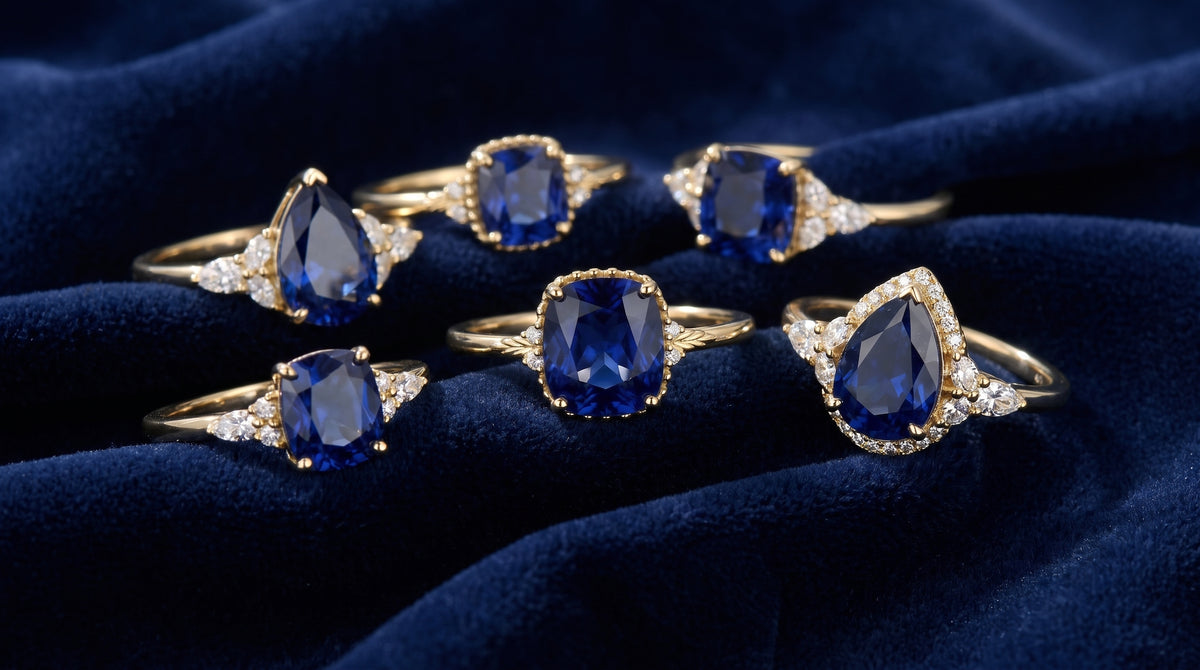
Type "sapphire ring gold" into a search bar and the results arrive from four completely different worlds at once: antique dealers listing 19th-century pieces in 18ct gold, mainstream jewelers selling 14K sapphire-and-diamond anniversary bands built for daily wear, luxury houses such as Tiffany & Co. that merchandise sapphire-and-diamond rings within their bridal storytelling, and editorial guides that mix natural, lab-grown, and simulated stones in the same list without always saying which is which. Those pages look interchangeable in a grid of thumbnails. They are not.
The phrase itself is doing three jobs at once, and most shoppers only realize it after they have a cart open. You are choosing a stone origin, a karat, and a gold color — and each one changes price, appearance, and long-term maintenance independently of the other two. This roundup walks those decisions in order, then maps them onto specific rings, including Awareness Avenue's royal-blue simulated sapphire designs in vermeil and solid gold. Where the available evidence is regional, undated, or purely promotional, we say so rather than repeating a number that would look authoritative but travel badly.
The three decisions hiding inside "sapphire ring gold"
Before comparing individual rings, it helps to name the variables, because retailers rarely present them as a single system.
1. The stone: natural, lab-grown, or simulated
These are three distinct categories, and the market blends them freely. Antique marketplaces and specialist jewelers list natural sapphires, sometimes with origin detail such as Ceylon material and specific carat weights. Review-style buying guides routinely place lab-grown sapphire rings next to natural ones in the same ranking. And brands like Awareness Avenue use simulated sapphire, which is engineered for a target color rather than mined or grown as corundum. A simulant is a design decision about how a stone looks, not a claim about what it is geologically — and any honest listing should tell you which one you are buying before you reach checkout.
2. The karat — or whether it is solid gold at all
Mainstream sapphire rings commonly appear in 14K; higher-end pieces and vintage-inspired reproductions often use 18K or 18ct. Awareness Avenue's solid gold rings are offered across 10K, 14K, and 18K. Separately, gold vermeil — a heavy layer of gold over a base metal — delivers a gold appearance at a different price tier than solid metal. Vermeil is not solid gold and should never be described as such, but it is a legitimate way to wear a bold gold-toned ring without committing to a solid-gold budget.
3. The color: white, yellow, or rose
This is the decision people make fastest and regret most often, because it interacts with both the stone's hue and the ring's future maintenance schedule. A deep royal-blue stone reads very differently against warm yellow gold than against a cool white metal, and white gold carries a rhodium-plating upkeep cycle that yellow and rose gold do not.
Natural, lab-grown, and simulated sapphire: what actually changes
Natural sapphire's appeal as a ring stone rests on a well-documented property: it ranks 9 on the Mohs hardness scale, one step below diamond at 10. Jeweler education pages, including Angara's, use that rating to argue that sapphire holds up to everyday wear, resisting abrasion and scratching in normal conditions; comparison content from colored-stone specialists makes the related point that at hardness 9 versus 10, the practical difference in daily wear is minimal because ordinary household abrasives sit far below both.
Price is where the evidence gets slippery. Jeweler and specialist sources consistently state that sapphire costs less per carat than diamond of comparable quality, and that is the reason many couples consider it. The specific figures we reviewed, however, were anchored to a single national market and a single publisher's rate guide, so we are not repeating them here as global benchmarks. Treat "sapphire generally costs less per carat than diamond" as the defensible version of that claim, and check live listings for anything more precise.
Treatments and disclosure
If you are buying a natural sapphire, treatment history matters. Angara's guidance flags heat treatment, diffusion, laser drilling, and surface coating as processes buyers should ask about directly, and recommends purchasing from jewelers who supply documentation of authenticity. None of that is exotic or scandalous — heat treatment in particular is widespread — but undisclosed treatment is a legitimate reason to walk away from a listing.
Where simulated stones sit
Awareness Avenue's sapphire-look rings use simulated stones, and the brand states the design goal plainly: the Arisara cushion is engineered toward an ideal "Royal Blue" benchmark, with deep, velvety saturation that stays consistent as light changes. That is a color-and-consistency proposition, and it is a real one — a simulant can deliver a uniform, saturated blue at a size that would carry a very different price in fine natural corundum.
What we will not tell you is that a simulated stone performs identically to natural sapphire in hardness or long-term wear. There is no published hardness rating or wear-testing data for these specific stones, so the Mohs figures above apply to natural sapphire only. If durability under rough daily wear is your primary criterion, ask the seller directly and factor the answer into your decision. If your priority is a striking royal-blue ring in real gold at a manageable price, a disclosed simulant is a rational choice made with open eyes. For a deeper look at how color, cut, and treatment interact when you are evaluating natural stones, our guide to sapphire rings engagement suitability, color, and cut goes further into the grading side.
Matching gold karat and color to a royal-blue stone
Metal specialists who compare platinum, white gold, yellow gold, and rose gold for sapphire rings converge on a few practical rules, and they are worth internalizing before you pick a finish you will live with for decades.
Yellow gold
Yellow gold adds warmth and contrast and is the metal most associated with antique styles; shoppers looking for a sapphire gold ring vintage aesthetic will find antique catalogs full of 18ct yellow gold bands, and reproduction Art Deco sapphire rings are frequently made in 18K yellow gold. Against a deep blue, yellow gold pushes the stone toward a richer, more antique read. It needs no plating to maintain its color.
White gold
White gold gives you a cool, platinum-adjacent look at a lower entry point, and it is the metal you will see most often in mainstream 14K sapphire-and-diamond bands. The trade-off is maintenance: white gold is typically rhodium-plated, and that plating wears, so periodic replating is part of owning the ring. Metal comparison guides recommend leaning white for crisp contemporary designs and fine pavé, where a cool metal keeps the setting looking sharp.
Rose gold
Rose gold is the romantic, modern-vintage option, and specialists often suggest it for softer or nontraditional stone colors. With a saturated royal blue it creates a warm-cool contrast that is more fashion-forward than classic — appealing if you want the ring to look deliberately chosen rather than default.
Platinum, for context
Platinum is naturally white and does not need rhodium replating, which is why it is often recommended for buyers prioritizing low upkeep and a substantial feel. If that profile appeals to you but the budget does not, 18K white gold with a planned replating cycle is the usual compromise. See our platinum engagement ring styles guide for more on platinum's low-maintenance case, or our 18K gold engagement ring buying guide for how higher-karat gold behaves in daily wear.
| Choice | Best for | Ongoing upkeep |
|---|---|---|
| Yellow gold | Warm contrast, vintage character | Polishing only |
| White gold | Cool tone, pavé and crisp modern settings | Periodic rhodium replating |
| Rose gold | Romantic, modern-vintage styling | Polishing only |
| 18K gold vermeil | Gold appearance at a lower entry point | Gentle handling; not solid gold |
The roundup: sapphire-look rings in gold worth comparing
The rings below are Awareness Avenue designs that genuinely answer the core blue sapphire ring gold query — featuring royal-blue simulated sapphires — plus notes on what each one is actually suited to. Stone type, metal, and available options come from the product listings; anything we are inferring from design cues is labeled as such.
The Astris Radiant Ring — Solid Gold: the engagement-style pick
The Astris Radiant Ring in solid gold is the closest match in this lineup to the halo silhouette that dominates editorial sapphire engagement ring roundups. It pairs a radiant-cut simulated sapphire with a deep royal-blue center and a pavé halo, and it is offered in 10K, 14K, and 18K solid gold across white, yellow, and rose. That metal matrix is the practical advantage: you can dial in karat for budget and hardness preference, then choose a color that suits the contrast you want against the blue.
A note on framing: the listing describes the design, not an occasion. Calling it "engagement-style" is our interpretation based on the center-stone-plus-halo construction that engagement catalogs use, not a manufacturer designation. If it is destined for a proposal, treat the pavé halo as a reason to consider white gold or a higher karat, since fine pavé shows metal wear more visibly than a plain band.
The Arisara Cushion Ring — 18K Gold Vermeil: the color statement
The Arisara Cushion Ring in 18K gold vermeil is the design where the brand's color intent is stated most explicitly: a simulated sapphire engineered toward an ideal royal-blue benchmark, with deep, velvety saturation that holds up as viewing conditions change. The cushion cut is the shape most associated with old-world sapphire jewelry, so this is the ring in the range that reads most vintage-adjacent — though it is a modern piece, not an antique, and we would not call it "vintage" in the sense that an antique dealer uses the word.

Vermeil is the honest trade here. You get a substantial gold-toned ring and a large, evenly saturated blue stone without a solid-gold outlay, and in exchange you accept a plated surface rather than solid metal throughout. For occasional wear, gifting, or testing whether royal blue suits your wardrobe before committing, that trade is reasonable.
The Arisara Cushion Ring — Solid Gold: the same silhouette, upgraded metal
If the cushion shape is the part you want and the vermeil construction is the part you do not, the solid gold Arisara carries the same design into solid metal. Confirm karat and color options on the product page, since those are the variables that drive both price and how the band ages.
The Aethelra Teardrop — Solid Gold: the pear-shape alternative
The Aethelra Teardrop in solid gold is listed in 10K, 14K, and 18K across white, yellow, and rose gold. A teardrop or pear silhouette elongates the finger and gives a different visual rhythm than a cushion or radiant. One transparency note: the metal options are documented, but we are not asserting the center stone type here — check the listing itself before assuming it matches the royal-blue simulated sapphire used elsewhere in the range.
Sibling designs worth shortlisting
Several adjacent pieces share the same solid-gold or vermeil construction and are worth a look if the four above do not land: The Caelise Halo in solid gold for another halo option, The Azurea Radiant Ring for a second radiant-cut treatment, The Aurelienne Emerald Cut in vermeil for a step-cut, architectural look, and The Azurene Studs if you want earrings that echo the ring. The full simulated sapphire collection groups these together, and the broader solid gold range is where to browse if karat is your starting filter. As always, confirm stone and metal specifics on each individual listing rather than assuming they carry across a collection.
How these compare with luxury, vintage, and mainstream alternatives
A roundup that only shows one brand is not a comparison. Here is where the rest of the market sits.
The luxury benchmark
For shoppers using a tiffany engagement ring as their luxury benchmark, Tiffany & Co. merchandises sapphire rings with diamonds and frames them within its bridal narrative, describing them in aspirational terms. That language is brand positioning, not a technical specification, and it is worth reading as such. If you are evaluating a sapphire ring tiffany and co lists against other brands, its useful function is as a style reference: it shows you what the top of the market considers a canonical sapphire-and-diamond composition, which you can then use to judge proportion and setting quality elsewhere.
Vintage and vintage-inspired
Antique specialists list genuine vintage sapphire engagement rings — 19th-century pieces, rose-cut diamond accents, 18ct gold bands — and some advertise services such as free resizing, which you should verify seller by seller rather than assuming as a category norm. Critically, "vintage" in these results means two different things: genuinely antique rings, and newly manufactured Art Deco reproductions in 18K yellow gold that mimic 1920s detailing such as engraved shoulders and fishtail prongs. Both are legitimate; they are not the same purchase. If provenance matters to you, ask explicitly whether a ring is antique or antique-styled.
Mainstream 14K
Mainstream jewelers such as Helzberg list 14K gold sapphire-and-diamond bands, often positioned as anniversary bands built for regular wear, and regional fine jewelers offer 18K white gold rings with natural sapphires and graded diamond accents. This is the tier that most directly answers the "sapphire ring 14k gold" version of the query, and it is the useful reference point for what natural-stone pricing looks like at everyday-wear scale.
What sapphire rings are said to mean
Symbolism is one of the strongest drivers behind this search, and it is also the least empirical part of it. Across jewelry retailers, antique marketplaces, and fashion editorial, sapphires are repeatedly associated with loyalty, trust, faithfulness, wisdom, fidelity, nobility, sincerity, and good luck; antique marketplaces additionally note that a blue sapphire ring conveniently satisfies the "something blue" wedding tradition. Fashion editorial layers on royal and old-world romance associations.
These are cultural and historical narratives repeated consistently across the industry — not measurable properties of corundum, and not claims anyone can verify in a lab. That does not make them worthless; meaning is a large part of why anyone buys a colored stone rather than a colorless one. It simply means you should read symbolic copy as tradition rather than specification. We unpack the color-by-color version of this in our article on sapphire engagement rings meaning and symbolism.
Long-term ownership: the questions to settle before checkout
Metal specialists recommend thinking in terms of total ownership cost — the purchase price plus expected maintenance over the next five to ten years, including resizing and refinishing. That framing is more useful than a single price comparison, and it reorders some decisions.
A practical checklist
- Confirm the stone category in writing. Natural, lab-grown, or simulated — and for natural stones, ask about heat, diffusion, laser drilling, or coating, plus whatever documentation is provided.
- Budget for white gold upkeep. If you choose white gold, ask how often the seller expects replating and what it costs. Yellow and rose gold avoid this line item entirely.
- Match setting to lifestyle. Lower profiles and protective settings suit hands-on daily wear better than high-set stones and delicate pavé; reserve the more fragile constructions for less punishing wear patterns.
- View the stone against all three golds. Royal blue shifts noticeably between warm and cool metals. Decide with images of the actual ring in each finish, not a swatch.
- Check resizing and service terms per seller. Policies differ by retailer; one shop's terms tell you nothing about another's.
Frequently asked questions
Is a sapphire durable enough for an engagement ring?
Natural sapphire rates 9 on the Mohs scale, immediately below diamond at 10, and jeweler education content consistently describes it as suitable for everyday wear. That rating applies to natural sapphire specifically. For simulated stones, ask the seller for wear guidance rather than assuming the same figure.
Is 14K or 18K gold better for a sapphire ring?
Both are standard. 14K is the volume choice among mainstream jewelers for daily-wear sapphire bands; 18K carries a higher gold content and a richer color, and appears frequently in higher-end and vintage-inspired pieces. Awareness Avenue's solid gold rings, including the Astris and Aethelra, are offered in 10K, 14K, and 18K, so you can weigh the trade-off directly within the same design.
What is the difference between gold vermeil and solid gold?
Vermeil is a thick gold layer over a base metal; solid gold is gold alloy throughout. Vermeil gives you the gold look at a lower entry point, while solid gold is what you want for a piece intended to be worn constantly for decades and passed on.
Does a blue sapphire look better in yellow or white gold?
Yellow gold warms and enriches a deep blue and leans vintage; white gold keeps the reading cool and modern and flatters pavé detailing. Rose gold is the deliberate contrast choice. There is no correct answer — only a maintenance difference, since white gold requires periodic replating.
Can a sapphire ring in gold be worn as a wedding or anniversary band?
Mainstream jewelers explicitly sell 14K sapphire-and-diamond bands as anniversary styles, so yes — though a raised center stone stacks less easily than a channel-set band. If stacking matters, prioritize profile height over stone size. For men's proportions and band widths, see our guide to choosing a men's sapphire ring.
The short version: decide the stone category first, because it sets your budget ceiling; choose karat second, because it sets how the ring ages; and pick the gold color last, with the stone in front of you. Do it in that order and "sapphire ring gold" stops being a wall of lookalike thumbnails and becomes three answerable questions.


Leave a comment
This site is protected by hCaptcha and the hCaptcha Privacy Policy and Terms of Service apply.