


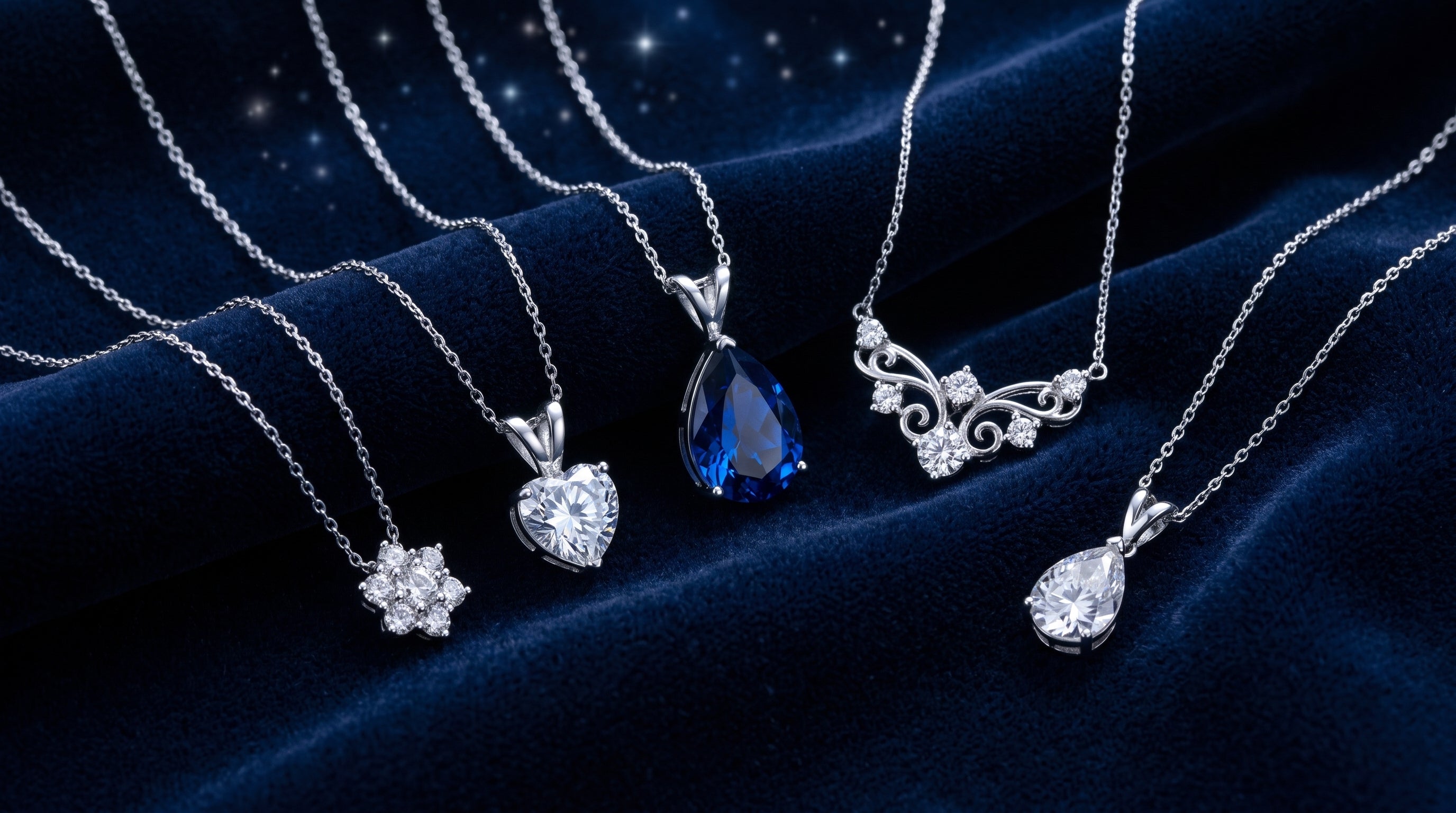
Two necklaces can be listed with almost identical wording — "S925 sterling silver moissanite necklace" — photograph the same way against a white background, and then behave completely differently after six months of daily wear. The stone is rarely the variable. Moissanite is a lab-created silicon carbide gem with consistent physical behavior; what changes between listings is the specificity of the grading, the construction of the chain and bail, and how the silver has been finished. This guide is organized around that reality: sterling silver first, stone second, style third, seller last. Where a claim comes from a brand or retailer rather than an independent test, it is labeled as such.
What "sterling silver moissanite necklace" actually describes
The phrase bundles two separate specifications, and shoppers who evaluate them separately make better decisions.
The 925 half of the equation
Sterling silver is an alloy that is 92.5% pure silver, which is why it is stamped 925 or listed as S925. Pure silver is too soft for prongs, bails, and link chains, so the remaining 7.5% (typically copper or a copper-based alloy) supplies the rigidity a setting needs. Sterling silver is the default metal across the moissanite necklace market: Charles & Colvard lists sterling silver pendants and tennis necklaces in its collections, Moissanite Outlet sells multi-carat sterling silver tennis designs, and Diamonds Factory includes sterling silver among the metals offered for its moissanite pendants. It is a mainstream choice, not a compromise metal.
The moissanite half of the equation
Moissanite is its own gemstone rather than a diamond imitation. Its chemical makeup is silicon carbide, whereas diamond is pure carbon, and that difference drives everything you see in the light. Specialist jewelers publish consistent figures: a refractive index of roughly 2.65–2.69 against diamond's 2.42, and a dispersion value near 0.104 against diamond's 0.044. Dispersion is the property responsible for splitting white light into spectral colors, so moissanite throws noticeably more rainbow flash than a diamond of the same cut and size. Do Amore, which sells both, describes this openly and notes that the extreme fire is often what reveals moissanite when the two are compared side by side.
Why the difference matters on a necklace specifically
A ring sits still on a hand; a pendant swings, rotates, and catches light from below as you move. That motion amplifies dispersion, which is why moissanite tends to read as more dramatic in necklaces than in rings of comparable carat weight. If you want an understated, mostly-white sparkle, size down or choose a step cut. If you want the piece to be visible across a room, moissanite's optical profile is working in your favor.
Why sterling silver suits moissanite — and where it has limits
The case for staying in silver
Silver is a cool, neutral white metal, which means it does not push warm tones into a near-colorless stone the way yellow gold can. For colorless moissanite, a white metal setting preserves the icy look most buyers are after. Sterling silver also lets you buy visual scale: because the metal itself costs less than gold, more of the budget can go toward stone size, cut quality, and finishing. Retailer guides consistently frame moissanite as far more affordable than diamond for a comparable look, and sterling silver amplifies that positioning at the entry and mid tiers. We are deliberately not quoting dollar figures here, because the price examples published across competing sites are brand-specific and change without notice.
The honest tradeoff: tarnish and softness
Sterling silver oxidizes. Humidity, perfume, sweat, chlorine, and household cleaners all accelerate the process, which is why Charles & Colvard's care guidance recommends removing jewelry before swimming or chores and storing pieces individually with anti-tarnish strips or silica gel packets. Silver is also softer than 14K gold, so a very fine silver chain worn continuously will show more wear over years than a gold equivalent. Neither issue affects the stone — moissanite's Mohs hardness of about 9.25 sits just below diamond's 10 — but it does mean the metal, not the gem, sets the maintenance schedule.
When to step up to gold
If you are considering a moissanite necklace gold upgrade, consider solid gold when the piece will be worn 24/7 without removal, when the design is a continuous line of stones with dozens of small prongs under constant tension, or when you are buying for a milestone occasion and want the metal to carry equivalent weight to the moment. Brand guidance in this category typically frames 14K gold as the durability upgrade and 925 sterling silver as the accessible-luxury standard. If you are weighing the two metals in depth, our comparison of moissanite in gold versus silver settings works through the same tradeoffs from a ring perspective, and the logic transfers cleanly to necklaces.
Judging stone quality on a necklace: color, clarity, cut, size
Color
Moissanite is graded on a letter scale borrowed from diamond convention, and D–F describes the colorless range that most buyers want in a white metal setting. Lower grades can read warm or faintly gray, which becomes more obvious in larger stones and in daylight. Do Amore explicitly warns that lower-quality, tinted moissanite looks noticeably off when placed next to a colorless stone. If a listing does not state a color grade at all, treat that silence as information.
Clarity and the VVS question
VVS is the clarity tier most frequently advertised in moissanite chains and pendants, and it signals inclusions that are very difficult to see under magnification. In practice, well-cut moissanite in the VVS range is eye-clean in any normal wearing condition. The more useful takeaway is procedural: a seller who names an actual clarity grade is disclosing something checkable, whereas "high clarity" or "brilliant stones" is copywriting. For chain-led pieces where dozens of stones sit in a row and any single dull stone breaks the line, clarity consistency matters more than it does on a single-stone pendant. Our VVS moissanite chain buying guide covers grade-by-grade specifics and the certificate red flags worth knowing before you commit.
Cut
Cut governs how much of that 0.104 dispersion you actually see. Brilliant cuts — round, pear, heart, oval — maximize fire and are the standard choice for pendants intended to sparkle. Step cuts such as emerald and Asscher produce broader, calmer flashes of light rather than rainbow scintillation; Do Amore notes that step cuts read as more subtle and are less immediately identifiable as moissanite. Neither is better; they are different visual intentions. Ask which cut style a pendant uses before assuming the photograph reflects real-world behavior, since studio lighting exaggerates fire in every brilliant-cut stone.
Size and proportion
Carat weight on a necklace is a styling decision more than a status one. A stone that looks balanced on a 16-inch chain against a collarbone can look oversized at 18 inches over a crew neckline. Larger stones also make color grade more visible, which is why buyers moving up in size should tighten their color requirement rather than relax it. Note that moissanite listings sometimes quote DEW (diamond equivalent weight) rather than true carat weight, because moissanite is slightly less dense than diamond — check which measurement a listing is using before comparing two pieces.
Style families: pendants, chains, and tennis necklaces
Pendant necklaces
When shopping for a moissanite necklace for women, the pendant is the dominant sterling silver moissanite format and the most versatile. Solitaires and halos read as classic; hearts and pears carry symbolic weight and are the shapes most heavily represented in gift-oriented moissanite collections across the market. Awareness Avenue's sterling silver pendant range reflects that same pattern — pear silhouettes such as The Thalyssa Pear Pendant, The Calystine Pear and The Amarante Pear, alongside heart designs like The Thalira Heart and the 3CT Moissanite Halo Heart Necklace. Confirm the individual specifications — stone dimensions, chain length, grading — on each product page rather than assuming they match across a collection.
The moissanite chain and pendant
When evaluating a moissanite chain and pendant as a system, buyers routinely underestimate the chain. A heavy pendant on an under-gauged cable chain will droop, twist, and stress the bail; a delicate pendant on a thick curb chain looks unbalanced. Match visual weight, and check whether the bail is fixed or slides freely, because a sliding bail lets the pendant self-center while a fixed bail keeps it oriented forward. If you plan to layer, buy pendants that sit at genuinely different lengths rather than two chains one inch apart, which tangle.
Tennis necklaces
A sterling silver moissanite tennis necklace is a continuous line of prong- or bezel-set stones running the full circumference. Charles & Colvard offers this style, proving it is available at the silver tier; at the premium end, a moissanite tennis necklace 14k gold or 10k gold design (such as those published by brands like IceLink) features specifications like 2.10–2.75 mm widths, which gives a sense of how narrow most everyday tennis lines actually are. Two practical checks: examine the clasp, since a tennis necklace's entire value hangs on it, and ask whether the piece has a safety catch. Because dozens of settings are involved, construction quality separates a tennis necklace that lasts from one that sheds stones.
Sets and coordinated looks
If the necklace is a gift, a matched set removes the guesswork of pairing metals and stone shapes later. Options such as The Aurora Jewelry Set in S925 sterling silver or the blue moissanite Eveline Jewelry Set deliver a coordinated finish out of the box. You can browse the full necklaces collection to compare formats side by side.
Choosing a length
Common necklace lengths run 14, 16, and 18 inches, with longer options above that. As a rough map: 14 inches sits close to the base of the neck and reads as a collar, 16 inches typically falls at or just below the collarbone, and 18 inches drapes lower and gives a pendant room to move. Neck circumference and neckline both shift where a given length lands, so if you are buying blind, 18 inches with an extender is the most forgiving choice.
How to vet the listing and the seller
What good disclosure looks like
Strong moissanite listings state metal purity explicitly (925 or S925 rather than "silver tone"), name a stone color grade and a clarity grade, give carat weight or DEW with stone dimensions, specify chain length and style, and reference a gemological certificate. Awareness Avenue's buying guidance for moissanite chains recommends prioritizing sellers who provide certification, explicit grading, transparent returns, and a clear warranty position. Awareness Avenue states on its moissanite collections that it offers a lifetime guarantee on its jewelry and that every moissanite item comes with GIA certification and tracing; treat that as a brand-level policy statement and verify how it applies to the specific piece you are buying.
Red flags
Vague stone language such as "diamond simulant" or "shiny CZ-quality stones" without a named grade, no metal stamp mentioned anywhere in the description, images that show only extreme close-ups under directional lighting, and no stated return window are all reasons to slow down. Silence about clarity in a listing that markets itself on brilliance is a particularly common pattern.
Verifying moissanite yourself
Two field checks are widely cited by moissanite specialists. First, fire: under strong directional light, moissanite produces pronounced rainbow flashes rather than the predominantly white-and-blue flash of diamond. Second, double refraction. Moissanite is doubly refractive, so viewing the stone at an angle through the crown with magnification can show doubled facet junction lines; diamond and cubic zirconia are singly refractive and will not. Note that near-colorless moissanite can register as diamond on basic handheld thermal testers, so a tester alone is not conclusive.
Why moissanite outperforms cubic zirconia here
The comparison matters because CZ occupies the same price conversation. Cubic zirconia's refractive index sits around 2.15–2.18 and its hardness around 8.0–8.5, and it is known to absorb oils and dull over time. Moissanite, by contrast, is described by specialist retailers as non-porous and resistant to clouding, which is the single strongest argument for paying more than CZ money for a piece you intend to keep.
Care that keeps sterling silver and moissanite looking new
The monthly routine
Fill a bowl with warm water and a few drops of mild dish soap. Soak the necklace for about ten minutes to loosen body oils, then scrub gently with a soft-bristled toothbrush, paying particular attention to the back of the pendant and the underside of the setting where residue collects and blocks light return. Rinse thoroughly under warm water and dry with a lint-free microfiber cloth. Charles & Colvard's care guidance mirrors this approach and advises against harsh chemicals and ultrasonic cleaners, which can stress settings.
Storage
Store each piece separately in a soft pouch or a lined compartment so stones cannot abrade neighboring metal, and add anti-tarnish strips or silica gel to control moisture. Tennis necklaces should be laid flat rather than coiled tightly, and chains fasten better if clasped before storing. Remove necklaces before swimming, cleaning, and applying lotion or perfume.
Annual inspection
Charles & Colvard recommends professional cleaning and inspection at least once a year, largely because prongs loosen gradually and silently. A jeweler can retighten settings, polish the metal, and flag wear at the bail or clasp before a stone is lost. Insuring higher-value pieces against loss, theft, or damage is also recommended in that guidance and is not limited to diamond jewelry.
A practical decision framework
Stay in sterling silver if
You want maximum visual impact per dollar, you rotate jewelry rather than wearing one piece continuously, you prefer a cool white metal against colorless stones, or you are buying a gift and want a classic pendant shape without overcommitting. Pendant designs such as The Anneliese Moissanite Necklace, The Aureliette Moissanite Necklace, and the Eternal Heart Moissanite Pendant Necklace sit squarely in this use case.
Upgrade the stone before the metal if
The piece will be worn where people look closely — at the throat, in office lighting, in photographs. Moving from an unspecified grade to a stated D–F color and VVS clarity changes the piece more than moving from silver to gold does, especially at smaller carat weights.
Upgrade the metal if
You never take jewelry off, you react to alloy metals, or you are buying a continuous-line design where prong tension is constant. Solid gold construction is the relevant comparison here, and our sterling silver versus white gold comparison lays out the durability differences in detail. Gold pieces are grouped in the solid gold collection.
Go custom if
You have a specific stone shape, carat weight, or setting style in mind that stock designs do not cover — a particular pear-to-halo ratio, an unusual bail, or a bespoke motif. That path requires deciding on color grade, clarity, cut precision, stone size, metal, and chain up front, which is exactly what our VVS moissanite custom pendant guide walks through spec by spec.
Frequently asked questions
Will a sterling silver moissanite necklace tarnish?
The silver can, over time and with exposure to moisture, chemicals, and skin oils. The moissanite will not. Regular gentle cleaning and dry, individual storage with anti-tarnish materials keep the metal bright, and a jeweler's polish restores it if it dulls.
Does moissanite cloud or lose sparkle?
Specialist retailers describe moissanite as dense and non-porous, so it does not absorb oils the way cubic zirconia does and does not cloud with age. Apparent dullness is almost always surface film from lotion, soap, or sunscreen, which the soap-and-soft-brush routine removes.
Is moissanite a fake diamond?
No. It is a separate gemstone with a different chemical composition, a higher refractive index, roughly double the dispersion of diamond, and a Mohs hardness of about 9.25. It looks similar at a glance but behaves differently in light, and reputable sellers describe it as moissanite rather than as diamond.
Can sterling silver hold a multi-carat moissanite?
Yes — sterling silver tennis necklaces with substantial total carat weight are sold across the market. What matters is the gauge of the metal, the depth of the prong seats, and the quality of the clasp, not the alloy alone.
Should I choose silver or 14K gold for a tennis necklace?
Sterling silver is the accessible entry point and works well if you rotate pieces and store them properly. Solid 14K gold is the more durable choice for a continuous-line design worn constantly, and it holds prong tension better over years. Decide based on wear frequency rather than on appearance, since both metals present a similar cool or warm white depending on plating and finish.
The short version: buy the disclosure, not the photograph. A sterling silver moissanite necklace with a stated 925 stamp, a named color and clarity grade, a specified cut, an honest chain gauge, and a clear returns and certification position will outperform a vaguer listing at the same size every time — and with a soap-and-water routine and sensible storage, it will still be doing it years from now.

Leave a comment
This site is protected by hCaptcha and the hCaptcha Privacy Policy and Terms of Service apply.