
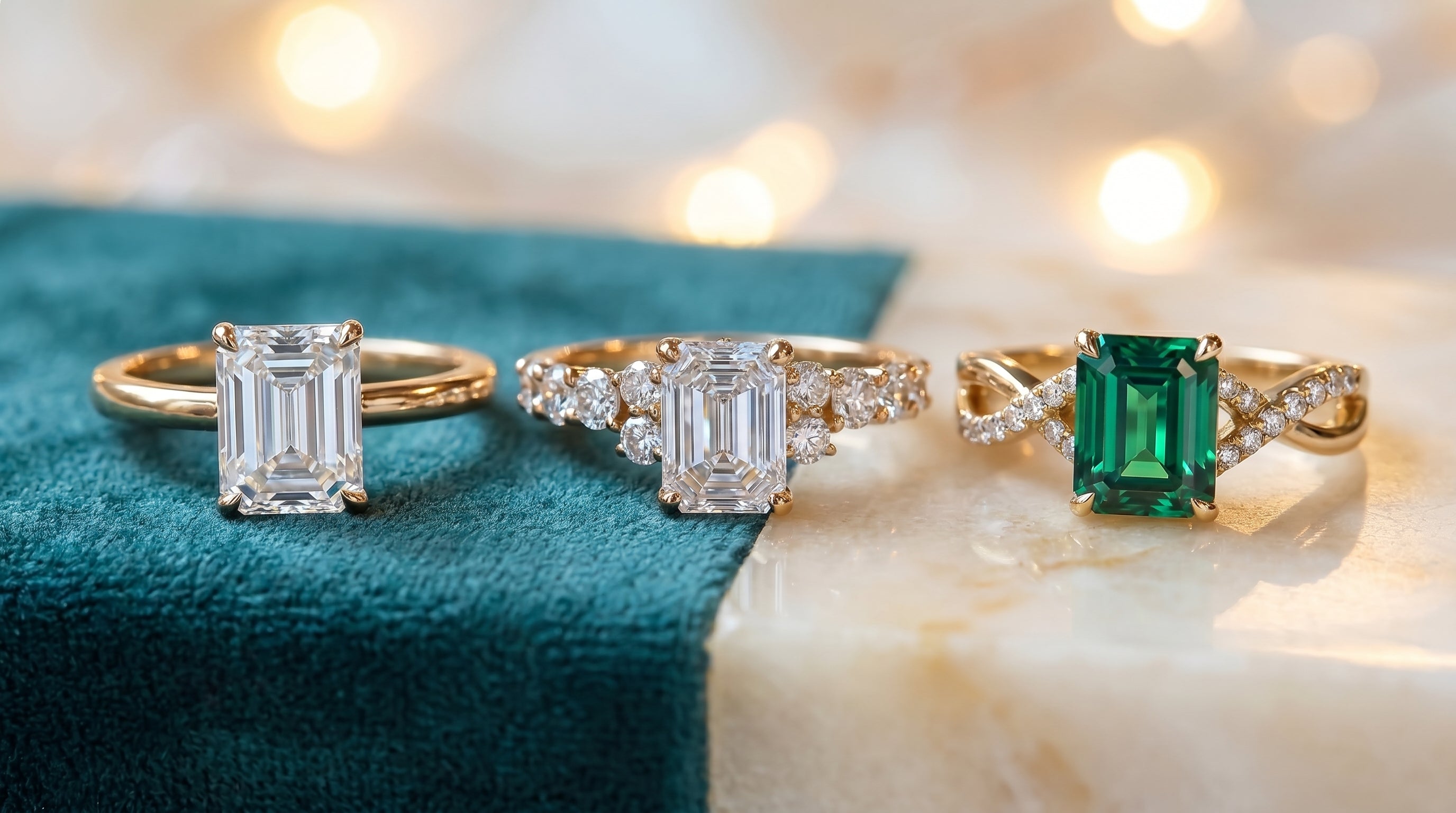
An emerald cut ring gold setting is one of the most architecturally striking choices in fine jewelry—and if you're reading this, you already sense that. You slip it onto your finger and the clean, rectangular lines command the room without trying. Unlike brilliant cuts that scatter light in a frenetic dance, the emerald cut offers something slower and more deliberate: broad, dramatic flashes that speak to vintage glamour and modern minimalism at once. Finding the right piece means understanding precise proportions, uncompromising clarity, and the interplay between a step-cut stone and warm, luxurious metal. In 2026, the options for securing a breathtaking gold emerald cut engagement ring have never been more exciting—or more accessible.

The allure of this cut dates back centuries, originally developed to prevent fragile green emeralds from chipping during the cutting process. Jewelers quickly realized that the truncated corners and long, parallel facets created a mesmerizing optical effect. When applied to clear stones like diamonds and moissanite, the result was nothing short of spectacular. Today, gold emerald cut engagement rings represent the pinnacle of refined taste. They don't need to shout to be heard. Their beauty lies in their transparency, their geometry, and the bold statement they make on the hand.
This guide walks you through every nuance of selecting your ideal ring. We'll explore the gemological parameters that make a step-cut stone sing, the dramatic price differences between natural diamonds and premium moissanite, and the subtle design choices that elevate a simple band into a family heirloom. By the time you finish reading, you'll have the exact knowledge needed to choose a ring that perfectly reflects your personal love story.
What to Know Before Buying an Emerald Cut Ring in Gold
Before buying an emerald cut ring in gold, you must understand its unique step-cut facet structure. Unlike brilliant cuts that maximize sparkle, emerald cuts create a sophisticated "hall of mirrors" effect that prioritizes clarity, geometric precision, and architectural elegance over intense scintillation. This makes stone quality absolutely paramount.
The anatomy of an emerald cut is entirely different from the round or oval stones you might be used to seeing. Instead of kite-shaped and triangular facets designed to bounce light in a thousand directions, the emerald cut features long, rectangular facets arranged in parallel lines down the pavilion and the crown. The large, flat table at the very top acts like an open window, allowing you to gaze directly into the heart of the gem. As light enters the stone, it reflects off the parallel tiers, creating those broad, dramatic flashes of light and dark—the signature "hall of mirrors" effect.
Because of this open-window effect, the emerald cut is famously unforgiving. It won't hide a poor cut, won't mask a low clarity grade, and will readily show any underlying color tint. You're essentially looking at the naked truth of the gemstone. This is why selecting an emerald cut requires a different strategy than buying a brilliant cut—you must prioritize the purity of the stone above almost all else.
Pairing this architectural stone with a gold setting adds another layer of complexity and beauty. Gold has been the standard for fine jewelry for millennia, offering a warmth and malleability that allows jewelers to craft secure, intricate settings. In 2026, we're seeing a massive resurgence in 14k and 18k yellow gold. The rich, buttery tone of yellow gold provides a striking contrast to the icy, geometric flashes of a white moissanite or diamond, giving the ring a distinctively vintage, old-Hollywood feel. If you want to dive deeper into the nuances of gold purities, our Complete 18k Gold Engagement Ring Buying Guide (2026) offers an exhaustive breakdown of alloys and durability.
White gold offers a seamless, monochromatic look—an emerald cut set in white gold appears larger and more fluid, as the cool tones of the metal blend perfectly with the colorless stone. Rose gold provides a romantic, unexpected twist, softening the severe angles of the step cut with a blush-toned warmth that flatters virtually every skin tone. Whichever gold alloy you choose, the metal frames the stone and dictates how light interacts with those long, elegant facets.
Key Factors: Cut, Clarity, Color, and Carat
The most critical factors for an emerald cut are cut quality and clarity. Because the long, open facets easily reveal inclusions, experts recommend a minimum clarity of VS2. Ideal proportions include a length-to-width ratio between 1.3 and 1.4 for classic balance, ensuring the stone looks elegant rather than blocky.
The four Cs work differently through the lens of the emerald cut. The rules you learned for round diamonds don't apply here. You have to adjust your priorities to ensure you get a stone that looks crisp, clean, and captivating.
The Importance of Cut Proportions
Cut is the single most important factor in determining the beauty of an emerald cut stone. If the parallel facets aren't aligned with mathematical precision, the stone will look glassy, dead, or off-balance. You want a stone cut to Excellent or Very Good standards—but beyond the top-line grade, the specific proportions matter enormously.
The length-to-width ratio dictates the overall silhouette on your finger. A ratio between 1.30 and 1.40 is the classic, traditional emerald shape—perfectly balanced, rectangular but not overly stretched. If you prefer a more elongated look, which can beautifully slenderize the finger, look for a ratio between 1.45 and 1.60. Anything below 1.30 starts to look like a square Asscher cut, while anything above 1.60 can look too thin and may be more vulnerable to damage if struck hard.
You also need to consider the table percentage and the depth percentage. Gemologists generally recommend a table between 60% and 65% and a depth between 58% and 65%. These parameters ensure that light enters the stone, hits the pavilion facets at the correct angle, and bounces back to your eye rather than leaking out the bottom.
Clarity: The Unforgiving Window
If you're buying a round brilliant cut, you can often get away with an SI1 or even SI2 clarity grade because the intense sparkle hides tiny imperfections. Don't try this with an emerald cut. The large, open table means there's absolutely nowhere for an inclusion to hide. A dark spot or a feather that would be invisible in an oval cut will stick out plainly in an emerald cut.
Set your absolute minimum clarity floor at VS2 (Very Slightly Included), and ideally aim for VVS1, VVS2, or Flawless. Here's where moissanite presents a remarkable advantage. Because premium moissanite is grown in controlled laboratory environments, it's crafted to VVS clarity standards as a matter of course. You get a completely eye-clean, flawless-looking stone without paying the astronomical premium that a natural VVS diamond commands.
Color: Trapping the Light
Step cuts tend to trap and concentrate color, particularly in the truncated corners. If a stone has a slight yellow or brown tint, the emerald cut will make it more obvious. Setting your stone in white gold generally calls for a colorless stone—D, E, or F on the GIA grading scale—to keep the look icy and crisp.
However, if you're choosing a yellow or rose gold setting, you have more flexibility. The warm tones of the gold will naturally reflect into the stone anyway. This means you can sometimes drop to a G or H color grade in yellow gold, as the slight warmth of the stone blends harmoniously with the band rather than fighting it.
Carat: The Face-Up Advantage
Carat refers to the physical weight of the stone, not its dimensions. One of the greatest secrets of the emerald cut is that it carries much of its weight in its surface area rather than its depth. Because it's a shallower cut than a round brilliant, a 2-carat emerald cut will generally look significantly larger face-up than a 2-carat round cut.
This face-up advantage means you get more finger coverage for your money. A beautifully proportioned emerald cut stretches elegantly up the finger, creating a substantial, luxurious presence even at lower carat weights.
| Feature | Premium Moissanite | Lab-Grown Diamond | Natural Diamond |
|---|---|---|---|
| Clarity Consistency | Consistently VVS1/VVS2 (Flawless to the naked eye) | Varies widely; requires careful selection to avoid visible inclusions | Varies widely; high clarity (VVS) is exceptionally rare and expensive |
| Refractive Index (Fire) | 2.65 - 2.69 (Exceptional rainbow flashes) | 2.42 (Standard white light return) | 2.42 (Standard white light return) |
| Durability (Mohs Scale) | 9.25 (Scratch-resistant, ideal for daily wear) | 10 (Maximum hardness) | 10 (Maximum hardness) |
| Price for 3-Carat (VS/VVS) | $1,500 - $3,000 | $5,000 - $9,000 | $25,000 - $45,000+ |
| Ethical Sourcing | 100% Conflict-free, lab-created with minimal environmental impact | Conflict-free, lab-created | Requires extensive tracing to ensure conflict-free origins |
Price Ranges and Value: Diamonds vs. Moissanite
A 3 carat emerald cut diamond ring price can easily exceed $30,000 for natural stones, while lab-grown diamonds average around $7,500. Moissanite offers the most exceptional value, delivering the exact same luxurious, durable, and brilliant three-carat architectural look for under $3,000 in a solid gold setting.
When you begin shopping for an emerald cut, the price disparities you encounter can be staggering. At the absolute ceiling of the market, an emerald cut diamond ring Tiffany-style—where you're paying for the stone, the platinum or gold setting, and a significant brand premium—can easily command $50,000, $75,000, or more depending on the exact color and provenance. An emerald-cut diamond ring Tiffany offers at that level represents a flawless natural stone, and the price reflects it.
Stepping away from legacy brands into the broader natural diamond market, the 3 carat emerald cut diamond ring price remains a serious financial hurdle. Because you can't compromise on clarity or cut with this shape, you're forced to buy premium grades. A 3-carat natural diamond with VS1 clarity and G color will typically cost between $25,000 and $35,000 for the loose stone alone. For many couples, tying up the equivalent of a house down payment in a single piece of jewelry doesn't align with their modern financial goals.
Lab-grown diamonds have disrupted this space, offering the exact same chemical composition as natural diamonds for a fraction of the cost. A high-quality 3-carat lab-grown emerald cut runs between $5,000 and $9,000. That's a meaningful improvement in value—but it's still a major purchase.
And here's where premium moissanite completely changes the paradigm. Moissanite isn't a fake diamond; it's its own distinct gemstone, originally discovered in a meteor crater and now expertly recreated in laboratories. With a refractive index of 2.65–2.69 versus diamond's 2.42, and a dispersion rating of 0.104 (2.4 times that of diamond), it's actually more brilliant than a diamond—producing vivid, fiery rainbow flashes that catch in direct sunlight in a way that stops people mid-sentence. Because it's lab-grown, every stone meets VVS clarity standards, which is exactly the high-clarity requirement needed to make an emerald cut look perfect. Every Awareness Avenue moissanite comes with GRA certification and is backed by our lifetime warranty.
You can secure a breathtaking, flawless 3-carat emerald cut moissanite set in solid 14k or 18k gold for between $1,500 and $3,000. You get the massive face-up size, the architectural elegance, the eye-clean perfection, and the daily-wear durability—at 9.25 on the Mohs scale, it withstands a lifetime of wear—all while keeping your finances intact for your wedding, your honeymoon, or your future. For a deeper dive into how these costs break down across different shapes and sizes, read our Moissanite vs Lab Diamond Price: The 2026 Breakdown.

How to Spot Quality in Gold Emerald Cut Engagement Rings
To spot a high-quality gold emerald cut engagement ring, examine the symmetry of the parallel facets and the thickness of the gold band. The stone should exhibit crisp, alternating flashes of light and dark, securely held by well-crafted prongs or a protective bezel setting that guards the truncated corners.
When you're evaluating a ring, your eye should first go to the symmetry of the stone. Look straight down through the table. The concentric rectangles radiating outward should be perfectly parallel and evenly spaced. If the lines look wavy, pinched, or misaligned, the stone has a poor cut and won't reflect light properly. You want to see distinct, sharp flashes of light turning on and off as you tilt the ring back and forth—that satisfying alternation of brilliance and shadow is the hallmark of a well-cut step stone.
Next, examine the setting itself. The emerald cut ring gold band should feel substantial in your hand. While whisper-thin bands are popular for their delicate look, a band under 1.5mm will warp over time and may not provide enough structural support for a large center stone. Look for a band width between 1.8mm and 2.2mm—the perfect balance of a dainty aesthetic with lifelong durability.
Pay close attention to how the stone is secured. The truncated corners of an emerald cut were originally designed to prevent chipping, but they still need protection. Double claw prongs are a beautiful, vintage-inspired choice that securely grips the corners while adding a touch of elegance. A bezel setting, where a rim of gold completely encircles the stone, offers the ultimate protection and creates a sleek, modern, architectural look that's also the most practical for active lifestyles.
Finally, consider the ring's profile. A classic solitaire allows the emerald cut to stand entirely on its own, projecting quiet confidence. A halo setting surrounds the center stone with a perimeter of smaller stones, adding brilliant sparkle that contrasts beautifully with the step-cut center while making the overall footprint of the ring look massive. A hidden halo—a delicate wrap of stones tucked just beneath the center stone—offers a secret detail of sparkle that's only visible from the side, keeping the top-down view clean and minimalist.
Our Top Recommendations for Emerald Cut Engagement Rings
Our top recommendations for emerald cut engagement rings combine flawless moissanite center stones with premium gold settings. From vintage-inspired designs to bold, colorful statement pieces, these rings offer unmatched durability, ethical sourcing, and breathtaking architectural beauty for the modern bride.
We've helped over 250,000 customers find their perfect piece, and we've spent years perfecting the art of the step cut. Our master jewelers understand exactly how to proportion a moissanite stone to maximize its hall of mirrors effect, and how to craft gold settings that elevate the stone to a work of art. Every ring ships with secure checkout, 30-day returns, and our lifetime warranty—because a forever ring deserves forever support. Here are our most beloved emerald cut designs for 2026.
The Adelina Rae – 2CT Emerald Cut Moissanite Ring
If you're searching for the quintessential, perfectly balanced emerald cut, The Adelina Rae is a masterpiece. Featuring a flawless 2-carat equivalent moissanite center stone, this ring hits the absolute sweet spot of size and wearability. Large enough to command attention from across the room, yet practical enough for everyday wear without catching on fabric or feeling overly heavy on the hand.
The setting lets the stone do all the talking. The clean, unadorned gold band draws the eye upward to the architectural perfection of the step cut. In yellow gold, The Adelina Rae takes on a warm, regal quality that feels like a treasured family heirloom. It's the ultimate choice for the minimalist who refuses to compromise on quality.

The Bella Jewel – 3CT Emerald Cut Moissanite Engagement Ring
For the bride who wants undeniable presence and breathtaking scale, The Bella Jewel delivers in spectacular fashion. A 3-carat emerald cut is a serious statement piece. Because of the face-up advantage of the step cut, this stone covers a significant portion of the finger, offering a luxurious, celebrity-inspired look that would cost tens of thousands in natural diamond.
Despite its impressive size, The Bella Jewel never feels gaudy. The inherent sophistication of the emerald cut ensures that even at three carats, the ring remains tasteful. The crisp, linear flashes of light give it a cool, collected energy. This is the ring for the woman who knows exactly what she wants and isn't afraid to wear a piece that stops traffic.
The Camilla – Solitaire Moissanite Ring
Sometimes, the most powerful design is the simplest one. The Camilla Solitaire strips away all distractions, presenting the emerald cut moissanite in its purest form. The band is expertly tapered as it approaches the center stone—a subtle design trick that makes the center gem appear even larger and more prominent.
This ring is a masterclass in restraint. By focusing entirely on the quality of the VVS moissanite and the flawless polish of the gold band, The Camilla achieves a level of elegance that will look just as relevant fifty years from now as it does today. It's also incredibly versatile, pairing beautifully with almost any style of wedding band you can imagine.

The Bella Jewel – 3CT Emerald Cut Green Moissanite Ring
Who says an engagement ring has to be white? In 2026, demand for colored center stones is surging, and The Bella Jewel in Green Moissanite is leading the charge. This ring pays homage to the original gemstone that gave the emerald cut its name, but with the superior durability and fire of moissanite.
The deep, mesmerizing forest green looks spectacular set in yellow gold. The warm metal makes the green hue pop with incredible intensity—it's a bold, non-traditional choice that feels deeply connected to nature while maintaining the sharp, high-fashion edge of the step cut. If you want a ring that sparks a conversation every single time you wear it, this is the one.
Red Dream: Emerald-Cut Ruby Sculpted Ring
For a truly passionate and unique expression of love, the Red Dream Emerald-Cut Ruby Ring offers a fiery alternative to traditional clear stones. Crafted in 18K gold vermeil, this ring features a stunning lab-grown ruby cut into the classic emerald shape.
The step cut does something magical to the ruby. Instead of a solid block of red, you get deep crimson shadows alternating with bright, cherry-red flashes of light as the ring moves. The sculpted gold setting adds a layer of vintage artistry, making it look like a piece pulled from a royal treasury. It's a magnificent choice for an engagement ring, an anniversary gift, or a right-hand statement piece.

Styling Your Emerald Cut Wedding Ring Set
Creating the perfect emerald cut wedding ring set requires balancing the architectural center stone with a complementary band. The best wedding bands for emerald cut rings feature sleek metal finishes, matching step-cut baguettes, or delicate pavé stones that don't compete with the main stone's geometric beauty.
Once you've secured your gold emerald cut engagement ring, the next exciting step is curating your complete bridal stack. Because the emerald cut has such a distinct, linear personality, you have to be intentional about what you pair it with. You want a band that enhances the center stone rather than fighting it for attention.
If you love a clean, modern aesthetic, pairing your emerald cut with a plain, solid gold band of the exact same width and metal alloy creates a stunningly cohesive look. This minimalist approach allows the center stone to remain the undisputed star of the show. The matching metals will age together, developing a beautiful, uniform patina over the decades.
For those who crave more sparkle, a pavé moissanite band is an excellent choice. The tiny, brilliant-cut stones provide a beautiful textural contrast to the broad, glassy flashes of the emerald cut—you get the sophisticated geometry of the step cut and the lively, dancing light of brilliant cuts all in one stack. Just ensure the pavé band sits flush against your engagement ring. If your emerald cut has a low-profile setting, you may need a contoured or curved wedding band that wraps gently around the base of the center stone.
And honestly? If you want to lean fully into the Art Deco, architectural vibe, look for a wedding band featuring step-cut stones. A band channel-set with small emerald cuts or tapered baguettes creates a seamless, highly structured look that's incredibly chic. This style of emerald cut wedding ring set feels intentional and custom-designed, echoing the linear facets of your main stone all the way around your finger. For more inspiration on building your perfect bridal stack, explore our curated Emerald Cut Engagement Rings in Gold: 10 Best Picks guide.
Frequently Asked Questions
Shoppers frequently ask about the durability, sparkle, and sizing of emerald cut rings. Understanding how moissanite performs in a step-cut shape and how gold alloys hold up to daily wear will help you make a confident, lasting investment for your engagement.
Does an emerald cut ring sparkle less than a round cut?
Yes, by design. Emerald cuts are step cuts, meaning they have long, parallel facets that create broad flashes of light—the "hall of mirrors" effect—rather than the intense, scattered scintillation of a round brilliant cut. It's a more subtle, sophisticated type of light return that emphasizes the stone's clarity and geometric shape. With moissanite's refractive index of 2.65–2.69, those broad flashes carry a vivid, fiery quality that's entirely their own.
Is moissanite a good choice for an emerald cut ring?
Moissanite is an exceptional choice for an emerald cut. Because emerald cuts require very high clarity to look good, natural diamonds in this shape are expensive. Moissanite is lab-grown to VVS clarity standards, ensuring a flawless look. Additionally, moissanite's high refractive index gives the step cut a beautiful, fiery life that makes the architectural facets truly pop—and every stone comes GRA certified.
What is the best gold color for an emerald cut ring?
There's no single "best" color—it depends entirely on your personal style. Yellow gold provides a beautiful, warm, vintage contrast to the icy stone. White gold creates a seamless, modern, monochromatic look that makes the stone appear larger. Rose gold offers a romantic, soft aesthetic that flatters all skin tones. All three are excellent, durable choices for a gold emerald cut engagement ring.
How thick should a gold band be for a 2 or 3-carat emerald cut?
For larger stones like a 2 or 3-carat emerald cut, you need a band that provides adequate structural support. We recommend a band width between 1.8mm and 2.2mm. This is thick enough to prevent the gold from warping or bending during daily wear, but thin enough to maintain a delicate, elegant proportion relative to the large center stone.
Final Advice for Your Forever Ring
Choosing your forever ring is a deeply personal journey that balances aesthetic desires with practical value. By prioritizing high clarity, excellent proportions, and a durable gold setting, you secure a timeless piece of jewelry that will captivate for generations to come.
An emerald cut ring gold setting isn't a trend that will fade in a few years. It's a historically significant, architecturally brilliant design that has graced the hands of royalty and Hollywood icons for nearly a century. By choosing this shape, you're aligning yourself with a legacy of quiet luxury and uncompromising elegance.
Here's the thing—the magic of the emerald cut lies in its transparency. Don't compromise on clarity, and ensure you're getting a stone cut to exacting proportions. By opting for premium moissanite, you bypass the inflated costs of the natural diamond market, securing a flawless, substantial center stone without sacrificing your financial future. You get the breathtaking 3-carat look, the durable gold setting, the GRA certification, and the ethical peace of mind, all in one magnificent package. We're a family-run brand, and we've built our reputation on exactly that promise—backed by 250,000+ customers who wear our rings every day.
Take your time, explore the subtle differences between solitaire and halo settings, and envision how the warm glow of gold will look on your hand every single day. When you're ready to find the piece that speaks to your soul, we invite you to explore our full collection of engagement rings and discover the brilliant, ethical luxury that awaits you.

Dejar un comentario
Este sitio está protegido por hCaptcha y se aplican la Política de privacidad de hCaptcha y los Términos del servicio.