
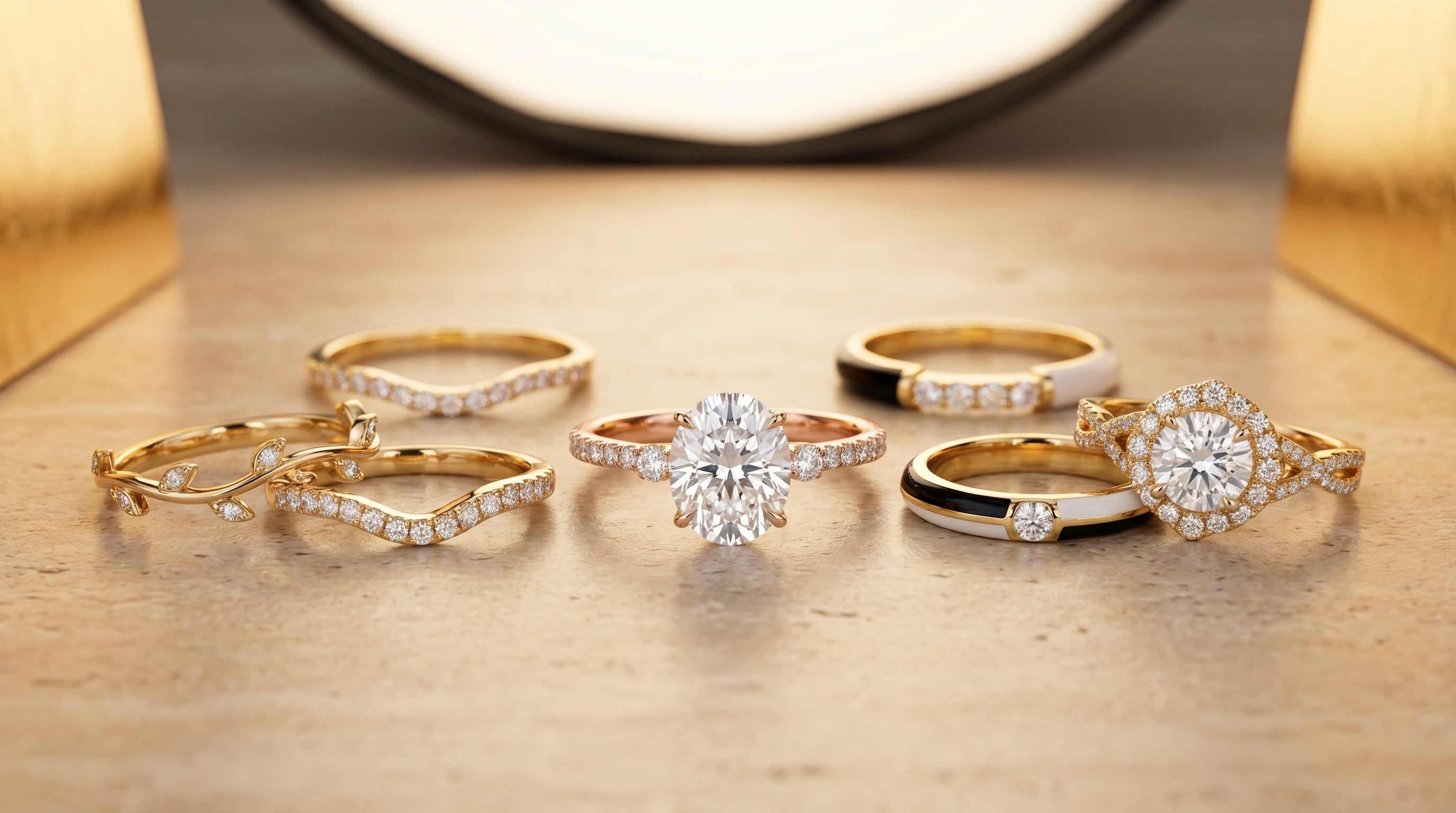
If you're searching for 14k gold moissanite rings, you already know what you want: the real weight of solid gold on your finger, a stone that throws light across an entire room, and a price that doesn't require a second mortgage. That combination exists. It's not a compromise. And in 2026, more than 250,000 customers have discovered that moissanite set in 14k gold doesn't just rival a diamond ring — in several measurable ways, it surpasses one.

What Are 14k Gold Moissanite Rings?
14k gold moissanite rings combine lab-created silicon carbide gemstones with an alloy of 58.3% pure gold and durable metals like silver, copper, or palladium. This pairing delivers exceptional scratch resistance, brilliant rainbow fire, and everyday durability — making it the premier choice for modern, ethical engagement rings and fine jewelry in 2026.
Here's the thing — moissanite isn't a diamond substitute. It's a completely distinct gemstone with its own remarkable origin story. French scientist Henri Moissan first discovered it inside a meteorite crater. This stone literally came from space. Because natural deposits are far too scarce for jewelry production, scientists perfected growing it in controlled laboratory environments. The result is a silicon carbide gemstone with optical properties that actually exceed those of a mined diamond.
When you set moissanite in 14k gold, you're engineering a piece for a lifetime. The "14k" designation means 14 parts pure gold and 10 parts alloy metals. Pure gold is notoriously soft — beautiful, but impractical for a ring you'll wear every day. Alloying it creates a metal that keeps that unmistakable warm glow while gaining the tensile strength needed to hold a precious gemstone securely in place for decades.
Why Choose 14k Gold Over Other Karats?
14k gold is the ideal metal for moissanite rings because it perfectly balances pure gold's rich color with the structural strength of alloyed metals. It resists scratching and bending far better than 18k or 24k gold, while offering a more luxurious finish and higher intrinsic gold value than 10k gold — the sweet spot for daily wear.
Choosing the right metal purity matters just as much as selecting the perfect center stone. You might assume a higher karat number automatically means a better ring. It doesn't. Jewelry design requires a careful balance between purity and practicality. Here's how the different gold karats actually perform when paired with moissanite.
A 10k yellow gold moissanite ring represents the most budget-friendly tier of solid gold jewelry. At only 41.7% pure gold, it's exceptionally hard and scratch-resistant. But that lower gold content produces a paler color — lacking the deep, warm luster most people associate with fine jewelry. The higher alloy concentration can also trigger metal sensitivities in some wearers.
An 18k yellow gold moissanite ring offers a stunningly rich, buttery color because it's 75% pure gold. Undeniably luxurious. But that higher purity makes the metal noticeably softer. If you work with your hands or live an active lifestyle, the prongs holding your moissanite in an 18k setting will wear down faster and need more frequent professional maintenance.
And a 24k gold moissanite ring? Pure 24k gold is magnificent to look at, but entirely impractical for prong-set rings. It's so soft you can bend it with your bare hands. A moissanite stone would loosen and fall out of a 24k setting within months of normal daily wear.
14k gold hits the absolute sweet spot. Gorgeous, saturated color that looks undeniably expensive — with the structural integrity required for a ring you plan to wear every single day. For a deeper dive into how different gold purities affect your choices, explore our comprehensive 14K Gold Engagement Rings: The Complete Buying Guide 2026.
| Gold Karat | Pure Gold % | Durability | Best Use Case |
|---|---|---|---|
| 10k Gold | 41.7% | Very High | Budget-conscious buyers, heavy manual labor. |
| 14k Gold | 58.3% | High | The perfect balance for everyday engagement rings. |
| 18k Gold | 75.0% | Moderate | Luxury pieces, wearers with low-impact lifestyles. |
| 24k Gold | 100% | Very Low | Investment bullion, not recommended for stone settings. |
Metal Colors: Yellow, White, and Rose Gold
The metal color of your ring dramatically impacts its overall aesthetic. Yellow gold offers classic warmth and zero maintenance. White gold provides a sleek, bright backdrop that amplifies a stone's icy brilliance. Rose gold delivers a romantic, vintage-inspired glow that flatters every skin tone — and each one interacts with moissanite's fire in a completely different way.
Yellow gold moissanite engagement rings have seen a massive resurgence in 2026. The warm, lustrous tone of a 14k yellow gold moissanite ring creates a breathtaking contrast against the crisp, icy white of the center stone — simultaneously vintage and entirely modern. And honestly? Yellow gold is the lowest-maintenance option of the three. Its color never fades and never needs re-plating.

A 14k white gold moissanite ring is a spectacular choice if you want a seamless, ultra-bright aesthetic. White gold is created by alloying pure gold with white metals like nickel, palladium, or silver, then plating the finished piece in rhodium. That rhodium layer gives the ring a mirror-like, silvery-white finish that makes near-colorless moissanite pop brilliantly. Keep in mind that white gold does require upkeep — you'll likely need the ring re-dipped in rhodium every 12 to 18 months to maintain that bright white finish.
Rose gold offers a deeply romantic alternative. By increasing the copper content in the alloy mix, jewelers create a warm, pinkish hue that feels genuinely unique. Rose gold moissanite rings carry a vintage, Art Deco energy — and the metal is surprisingly durable thanks to the strength of the copper alloy.
The Brilliance Factor: Moissanite vs. Diamond
Moissanite outshines diamonds with a refractive index of 2.65 versus diamond's 2.42, and a dispersion rating of 0.104 — more than double diamond's 0.044. This produces the signature rainbow fire moissanite is known for. At a Mohs hardness of 9.25, it's also exceptionally resistant to daily scratching and chipping.
The most common question buyers ask is how moissanite actually compares to a diamond in person. The answer is in the science of light. Gemologists measure a stone's sparkle using the refractive index. A natural diamond scores 2.42. Moissanite scores 2.65. That means moissanite literally bends and reflects more light than a diamond does — not marginally more, but measurably more.
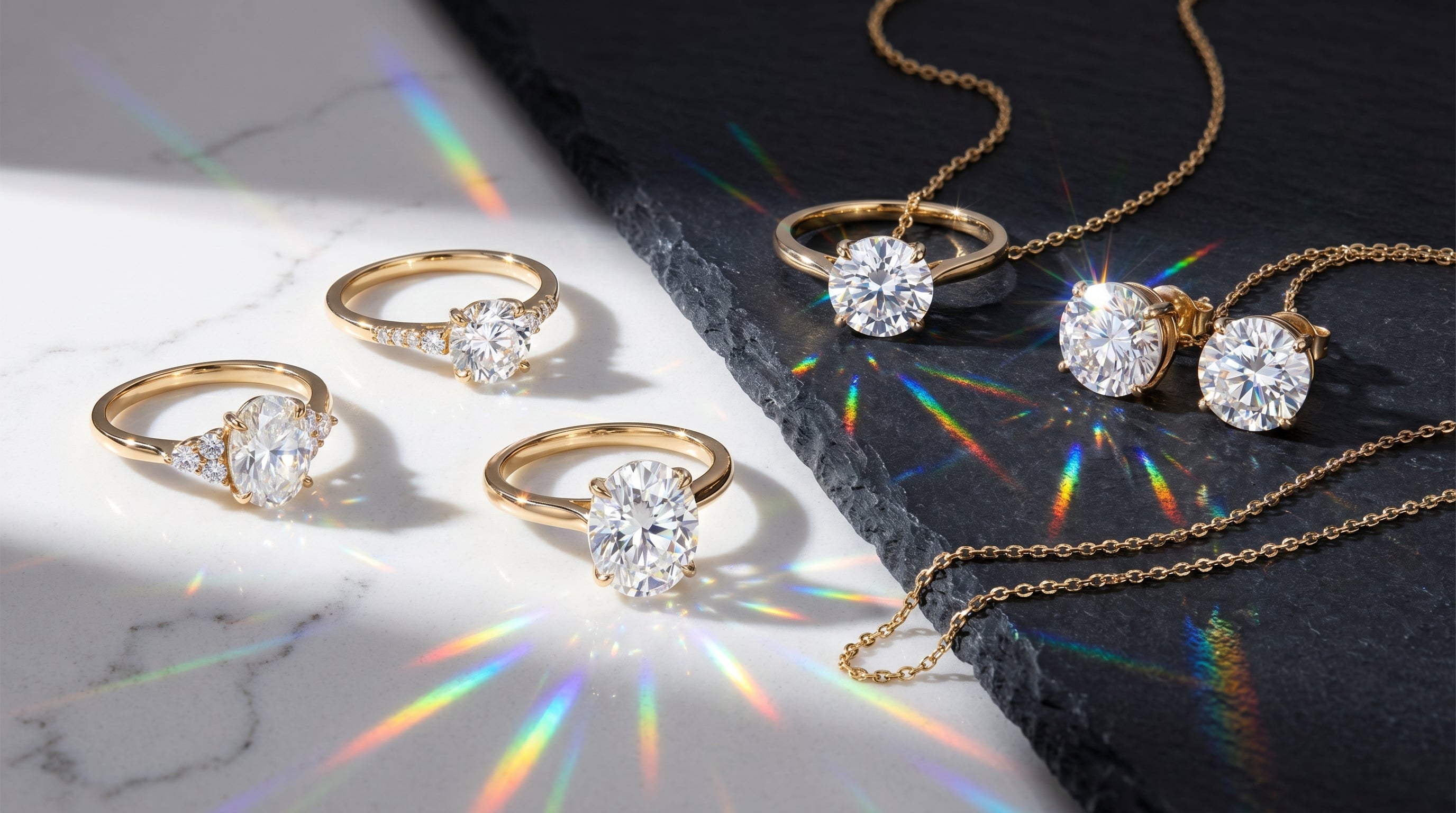
But here's where it gets interesting: moissanite's dispersion rating of 0.104 is 2.4 times higher than diamond's 0.044. Dispersion is what creates "fire" — those flashes of spectral color you see when the stone moves. Under direct sunlight or bright jewelry store lighting, a moissanite ring throws off dazzling rainbow flashes that a diamond simply can't match. Some people love this intense, prismatic sparkle. Others prefer the more subdued, white-light brilliance of a diamond. If you want to see the visual differences side by side, our detailed breakdown in Moissanite vs Diamond Side by Side: The Full 2026 Guide covers exactly that.
Durability is another major selling point. The Mohs scale measures scratch resistance — diamonds sit at a perfect 10, moissanite at 9.25. Rubies and sapphires score a 9. Emeralds sit around 7.5. Moissanite is tough enough to handle decades of hand-washing, accidental doorframe knocks, and daily life without scratching or chipping under normal wear. Every Awareness Avenue moissanite comes with GRA certification and a lifetime warranty guaranteeing its optical properties won't fade or cloud — ever.
Price Ranges and True Value in 2026
In 2026, high-quality 14k gold moissanite rings typically cost between $300 and $1,500, depending on diamond equivalent weight, cut complexity, and setting style. Moissanite delivers massive upfront savings compared to mined diamonds, though it carries less secondary resale value — making it an emotional investment rather than a financial one.
Let's talk numbers. A high-quality three-carat oval diamond engagement ring at a traditional jewelry store will run you anywhere from $15,000 to $40,000 for the center stone alone. That's a staggering financial burden for a couple just starting their lives together.
A flawless three-carat moissanite set in a beautifully crafted 14k gold setting? Typically between $800 and $2,850, depending on the brand and design complexity. Same finger coverage. A heavier, more luxurious gold setting. Arguably more sparkle. And tens of thousands of dollars kept in your account for a house down payment, a dream honeymoon, or your future.
When shopping, you'll frequently see moissanite measured in millimeters and DEW — Diamond Equivalent Weight. Because moissanite is about 10% lighter than diamond by volume, a 6.5mm round moissanite weighs slightly less than one carat on a scale, but looks exactly the same size as a one-carat diamond on the finger. DEW tells you precisely how large the stone will appear.
One thing to be clear-eyed about: moissanite's resale value is soft. Because it's so affordable to buy new, the secondary market typically returns only 20% to 40% of the original purchase price. As we explore in our Moissanite vs Lab Grown Diamond Price: The Full Breakdown, even natural diamonds lose a significant chunk of retail value the moment you leave the store. The real value of moissanite is the extraordinary upfront savings — and the fact that you get a more brilliant stone for a fraction of the cost.
How to Spot Quality and Avoid Common Mistakes
To ensure lasting brilliance, verify your moissanite's color grade and confirm reputable certification before purchasing. Avoid oversized stones that clash with your lifestyle, understand that white gold requires periodic rhodium re-plating, and never accept a GRA report without verifying the matching laser inscription on the stone's girdle.
The moissanite market has exploded, and with that growth comes a flood of lower-quality options. The first major mistake buyers make is ignoring the color grade. Just like diamonds, moissanite is graded on a color scale. For a crisp, icy look, you need a stone graded D, E, or F (Colorless). Stones graded G, H, or I (Near-Colorless) carry a slight warm tint — especially noticeable in larger sizes or when set in white gold. Buy without checking the grade and you risk being disappointed by a yellowish hue.
Another common trap is the temptation to oversize. Because moissanite is so affordable, it's easy to think, "Why not go four carats?" Large stones are breathtaking — but they also amplify the rainbow effect dramatically. In bright sunlight, a massive moissanite throws off intense, colorful fire that immediately reads as something other than a diamond. If a subtle, diamond-like appearance is your goal, stones under two carats are the smarter play. Larger stones also sit higher off the finger, making them more prone to snagging on fabric or knocking against hard surfaces.
Finally, be vigilant about certification. Many budget sellers offer "GRA Certificates" (Gemological Research Association) to make their stones appear official. The market is flooded with fake GRA reports. Always verify that the laser inscription on the girdle of the stone perfectly matches the number on the certificate. Reputable brands back their stones with clear, verifiable warranties — at Awareness Avenue, every piece ships with documentation you can trust.
Our Top 14k Gold Moissanite Ring Recommendations
We've spent years perfecting our craft at Awareness Avenue, helping over 250,000 customers find pieces that balance breathtaking aesthetics with structural integrity. Whether you're searching for 14k gold moissanite engagement rings, a matching yellow gold moissanite wedding set, or a couples ring that tells your story — these are the designs our customers fall in love with again and again. Every piece ships with secure checkout, 30-day returns, and our lifetime warranty.
The Luna - Rose Gold
There's something undeniably captivating about warm rose gold paired with the icy fire of moissanite. The Luna - Rose Gold is a masterclass in elegant restraint. The setting elevates the center stone, allowing light to enter from every angle and maximize that signature moissanite brilliance — refractive index 2.65, throwing rainbow fire with every movement. It's the perfect choice for someone who wants a ring that feels both vintage and entirely fresh.

The Liana 3ct Oval Cut
Oval cuts are dominating the bridal landscape in 2026, and it's easy to see why. The elongated shape flatters the finger, making it appear longer and more slender. The Liana features a breathtaking 3-carat oval cut moissanite that delivers massive finger coverage and jaw-dropping scintillation. Set in bright 14k white gold, this ring offers a sleek, modern aesthetic that commands attention the moment you walk into a room. The satisfying weight of the solid gold shank tells you immediately — this is fine jewelry.

The Curved Moissanite Couples Rings
Finding a wedding set that feels cohesive without being overly matched is harder than it sounds. The Curved Moissanite Couples Rings solve this beautifully. The gentle curve of the bands allows them to sit flush against a variety of engagement ring styles, while the embedded moissanite accents create a continuous ribbon of sparkle around the finger. Substantial. Comfortable for daily wear. Deeply symbolic of two lives curving together.

The Nova Elise
For the bride who wants classic elegance with a practical edge, The Nova Elise is an absolute standout. The setting is designed to sit low-profile on the finger — ideal for women who work with their hands or wear gloves daily. It sacrifices nothing in terms of brilliance. The solid gold shank carries a reassuring weight that tells you this ring was built to last a lifetime, not just a season.

Frequently Asked Questions
Got questions about moissanite jewelry? We've compiled the most common inquiries about durability, maintenance, and visual performance to help you make a confident, informed decision for your forever ring.
Does moissanite get cloudy over time?
No. High-quality moissanite will never internally cloud, fade, or change color over time. It's a non-porous, chemically stable gemstone — it doesn't absorb oils or moisture. If your ring starts to look dull or "milky," a layer of hand lotion, soap residue, or hard water minerals has built up on the surface. A quick clean restores its original, dazzling fire completely.
Can I pass a 14k gold moissanite ring off as a diamond?
To the untrained eye in normal indoor lighting, a well-cut moissanite under two carats looks virtually identical to a diamond. In bright sunlight, moissanite's higher dispersion (0.104 vs. diamond's 0.044) creates intense, colorful rainbow flashes that a diamond can't produce. A trained jeweler with a loupe will also spot the difference through moissanite's characteristic double refraction. We always recommend embracing moissanite for its own spectacular beauty rather than trying to pass it off as something else.
How do I clean my 14k gold moissanite ring?
Cleaning at home is straightforward. Fill a small bowl with warm water and a few drops of mild dish soap. Let the ring soak for 10 to 15 minutes to loosen any oils. Then use a soft-bristled baby toothbrush to gently scrub the stone — pay special attention to the underside of the setting where dirt accumulates. Rinse thoroughly under warm water and dry with a lint-free microfiber cloth. For more detailed care tips, check out our guide on How to Clean Moissanite Rings.
Will a 14k white gold moissanite ring tarnish?
Solid 14k white gold doesn't tarnish like silver, but it does require maintenance. White gold is naturally a pale, yellowish-gray color — jewelers plate it in rhodium to create that bright, mirror-like white finish. Over time, daily friction causes this thin rhodium layer to wear off, revealing the warmer gold tone underneath. A jeweler can re-dip the ring in rhodium every 12 to 18 months to keep it looking brand new.
Finding Your Perfect Forever Ring
You don't have to choose between the ring of your dreams and your financial future. A 14k gold moissanite ring gives you the luxurious weight of fine jewelry, the peace of mind that comes with ethical lab creation, and a level of brilliance — refractive index 2.65, dispersion 0.104 — that outperforms the most expensive mined diamonds on the market. It's a modern choice for a modern love story.
What does that mean in practice? It means you can wear a stunning, GRA-certified, solid gold ring every single day, backed by a lifetime warranty, knowing it was created without environmental destruction or ethical compromise. Over 250,000 customers have made that choice. The only question is which design speaks to you.
Ready to find it? Explore our full range of designs in our Engagement Rings Collection, browse our premium Solid Gold Pieces, discover matching sets in our Couples Ring Sets, or see what other couples are falling in love with in our Best Sellers. Your perfect forever ring is waiting.

Dejar un comentario
Este sitio está protegido por hCaptcha y se aplican la Política de privacidad de hCaptcha y los Términos del servicio.