
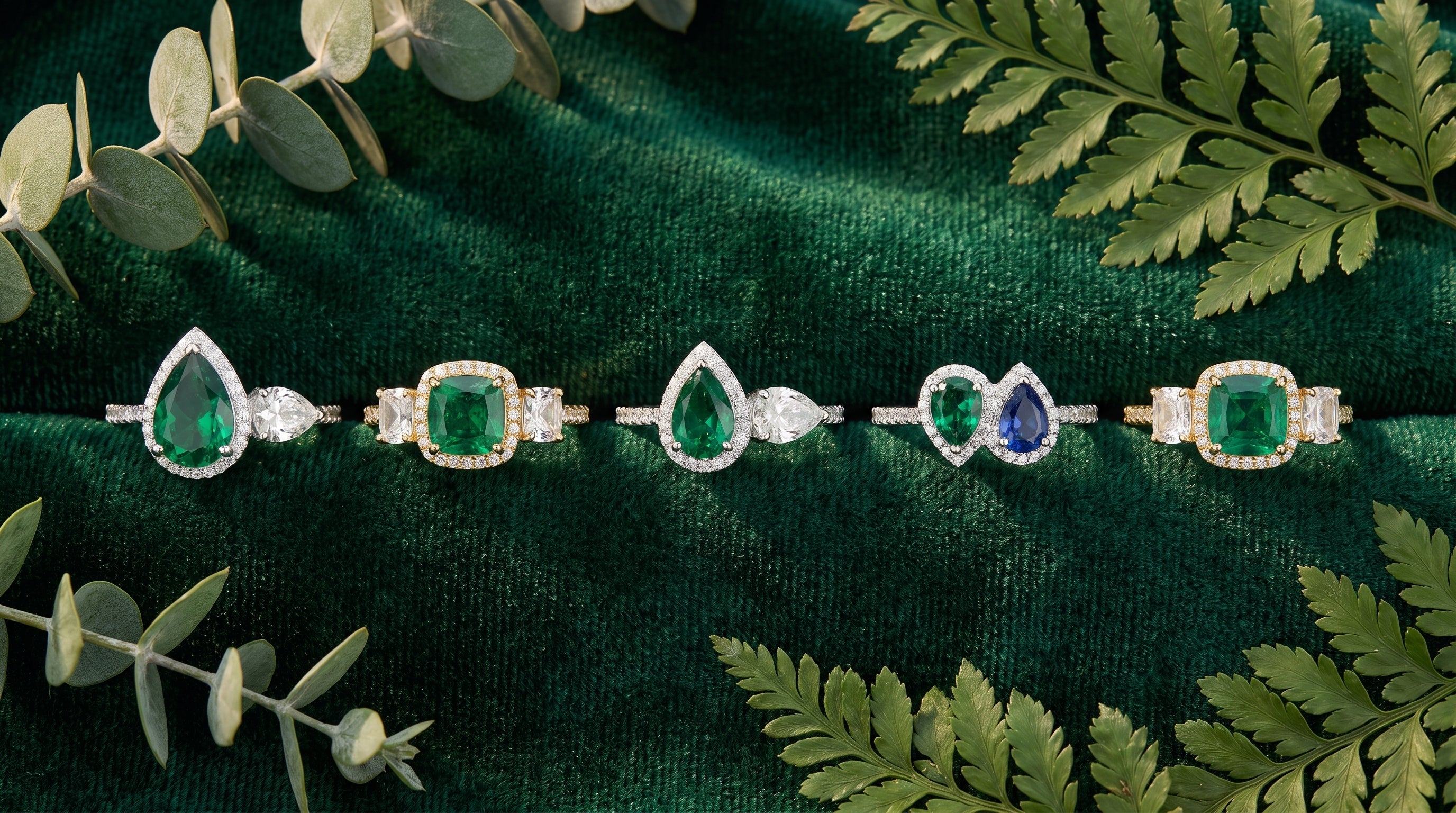
Two stones is the smallest number that tells a story. One stone is a piece of jewelry; two stones are a relationship — a couple, a parent and a child, two siblings, two best friends. That is why the phrase "birthstone ring, 2 stones" behaves so differently from a general gemstone search: shoppers already know the configuration they want before they know the metal, the setting, or even which stones their two birth months call for.
The problem is that most of what ranks for this search is a product page. You can see two stones on a band, a price, and a delivery window — but almost nothing about whether pairing a September sapphire with an October opal is a good idea, how a wide side-by-side setting will actually sit under a wedding band, or what happens to the sentiment if a third child arrives in two years. This guide fills those gaps, in the order the decisions actually arrive.
What a Two-Stone Birthstone Ring Actually Is (Three Distinct Designs)
"Two stones" describes a count, not a style. Once you start comparing listings, three clearly different design families emerge, and they signal very different things on the hand. Choosing the wrong family is the most common source of disappointment, because the ring may be beautifully made and still say the wrong thing.
The Toi et Moi duo
Toi et Moi is French for "you and me," and the style places two stones side by side on a single ring to symbolize two lives coming together. It is widely described as romantic and timeless, and it is frequently used for engagement rings. In birthstone form, each stone stands for one partner's birth month, so the ring reads as a two-person portrait rather than a solitaire.
Toi et Moi designs usually use the two largest stones of any two-stone layout, and they often mix cuts deliberately — an emerald cut beside a pear, for example — so each stone keeps its own identity. That asymmetry is the point. If you want the ring to announce its meaning, this is the archetype that does it loudest.
The mother-and-child pair
The second family uses a similar side-by-side or gently crossing layout but frames the relationship differently. Marketplace listings for two-stone rings sold under labels such as "Mother & Daughter" and personalized "forever besties" promise rings show how strongly this category is organized around the relationship rather than the aesthetic.
In many of these designs one stone is set slightly larger than the other — the larger for the parent, the smaller for the child — though proportions vary considerably between makers. Many also allow engraving of names or dates alongside the stones, which is where the piece stops being a color pairing and becomes a record.
The minimalist duo band
The third family treats the two stones as quiet color accents on a slim band rather than as the focal point. A representative example is a personalized duo birthstone ring described as two luminous simulated birthstones set on a refined gold band — understated, lightweight, and personal without being obvious to anyone who doesn't already know.
Minimalist duos typically use small, matched stones in the same size and cut, aligned horizontally, vertically, or diagonally across the band. They stack well with other rings and suit recipients who don't want a statement piece. They also tend to be the most affordable of the three, partly because they frequently use simulated stones.
How to choose between them: ask whether the ring should be read by others or only by the wearer. Romantic milestone gifts and engagement-adjacent pieces suit Toi et Moi. Family pieces meant to be worn every day, often alongside a wedding set, usually suit the mother-and-child pair or the minimalist duo, which sit lower and snag less.
Choosing the Two Stones: Months, Modern vs. Traditional, and Color Harmony
Two birth months rarely produce a perfectly coordinated palette, so this is where most buyers get stuck. The first thing to know is that there is more than one correct answer for several months.
You often have two legitimate options per month
Widely cited birthstone charts, including the reference chart maintained by the International Gem Society, list both modern and traditional stones by month: garnet for January, amethyst for February, aquamarine for March (modern), diamond for April, emerald for May, pearl for June, ruby for July, peridot and spinel for August (modern), sapphire for September, tourmaline for October (modern) with opal as the traditional stone, golden topaz and citrine for November (modern), and blue zircon, blue topaz, and tanzanite for December (modern).
This matters practically, not just academically. If a modern assignment produces a color clash or an impractically soft stone for a ring, the traditional assignment — or the alternate modern stone — is a legitimate substitute rather than a compromise. Emerald, for its part, is a member of the beryl family and is counted among the traditional "Big Four" gems alongside diamond, ruby, and sapphire, which is part of why May pieces often carry a different price character than neighboring months. For a fuller walkthrough of the modern-versus-traditional question across all twelve months, our birthstone ring buying guide is the deeper reference.
Three pairing strategies that reliably work
- Complementary contrast. Put a warm stone next to a cool one and let the difference do the work — a July ruby beside a September sapphire, or a November citrine beside a December blue topaz. This reads as intentional rather than accidental.
- Tonal harmony. Pair stones that sit near each other in hue, such as a March aquamarine with a December blue topaz, or a May emerald with an August peridot. Softer and more wearable, but the two stones can blur together at a glance, so choose slightly different cuts to keep them distinct.
- Anchor and accent. Give one stone visual weight and let the other read as a companion. This is the natural fit for parent-and-child rings and for cases where one month's stone is a colorless diamond (April) or a soft white pearl (June) that would otherwise disappear.
When both people share a birth month
Two identical stones can look like a mistake rather than a choice. Three workable solutions: use the modern stone for one and the traditional stone for the other where the month offers both (October's tourmaline and opal, for example); keep the same stone but change the cuts so the pair reads as deliberate; or keep the same stone and differentiate by size, using the anchor-and-accent approach. The one thing to avoid is two identical stones in identical cuts and sizes with nothing else to distinguish them.
Hardness, Setting, and Whether the Ring Can Survive Daily Wear
A ring takes more abuse than any other category of jewelry. It gets knocked against door frames, dunked in dishwater, and pressed into steering wheels. That is why hardness and daily-wear suitability deserve as much attention as color — and why they are almost entirely missing from the product pages competing for this search.
The two-stone hardness problem
A two-stone ring has a specific structural quirk: you are locking two different gem materials into one piece, and they may not be equally tough. Pair a durable September sapphire with a more delicate October opal and the ring's real-world care requirements are set by the more fragile of the two, not the average. Every time you wear it, wash in it, or store it, you are effectively caring for the weaker stone.
The practical consequences:
- Care to the softer stone. Avoid harsh chemicals, ultrasonic cleaning, and knocks based on the more sensitive of your two stones, not the sturdier one.
- Consider a protective setting for the vulnerable half. A bezel, which wraps metal around the stone's girdle, protects edges far better than a high open prong setting. Mixed settings — bezel for the softer stone, prongs for the harder one — are a reasonable and visually interesting solution.
- Match the setting height to the life. Low-profile settings snag less on clothing, car seats, and children's hair. If the recipient works with their hands, a low bezel duo will outlast a tall, open Toi et Moi.
- Be honest about "occasional wear" stones. Some birthstones are better suited to pendants and earrings than to rings. If a month's modern stone is one of them, either switch to the traditional or alternate stone, protect it in a bezel, or accept that the ring is a special-occasion piece.
None of this argues against softer birthstones. It argues for deciding, before you buy, whether this ring is a daily wedding-stack companion or a piece that comes out on birthdays and holidays. The two answers lead to genuinely different rings.
Natural, lab-created, or simulated?
This distinction is rarely explained on product pages, yet it drives price more than almost anything else. Some two-stone rings state plainly that they use simulated birthstones — stones that reproduce the look of the birthstone color without being the same material. Others use lab-created stones, which share the chemistry of their natural counterparts. Others use natural gems.
All three are legitimate; they simply answer different questions. Simulated stones make a color-symbolic ring affordable and consistent, which suits gift pieces and minimalist duos. Lab-created and natural stones carry more intrinsic value and, in the case of harder materials, better long-term wear. What you should not do is infer which one you're getting from price alone, or assume that a beautiful photograph implies a natural gem. Ask, or buy from a listing that says so explicitly.
Metals: What Silver, Vermeil, and Solid Gold Mean for a Two-Stone Ring
Metal choice decides three things at once: color harmony with your two stones, how the ring ages, and most of the price gap between otherwise similar designs.
The four options you will actually encounter
- Sterling silver (925). The most common base in personalized multi-stone rings. Widely used across affordable mother's ring ranges, and a genuine jewelry metal rather than a substitute. It will tarnish with exposure and needs periodic polishing, but tarnish is reversible.
- Gold vermeil. A thick layer of gold over a sterling silver core — one two-stone birthstone ring in this space is described as a thick layer of 14K gold over sterling silver, offered in vermeil or 10K solid gold. Vermeil gives gold color at a fraction of solid-gold cost with a more substantial gold layer than standard plating.
- Gold-plated base metal. A thin gold layer over a non-precious core. Cheapest, and the shortest-lived on a ring specifically, because rings abrade against everything.
- Solid gold. Some two-stone and multi-stone birthstone rings are offered in 10K, and three-stone family rings are commonly sold in 10K yellow, white, or rose gold. Solid gold does not wear through to a different color, which is the single strongest argument for it in a ring meant to be worn daily for decades.
Reading durability claims sensibly
Brands describe vermeil pieces with terms like tarnishproof and water-resistant. Treat those as the brand's own characterization of its specific construction, not as a property of vermeil in general — and remember that no plated or layered finish is permanently immune to abrasion on a ring. The honest framing is that a thicker gold layer buys you more years before wear shows, and that solid gold removes the question entirely.
Durability is not a minor concern to shoppers, either. For example, while a birthstone Kendra Scott piece is widely recognized, Trustpilot reviews for the brand include complaints about product quality and customer service, which is a useful reminder that sentimental jewelry gets judged harshly when it fails. If a two-stone ring is meant to mark a birth or an engagement, buying one tier up in metal is usually a better use of budget than buying larger stones.
Matching metal to your two stones
Warm stones — garnet, citrine, golden topaz, ruby, peridot — generally intensify against yellow gold. Cool stones — aquamarine, sapphire, blue topaz, tanzanite, amethyst — read crisper against silver or white gold. Rose gold flatters pinks, reds, and warm neutrals but can fight with cool greens and blues. When your two months pull in opposite directions, yellow gold is the safest mediator, and a neutral silver-tone metal is the second safest.
Personalization: Engraving, Arrangement, and the Decisions Worth Paying For
Two-stone rings sit in a heavily personalized category, and the options multiply quickly. Across this market you'll find rings built to order with a selectable stone count, rings that pair each stone with an engraved child's name, and asymmetric family designs customizable with several birthstones. Marketplace listings for dual birthstone rings routinely combine custom stones with engraved names, dates, or short phrases.
Here is how to prioritize when the budget is finite:
- Stone identity first. Getting the two months right — and choosing wearable versions of them — matters more than anything else. This is the part that cannot be redone.
- Metal second. As above, metal determines how the ring ages. A modest ring in a durable metal beats an ambitious ring in a thin plating.
- Arrangement third. Side-by-side, crossing, stacked vertically, or offset in size: this decides whether the ring reads as romantic, parental, or purely decorative.
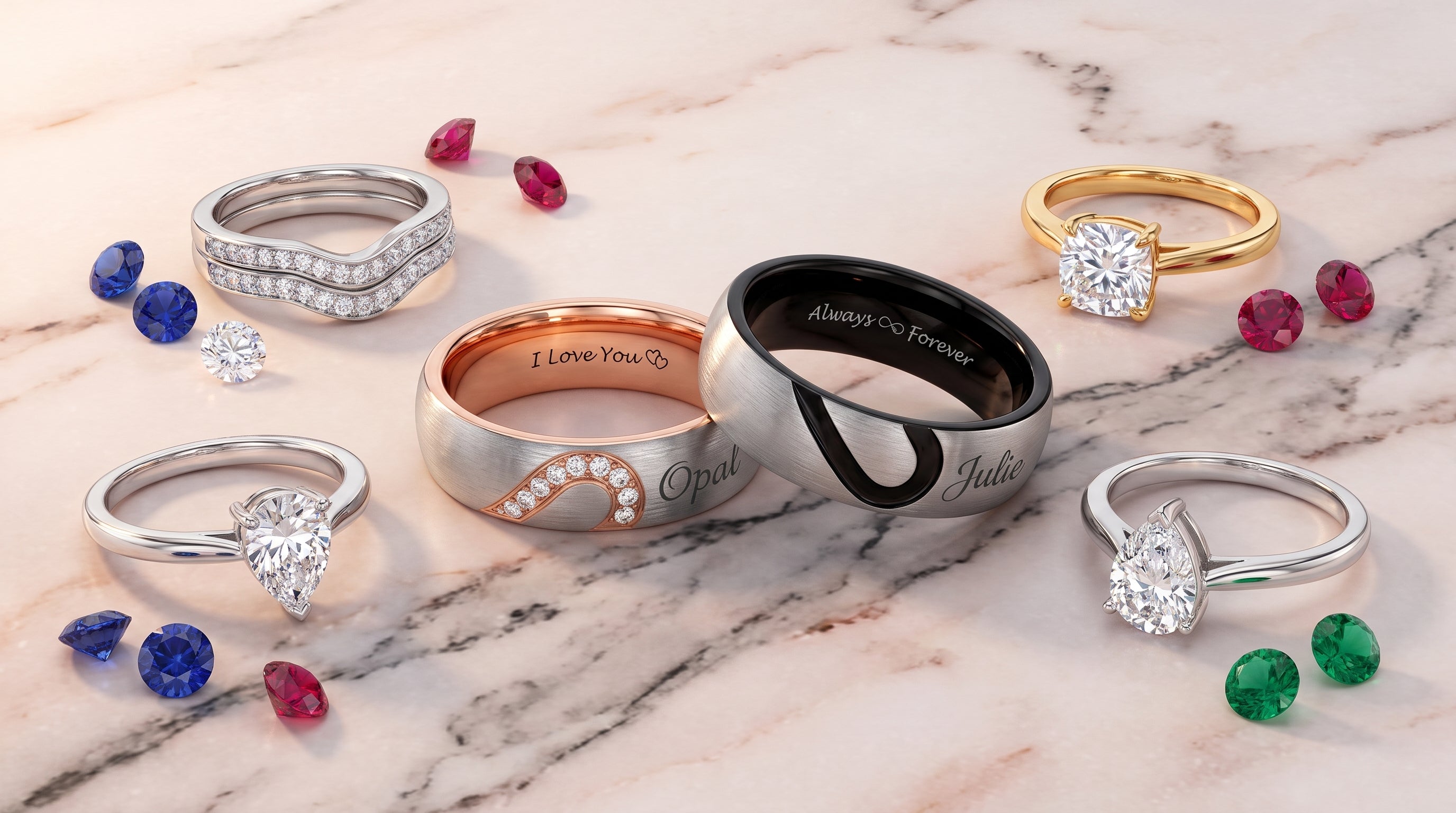
- Engraving fourth. Names, initials, or a date on the inner band adds meaning at low cost and no visual risk. Outer-surface engraving on a two-stone ring can crowd the design, since the stones already occupy the visual center.
- Extras last. Font choices and added accent stones are nice, not decisive.
One caution on engraving length: inner-band space on a slim duo ring is limited, and multi-stone settings consume some of the band's interior real estate. Two short names or a single date usually fits comfortably; a full sentence often does not.
Fit, Sizing, and Wearing a Two-Stone Ring With Other Rings
A two-stone ring occupies more finger width than a solitaire of comparable carat weight, because the stones sit beside each other rather than in a single center. Two sizable stones set side by side, as in a Toi et Moi layout, can feel notably wider than a plain band, which affects comfort on smaller hands and shorter fingers.
Points to work through before ordering:
- Band width and stone spread. Look for the total width across both stones, not just the band width. A wide spread can press against adjacent fingers.
- Orientation. Stones set along the finger (north-to-south) elongate the hand and interfere less with neighboring fingers than stones set across it.
- Stacking plans. If the ring will sit against a wedding band or another birthstone ring, low settings and flat profiles line up cleanly. Tall or angled settings create gaps and pressure points.
- Sizing accuracy. Multi-stone rings are harder to resize than plain bands, because settings sit close to the shank. Get the size right the first time — ideally professionally measured, or with a reliable at-home method taken at the end of the day when fingers are largest.
- Which hand and finger. A dominant-hand ring takes more knocks. If your stone pairing includes anything delicate, favor the non-dominant hand.
When Two Stones Aren't Enough: Planning for Three, Five, or Six
This is the objection that stops many buyers mid-checkout: what if the family grows? It is a reasonable worry, and the market has already answered it in three different ways.
Scale up within one ring
Many multi-stone rings are sold as ranges rather than fixed counts — two to four stones, two to six stones — and specialist family jewelers advertise configurations from one stone up to twelve, effectively meaning almost any family size can be accommodated. A three birthstone ring is the most common step up, typically read as three children in family contexts or as past, present, and future in romantic ones; a representative triple birthstone ring uses three roughly 3 mm stones on a delicate solid 925 sterling silver band with sterling, 18K gold, and rose gold finishes.
The trade-off as counts rise: either stone size shrinks or band width grows. For larger families, a mothers ring 5 stones or a mothers ring 6 stones design often relies on smaller gems so the band remains comfortable. If you are specifically looking for birthstone rings for mom 3 stones, our dedicated guide to a birthstone ring 3 stones covers the proportions and layout choices at the next tier up.
Build a stack instead
The second answer is to distribute stones across multiple rings. Some six-birthstone designs are sold as stacks, pairing one ring carrying the six stones with a companion band for a name or phrase, which solves the legibility problem that comes with cramming many stones onto a single narrow band. Three-stone family rings are also frequently marketed as stackable for exactly this reason.
Stacking is the most future-proof route for a two-stone buyer. Choose a slim, low-profile duo now, and a matching band can join it later without replacing the original piece — which preserves the sentiment attached to the first ring.
Or keep the two stones meaningful and add elsewhere
The third answer is to stop treating the ring as a family census. A two-stone ring that specifically commemorates a couple, or a mother and her firstborn, does not become incomplete when a third person joins the family — it simply means something more specific. Additional birth months can then live on a different piece entirely, which is often more comfortable to wear than a crowded six-stone band. If you go this route, a two-stone jewelry overview is a useful comparison of how the same pairing plays out across rings, necklaces, and bracelets.
Ring vs. Necklace vs. Bracelet for the Same Two Birth Months
A ring is not always the right format, and this is a question almost no ring product page will raise with you. Large lifestyle brands present birthstone jewelry as a broad giftable category spanning necklaces, bracelets, and earrings across all twelve months and several metal finishes — evidence that the same sentiment travels comfortably across formats.
Choose a ring when the recipient wants the piece visible to themselves throughout the day, when the design carries relationship meaning that benefits from being on the hand (engagements especially), and when sizing is known.
Choose a necklace when the recipient works with their hands, has a job or hobby that bars rings, when you don't know their ring size, or when the two birthstones include something you'd rather not expose to daily impact. For example, a kendra scott birthstone necklace might be a safer home for softer stones because pendants take dramatically less abuse than rings. Our three-stone birthstone necklace guide covers how multi-stone layouts translate to pendants.
Choose a bracelet when you want room to add stones over time without redesigning anything, since charm and station styles expand naturally. A two-stone bracelet—or an alternative like a kendra scott 2 birthstone bracelet—is often the most forgiving format for growing families for exactly this reason.
Alternative Birthstone Expressions
If you prefer not to combine multiple gems into a single setting, another approach is to wear a single-stone fashion ring that complements your birthstone colors. Pieces like The Marcella Pear Ring - S925 Sterling Silver or the Valerine Cushion Ring - 18K Gold Vermeil offer elegant solitaire designs. While these are not customizable two-stone birthstone rings, they serve as beautiful style-complementary pieces that can be worn alongside other meaningful jewelry.
A Practical Checklist Before You Order
- Confirm both birth months and both stone options. Note whether you're using the modern or traditional stone for each, and whether either month offers an alternate you prefer.
- Decide the design family. Toi et Moi, mother-and-child proportions, or matched minimalist duo.
- Test the color pairing. Complementary, tonal, or anchor-and-accent — and check it against your intended metal color.
- Identify the softer stone and set care expectations to it. Then decide whether it needs a bezel or a protective setting.
- Choose the metal for the ring's real life. Daily wear pushes toward solid gold or a substantial vermeil layer; occasional wear widens the field.
- Verify what the stones are. Natural, lab-created, or simulated — stated explicitly, not inferred.
- Check total width across both stones and how the profile will sit against any ring it stacks with.
- Get the size professionally, since multi-stone bands resize less easily than plain ones.
- Plan the engraving to fit, favoring the inner band and keeping it short.
- Decide your growth plan now: upgrade the ring later, add a stacking band, or keep the two stones specific and add a separate piece.
Frequently Asked Questions
Can a two-stone birthstone ring work as an engagement ring?
Yes — the Toi et Moi style, with two stones side by side symbolizing two lives coming together, is often used for engagement rings. If you choose it for that purpose, prioritize a durable stone pairing and a metal that will hold up to decades of daily wear, and check how the profile sits against a future wedding band before committing.
What if one of the two birthstones is too soft for a ring?
You have four options: substitute the month's traditional or alternate stone, protect the softer stone in a bezel setting, accept the ring as an occasional-wear piece, or move the pairing to a necklace where impact risk is far lower.
Is a two-stone ring or a three-stone ring better for a mom of two?
Two stones is the exact match if the stones represent two children. Some mothers prefer three so their own birth month joins their children's — a legitimate and common choice, and one reason three-stone family rings are so widely offered. Decide whose months belong on the ring before you decide the count.
Are simulated birthstones acceptable for a sentimental ring?
They are widely used in duo birthstone rings and deliver consistent color at accessible prices, which suits gift pieces. If long-term intrinsic value or maximum scratch resistance matters to you, lab-created or natural stones in harder materials are the better fit. The important thing is knowing which you're buying.
How do I choose stone sizes for a parent-and-child ring?
Slightly unequal sizing reads as intentional and reinforces the relationship; proportions vary by maker, so look at photographs on a hand rather than at millimeter specs alone. If you'd rather avoid hierarchy, matched sizes with different cuts keep the two stones distinct without ranking them.
Where to Look Next
If you're still deciding between stone counts and formats, start with the foundations and work outward. The birthstone ring buying guide covers the modern-versus-traditional question, hardness, and gold-versus-silver in more depth than any single-configuration page can. From there, browse the birthstone jewelry collection to see how specific months translate into finished pieces, and the fine jewelry collection if solid metals and heirloom construction are your priority.
The single most useful thing you can do before ordering is to write down the two birth months, the two stones you've chosen for them, and one sentence describing where and how often the ring will be worn. Almost every remaining decision — setting height, metal, stone size, engraving length — follows from those three facts.

Dejar un comentario
Este sitio está protegido por hCaptcha y se aplican la Política de privacidad de hCaptcha y los Términos del servicio.