
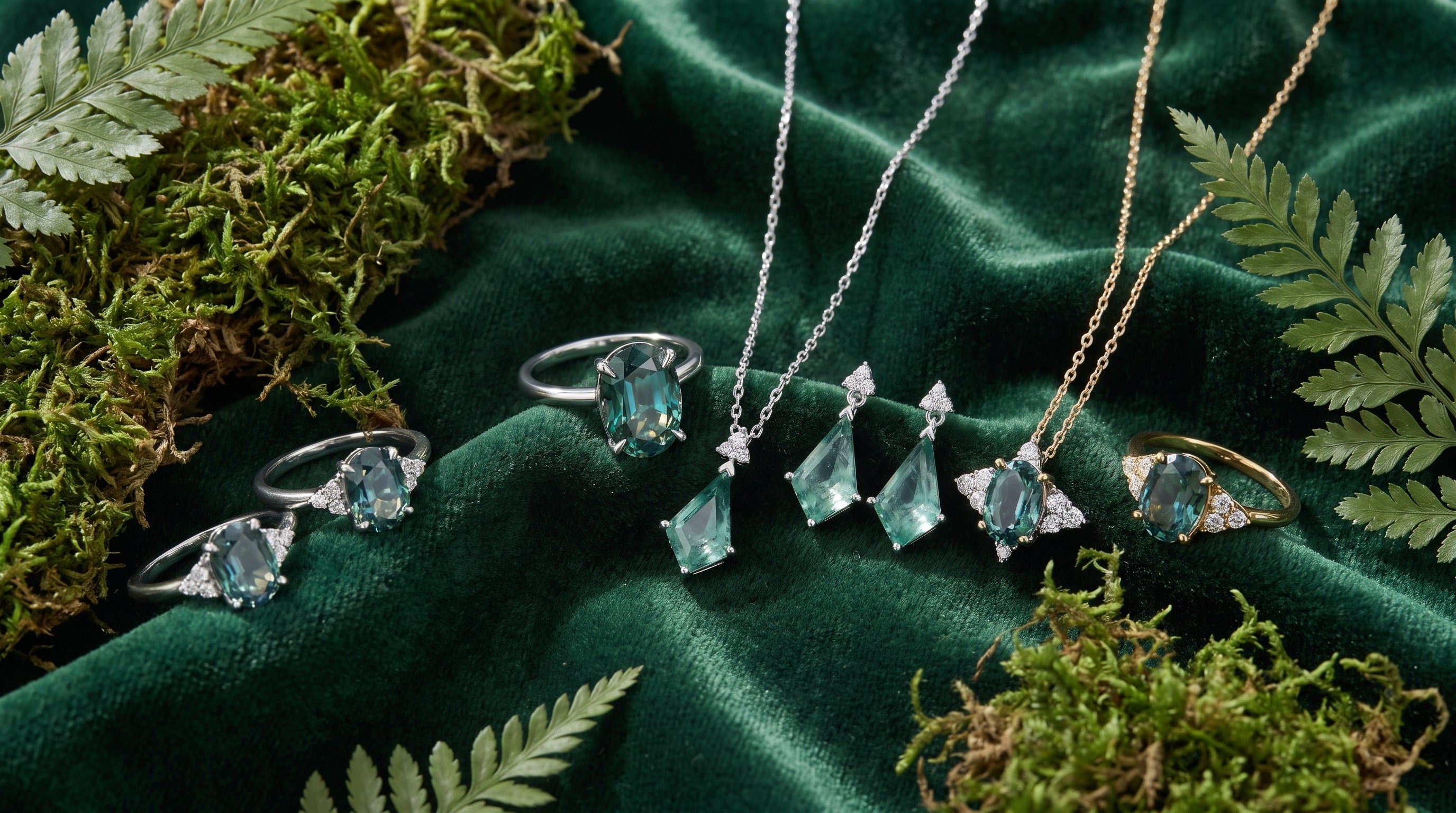
Here is the detail that decides whether a flat back earring set will actually work on your ears: the post. Flat back studs commonly run at an 18 gauge post, which is thicker than the 20 gauge posts typical of traditional butterfly-back earrings, according to Bodymod's guide to flat back earrings. That single specification is why a "set" of flat backs is a hardware decision before it is a styling decision. If you buy four beautiful tops that are the wrong gauge for your piercings or the wrong post length for your lobe thickness, you own four earrings you cannot comfortably wear at once.
The second thing worth knowing before you shop: genuine multi-piece flat back sets are harder to find than the search term suggests. Most flat back retail pages — Grayling, Maison Miru, ComfyEarrings, Studs, Estella Collection, CordsClub, Musemond, Get Pierced Co — are collections of individual pieces you assemble yourself, and even editorial coverage such as Reader's Digest's test of 20 pairs of flat-back earrings evaluates single pairs rather than curated stacks. So the practical skill this guide teaches is set-building: choosing pieces that share a mechanism, a metal, and a sizing logic so they behave like a set even when they weren't sold as one.
What a flat back earring set really is
A flat back earring is a stud whose backing is a smooth, flat disc that sits flush against the skin instead of a protruding post-and-clutch. In professional piercing language it is usually called a labret stud: a flat disc at one end, a decorative top at the other. Bodymod and Studs both frame the category by direct contrast with butterfly backs, noting that the flat disc removes the sharp post that otherwise sticks out behind the ear and catches on hair, clothing, and pillows.
That geometry is why flat backs became the default for cartilage. Kosiner Jewelry's comparison of flat back versus regular earrings notes that industry standards cited by the Association of Professional Piercers favor flat back posts for cartilage placements, and brand collections from Maison Miru, Studs, and Get Pierced Co are built around helix, conch, and tragus wear. But the same sources are clear that lobes benefit too: Kosiner states plainly that lobes can absolutely use flat backs and that many people prefer them for daily comfort, while ComfyEarrings and Studs position their flat backs as pieces you can sleep in and wear continuously.
Why "set" thinking matters more here than with regular studs
With butterfly backs, mixing brands is trivial — the clutch is nearly universal. With flat backs, the top and the post are a matched system. A push-pin top from one brand will not necessarily seat in another brand's hollow post, and a threaded top will not fit an unthreaded one at all. Building a set therefore means committing to one mechanism family, then varying only the decorative top and the post length. Do that and you gain something a mixed drawer never gives you: interchangeable tops across placements, and spares that actually fit.
Push-pin vs threaded: the two mechanisms you're choosing between
Bodymod distinguishes two main flat back types. In a push-pin design, the decorative top has a pre-bent pin and the flat disc carries a hollow post; you pass the post through from the back of the piercing so it emerges at the front, then push the pre-bent pin into the hollow post until the friction created by the bend holds it. In a threaded design, the top carries a small screw thread and the post is internally threaded, so the top is inserted and rotated until it tightens. Studio Cult's demonstration of internally threaded studs shows the same principle: the front screws into the back.
Living with each mechanism
Push-pin systems are fast — no rotating, no cross-threading — and Studs' instructions cover the whole routine: push the post through from behind, insert the pre-bent top, press both ends firmly together, then perform a gentle tug test to confirm it is secure. Studs also gives the two pieces of advice most new wearers learn the hard way: don't do the insertion over a sink, and if a stud feels loose, the top may need to be re-bent slightly to restore the friction that holds it.
Threaded systems trade speed for a mechanical lock, but they add a rotation step that some people find fiddly on a placement they cannot see, such as a conch or an industrial-adjacent helix. Neither mechanism is universally "more secure" in any measured sense — the sources describe security as a design intention, not a tested failure rate — so pick the one you can operate confidently with one hand and a mirror. Then buy your whole set in that family.
Materials: what the metal claims actually mean
Three materials dominate flat back offerings, and each occupies a distinct position.
Implant-grade titanium
Titanium is the material most consistently recommended for sensitive ears. Grayling's collections describe implant-grade F136 titanium as naturally hypoallergenic, 100% nickel-free, lightweight, and durable, and note it is commonly used in body jewelry and medical applications. Maison Miru's cartilage and flat back collection uses medical-grade titanium (ASTM F136) and markets it as hypoallergenic, nickel-free, and safe for new and healing piercings. Get Pierced Co sells its flat back titanium studs as piercer-grade and piercer-approved. Bodymod's educational guide reaches the same conclusion, calling titanium the best option for sensitive ears.
Worth stating plainly: these are brand and industry positions, not clinical guarantees. ASTM F136 is a recognized material standard for implant-grade titanium alloy; none of the available sources present peer-reviewed allergy data, so treat "hypoallergenic" as a strong material argument rather than a promise that no one will ever react.
Surgical stainless steel
Steel is the workhorse of the mass-market and children's segments. Pierced Co describes its earrings as surgical grade stainless steel with 18k gold plating, marketed as waterproof, hypoallergenic, and free of nickel, lead, and copper, with earrings designed to be played in, slept in, and lived in. An Amazon listing for LOLIAS flat back earrings similarly specifies stainless steel construction with a surgical steel metal type, a screw-back finding, and cubic zirconia stones — a reminder that marketplace listings compete on spec sheets: material, back type, design format, gem type.
Solid 14k gold
Gold is the long-horizon choice. Estella Collection's flat back studs and cartilage earrings are described as solid 14k yellow, rose, and white gold, hypoallergenic and comfortable, with heirloom framing; Musemond's solid gold flat back earrings and labret studs are positioned as minimal, luxury additions to an ear stack. Bodymod places gold as the option for people who want the finer side of the category. If you plan to leave a piece in for months and want it to still look like itself, solid gold behaves differently from plating — plating is a surface layer, and the underlying alloy is what your skin contacts once it wears.
A practical rule for mixed sets
If you have a known nickel sensitivity or a piercing that is new or still settling, build the set in titanium and treat gold as the upgrade you add later to healed placements. If everything is long healed and you want the set to read as fine jewelry, solid 14k gold is the coherent choice — the same logic we apply in our guide to 14k gold jewelry sets. Mixing metals across an ear is a style decision; mixing mechanisms is a mistake.
Sizing: gauge and post length by placement
This is where most flat back purchases go wrong, and where most product pages go quiet.
Gauge
Bodymod notes that flat backs generally use thicker 18 gauge posts versus 20 gauge for traditional butterfly posts, and that a lower gauge number means a thicker post. The implication is direct: if your piercings were done or maintained at 20 gauge, an 18 gauge flat back may not pass through comfortably, and forcing it is not the answer. Know your gauge before you build a multi-piece set, because the whole set inherits that number.
Post length
Bodymod lists common flat back post lengths of 6, 8, and 10 mm, with shorter posts suited to thinner areas such as the conch and helix and longer posts for thicker parts such as the lobe. Kosiner Jewelry gets more granular: 5 mm as the shortest standard length for thin earlobes without swelling, 6.5 mm as the common everyday length for average lobe thickness or healed cartilage, and 8 mm for thicker lobes, fresh piercings with swelling, or deeper cartilage placements. Kosiner's placement table also gives working ranges such as roughly 5–6.5 mm for standard healed lobes and 6–8 mm for helix piercings.
Two caveats both sources emphasize: these are general ranges, not prescriptions, and anatomy varies enough that Bodymod recommends consulting a professional piercer to confirm the right length for your ear. A post that is too long leaves the disc sitting proud and the top rocking; too short and it presses. If you are buying a set for lobes specifically, our dedicated guide to flat back earrings for lobes goes deeper on that placement.
Three set formulas that work
Because the market sells pieces rather than packages, here are three assemblies to build from any single-brand collection.
1. The comfort-first lobe set
Two to four pieces, all one mechanism, all in the same metal, in the length your lobes call for — Kosiner's 5–6.5 mm band for standard healed lobes is the starting point. Choose small stone or plain metal tops in the 2–3 mm range; CordsClub's flat back range spans roughly 2 mm through 5 mm studs, which shows how quickly a stud reads as a statement past about 4 mm. This is the set for anyone who sleeps on their side, wears earrings continuously, or has had recurring irritation from butterfly backs — precisely the group Kosiner identifies as getting the clearest comfort upgrade.
2. The lobe-plus-helix stack
Here you deliberately buy two post lengths: your lobe length and a shorter cartilage length, since Bodymod puts helix and conch in the thinner, shorter-post category and Kosiner's helix range runs roughly 6–8 mm depending on the ear. Keep the metal constant and let size do the work: a slightly larger anchor stone in the first lobe, a smaller companion in the second, a minimal top in the helix. Because the tops are interchangeable within one mechanism family, you can rotate them without re-learning insertion each time.
3. The all-cartilage set
For helix, conch, tragus and similar placements, titanium is the material the sources converge on — Maison Miru markets ASTM F136 titanium as safe for new and healing piercings, and Get Pierced Co builds its flat back studs around piercer-grade titanium. Build this set with your piercer's measured lengths, expect to size down once swelling settles on any newer placement, and keep the designs low-profile so nothing catches during sleep.
A pre-purchase checklist for any flat back set
Before you add a set to your cart, confirm the listing states all five of the following. If it states fewer than four, you are guessing.
- Backing type in writing — "flat back," "flatback," or "labret," not just a photo that looks flush.
- Mechanism — push-pin or threaded, so you know whether tops from that brand will interchange.
- Material and grade — for example implant-grade F136 titanium, surgical stainless steel, or solid 14k gold, and whether gold is solid or plated.
- Gauge — 18 gauge is typical for flat backs; confirm it matches your piercings.
- Post length options — a set sold in one length only is a set for one placement only.
Editorial testing supports the underlying priorities: Reader's Digest tested 20 pairs and evaluated comfort, security, price, and aesthetics, naming PAVOI studs a budget favorite and singling out Maison Miru among its preferred brands. Guarantees can also form part of value — Pierced Co, for instance, advertises a sensitive-free policy offering a refund if its earrings irritate the wearer's ears. Whether that matters to you depends on how much sensitivity history you're managing.
Where Awareness Avenue's coordinated sets fit
An honest note, because this is a hardware-specific category: our coordinated earring and jewelry sets are curated for matched design across pieces, not marketed here as flat back or labret hardware. We are not going to tell you a set uses flat back posts unless its product page says so — check the specifications on each listing for backing style, and read this article as the framework you use to evaluate any set, ours included.
If you're shopping coordinated looks rather than piercing-specific hardware, The Celeste Earring Set and The Celestial Trio Earrings are multi-piece earring groupings, while The Aurora Jewelry Set is offered in S925 sterling silver and a solid gold version. The Ornella Jewelry Set and The Crimson Koi Earrings round out the coordinated pieces, and you can browse everything in earrings or the wider jewelry sets collection. For stone-led earring inspiration, our aquamarine earrings guide covers design selection in more depth.
Wearing and caring for a flat back set
Cleaning
Bodymod's maintenance guidance is straightforward: soak flat back earrings in warm water with mild soap, avoid harsh chemicals that could damage the metal or irritate skin, use a soft-bristled brush for stubborn residue, pat dry with a clean soft cloth, and store the pieces in a dry place away from direct sunlight. The same guide notes that while some wearers report leaving flat backs in for months without issues, periodic removal for cleaning — it suggests roughly every couple of weeks — is still sensible.
Continuous wear
Continuous wear is the category's core promise. Studs describes its flat back studs as comfortable enough to sleep in and durable for everyday wear; Grayling markets its implant-grade titanium as suitable for wearing day and night through showering and sweating without irritation or tarnishing. Treat those as design intentions rather than clinical assurances, and keep the cleaning routine anyway.
If something feels wrong
A loose push-pin usually means lost friction — Studs' fix is to re-bend the top slightly, then re-seat and tug test. Persistent redness, soreness, or discharge is not a jewelry-styling problem; it is a reason to stop, remove nothing on your own if the piercing is new, and speak to your piercer or a clinician. None of the available sources provide medical guidance on irritation or infection, and no metal claim substitutes for professional advice on a piercing that isn't behaving.
The short version
Choose a mechanism you can operate confidently, commit to one metal for the whole set — titanium if sensitivity or healing is in play, solid 14k gold if everything is long healed and you want the set to last visually — confirm your gauge, and buy the post length each placement actually needs rather than one length for all of them. Do that, and a flat back "set" stops being a marketing phrase and becomes what it should be: a small, interchangeable system that disappears against the back of your ear.

Dejar un comentario
Este sitio está protegido por hCaptcha y se aplican la Política de privacidad de hCaptcha y los Términos del servicio.