
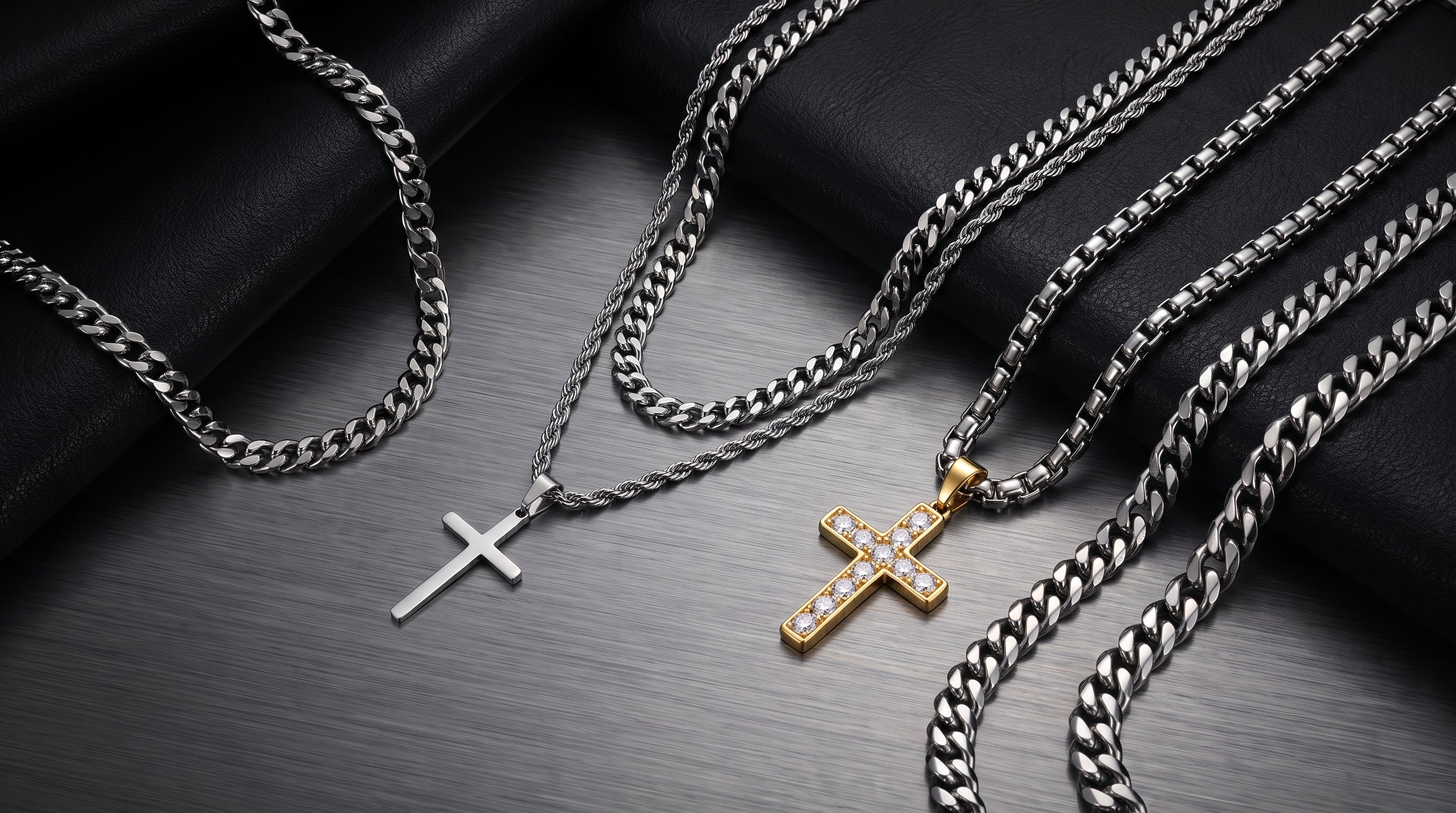
Almost every question about men's necklace styles collapses into three variables that get talked about as if they were one thing: the link (what the chain is made of, structurally), the fit (length and width, measured against your own frame), and the metal (karat gold, sterling silver, or steel). Get those three right and style takes care of itself. Get them muddled — a 12 mm Cuban at 18 inches on a slim frame, or a soft high-karat chain worn to the gym — and no amount of styling advice fixes it.
This guide separates the two things most articles blend together: the parts that are genuinely factual (link geometry, karat percentages, alloy composition, standard lengths) and the parts that are stylistic convention (what "looks right" with a crew neck, how many chains is too many). Both matter. Only one of them is fixed.
The Four Families of Men's Necklace Styles
Style guides written by jewelers and menswear publishers converge on the same taxonomy: chain necklaces, pendant necklaces, beaded necklaces, and layered combinations. Everything else is a variation.
- Chains are the structural foundation — defined by link shape, link size and how the links articulate.
- Pendants are chains carrying a single ornament, which is where personal meaning enters the equation.
- Beaded necklaces sit outside the metal category entirely, associated with bohemian and surf-influenced dressing.
- Layered looks combine two or more pieces at deliberately different lengths.
The useful insight here is that these families are not equally represented in the market. Sampling men's jewelry retailers shows catalogs heavily weighted toward metal chains and pendants, with comparatively thin beaded selections — so if beads are what you want, expect to shop specialists rather than mainstream chain retailers.
Chain Styles, Link by Link
The names on product pages describe geometry, not marketing mood. Knowing what each link actually does tells you how the chain will wear, drape and hold a pendant.
Curb chain
Curb is the style jewelers most often name as the single most popular men's chain. Its links are uniform and twisted so they lie flat against the skin rather than rolling. That flat lay is why curb reads as tidy and versatile enough for both a T-shirt and a collared shirt, and why it appears across gold, silver and steel catalogs at almost every width.
Cuban link
A Cuban chain is a close relative of curb: similar interlocking structure, but typically thicker and more rounded, with more visual mass per inch. It is consistently described as the bold, statement-oriented option with streetwear associations. Because a Cuban chain carries its own weight visually, it usually works best worn alone rather than buried in a layered stack. In steel, Awareness Avenue's Foundation Cuban sits in this category.
Figaro chain
Figaro follows a repeating pattern — typically three standard links followed by one elongated link — which gives the chain a rhythm along its length instead of uniform texture. It reads slightly more decorative than curb without becoming loud, which is why it turns up often in classic, dressier recommendations.
Rope chain
Rope chains use twisted, intertwined links that mimic the texture of actual rope, catching light along the twist. They range from delicate to substantial, with twisted-rope constructions built for more strength. Rope is one of the few textures that stays interesting at narrow widths, which makes a 4 mm rope — like the Golden Rope Chain 4mm in gold-tone stainless steel — a reasonable everyday choice for someone who finds flat chains too plain. If gold rope specifically is what you're after, our guide to gold rope chains for men goes deeper on construction and weight.
Belcher (rolo) chain
Belcher, also sold as rolo, is built from uniform, often rounded links. Jewelers describe it as sturdy and masculine without excess flash — a sensible pick when you want daily durability more than shine.
Box, Franco and wheat chains
Box chains use square links; Franco chains use closely engineered, tightly interlocking links that produce a smooth, dense surface; wheat chains present a similarly structured, textured line. All three are valued for a smooth profile and for holding pendants well, which is why they appear so frequently in gold chain inventories as pendant carriers. Awareness Avenue's Wheat Chain and Originator Chain are stainless steel options in this everyday-wear chain category. For a broader look at link families, see our guide to men's chain link necklaces.
Pendant Necklaces and What They Communicate
A pendant necklace is simply a chain or cord carrying a single ornament that rests near the breastbone. Menswear writers are consistent on one practical rule: the pendant should be small enough to sit comfortably against the chest, and it is normally worn outside a T-shirt but tucked beneath a shirt with a turn-down collar. Deep V-necks expose short-cord pendants more fully, which changes how prominent the piece reads.
Common pendant types
- Cross pendants — carry religious or spiritual meaning and are treated as a classic, timeless men's option. Awareness Avenue offers cross designs including The Devotion Cross in stainless steel and the Divine Cross Pendant in gold-tone stainless steel.
- Dog tags — military-derived, rugged, often tied to identity or personal history.
- Medallions — historical or artistic motifs, sometimes engraved.
- Minimalist pendants — bars, circles and simple geometry that stay quiet under a shirt.
Pendant and chain choice interact. A textured rope or curb chain suits an ornate pendant; a smooth box or Franco chain lets a detailed pendant do the talking without competing. If you're weighing pendant styles specifically in precious metal, our guide to men's necklace pendants in gold covers that decision in detail.
Fit: Length and Width Are the Real Decisions
More men get fit wrong than get style wrong. Length determines where the chain lands; width determines how much it announces itself.
Standard lengths and where they sit
Jeweler length guides agree closely:
- 16–18 inches — sits at the base of the neck; a close, minimalist choker-adjacent look.
- 20 inches — the most commonly cited men's size; rests near or just at the collarbone and reads polished enough for formal dressing.
- 22 inches — falls just below the collarbone, more visible, highly adaptable for smart-casual outfits.
- 24 inches — lands around mid-chest; more prominent, pairs naturally with casual clothing.
- 27–30 inches — relaxed, statement territory, often used for larger pendants or deliberately loose layering.
Pendant necklaces are generally recommended in the 20–22 inch range so the pendant sits on the chest without fighting a collar. Because torso length and neck circumference vary, the reliable method is to measure: wrap a soft tape or a length of string around your neck where you want the chain to sit, add a little slack for comfort, then compare against standard sizes. If you're adding a pendant, jewelers commonly suggest a few extra inches so it doesn't ride too high.
Length by build
These are proportion conventions, not physiology — useful starting points rather than rules:
- Taller or broad-shouldered: 24–27 inches keeps proportion and leaves room for layering.
- Shorter or slim: 20–22 inches, with narrower widths around 2–3 mm to avoid overwhelming the frame.
- Muscular or athletic: 22–24 inches with a bit more weight, roughly 3–5 mm, so the chain neither pulls tight nor disappears.
- Larger neck or fuller build: start at 24 inches, move to 27 for better drape and comfort.
Width categories
Width guides from chain retailers break down consistently:
- 1–3 mm (thin): minimalist; ideal for layering and small pendants.
- 4–6 mm (medium): the balance point — present but not dominant, workable casually or in business settings.
- 7 mm and up (thick): deliberately bold; the jewelry becomes a focal point.
Across jeweler guidance, 2–4 mm is repeatedly named as the most popular general range for men's necklaces, with 2–6 mm covering most of what gold chain retailers stock. Thin chains are the safe default for daily wear and pendant pairing; wide chains are usually worn alone.
Metals: Gold Karats, Silver and Steel Compared
Material is where the style conversation turns technical — and where a lot of shopping mistakes happen.
How gold karats actually work
Karat is a fraction of 24. Divide the karat by 24 and multiply by 100 to get gold content: 12K is 50% gold, 14K is roughly 58.3% gold with about 41.7% other metals (copper, nickel, palladium, silver or zinc), and 18K is exactly 75% gold. Jewelers list the full range as 9ct (37.5%), 14ct (58.33%), 18ct (75%), 22ct (91.66%) and 24ct (99.99%).
The trade-off is consistent: the higher the karat, the more gold and the softer the metal. 14K is widely described as the better choice for daily-wear chains because it resists scratching better and costs less than higher karats while still reading clearly as gold. 18K contains more gold and fewer alloying metals, which makes it richer in color and generally gentler on sensitive skin, but softer and more vulnerable to damage — better suited to occasional wear. Our 14K gold chain buying guide works through that comparison in more depth.
What to know about 24K
Pure 24K gold is soft enough that jewelers openly call it impractical for chains meant to be worn regularly; 22ct or 18ct is the usual recommendation when purity is the priority. If you see a chain marketed at 24K, verify whether it is solid gold or gold plated over a base metal before assuming precious-metal value. Metal stamps and hallmarks are the only reliable confirmation.
Sterling silver
"Silver chain" almost always means sterling silver: 92.5% pure silver with 7.5% copper. The copper isn't there to cut cost — pure silver is too soft and bends or dents easily. Sterling holds up well mechanically, but it tarnishes: exposure to sulfur in air, sweat and skincare products darkens the surface over time unless it's cleaned and stored properly. Gold's advantage is color stability, since it doesn't tarnish. Neither metal is universally "better" — gold wins on long-term appearance, sterling wins on upfront cost and versatility, and both can last decades if they're solid rather than hollow and reasonably maintained. If you're leaning silver-toned, our guide to silver men's chain necklaces covers the style options.
Construction: solid, hollow and plated
Independent of metal, construction changes durability more than most buyers expect. Hollow chains cost less but are more prone to denting and breaking. Plated chains can lose their plating over time, exposing the base metal underneath and requiring replating to restore color. Solid chains are the most durable and the most expensive. Ask which one you're buying.
Skin sensitivity
Nickel is the usual culprit in jewelry reactions, and sensitivity is common — accessory guides citing dermatology data put nickel sensitivity above 18% of North Americans. Lower-purity gold alloys and unlabeled "silver-tone" base metals tend to contain more nickel; higher-karat gold and genuine sterling silver contain less. If you react to jewelry, the practical move is to ask for the specific alloy composition of any piece before buying, whatever the metal.
Where stainless steel fits
Stainless steel is not a precious metal, and its role in men's necklace styles is aesthetic and functional rather than about metal value. Steel chains reproduce the look of silver and gold tones through polishing and finishing at a lower cost, and steel is generally valued for mechanical strength in daily wear. Awareness Avenue's chains and cross pendants — including the Cuban, wheat, rope and link styles referenced above, plus the gold-tone Devotion Cross — are stainless steel or gold-tone stainless steel, not solid karat gold or sterling silver. If your priority is verified karat purity, hallmarking or precious-metal resale, that's a different purchase, and it should be made from marked, assayed gold.
Styling: Neckline, Occasion and Restraint
The strongest recurring theme in men's style writing is that a necklace should complement an outfit rather than lead it. The common warning is against costume-style pieces — big, chunky, jewel-covered designs — in favor of jewelry that looks natural and lived-in, as though it has been worn for years. Bolder pieces read better with casual clothing; subtler ones suit formal and business contexts, where metal chains are often worn mostly under the shirt with only a little showing.
Matching necklines
Necklines matter more than most men realize. A V-neck or open shirt creates a sharp downward corner, and a pendant chain should hang low enough to work with that shape rather than crowd it. Crew necks sit close to the neck with a simple rounded boundary, which makes them the easiest base for necklaces — a plain black crew neck in particular functions as a blank stage. Heavily patterned or graphic tops compete with chains and are usually the wrong backdrop, especially for layers.
Style identities
Broadly, thin simple chains and small pendants align with minimalist and modern dressing; bold curb and Cuban chains sit with edgier, street-influenced looks; thin rope or Figaro chains and restrained pendants read classic; beaded and mixed layered pieces lean bohemian. None of these are prescriptive — they're conventions you can use or deliberately break.
Layering Without Looking Cluttered
Layering is its own style family, and the rules are practical rather than aesthetic dogma:
- Pick one centerpiece. Choose the piece that should draw the eye, then surround it with lighter, thinner supporting chains rather than competing statements.
- Vary length deliberately. Multiple chains at the same length tangle and read as visual noise. A common recommendation is roughly 2–4 inches of separation between layers, especially when mixing a heavy chain with a pendant necklace.
- Vary texture, not just length. A flat curb next to a twisted rope creates contrast that identical chains can't.
- Match metal tones. Layers look intentional when the supporting chains match the dominant tone of the centerpiece, and when watches, rings and buckles follow the same tone. Mixing metals can work, but it needs to look chosen.
- Skip additional statement pieces. Layering is already the statement; adding a bold pendant on top of a bold stack usually tips into clutter.
Some designs handle the length variation for you. The Men's Double Layer Cross Pendant Charm Necklace is built as a double-layer design — a thicker choker-length chain paired with a slimmer, longer chain carrying a cross pendant — which is essentially the centerpiece-plus-support principle pre-assembled. Coordinated stainless steel chain sets such as the Origin Link Set and The Originator Set serve a similar purpose for men who'd rather not build a stack piece by piece, and the wider men's jewelry range shows how the chain and pendant styles above pair together.
Care: Keeping a Necklace Looking New
Maintenance advice from jewelers is refreshingly boring and consistent:
- Clean with lukewarm water and mild soap, using a soft brush to reach between links where oils and grime collect.
- Store necklaces separately — soft pouches or a sectioned jewelry box — to prevent tangling and surface scratching.
- Keep pieces in a dry place when not worn; humidity and sulfur exposure accelerate tarnish on silver.
- Have valuable pieces checked and cleaned by a jeweler periodically, particularly clasps and pendant bails, which fail before the chain does.
Sterling silver benefits from regular polishing to hold color. Gold generally holds its color without tarnishing but still collects oils. Plated finishes of any kind wear at friction points first — the back of the neck and the clasp — so avoid abrasives on them entirely.
A Short Decision Framework
If you want the whole guide compressed into a sequence:
- Decide chain or pendant. A chain alone is the more versatile starting point; a pendant is the more personal one.
- Pick the link. Curb or box for versatility, Cuban for presence, rope or Figaro for texture, belcher for durability, box/Franco/wheat if a pendant is going on it.
- Set the length by measuring. 20–22 inches covers most men and most pendants; go longer for taller or broader frames and for statement wear.
- Set the width by build and intent. 2–4 mm for everyday and layering, 4–6 mm for balanced presence, 7 mm+ only when the chain is the point.
- Choose the metal by wear pattern, not just looks. 14K gold for hard daily wear, 18K for purity and color with more care, sterling silver for cooler tone with tarnish upkeep, stainless steel for durable everyday styling without precious-metal claims.
- Confirm construction. Solid, hollow or plated — and, for gold, check the stamp.
Common Questions
What is the most popular men's chain style?
Curb is the style most often identified as the most popular men's chain, largely because its twisted, flat-lying links suit both casual and formal contexts and scale across widths.
What length necklace should most men buy first?
20 inches is the most commonly cited men's size, sitting at or near the collarbone; 20–22 inches is the usual recommendation for pendant necklaces. Measure your neck and add comfort slack rather than assuming.
Is 14K or 18K better for a men's gold chain?
For everyday wear, 14K is generally recommended because it's harder and more scratch-resistant at roughly 58.3% gold. 18K, at 75% gold, offers richer color and fewer alloying metals but is softer and more easily damaged — a better fit for occasional wear.
Can you wear a gold chain and a silver chain together?
You can, but layers look most deliberate when supporting chains match the tone of the centerpiece and when other accessories follow the same metal. Mixed metals need to look like a decision, not an accident.
Do gold-tone stainless steel chains count as gold chains?
No. Gold-tone finishes reproduce the color of gold on a base metal; they are not solid karat gold and shouldn't be evaluated on purity, hallmarking or precious-metal value. Judge them on style, construction and finish instead.
,%20the%20fit%20(lengt...)
Dejar un comentario
Este sitio está protegido por hCaptcha y se aplican la Política de privacidad de hCaptcha y los Términos del servicio.