
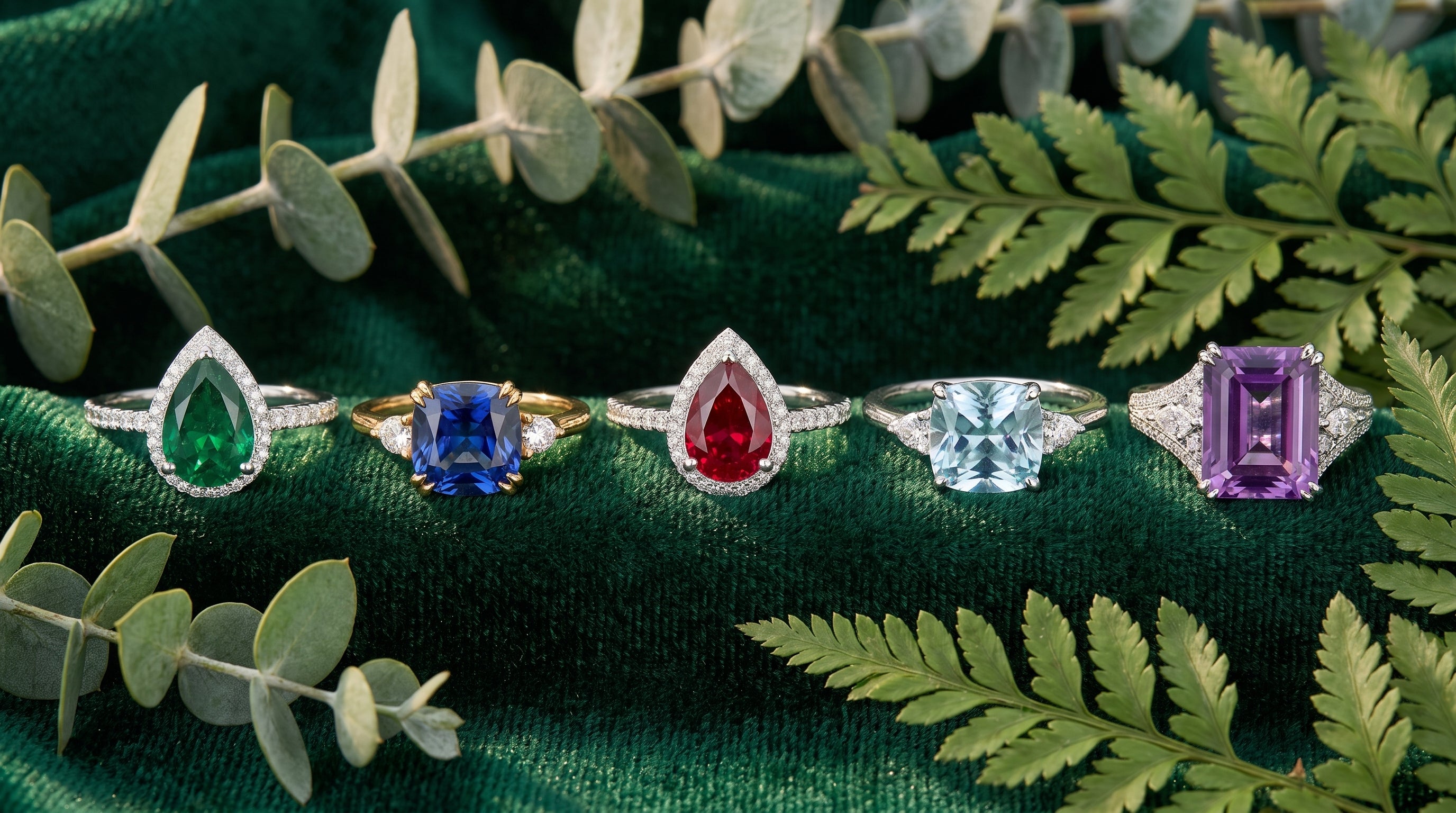
Almost every difficult decision in birthstone ring shopping is really an arithmetic problem wearing a romantic disguise. A shopper types birthstone jewelry ring into a search bar, but what they actually need to resolve is how many people the ring has to represent, whether those people are partners or children, and how many stones a band can hold before it stops being wearable at the school pickup line. That is why the same product category splits into such specific searches: two stones for couples, three stones for a mom with three kids, four stones for a family that grew. This guide is organized the way that decision actually unfolds — stone count first, then metal, then stone type, then sourcing and care.
Start With the Math, Not the Metal
Across the customizable ring market, stone count carries a fairly consistent unwritten meaning. Getting this right prevents the most common gifting misfire: buying a two-stone ring for a mother of three, or a four-stone family ring for a couple celebrating an anniversary.
Where the mothers ring tradition comes from
Mothers rings are not a generic ring blank with a modern marketing label attached. According to MothersFamilyRings.com’s guide to mother's jewelry, the format is a category with real history — created specifically so a mother could carry a visible, wearable record of each child she raised, distinct from ordinary fashion rings from the start. That origin is what still gives the two-, three-, and four-stone formats their emotional weight today, and it is why many shoppers searching for birthstone rings for mothers want the piece labeled and framed as a mother's ring rather than as generic multi-stone jewelry.
What two stones usually signals
Two-stone designs do double duty. Retailers who market them to couples frame the pair as one birthstone per partner, often paired with optional engraving of initials or a date. Retailers who market the same architecture to mothers frame the two stones as two children or two significant family members. The design can be identical; the story is what changes. If you are buying for a couple, choose stones that sit well together visually — a deep garnet next to a pale aquamarine reads as intentional contrast, while two similarly saturated blues can read as a manufacturing error unless the setting separates them.
What three and four stones usually signal
Once you cross into three and four stones, the symbolism tilts heavily toward motherhood and family. This is also where the search birthstone rings for mothers most often lands, since three- and four-stone formats are built specifically for that role. Three-stone rings are typically read as three children, or as a parent-plus-two arrangement. Four-stone mothers rings exist as a distinct product category with dedicated collections at family-ring specialists, and many mainstream jewelers name their four-stone designs explicitly as family rings. If a mother has more children than the ring has settings, she will notice, and so will the children.
When the count outgrows the band
Some customizable settings accept anywhere from one to five stones, but comfort degrades as the row lengthens. A long line of stones across the top of a finger catches on fabric, sits awkwardly next to a wedding band, and increases the number of prongs that need periodic checking. Beyond four or five stones, most shoppers are better served by switching format entirely — to a stacking set, a pendant, or a wider band with smaller stones. Our guide to the birthstone ring 3 stones format walks through the specific proportions that keep a multi-stone row comfortable.
8 Birthstone Ring Formats, Ranked by the Job They Do
Rather than ranking brands, this list ranks formats — because the format is what determines whether the ring gets worn daily or lives in a drawer.
1. The two-stone couples ring
Two birthstones, one per partner, usually set side by side or in a slight bypass. This is the format most often marketed for anniversaries, and engraving is nearly always offered as an add-on. It works best when the two months produce colors that either harmonize (amethyst and garnet) or contrast cleanly (peridot and topaz). Buy it when the occasion is the relationship itself rather than a family milestone. For color-pairing logic and setting styles, see our guide to birthstone rings for couples.
2. The two-stone mothers ring
Structurally the same as above, emotionally different. Personalized jewelers commonly let buyers add two birthstones to represent two children or two family members and then choose the metal separately, so the same setting appears in sterling silver and in gold. This is the classic birthstone ring 2 stones configuration shoppers search for when they know they want two settings but have not yet decided on stone or metal. For those seeking birthstone rings for mom 2 stones, it is also the natural first purchase for a parent who expects the family to grow — you can add a matching second ring later rather than replacing the first. Our two-stone birthstone ring guide covers how to pair months that clash.
3. The three-stone mothers ring
Three stones is the sweet spot for balance: it fills the top of the band without extending past the finger's width. When shopping for birthstone rings for mom 3 stones, multi-stone designs at this count are frequently offered in gold vermeil as well as solid gold, which is how the same silhouette lands at very different quality tiers. Look closely at whether the center stone is raised above the two flanking stones; a level row is easier to wear under gloves and next to other rings.
4. The four-stone mothers or family ring
Four-stone mothers rings are a category unto themselves, with specialist vendors offering custom-designed four-stone settings in metals ranging from sterling silver to palladium, and established jewelers naming four-stone family rings as flagship designs. Shoppers who search mothers ring 4 stones or birthstone ring 4 stones are almost always outfitting one setting per child across four kids, so stone size discipline matters most here: four 3mm stones read as a deliberate band, while four 5mm stones read as a cocktail ring and will rotate on the finger unless the shank is weighted.
5. The crossover or curved multi-stone family ring
Instead of a straight row, crossover designs run stones along curved rows that overlap. Mainstream customizable versions of this style commonly support up to three different birthstones, filling the remaining settings with accent stones. The advantage is visual movement; the trade-off is that a curved design has more surface area and more prongs than a simple row, which means more places for lotion and soap film to collect.
6. The stacking set: one stone per ring
If you want one stone per person but dislike crowded bands, buy several slim single-stone rings and wear them together. Stacking solves three problems at once: you can add a ring when a child is born, you can wear fewer on days when a full stack is impractical, and each ring keeps its own clean silhouette. Slim, low-profile designs such as The Iridiana Stack Opal Ring are built for exactly this kind of layering, and opal is the traditional October stone.
7. The single-stone solitaire
The most under-considered option in the birthstone category. A solitaire says one thing clearly: this month, this person. It is the right choice for a milestone birthday, a first Mother's Day with one child, or a self-purchase tied to your own birth month. Pieces like The Grand Duchess Amethyst Ring (amethyst is the February stone) and The Majesty Oval Opal Ring work this way, while The Valerise Ring in S925 sterling silver is an emerald design, the gem traditionally tied to May. It is important to note that Awareness Avenue rings are single-stone pieces, not multi-stone mothers or couples rings — choose them for simpler designs or when you prefer to represent one birth month per ring, rather than when you need to represent several people at once. Browse the full birthstone jewelry collection if you want to shop by month rather than by format.

8. The engraved anniversary ring with names
A hybrid format: birthstones supply the color, engraving supplies the specificity. Names, initials, or a date engraved on the band or the inside of the shank turn a generic two-stone ring into a dated record of a relationship. Interior engraving is the more conservative choice because it never wears against other jewelry; exterior engraving is more visible but shallows over years of contact with harder surfaces.
Metal Choice: Sterling Silver, Gold Vermeil, and Solid Gold
Metal determines how the ring ages far more than the stones do. Three tiers dominate the birthstone ring market.
Sterling silver
Sterling silver is an alloy formulated specifically for jewelry, harder than pure silver and durable enough to last a lifetime with maintenance. It is also the most affordable of the three tiers and is generally described as hypoallergenic. The honest trade-offs: it tarnishes, and it scratches. Neither is a defect — tarnish is a surface reaction that polishing reverses, and fine scratches are what a well-worn silver band looks like after a few years. Choose sterling if you want the lowest entry cost and do not mind occasional polishing. Many multi-stone mothers rings, including four-stone designs, are offered in sterling as the base metal.
Gold vermeil
Gold vermeil is a thick layer of gold over a sterling silver base. Compared with standard gold plating, the thicker gold layer makes it more durable and more tarnish-resistant, and it delivers a genuine gold appearance at a fraction of solid-gold cost. The unavoidable caveat is that the gold layer is a layer: friction and exposure wear it down over time, eventually revealing the silver beneath. Gentle wear, removal before abrasive tasks, and careful storage extend its life. Vermeil is the right pick when you want warm gold color on a multi-stone design that would be prohibitively expensive in solid gold — styles like The Valerine Cushion Ring in 18K gold vermeil and The Azurina Cushion Ring sit in this tier.
Solid gold and other precious metals
Solid 10k and 14k gold appear across the birthstone category, from handcrafted four-stone keepsake rings on slim 2mm bands to 14k collections offered in yellow, rose, and white finishes. Some specialist family-ring makers also work in palladium. Solid metal has no layer to wear through, which makes it the sensible choice for a ring intended to be worn every day for decades and eventually handed down. If a heirloom is the goal, see the solid gold collection rather than a plated equivalent.

Stones: Natural, Lab-Created, and the Hardness Question
Natural versus lab-created
Both appear routinely in birthstone rings. Natural stones are the more expensive option and are the ones most often described in terms of traditional or spiritual significance. Lab-created stones are the cost-effective option and allow larger or better-matched stones within the same budget — which matters a great deal when you need four stones to look like a coordinated set rather than four separate purchases. Neither choice is inherently more meaningful; the symbolism lives in the month, not the growth method. What does matter is disclosure: a seller should tell you plainly which you are buying.
Hardness and daily wear
Birthstones vary enormously in hardness, and hardness is the single best predictor of whether a ring survives daily wear. Harder stones resist the surface scratching that dulls a gem's polish; softer stones — opal being the classic example — need a protective setting, a lower profile, and more thoughtful wear habits. Read hardness honestly rather than optimistically: if the ring is going on the hand that does dishes, gardening, and gym work, favor a harder stone, a bezel or half-bezel setting, and a low crown. Reputable buyer's guides for birthstone rings explain month-to-stone mapping alongside hardness for exactly this reason.
Accent stones and what they mean
Multi-stone family rings frequently include accent stones — commonly lab-created white sapphires — to fill settings when a customer selects fewer birthstone types than the design accommodates. This is a design decision, not a downgrade, but it is worth understanding before you order: if you choose two birthstones for a three-stone crossover setting, the third position may be filled with an accent rather than left empty.
Sourcing Questions Worth Asking Before You Buy
Ethical sourcing in gemstones goes well beyond avoiding conflict minerals. Guidance in this area frames it as the whole journey from mine to market meeting standards of fairness, sustainability, and transparency — which is only verifiable if someone can actually document that journey. Practical questions to put to any jeweler, including ones you already trust:
- Where was this stone mined, and can you tell me how it reached you?
- Is the stone natural or lab-created, and have any treatments been applied?
- Do you hold certification from bodies such as the Responsible Jewellery Council or Fairtrade Gold, and does it apply to this piece?
- Is there an independent gemstone report from a laboratory such as GIA, Gübelin, SSEF, or GIT, covering origin, treatment, weight, and dimensions?
The recognized red flags are missing paperwork, a refusal to disclose origin, and prices that are implausibly low for the claimed material. A stone marketed as ethical without any sourcing information behind it is an unsupported claim, not a credential. Two legitimate alternatives if full traceability is unavailable: lab-grown stones and recycled metals, both of which sidestep certain mining impacts entirely. Expect ethically sourced material to cost more, because fair wages and environmental controls are real line items.
Care That Actually Extends the Life of the Ring
Multi-stone rings need slightly more care than plain bands, simply because there are more prongs and more crevices. The routine that keeps a birthstone ring looking new is unglamorous and effective:
- Clean periodically with mild soap and a soft brush, then dry thoroughly — soap film in the settings is what makes stones look cloudy.
- Store the ring separately rather than loose in a dish with other jewelry, so harder pieces do not scratch softer stones or plated surfaces.
- Remove it for manual work and before swimming.
- With gold vermeil in particular, minimize friction and chemical exposure; the thickness of the gold layer is what you are protecting.
- Have prongs checked periodically on multi-stone designs, especially after a knock.
Handled this way, both the stones and the metal keep their finish for years. What no seller can honestly promise is that any specific ring will never tarnish or last forever — those outcomes depend on metal type, stone hardness, and how the wearer lives.
Match the Format to the Person: A Quick Decision Path
If you are still deciding, work through these in order:
- Count the people. Two partners means a two-stone couples ring. Two, three, or four children means the corresponding mothers ring. Five or more means a stacking set or a different format entirely.
- Check the colors together. Look at the actual months side by side before ordering. Two dark stones or two pale stones next to each other need a setting that separates them.
- Pick the metal by lifestyle and horizon. Sterling silver for accessible everyday wear with occasional polishing; gold vermeil for gold color at a lower cost with gentler wear habits; solid gold for a piece meant to be handed down.
- Screen for hardness. Soft stones want protective settings and lower profiles.
- Ask the sourcing questions before you check out, not after.
- Decide on engraving early — most personalized settings will not accept it after production.
If the recipient is a mother and you want format-by-format help specific to her, our guide to birthstone jewelry for mom covers necklaces and bracelets alongside rings, which is useful when a ring is not the right answer.
Frequently Asked Questions
Can a two-stone ring work as both a couples ring and a mothers ring?
Yes. The architecture is identical; only the story attached to the stones changes. If you want the piece to read unambiguously as one or the other, engraving is what does the work — a wedding date reads as a couples ring, children's initials read as a mothers ring.
Should I use my own birthstone or the recipient's?
For a gift, the recipient's stones are the convention: a mothers ring holds her children's months, a couples ring holds both partners'. A self-purchase is the case where your own month is the obvious choice.
Is a lab-created birthstone still "my" birthstone?
The birthstone tradition assigns a gem species to a month, and lab-created material is the same species. Practically, lab-created stones make matched multi-stone sets far more attainable. The only requirement is that the seller identifies the stone accurately.
What if the family grows after I buy a three-stone ring?
This is the strongest argument for stacking. A set of slim single-stone rings expands indefinitely; a fixed three-stone setting does not. If a multi-stone ring is non-negotiable, ask before purchase whether the setting can be reworked later, and treat any answer as specific to that jeweler.
Which format is best for someone who works with their hands?
A low-profile single-stone or two-stone design in a harder gem, with a bezel or protective setting, and in a solid metal if the budget allows. Long multi-stone rows and raised crowns take the most abuse. For everyday options across price points, the under-$100 selection and the broader fine jewelry range both include low-profile settings.
The right birthstone jewelry ring is rarely the prettiest one on the page — it is the one whose stone count matches the family, whose metal matches the wearer's routine, and whose stone is hard enough for the life it is about to live. Solve those three in order and the aesthetics tend to take care of themselves.

Dejar un comentario
Este sitio está protegido por hCaptcha y se aplican la Política de privacidad de hCaptcha y los Términos del servicio.