


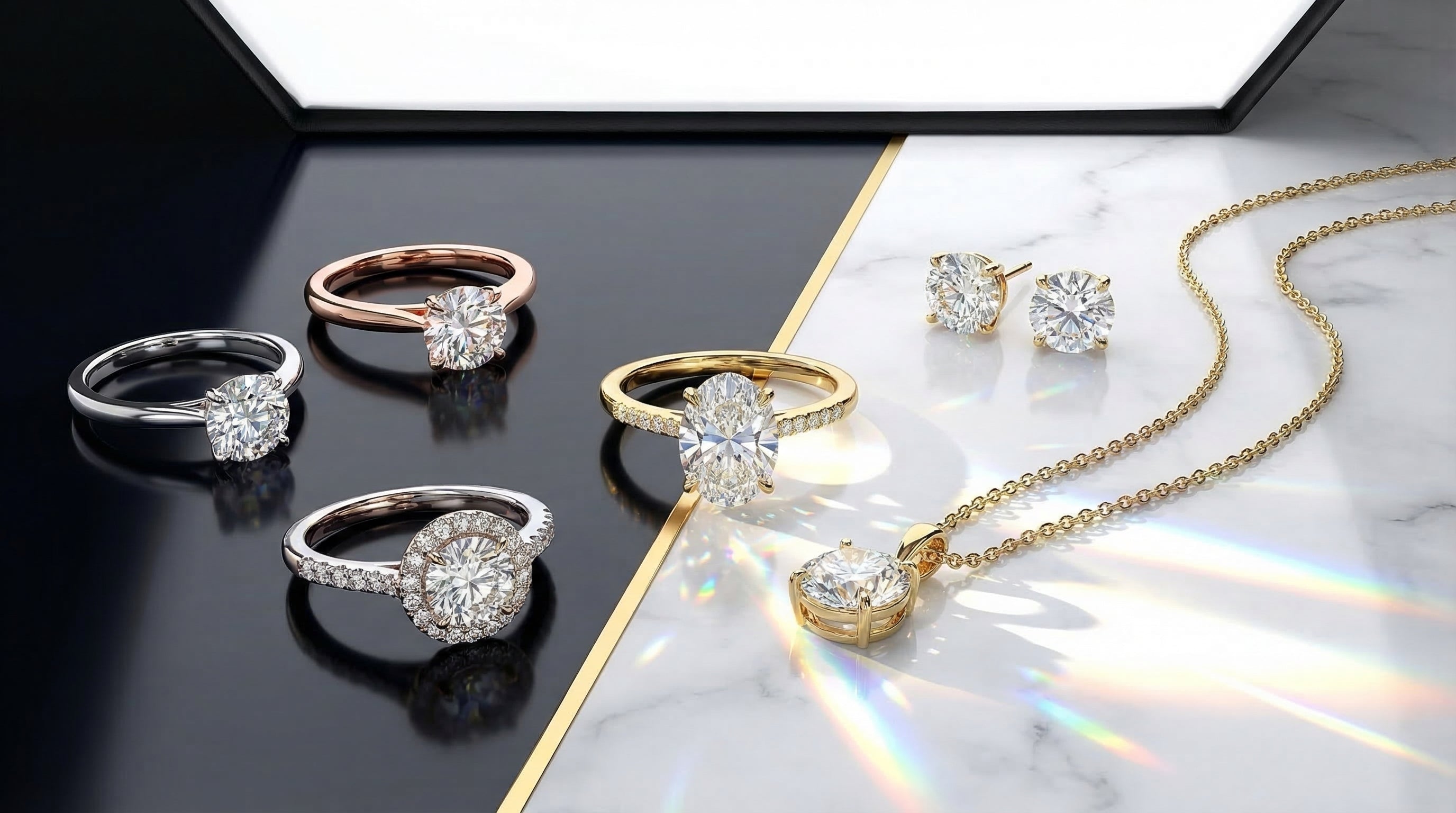
Voici le chiffre qui arrête la plupart des gens net : une moissanite impeccable de 1 carat coûte entre 400 et 600 $. Un diamant extrait comparable ? Entre 4 000 et 10 000 $. Voilà l’écart de prix entre moissanite et diamant en termes clairs — et une fois que vous comprenez ce qui le motive réellement, la décision devient beaucoup plus évidente. Pendant des décennies, l’industrie de la joaillerie a conditionné les couples à croire que la valeur d’une bague se mesure au nombre de mois de salaire qu’elle représente. Mais plus de 250 000 clients ont découvert une autre vérité. Vous n’avez pas à faire de compromis sur la taille, l’éclat ou la qualité pour rester dans un budget réaliste. Vous avez juste besoin des bonnes informations.

Ce qu’il faut savoir avant d’acheter une moissanite ou un diamant
La moissanite et les diamants sont des pierres précieuses totalement différentes. Les diamants sont du carbone pur ; la moissanite est du carbure de silicium. Cette différence structurelle confère à la moissanite un indice de réfraction plus élevé (2,65–2,69 contre 2,42 pour le diamant) et un taux de dispersion de 0,104 — soit 2,4 fois celui du diamant — ce qui signifie plus de feu, plus d’éclats arc-en-ciel et plus de brillance par dollar dépensé.
L’histoire de l’origine est importante ici. En 1893, le scientifique français Henri Moissan a découvert des particules microscopiques d’un nouveau minéral dans un cratère météoritique en Arizona. Il pensait initialement avoir trouvé des diamants. Il a fallu des années pour confirmer qu’il avait découvert quelque chose de totalement nouveau : le carbure de silicium. La moissanite naturelle est extraordinairement rare — on la trouve uniquement dans les roches du manteau supérieur et les météorites — donc pratiquement toute la moissanite utilisée aujourd’hui en joaillerie fine est créée en laboratoire par des scientifiques qui ont perfectionné le procédé.
Cette origine créée en laboratoire explique précisément pourquoi les prix de la moissanite et du diamant sont si différents. Les diamants extraits nécessitent d’énormes opérations de terrassement, des chaînes d’approvisionnement mondiales complexes et une structure de marché centenaire qui a artificiellement gonflé les prix. La moissanite évite tout cela. Vous payez pour l’art de la taille et la qualité de la pierre — pas pour les lourds engins utilisés pour l’extraire du sol.
Beaucoup de gens se demandent naturellement quelle est la différence entre la moissanite et le diamant de laboratoire. Les diamants de laboratoire sont chimiquement identiques aux diamants extraits et sont également créés dans des environnements contrôlés. Ils sont nettement plus abordables que les diamants extraits, mais ils conservent tout de même une prime simplement parce qu'ils portent le nom de « diamant ». La moissanite est une pierre précieuse à part entière. Elle ne cherche pas à être un diamant — elle offre des propriétés optiques uniques que beaucoup préfèrent réellement. De plus, elle est certifiée GRA, créée de manière éthique et garantie à vie.
Lorsque vous glissez une bague en moissanite à votre doigt, vous ressentez le poids substantiel d'un savoir-faire haut de gamme. Vous voyez une pierre éthiquement sourcée, respectueuse de l'environnement et visuellement spectaculaire. Il ne s'agit pas de se contenter de moins. Il s'agit de choisir les caractéristiques qui correspondent à vos valeurs, à votre esthétique et à vos objectifs financiers pour la vie que vous construisez ensemble.
Facteurs clés influençant le prix de la moissanite vs diamant
Les prix des diamants fluctuent énormément selon les 4 C—taille, couleur, clarté et poids en carats—ainsi que les monopoles du marché. Le prix de la moissanite est beaucoup plus simple, principalement déterminé par la taille et la qualité de la couleur, car la création en laboratoire garantit une clarté quasi parfaite comme norme plutôt que comme exception.
Si vous avez déjà cherché un diamant traditionnel, vous connaissez la danse épuisante des 4 C. Vous trouvez une pierre qui correspond à votre budget, pour découvrir qu'elle a une teinte jaune visible ou une inclusion juste au centre de la table. Pour obtenir un diamant vraiment incolore et sans défaut à l'œil nu, le prix monte en flèche de façon exponentielle. L'industrie s'appuie sur la rareté—réelle et fabriquée—pour justifier ces hausses importantes.
La moissanite bouleverse complètement ce modèle. Parce qu'elle est cultivée par des scientifiques qui ont perfectionné le processus de cristallisation, la grande majorité des pierres de moissanite atteignent une qualité de clarté équivalente à VVS (Très, Très Légèrement Incluse) ou mieux. Il n'y a pas de pics de prix massifs pour la clarté car une clarté quasi parfaite est la norme. Vous ne payez pas une prime pour une trouvaille chanceuse dans la nature ; vous payez un prix juste et constant pour une précision scientifique.
Et voici où la question moissanite vs zircone cubique se pose—car les gens les confondent souvent, ce qu'ils ne devraient pas faire. La zircone cubique est un simulant très poreux et peu coûteux qui absorbe les huiles et la saleté, devenant terne et trouble en un an ou deux d'usure quotidienne. La moissanite est une véritable pierre précieuse dure avec une dureté de 9,25 sur l'échelle de Mohs, qui ne ternira jamais, ne se rayera pas facilement et ne perdra pas son éclat. Notre guide sur moissanite vs diamant vs zircone cubique explique la science exacte derrière pourquoi la zircone cubique échoue là où la moissanite perdure.
La durabilité façonne la valeur perçue de manière réelle. Avec 9,25 sur l’échelle de Mohs, le moissanite est la deuxième pierre précieuse la plus dure utilisée en bijouterie. Il supporte les chocs et les coups de la vie quotidienne sans se plaindre. Et voici quelque chose que la plupart des gens ignorent : le moissanite a une ténacité supérieure à celle des diamants. Les diamants ont des plans de clivage naturels — des directions où la structure cristalline est plus faible — ce qui signifie qu’un coup dur sous un mauvais angle peut fendre un diamant en deux. Le moissanite ne possède pas ces plans de clivage, ce qui le rend exceptionnellement résistant pour un usage quotidien.
| Caractéristique | Moissanite | Diamant extrait | Diamant synthétique |
|---|---|---|---|
| Composition | Carbure de silicium | Carbone pur | Carbone pur |
| Dureté (Mohs) | 9,25 (Excellent pour un port quotidien) | 10 (Dureté maximale) | 10 (Dureté maximale) |
| Brillance (Indice de réfraction) | 2,65–2,69 (Feu exceptionnel) | 2,42 (Éclat classique) | 2,42 (Éclat classique) |
| Consistance de la pureté | Presque toujours VVS ou parfait | Varie énormément ; parfait est rare | Haute constance, mais variable |
| Prix moyen pour 1 ct | 400 $–600 $ | 4 000 $–10 000 $ | 800 $–1 500 $ |
L’indice de réfraction est là où le moissanite fait sa réputation. Avec un indice de 2,65 à 2,69, il dévie la lumière plus efficacement qu’un diamant à 2,42. Cette dispersion plus élevée — 0,104 contre 0,044 pour le diamant — signifie que le moissanite divise la lumière blanche en un spectre fascinant de couleurs arc-en-ciel, le « feu » qui capte la lumière directe du soleil et attire les regards dans une pièce. Certaines personnes préfèrent l’éclat plus froid et plus blanc du diamant. D’autres sont captivées par la brillance vibrante et scintillante du moissanite. Aucun n’est objectivement meilleur. C’est entièrement une question d’esthétique personnelle.
Fourchettes de prix et décomposition de la vraie valeur
Un moissanite d’un carat parfait coûte généralement entre 400 $ et 600 $, tandis qu’un diamant extrait comparable varie de 4 000 $ à 10 000 $. Cet écart de prix reflète le contrôle traditionnel du marché du diamant — pas une différence de durabilité, de beauté visuelle ou de l’amour que la bague représente.
Parlons chiffres réels. Disons que vous avez un budget de 3 000 $ pour une bague de fiançailles. En entrant dans une bijouterie traditionnelle, ce budget vous permet d’obtenir environ 0,75 à 0,80 carat de diamant extrait. Pour rester dans le budget, vous devrez probablement faire des compromis sur la couleur (en acceptant une légère teinte jaune) ou la pureté (en acceptant une inclusion visible). La bague sera belle — mais ce ne sera probablement pas la pièce parfaite et époustouflante que vous aviez imaginée.
Maintenant, prenez ces mêmes 3 000 $ dans l'univers des bagues en moissanite. Vous n'obtenez pas seulement une pierre d'un carat. Vous avez le pouvoir d'achat pour choisir une moissanite incolore, impeccable, de 2 carats voire 3 carats, sertie en or massif 14k ou 18k, peut-être entourée d'un halo caché ou d'un pavage délicat. Et il vous restera encore de l'argent — pour une lune de miel, un acompte ou des investissements dans votre véritable avenir. Voilà la vraie force de la dynamique des prix moissanite vs diamant. Elle déplace la conversation de la contrainte financière vers la liberté financière.

Même en comparant la moissanite au diamant de laboratoire, les économies sont substantielles. Un diamant de laboratoire de haute qualité de 2 carats coûte entre 2 000 et 4 000 $. Une moissanite premium de 2 carats coûte généralement moins de 1 000 $. Pour les couples qui veulent un impact visuel maximal et une origine totalement éthique, la moissanite offre une proposition de valeur imbattable.
Et honnêtement ? L'argument de la valeur de revente ne tient pas non plus. Les bijoutiers traditionnels justifient souvent les prix élevés des diamants en les qualifiant « d'investissement ». La réalité : dès que vous sortez d'une bijouterie avec un diamant extrait, il perd environ 50 % de sa valeur au détail. À moins d'acheter un diamant coloré historiquement significatif aux enchères, votre bague de fiançailles n'est pas un actif financier qui prendra de la valeur. C'est une œuvre d'art portable. La moissanite assume cette vérité. Vous payez un prix juste pour les matériaux et le savoir-faire — sans l'illusion de retours financiers futurs. Vos véritables investissements restent là où ils doivent être.
Comment repérer la qualité des bagues en moissanite
Pour repérer une moissanite de haute qualité, recherchez des pierres classées incolores (D–E–F) ou presque incolores (G–H–I) avec une pureté VVS. Une moissanite premium ne paraîtra jamais trouble ni ne perdra son éclat avec le temps, en faisant un héritage brillant qui conserve sa beauté pendant des générations.
Toute la moissanite n'est pas créée égale. Le processus de création en laboratoire garantit un niveau de qualité élevé, mais les techniques spécifiques utilisées par différents fabricants produisent des degrés de beauté variés. Lors de l'évaluation des bagues de fiançailles en moissanite, votre attention principale doit se porter sur le grade de couleur et la précision de la taille.
Aux débuts de la production de moissanite, les pierres présentaient souvent une teinte jaune ou verdâtre distincte à la lumière naturelle du soleil — ce qu'on appelle la moissanite « classique ». Aujourd'hui, des techniques de croissance avancées produisent des pierres véritablement incolores. Recherchez les grades D, E ou F : blanc glacé, net et totalement dépourvu de nuances chaudes. Si vous préférez une sensation légèrement plus chaude et vintage, un grade presque incolore G–H–I s'accorde parfaitement avec des montures en or jaune ou rose.
On demande souvent : la moissanite est-elle un diamant synthétique ? Ce n'est pas le cas. Un diamant synthétique est du carbone ; la moissanite est du carbure de silicium. En raison de cette différence, la taille doit être spécifiquement adaptée aux propriétés optiques uniques de la moissanite. Une moissanite mal taillée paraît plate et sans vie. Une pierre parfaitement taillée maximise cette dispersion flamboyante caractéristique — une scintillation qui danse dans la pièce à chaque mouvement. Recherchez les mentions « taille excellente » ou « taille idéale », avec des facettes nettes, symétriques et parfaitement alignées pour renvoyer la lumière directement à votre œil.
Vous rencontrerez également le choix entre une « taille brillant » et une « taille glace pilée », notamment pour les formes ovales et radiant. Une taille brillant présente des facettes claires et distinctes qui créent des éclats de lumière intenses. Une taille glace pilée comporte de nombreuses petites facettes sur la culasse, créant un effet scintillant dispersé qui imite de près l'apparence d'un diamant traditionnel. Aucune n'est mauvaise — tout dépend simplement du type d'éclat que vous souhaitez voir sur votre doigt chaque jour.
Nos meilleures recommandations pour les bagues de fiançailles en moissanite
Trouver le symbole parfait de votre amour signifie choisir un design qui capture son style unique. Des solitaires classiques aux tailles émeraude audacieuses, nos meilleures bagues de fiançailles en moissanite allient éclat éthique et savoir-faire exceptionnel — des pièces conçues pour être chéries toute une vie.
Chez Awareness Avenue, nous sommes obsédés par les détails. Chaque griffes, chaque facette, chaque anneau poli est conçu pour sublimer la pierre centrale. Chaque pièce est certifiée GRA, accompagnée d'une garantie à vie, et expédiée avec un paiement sécurisé et un retour sous 30 jours — car la confiance dans votre achat compte autant que la bague elle-même. Voici quelques-uns de nos modèles les plus appréciés.
Bague de fiançailles Opaline 2ct taille ovale en moissanite
Les tailles ovales connaissent un immense succès, et il est facile de comprendre pourquoi. La forme allongée flatte le doigt, le faisant paraître plus long et plus fin, tout en offrant une surface plus grande qu'une taille ronde de même poids en carats. L'Opaline présente une spectaculaire moissanite ovale de 2 carats qui attire l'attention dès que vous entrez dans une pièce.

L’éclat de cette pièce réside dans son sertissage délicat et discret. Une bande fine laisse la pierre centrale prendre pleinement le commandement, captant la lumière sous tous les angles possibles — projetant un feu arc-en-ciel en plein soleil, brillant d’une scintillation douce à l’intérieur. Comparez le prix de l’Opaline à une bague ovale en diamant extrait de 2 carats, et la différence est stupéfiante. Vous obtenez ce look très convoité, inspiré des célébrités, sans le prix astronomique. Un luxe moderne et intelligent — exactement comme il se doit.
La bague Luna - Or rose en moissanite
Il y a quelque chose d’indéniablement romantique dans l’or rose. Ses tons chauds et rosés évoquent le charme vintage et une féminité intemporelle. La Luna - Or rose associe ce métal magnifique à une moissanite taille ronde brillante, créant un contraste qui fait ressortir la pierre blanche glacée de façon spectaculaire contre l’anneau chaud.
La taille ronde brillante est la forme la plus populaire pour une raison — elle est conçue pour maximiser le retour de lumière, offrant l’éclat le plus intense de toutes les tailles. Associée à la douceur chaleureuse de l’or rose, le feu de la moissanite est amplifié, projetant des éclats de lumière pastel qui dansent à chaque mouvement. Elle se sent substantielle au doigt, sécurisée dans son sertissage, et profondément personnelle dans sa chaleur.
La bague Adelina Rae en moissanite taille émeraude 2 ct
Pour la femme au style audacieux et architectural, la taille émeraude est la déclaration ultime. Contrairement aux tailles brillantes qui dispersent l’éclat dans toutes les directions, la taille émeraude présente de longues facettes linéaires qui créent un effet « hall de miroirs » — profond, vitreux et discrètement imposant. L’Adelina Rae met en valeur une moissanite taille émeraude impeccable de 2 carats qui dégage un glamour sophistiqué sans effort.

Les tailles émeraude ont de grandes tables ouvertes qui ne cachent absolument rien. Toute inclusion ou teinte de couleur dans un diamant extrait serait instantanément visible. C’est là que la perfection créée en laboratoire de la moissanite brille le plus. L’Adelina Rae offre une fenêtre immaculée et sans défaut sur les profondeurs de la pierre — une bague prête pour le tapis rouge, à un prix qui reste confortable dans un budget réaliste.
La bague Bethany en moissanite bleue brillante taille ronde de 1,5 ct
Qui a dit qu’une bague de fiançailles devait être blanche ? Les mariées modernes sont de plus en plus attirées par les pierres précieuses colorées qui reflètent leur personnalité. La Bethany présente une moissanite bleue brillante de 1,5 carat qui capture la profondeur de l’océan et l’étendue d’un ciel crépusculaire.
La moissanite colorée est créée en introduisant des éléments traces spécifiques lors du processus de croissance, ce qui donne une teinte permanente et vibrante qui ne s’estompera jamais. La Bethany offre l’apparence royale d’un diamant bleu ou d’un saphir fin, avec le feu inégalé et la dureté de 9,25 sur l’échelle de Mohs de la moissanite. C’est un déclencheur de conversation, une déclaration audacieuse d’individualité et un bijou d’exception — tout à la fois.
Bague moissanite ronde 1CT à bande torsadée
Parfois, la magie réside dans l’anneau. La Bague moissanite ronde 1CT à bande torsadée reprend le concept classique du solitaire et l’élève avec un anneau magnifiquement entrelacé, semblable à une vigne — deux chemins qui s’entrelacent, un symbole discret d’unité et de connexion éternelle.

La pierre centrale de 1 carat est la taille idéale pour un port quotidien — assez visible pour être remarquée, assez pratique pour ne pas accrocher les vêtements ni gêner un style de vie actif. Le anneau torsadé ajoute de la texture et un intérêt visuel, attirant le regard vers la pierre centrale brillante. Délicat. Romantique. La preuve qu’il ne faut pas une pierre massive pour faire un impact massif.
Questions fréquemment posées
Vous avez des questions sur la comparaison de ces pierres dans la vie réelle ? Nous avons les réponses. Des différences visuelles à la durabilité à long terme, voici tout ce que vous devez savoir pour choisir entre la moissanite et les diamants traditionnels pour votre bijou éternel.
Comment la moissanite et le diamant se comparent-ils visuellement côte à côte ?
Côte à côte, la moissanite présente plus de « feu » — ces éclats colorés de lumière — grâce à son indice de réfraction plus élevé de 2,65 à 2,69 contre 2,42 pour le diamant. Pour un œil non averti, ils semblent presque identiques, mais la moissanite paraît légèrement plus brillante et vibrante sous la lumière directe du soleil ou un projecteur. Si vous souhaitez explorer davantage les nuances visuelles, notre analyse approfondie de moissanite vs diamant côte à côte offre des comparaisons détaillées.
La moissanite devient-elle trouble avec le temps comme le zirconium cubique ?
Absolument pas. La moissanite est une pierre précieuse durable et authentique qui ne perdra jamais sa clarté, ne deviendra pas trouble, ni ne changera de couleur avec le temps. Contrairement aux simulants poreux, elle résiste parfaitement à la saleté et aux huiles. Un nettoyage simple avec du savon doux et de l’eau tiède suffit à maintenir son éclat d’origine pendant des générations—aucun traitement spécial, ni polissage professionnel requis.
La moissanite est-elle considérée comme un faux diamant ?
Non. La moissanite est une pierre précieuse distincte avec des propriétés chimiques et optiques uniques. Bien qu’elle soit une alternative brillante et éthique aux diamants pour les bagues de fiançailles, c’est un joyau légitime et très respecté en soi. Qualifier la moissanite de « faux diamant » revient à appeler un saphir un « faux diamant bleu »—c’est une méconnaissance de ce qu’est réellement la pierre.
Un bijoutier peut-il faire la différence entre la moissanite et un diamant ?
Oui, un bijoutier formé utilisant une loupe peut identifier la moissanite en recherchant la « double réfraction ». En raison de la façon dont la moissanite se forme, la lumière entrant dans la pierre se divise en deux, créant un léger effet de doublement sur les facettes à fort grossissement. Les testeurs de diamant standards peuvent également confondre la moissanite avec un diamant en raison de sa haute conductivité thermique, nécessitant des testeurs spécialisés pour une identification précise.
Conseil final pour choisir votre bague éternelle
Votre bague de fiançailles doit être une source de joie, pas de stress financier. Choisir la moissanite signifie obtenir une pierre plus grande, plus brillante, créée de manière éthique—certifiée GRA, garantie à vie, et conçue pour durer—sans compromettre la qualité, la beauté ou la signification de ce moment.
La réalité du prix moissanite vs diamant vous offre quelque chose de rare dans le monde de la joaillerie : la liberté. La liberté de choisir selon l’esthétique et l’éthique plutôt que selon des contraintes budgétaires artificielles. Vous choisissez une pierre née des étoiles, perfectionnée par la science, et conçue pour durer toute une vie. Ce n’est pas un compromis. C’est un choix plus intelligent.
Nous vous invitons à explorer notre collection complète de bagues de fiançailles en moissanite et à trouver le modèle qui vous parle. Que vous soyez attiré par le charme vintage de l’or rose, la géométrie audacieuse d’une taille émeraude, ou le romantisme classique d’un solitaire rond brillant, votre bague parfaite vous attend. Découvrez pourquoi plus de 250 000 clients ont choisi le luxe intelligent de nos bagues en moissanite les plus vendues—et entrez dans votre avenir avec un symbole d’amour aussi brillant que votre histoire.

Laisser un commentaire
Ce site est protégé par hCaptcha, et la Politique de confidentialité et les Conditions de service de hCaptcha s’appliquent.