


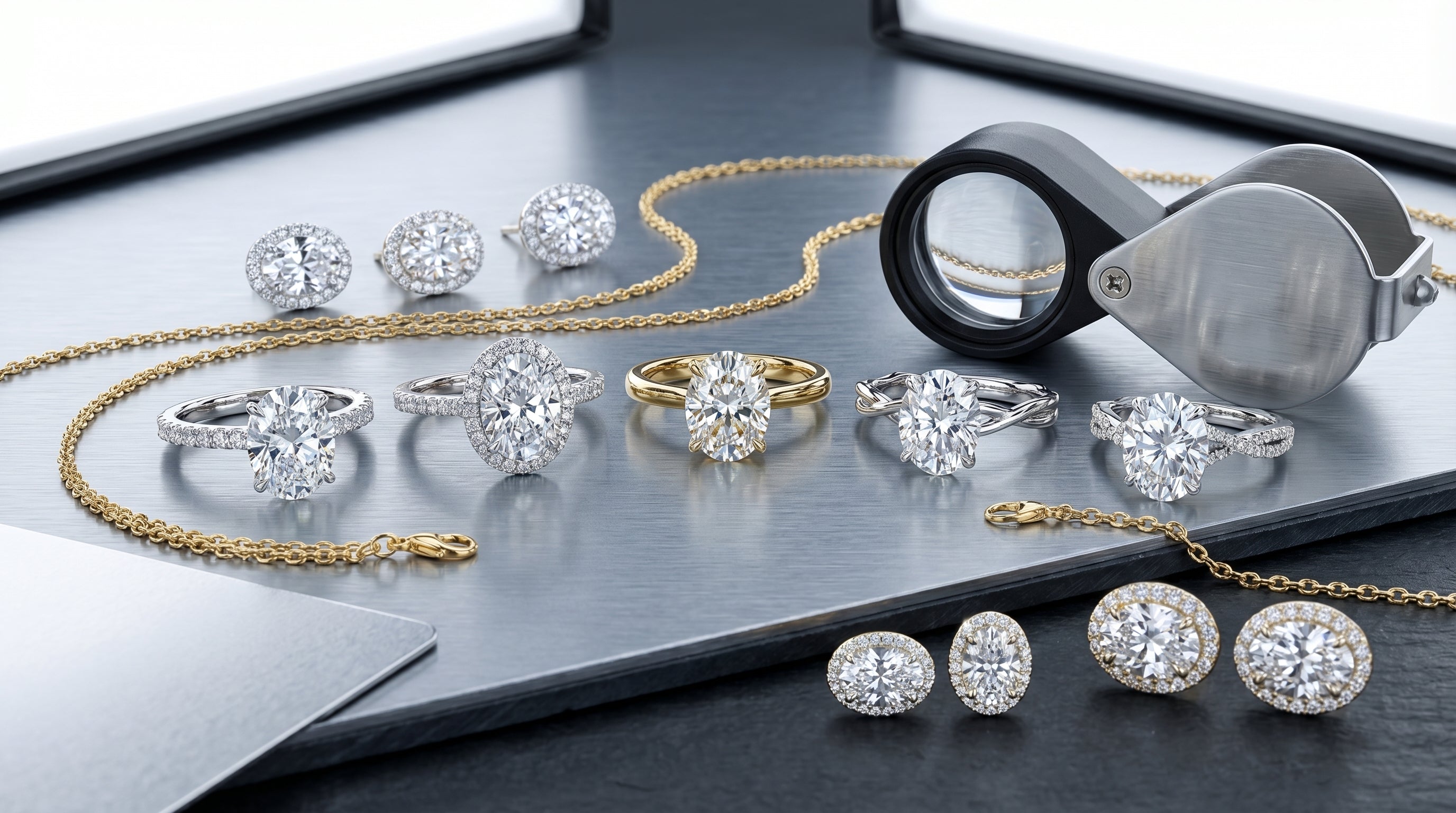
Vous tenez donc une bague à la lumière et vous vous posez la question qui vous taraude : la moissanite est-elle un vrai diamant ? La réponse courte — non. Mais ce n'est pas toute l'histoire, et le tableau complet est bien plus intéressant qu'un simple oui ou non. La moissanite est une pierre précieuse complètement distincte avec sa propre science remarquable, sa propre histoire d'origine et des propriétés optiques qui surpassent en fait les diamants dans plusieurs aspects mesurables. Si vous cherchez une bague de fiançailles et que vous essayez de comprendre ce que vous achetez vraiment, c'est l'article qu'il vous faut.

La Grande Question : La Moissanite est-elle un Vrai Diamant ?
Non, la moissanite n'est pas un vrai diamant. Les diamants sont du carbone pur. La moissanite est du carbure de silicium — un minéral complètement différent avec sa propre structure chimique, son propre profil optique et sa propre histoire fascinante. Appeler la moissanite un diamant faux, c'est comme appeler un saphir un rubis faux. Ce sont simplement des pierres différentes, et la moissanite s'impose fièrement par ses propres mérites.
Voici l'histoire d'origine que la plupart des gens ignorent. Le chimiste français Henri Moissan a découvert ce minéral en 1893 en examinant des échantillons de roche provenant d'un cratère de météorite en Arizona. Pendant des décennies, les scientifiques ont cru qu'il venait exclusivement de l'espace. La moissanite naturelle est si extraordinairement rare qu'il n'en existe pas assez sur Terre pour tailler une seule pierre précieuse. Les scientifiques ont donc passé des années à apprendre à la cultiver en laboratoire dans des environnements contrôlés — et ce qu'ils ont créé a changé l'industrie de la joaillerie pour toujours.
Aujourd'hui, chaque bague en moissanite que vous voyez dans une collection de bijoux fins est créée en laboratoire. Ce processus de croissance contrôlée produit des pierres d'une clarté parfaite et d'un grade incolore impeccable que la nature atteint rarement, même pour les diamants. Vous n'achetez pas un « diamant faux ». Vous achetez une pierre précieuse scientifiquement avancée dont l'histoire commence littéralement dans les étoiles.
Moissanite vs Diamant Côté à Côté : Différences Optiques & Physiques
Lorsqu'on compare la moissanite et le diamant côte à côte, la moissanite affiche un feu plus coloré grâce à un indice de réfraction plus élevé de 2,65 à 2,69, contre 2,42 pour le diamant. Les diamants émettent un éclat blanc classique. La moissanite projette des éclairs arc-en-ciel vibrants dans toute la pièce. Les deux sont exceptionnellement durs et conçus pour un port quotidien — mais ils ont une apparence et un comportement différents à la lumière.
Parlons de ce qui se passe réellement lorsque la lumière frappe une pierre de moissanite. Les gemmologues mesurent la capacité d'une pierre à plier la lumière grâce à l'indice de réfraction. L'indice de réfraction du diamant de 2,42 est indéniablement beau. Mais celui de la moissanite, entre 2,65 et 2,69, signifie qu'elle plie et renvoie plus de lumière à votre œil. Si vous aimez une bague qui capte la lumière de l'autre côté de la pièce, la moissanite offre une performance que les diamants ne peuvent égaler.
Ensuite, il y a le feu — la dispersion de la lumière blanche en couleurs spectrales. La moissanite a un taux de dispersion de 0,104. Celui du diamant est de 0,044. Cela signifie que la moissanite produit plus du double des éclats arc-en-ciel d'un diamant. En plein soleil, un diamant scintille en blanc et argenté. La moissanite explose en couleurs. Certaines personnes adorent cet éclat vibrant et flamboyant. D'autres préfèrent la retenue glacée d'un diamant. C'est entièrement une question de goût personnel — et aucun choix n'est mauvais.
La durabilité est un autre facteur crucial. Sur l'échelle de Mohs, le diamant atteint un parfait 10. La moissanite est à 9,25, ce qui en fait la deuxième pierre précieuse la plus dure utilisée en bijouterie commerciale — plus dure que les saphirs, rubis et émeraudes. Vous pouvez porter une bague de fiançailles en moissanite tous les jours pendant des décennies sans craindre de rayer ou de perdre ces facettes nettes et brillantes. Pour une analyse complète de la comparaison entre ces pierres et d'autres alternatives, notre guide sur Moissanite vs Diamant vs Zircone Cubique : La Vérité Complète couvre les métriques exactes de durabilité.
La moissanite est-elle un diamant cultivé en laboratoire ?
Non, la moissanite n'est pas un diamant cultivé en laboratoire. Les diamants cultivés en laboratoire sont des cristaux de carbone pur, chimiquement et physiquement identiques aux diamants extraits. La moissanite est du carbure de silicium — un minéral complètement différent. Les deux sont créés en laboratoire, ce qui en fait des choix éthiques, mais ce sont des pierres précieuses entièrement distinctes avec des compositions différentes, des propriétés optiques différentes et des gammes de prix différentes.
C'est le point de confusion le plus courant pour les acheteurs de bijoux en 2026. Un diamant cultivé en laboratoire est exactement ce que son nom indique : un vrai diamant. Les scientifiques reproduisent la chaleur extrême et la pression du manteau terrestre pour cristalliser les atomes de carbone. Placez un diamant cultivé en laboratoire et un diamant extrait sous un microscope, un gemmologue ne pourra pas les différencier — car il n'y a aucune différence. Même composition chimique. Même normes de classification GIA. Tout est identique.
La moissanite est cultivée en laboratoire, mais la recette est totalement différente. Les scientifiques utilisent du silicium et du carbone pour faire croître des cristaux de carbure de silicium. Demander si la moissanite est un diamant de laboratoire revient à demander si un rubis de laboratoire est un saphir de laboratoire. Ce sont simplement des pierres différentes. Cela dit, la moissanite et les diamants de laboratoire partagent un avantage énorme : ils sont 100 % sans conflit, créés en surface, sans extraction destructrice et avec une empreinte carbone drastiquement réduite. Si l'approvisionnement éthique compte pour vous — et pour nos plus de 250 000 clients, c'est souvent le cas — les deux sont d'excellents choix.
La moissanite passe-t-elle un testeur de diamant ?
Oui, la moissanite passe un testeur de diamant basique. Les testeurs standards mesurent la conductivité thermique, et comme la moissanite conduit la chaleur de manière similaire aux diamants, elle est détectée comme un diamant sur ces appareils. Seuls les multi-testeurs avancés qui mesurent aussi la conductivité électrique peuvent distinguer précisément les deux pierres.
Si vous avez déjà vu un bijoutier appuyer un outil en forme de stylo contre une pierre et attendre un bip, vous avez vu un testeur thermique pour diamant en action. Les diamants sont d'excellents conducteurs de chaleur — pendant des décennies, c'était le moyen le plus simple de repérer le verre ou le zirconium cubique, qui conduisent mal la chaleur. Mais la moissanite a bouleversé cette méthode. Parce que le carbure de silicium est aussi un excellent conducteur de chaleur, un testeur thermique basique s'allume en vert et émet un bip, indiquant un diamant.
Et honnêtement ? Cette particularité a généré de nombreuses vidéos virales et une vraie confusion. Pour identifier précisément la moissanite, les bijoutiers en 2026 utilisent des multi-testeurs avancés qui mesurent la conductivité électrique. La moissanite conduit une petite quantité d'électricité. Les diamants non. Un gemmologue formé peut aussi repérer la moissanite sous une loupe de bijoutier en cherchant la double réfraction — lorsque vous regardez à travers le dessus d'une pierre de moissanite en angle, les facettes du bas apparaissent doublées. Les diamants sont à réfraction simple, leurs facettes paraissent donc toujours nettes et uniques. Pour en savoir plus, lisez notre article : La moissanite passe-t-elle un testeur de diamant ? La vérité complète.
Prix de la Moissanite vs Diamant : Comprendre la Valeur
La différence de prix entre la moissanite et le diamant est spectaculaire. Une moissanite de haute qualité d'un carat coûte généralement entre 200 et 600 $. Un diamant extrait comparable coûte entre 4 000 et 8 000 $. Cela représente une économie de 80 à 90 % — assez pour choisir une taille bien plus grande, améliorer votre métal ou simplement garder plus d'argent dans votre poche.
Voici le point — cet écart de prix transforme complètement la manière dont les couples abordent les bagues de fiançailles. Vous n’avez plus à choisir entre une bague magnifique et un apport pour une maison, une lune de miel incroyable ou le remboursement de prêts étudiants. Parce que le moissanite est cultivé en laboratoire, l’offre n’est pas artificiellement limitée par les conglomérats miniers. Vous payez la technologie, le savoir-faire et le sertissage en métal précieux — pas les coûts des opérations minières mondiales.
Voyons ce que cela signifie concrètement. Avec un budget de 3 000 $, vous pourriez vous offrir un diamant extrait d’un demi-carat de qualité correcte. Ce même budget de 3 000 $ vous permet d’acquérir un moissanite époustouflant de 3 carats, couleur D, sans défaut, serti en or massif 14 carats — avec de l’argent restant pour une alliance assortie. Pour comprendre comment les diamants de laboratoire s’intègrent dans cette comparaison de prix, consultez notre guide sur Moissanite vs Diamant de laboratoire : l’analyse complète.
| Taille en carats | Prix moyen du diamant extrait (2026) | Prix moyen du moissanite (2026) | Économies estimées |
|---|---|---|---|
| 1,0 carat | $4,000 - $8,000 | $200 - $600 | ~90 % |
| 2,0 carats | $12,000 - $20,000 | $400 - $900 | ~95 % |
| 3,0 carats | 25 000 $ - 40 000 $+ | $600 - $1,200 | ~97 % |
Une chose importante à savoir : le moissanite n’est pas un véhicule d’investissement. Les diamants extraits se revendent généralement à 40–60 % du prix de détail. Le moissanite conserve très peu de valeur sur le marché secondaire. Mais comme le prix d’achat initial est très bas, votre perte réelle en valeur est souvent inférieure à la dépréciation d’un diamant extrait. Vous achetez du moissanite pour la joie immédiate, la beauté et la liberté financière qu’il vous offre aujourd’hui.
Comment repérer des bagues en moissanite de haute qualité en 2026
Pour identifier des bagues en moissanite de haute qualité en 2026, recherchez des pierres classées D, E ou F pour une perfection incolore, et une pureté VVS1 ou VS1 pour un résultat sans inclusions visibles à l'œil nu. Achetez toujours auprès de bijoutiers fournissant une certification GRA et des numéros de série gravés au laser. Ces détails distinguent les pierres premium des alternatives économiques qui jaunissent ou s’opacifient avec le temps.
Tous les moissanites ne se valent pas. Comme les diamants, le moissanite est évalué selon les 4 C : Couleur, Pureté, Taille et Carat. Aux débuts de la production, les pierres présentaient souvent une teinte jaune ou verte distincte à la lumière naturelle du soleil. Grâce à des avancées technologiques majeures, le moissanite premium en 2026 est totalement incolore — et la différence est visible à l'œil nu.
Priorisez la couleur et la pureté
Recherchez des pierres classées D, E ou F sur l’échelle de couleur des diamants. Ces grades « incolores » vous offrent ce blanc glacé net qui s’accorde parfaitement avec les montures en or blanc ou platine. Pour la clarté, visez VVS1 ou VS1. Comme la moissanite est cultivée en laboratoire, obtenir une clarté quasi parfaite est bien plus constant que pour les diamants extraits — ne vous contentez donc pas d’une pierre avec des inclusions visibles ou une quelconque opacité. Chaque pierre Awareness Avenue est accompagnée d’une certification GRA confirmant ces grades.
Exigez des proportions de taille Excellent
La taille est sans doute le facteur le plus important pour la brillance de votre bague. Une moissanite mal taillée paraît plate et sans vie. Une taille de qualité Excellent maximise le feu naturel, l’éclat et la scintillation de la pierre — ce jeu vivant de lumière et d’ombre lorsque la bague bouge. En raison de la double réfraction de la moissanite, un facettage précis est indispensable. Un maître tailleur incline chaque facette pour éviter le flou et maximiser ce retour de lumière extraordinaire qui fait s’arrêter et admirer.

Nos meilleures recommandations de moissanite pour 2026
Trouver la bague parfaite signifie équilibrer style, éclat et budget. Nos meilleures recommandations de moissanite pour 2026 présentent des pierres D couleur parfaites, certifiées GRA, et des designs intemporels conçus pour durer toute une vie. Ces pièces montrent exactement pourquoi les couples modernes choisissent la moissanite plutôt que les diamants extraits — et ne regrettent jamais leur choix.
Nous avons aidé plus de 250 000 clients à trouver leur pièce parfaite, et chaque bague ci-dessous est garantie à vie, avec un retour possible sous 30 jours et un paiement sécurisé. Voici les modèles dont nos clients ne cessent de tomber amoureux.
La Liana - Bague moissanite taille ovale 3ct
Les tailles ovales dominent le paysage nuptial en 2026, et La Liana est un exemple parfait d’élégance allongée. Cette pierre centrale ovale de 3 carats crée un effet flatteur qui allonge le doigt et se photographie magnifiquement sous tous les angles. La taille ovale, avec ses facettes brillantes, maximise le feu naturel de la moissanite — en plein soleil, la dispersion arc-en-ciel est véritablement à couper le souffle. Sertie dans le métal premium de votre choix, c’est une silhouette intemporelle avec une présence remarquable.

La Ava - Bague de fiançailles en or taille poire
Pour la mariée qui veut quelque chose d’incontestablement unique, L’Ava - Or offre une silhouette frappante en forme de goutte, disponible de 1 à 5 carats. La taille poire combine l’éclat d’une pierre ronde avec la longueur flatteuse d’une marquise. Le sertissage en or chaud contraste magnifiquement avec la moissanite blanche glacée de couleur D — d’inspiration vintage dans l’esprit, entièrement contemporaine dans l’exécution.

L’Emily - Bague trois pierres taille princesse
Symbolisant votre passé, présent et futur, L’Emily est un chef-d’œuvre romantique. Une pierre centrale audacieuse de 1,5 ct taille princesse, flanquée de pierres latérales brillantes. La géométrie nette et moderne de la taille princesse produit un éclat structuré et architectural, totalement distinct des pierres arrondies. Elle attire l’attention sans paraître excessive — et le symbolisme des trois pierres ne se démode jamais.
L’Opulence - Bague éternelle multi-pierres
Parfois, une seule pierre ne suffit pas. L’Opulence est un cercle ininterrompu de feu — des pierres de moissanite brillantes tout autour du bracelet. Elle fonctionne comme une pièce maîtresse à elle seule, une alliance luxueuse ou le cadeau d’anniversaire ultime. Avec une dureté de 9,25 sur l’échelle de Mohs, la moissanite supporte l’usure quotidienne qu’exige une bague éternelle sans perdre une seule facette de son éclat.

Questions fréquemment posées
Vous avez encore quelques questions ? Parfait. Prendre une décision en toute confiance pour votre bague éternelle signifie ne rien laisser sans réponse. Voici les questions que nous recevons le plus souvent — avec des réponses claires.
La moissanite devient-elle terne avec le temps ?
Non. La moissanite de haute qualité ne devient jamais terne, opaque ou ne change de couleur avec le temps. Contrairement au zirconium cubique, qui est poreux et absorbe de façon permanente les huiles et la saleté, la moissanite possède une structure cristalline solide. Si votre bague semble légèrement terne, elle a simplement besoin d’un nettoyage rapide à l’eau tiède, avec un savon doux et une brosse souple. Une fois nettoyée, son éclat d’origine revient immédiatement — à chaque fois.
Puis-je porter ma bague en moissanite tous les jours ?
Absolument. Avec une dureté de 9,25 sur l'échelle de Mohs, la moissanite résiste aux rayures et à l'abrasion mieux que presque toutes les autres pierres précieuses sur le marché. Elle est conçue pour un port quotidien. Cela dit, retirez votre bague lors de travaux manuels lourds, de séances de musculation ou lors de l'utilisation de produits chimiques ménagers agressifs — non pas pour protéger la pierre, mais pour protéger le sertissage en métal précieux de la déformation ou du pliage.
La moissanite est-elle considérée comme kitsch ou fausse ?
Pas du tout. La moissanite est une pierre précieuse légitime et respectée en soi. Le stigmate autour des alternatives au diamant a largement disparu en 2026, remplacé par une véritable appréciation pour l'approvisionnement éthique, la responsabilité environnementale et l'intelligence financière. La plupart des gens qui verront votre bague penseront qu'il s'agit d'un diamant parfait. Ceux qui savent que c'est de la moissanite admirent généralement le feu — et le choix intelligent qui en est à l'origine.
Comment nettoyer mes bijoux en moissanite à la maison ?
Faites tremper la bague dans de l'eau tiède avec quelques gouttes de savon à vaisselle doux pendant dix minutes. Brossez délicatement la pierre et le sertissage avec une brosse à dents pour bébé à poils souples, en accordant une attention particulière au dessous de la pierre où se déposent lotions et huiles. Rincez sous l'eau tiède courante et séchez avec un chiffon microfibre sans peluches. C'est tout. Pas de produits chimiques agressifs, pas de nettoyeurs ultrasoniques nécessaires.
Conseils finaux pour votre parcours bijou
Choisir votre bague pour toujours est une décision profondément personnelle. Et maintenant, vous avez toutes les informations. La moissanite est-elle un diamant véritable ? Non — c'est quelque chose de différent, et à plusieurs égards mesurables, quelque chose de mieux. Elle offre plus de feu, plus de brillance par dollar, une origine totalement éthique, et le même poids satisfaisant sur votre doigt qui fait qu'une bague ressemble à un véritable engagement.
Vous n'avez pas à faire de compromis sur la taille, la clarté ou la brillance pour respecter votre budget. La moissanite vous permet de porter une pierre précieuse époustouflante, certifiée GRA, qui capte la lumière de toute la pièce — en sachant que votre achat n'a causé aucun dommage à la Terre ni à ses habitants. C'est un choix moderne pour une romance moderne, et plus de 250 000 clients l'ont déjà adopté.
Prêt à trouver la bague qui fait battre votre cœur à chaque fois que vous regardez votre main ? Parcourez notre Collection complète de bagues de fiançailles en moissanite pour trouver votre pièce éternelle, ou explorez nos Meilleures ventes pour découvrir les styles brillants que d'autres couples choisissent en ce moment. Et si vous souhaitez chercher par style, notre Collection complète de bagues en moissanite offre quelque chose pour tous les goûts et tous les budgets.


Laisser un commentaire
Ce site est protégé par hCaptcha, et la Politique de confidentialité et les Conditions de service de hCaptcha s’appliquent.