
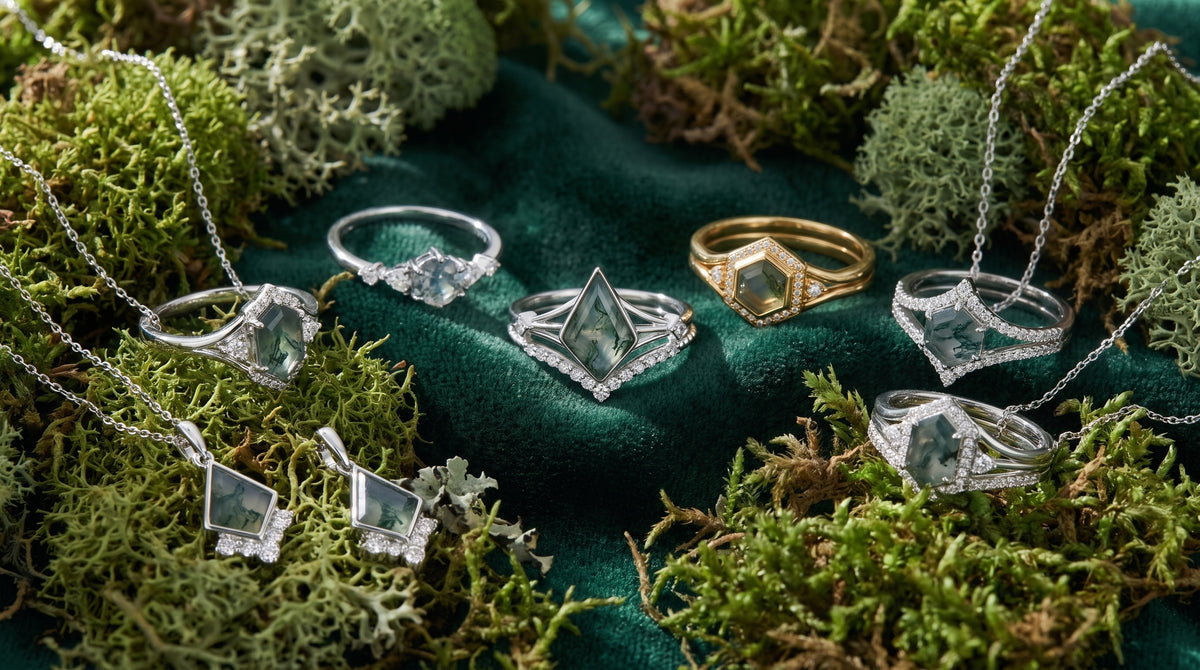
An engagement moss agate ring lives or dies, visually, on setting and care decisions most buyers only think about after the fact. The green "foliage" drifting through the stone has never been alive—it's dendrites, branching crystallizations of manganese and iron oxide suspended in chalcedony—and that single fact explains why the stone chips where it does, fades only under specific conditions, and needs a cleaning routine that differs meaningfully from a diamond's. If you want the broader picture first—cuts, symbolism, price context, style direction—read our complete moss agate engagement ring buyer's guide. This article goes deep on the part that determines whether the ring still looks good in year three: durability, protective settings, and care.
Why Moss Agate Behaves the Way It Does
If you find yourself asking what is moss agate exactly, it is a semi-precious gemstone composed primarily of silicon dioxide (SiO₂), belonging to chalcedony, the microcrystalline branch of the quartz family. Its patterns come from inorganic inclusions—mainly manganese and iron oxides—that formed in branching, fern-like structures within the silica. No organic material is present, and strictly speaking, the stone lacks the concentric banding that defines true agate, making it more accurately a dendritic chalcedony that the trade universally calls "agate" anyway.
Two practical consequences follow directly from this composition. First, the silica structure is non-porous and does not absorb water, which is why brief clean-water contact is low risk. Second, because dendritic patterning forms without repetition, no two stones match, and the cutter's chosen slice and orientation determines what pattern you actually receive. Shop by the specific stone photographed, not the style name alone, and view it in daylight, warm indoor light, and mixed lighting before deciding, since its perceived depth shifts noticeably with light temperature.
Durability: The Honest Numbers
Hardness and toughness are not the same property
Moss agate sits at roughly 6.5–7 on the Mohs hardness scale, between orthoclase feldspar and quartz—respectable scratch resistance against everyday materials, but meaningfully softer than diamond, sapphire, ruby, and moissanite. It can be scratched by anything at or above its own hardness, including airborne quartz dust from ordinary household grit.
Toughness—resistance to chipping and fracturing on impact—is a separate measure, and here moss agate rates only fair to moderate. Multiple sources describe it as "moderately durable but somewhat brittle," with microfractures and thin edges as the real vulnerable points, not the flat top surface.
What the available wear evidence suggests
One published durability analysis reports a wear test in which roughly 68% of moss agate rings showed visible edge nicks or surface abrasion after about six months of normal wear, compared with 12% for sapphire and 5% for diamond, and notes that prong-set moss agate needed tightening more than twice as often as diamond equivalents over a comparable period. That is a single brand-published data set rather than independent laboratory testing, so treat it as directional, not definitive—but the direction matches what the material properties predict.
Worth naming plainly: claims that a moss agate ring "will last for decades" are extrapolations from quartz's general chemical stability and individual jeweler experience, not from standardized long-term studies. Short-term wear observations exist; multi-year performance data does not, publicly, in any rigorous form.
Who this stone genuinely suits
While the moss agate engagement ring meaning is often tied to growth, renewal, and harmony with nature, the physical reality of the stone requires practical care. An engagement moss agate ring is a reasonable daily-wear choice if you're willing to set it protectively, remove it for hands-on tasks, and accept occasional maintenance like prong checks and light re-polishing. Put plainly, moss agate engagement rings reward owners who treat them as semi-precious jewelry rather than indestructible hardware. They are a poor fit if your work involves frequent impacts, you rarely remove rings, or a visible nick would genuinely bother you—a harder, tougher center stone is the more honest recommendation there, and moss agate remains a strong choice for a moss agate wedding band, a right-hand ring, or a moss agate promise ring instead.
Settings and Cuts: The Decisions That Actually Protect the Stone
Bezels do the heaviest lifting
Whether you are looking at a modern geometric cut or a vintage moss agate ring with intricate filigree, setting style is the single highest-leverage protective decision you'll make. A full bezel—a continuous metal rim around the stone—shields the entire edge from direct knocks and is the configuration most consistently recommended in durability-focused guidance. A half-bezel or heavy-shouldered setting with substantial metal at the corners is the next best option. Open four-prong solitaires look elegant but leave thin edges exposed, and that's the configuration where the reported prong-tightening burden shows up most.
Shape choices and their pressure points
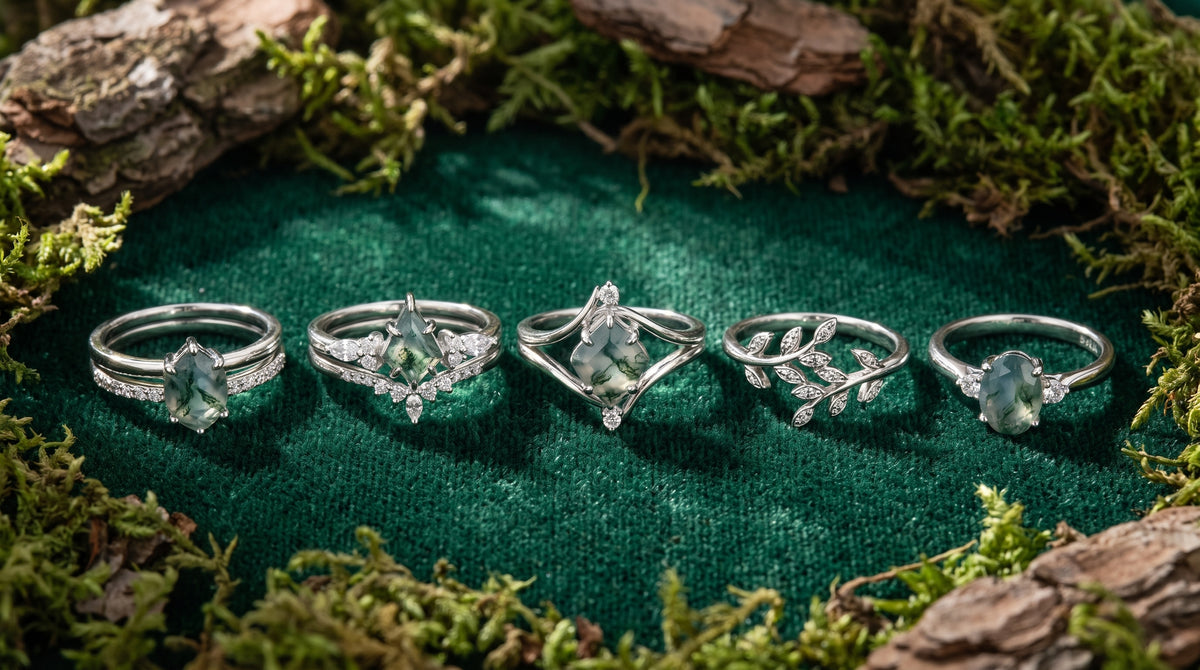
Moss agate is cut into cabochons, ovals, cushions, hexagons, kites, V-cuts, rounds, and faceted geometries. Cabochons and large-table cuts show the dendrites most completely, which is part of why they remain popular for this stone specifically. Pointed geometries like kites and V-cuts read as modern and distinctive, but their points are the thinnest, most chip-prone part of the stone and should ideally be covered or wrapped by metal.
Across Awareness Avenue's designs you can see these trade-offs directly: the Natural Moss Agate Oval Solitaire Ring keeps the stone's landscape wide open, while the Natural Moss Agate Kite Cut Ring takes the sharper geometric route with metal support at the points. Cushion cuts—including the halo and pavé variations—split the difference with softened corners. Browse the full range in the moss agate rings collection.
Stacking without scratching
A hazard rarely mentioned: a diamond-set wedding band worn directly against a moss agate engagement ring can abrade the softer stone, since diamond outranks chalcedony on the Mohs scale by a wide margin. Manage it with a contoured or chevron band that nests around the center stone rather than pressing into it, a plain metal band worn adjacent, or a matched moss agate engagement ring set engineered as a unit—such as the Natural Moss Agate V Cut Solitaire Ring Set or the Natural Moss Agate Hexagon Ring Set in 18K gold vermeil, where the band sits flush without grinding against the stone's girdle. Our guide to pairing an engagement ring with a wedding band covers the general principles.
Questions to Ask Before You Buy
Has the stone been treated?
This is the largest disclosure gap in the moss agate market. Some agate and chalcedony material is dyed to intensify color, and durability analyses warn that lower-tier supply chains use dyes and enhancements more often. Natural, untreated moss agate is described as having strong color stability and high fade resistance under normal conditions, while dyed material is the category linked to reported clouding or gradual color change. Ask directly whether a stone is natural or dyed.
What's the setting construction, and what service is available?
Ask what setting style secures the stone, whether edges or points are protected by metal, and how resizing would be handled—resizing puts stress on a bezel-set gemstone and isn't always straightforward.
Care and Cleaning That Actually Preserves the Stone
The routine sources agree on
Fill a bowl with lukewarm water, add a drop of mild, non-detergent soap, and soak the ring five to ten minutes. Gently work around the stone and beneath the setting with a soft-bristled toothbrush, rinse in clean water, and pat dry with a soft, lint-free cloth, making sure moisture doesn't linger in crevices. Every week or two is sufficient to keep oils and skin debris from dulling the surface.
Avoid ultrasonic and steam cleaners. Ultrasonic vibration can aggravate existing microfractures, and steam introduces the thermal shock moss agate tolerates poorly. Skip bleach, ammonia, strong acids, abrasive pastes, and general household cleaning sprays.
Water: what's fine and what isn't
Because moss agate is non-porous silica, brief contact with clean water is generally safe—handwashing, a rinse, or light rain is low-risk. Higher-risk exposures are prolonged hot water, chlorinated pools and hot tubs, saltwater, and any combination of heat plus chemicals, which can dull the stone and loosen or degrade metal settings over time.
Habits that extend the ring's life
- Store moss agate separately from diamonds and other harder stones—a fabric-lined box or soft pouch, not a shared tray.
- Remove the ring for gardening, weightlifting, manual work, cleaning, and swimming.
- Apply lotions, perfumes, and cosmetics before putting the ring on, not after.
- Have prongs or the bezel inspected periodically; a loose setting is the most common preventable cause of stone loss.
Frequently Asked Questions
Is moss agate durable enough for an engagement ring?
With qualifications, yes. At 6.5–7 Mohs it resists everyday scratching reasonably well, but fair-to-moderate toughness means edges chip more readily than diamond or sapphire. Protective setting plus mindful wear habits is what makes it workable for daily use.
Which setting protects a moss agate center stone best?
A full bezel offers the most edge protection, followed by heavy-shouldered or half-bezel designs. Open prong solitaires give the least protection and are most associated with reported prong-tightening needs.
Does moss agate fade over time?
Natural, untreated moss agate is described as highly resistant to fading, with stable color and pattern under normal wear and cleaning. The caveat is treated material—dyed stones are where reports of clouding or color shift originate.
Making the Call
An engagement moss agate ring is a deliberate trade: a genuinely one-of-a-kind center stone with real nature symbolism, set against moderate toughness that demands a protective setting and a cleaning routine that rules out ultrasonics and harsh chemicals. Choose the setting for protection first and aesthetics second, ask about treatment before you pay, and inspect the specific stone rather than the style name. For style, symbolism, and pricing context beyond durability and care, the complete moss agate engagement ring guide picks up where this one leaves off.

Laat een reactie achter
Deze site wordt beschermd door hCaptcha en het privacybeleid en de servicevoorwaarden van hCaptcha zijn van toepassing.