

The most useful thing you can learn about "cheap" jewelry websites is that the word cheap has quietly stopped meaning what shoppers think it means. Search the phrase and you will not find a directory of the lowest prices on the internet. You will find Business Insider naming Ana Luisa the top place to buy affordable fine jewelry after editors wore its gold and gold-plated pieces consistently over an extended testing period, and a companion guide noting shoppers can expect to spend around $70 per piece there. You will find EtMaison arguing that a fair price for a PVD-coated stainless steel necklace sits between $40 and $90, and $60 to $150 for a gold-filled piece. You will find Rank & Style telling readers that the phrase "gold tone" on a product page is a warning sign and "gold vermeil" is not.
In other words, the entire published consensus has reframed the question. Nobody credible is recommending the cheapest jewelry. They are recommending the jewelry that costs the least per year of wear. That reframe matters, because almost every objection people raise about buying jewelry from a budget website—it will tarnish, it will turn my finger green, it will look plastic in person, it will never arrive—is really an objection about lifespan and trust, not about price.
What follows works through those objections one at a time, using what the evidence actually supports. Where the evidence runs out—and it runs out more often than most buying guides admit—this guide says so.
Objection 1: "Cheap jewelry always tarnishes within weeks"
This is the foundational fear, and it is well earned. Cosmopolitan is blunt about the mechanism: gold- or silver-plated jewelry is typically the cheapest option available and is prone to deteriorating quickly. Plating is a thin surface layer. Rub it against a sleeve, a keyboard, a steering wheel, or a washing-up bowl a few thousand times and it wears through to whatever base metal sits underneath.
But the objection collapses the moment you separate price from construction. Tarnish is a chemical event, not a budget event. It happens when a reactive metal meets oxygen, sulfur, or moisture. Choose a construction where that reaction is suppressed, and the price tag becomes almost irrelevant to the outcome.
The constructions that actually resist tarnish
Three approaches dominate the affordable end of the market, and each works differently. The first approach relies on high-grade stainless steel. Awareness Avenue's Devotion Cross product page describes a Swiss watchmaker grade 316L stainless steel body with a chromium content of 16–18%, and argues that this chromium is what prevents oxidation—to the point that the brand describes tarnish as chemically impossible for the material. The piece carries an ion-bonded gold finish and a lifetime replacement guarantee. That is a first-party claim rather than independently lab-verified data, and worth reading as such, but it is at least a specific, falsifiable claim about a named alloy rather than vague reassurance.
A second approach uses a PVD coating over a steel core. The Sailor Lock Necklace page describes a surgical-grade 316L stainless steel core finished with an 18k gold-tone PVD coating, and makes a point that is genuinely useful for anyone with sensitive skin: nickel in that alloy is locked into the steel lattice rather than sitting loose on the surface. Hey Harper builds its whole waterproof collection on the same principle, describing resilient stainless steel fortified with a PVD coating it claims is ten times stronger, backed by a lifetime color warranty. EtMaison's comparative analysis independently rates Hey Harper a top waterproof performer specifically because of that PVD-over-steel construction.
The third route involves sterling silver with a noble-metal finish. Awareness Avenue's Mirelle Halo takes this path, utilizing a solid 925 sterling silver base finished with either rhodium—a rare member of the platinum family—or 18k gold vermeil. The brand describes these finishes as chemically bonded armor engineered to withstand water, sweat, and daily hand sanitizer exposure, with rhodium specifically credited for a mirror-like finish and hypoallergenic wear.
The practical takeaway is that when a site names its alloy, its coating method, and its base metal, tarnish resistance becomes a reviewable engineering claim. When a site says "gold tone" and nothing else, you are buying a surprise.
Objection 2: "I can't wear it in the shower or the ocean, so what's the point?"
This objection is the real engine behind the surge in searches for waterproof jewelry and non-tarnish jewelry. People do not want a jewelry routine. They want to put something on and forget about it.
Cosmopolitan sets a deliberately strict benchmark here: in its most literal sense, tarnish-free jewelry should not fade or discolor over time. That is an outcome standard, not a marketing adjective, and it is the right bar to hold sites to.
EtMaison's analysis of waterproof brands is the most useful independent framework available on this point. Its argument is that the brands that genuinely deliver—it names Hey Harper, Rellery, Mejuri, and Aurate—succeed because they build on inherently waterproof substrates: PVD-coated stainless steel, gold-filled layers, 14k solid gold, and titanium. They are not applying a waterproof treatment to a fragile base. The base itself is the waterproofing. Thin plating, by contrast, has a short lifespan under repeated water, sweat, and lotion contact no matter what the listing promises.
How to read a waterproof claim honestly
Brand pages make strong claims. The Devotion Cross is described as waterproof, hypoallergenic, scratch-resistant, and suitable for showering, swimming, and gym wear. The Sailor Lock Necklace is described as fully waterproof, sweat-proof, tarnish-resistant, and nickel-free. Hey Harper promises its pieces endure sweat, showers, and beach days without losing color.
These are plausible given what the named materials are known to do—but they are self-reported. The way to pressure-test them is to check whether the claim is anchored to a named construction and whether the brand is willing to put a warranty behind it. A waterproof claim attached to "316L stainless steel with PVD coating, lifetime color warranty" is structurally different from a waterproof claim attached to an unnamed "gold-tone metal blend." The first gives you both a mechanism and a remedy. The second gives you neither.
It is also worth noting where waterproof claims do not automatically transfer. A brand that engineers waterproof stainless steel necklaces has not thereby made every item in its catalog waterproof. Fine jewelry with set stones—moissanite rings, for instance—is a different product category with different care considerations, and the waterproof specification of a necklace tells you nothing about a ring. Always check the individual product page rather than assuming a brand-wide property. For a broader materials-first breakdown, our guide to cheap good quality jewelry works through this in more depth.
Objection 3: "Budget sites hide what the jewelry is actually made of"
This one is not a fear. It is an accurate observation about a large share of the market, and it is the single most efficient filter you have.
Rank & Style's guidance is the clearest published version of the test: start with materials, and treat specific terms like "14k gold," "gold vermeil," and "sterling silver" as green lights, while treating vague descriptors like "gold tone" or "metal blend" as red flags. Cosmopolitan reinforces the hierarchy from the other direction, noting that plated pieces are cheapest but deteriorate fastest, while gold vermeil offers meaningfully better durability for a modest step up in price.
A working vocabulary for product pages
Because these terms are used loosely across the web, it helps to know what each one commits the seller to. Sterling silver, often marked as 925, means a solid silver alloy throughout, not a coating. Awareness Avenue's Mirelle Halo is built on a solid 925 base before any finish is applied, which is why a rhodium or vermeil layer on top behaves differently than the same layer over a mystery base metal. Gold vermeil, by contrast, is a specific gold layer over sterling silver. Cosmopolitan positions it as the sensible upgrade from standard plating for buyers willing to spend a little more.
When evaluating steel, 316L stainless steel refers to a specific marine-grade alloy. The Devotion Cross page ties its corrosion resistance directly to a 16–18% chromium content, a number you can check against the alloy standard rather than take on faith. For finishes, PVD coating is a vapor-deposition process that bonds color at a molecular level, which is why brands describe it as fundamentally different from surface electroplating. EtMaison treats it as a marker of genuine waterproof capability. Rhodium is a platinum-family metal used as a finish, credited by Awareness Avenue with both tarnish resistance and hypoallergenic wear. Conversely, terms like "gold tone," "metal blend," or "alloy" commit the seller to nothing, and Rank & Style flags them for exactly that reason.
Objection 4: "The stones will look obviously fake"
Affordability in metals is a coating question. Affordability in stones is a completely separate question, and conflating them is where a lot of budget jewelry disappointment originates.
A piece can be built on flawless 316L steel and still look cheap if the stones are poorly cut or badly set. Conversely, a well-cut lab-created or alternative stone in a properly finished setting reads as fine jewelry at a fraction of natural-diamond pricing. Moissanite is the clearest example of this second category—a genuine gemstone used in fine jewelry, not an imitation crystal, and typically positioned as an accessible alternative to diamonds rather than as a budget-basics material.
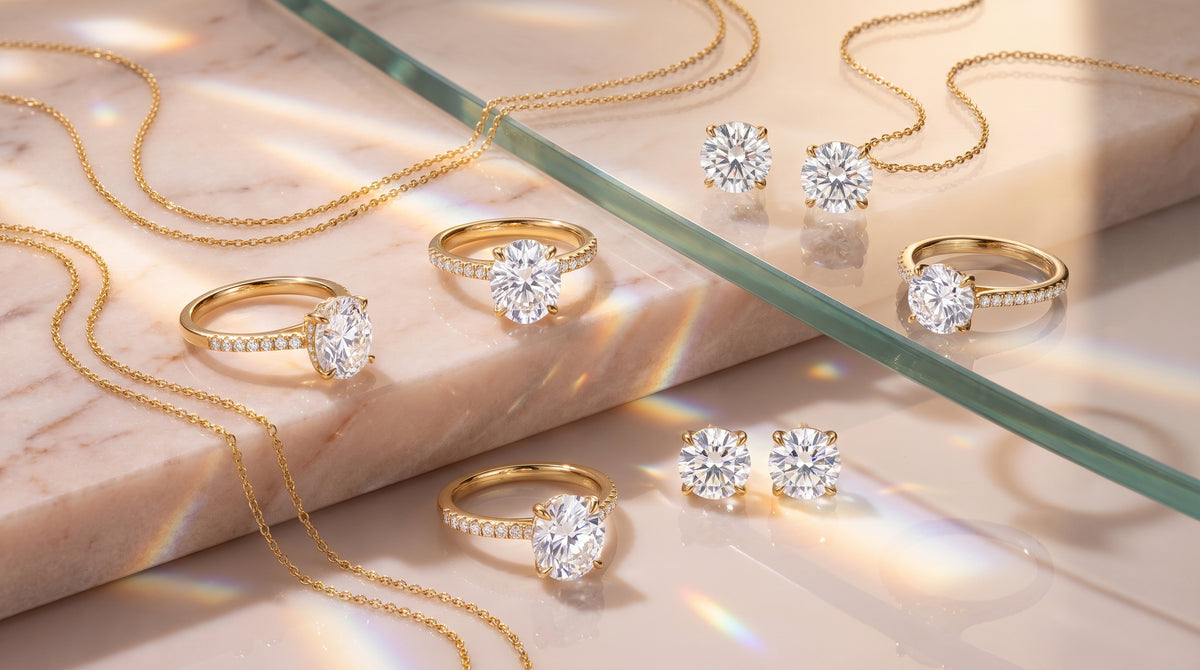
This is worth stating plainly because it cuts both ways. Moissanite rings are not cheap jewelry in the everyday-basics sense, and any site that lumps them in with $15 stacking rings is misleading you about what you are buying. Awareness Avenue's own ring collection sits in this accessible-fine-jewelry tier rather than the disposable tier. Pieces like The Ethereal or the pavé-set Gleam are built on sterling silver rather than mystery alloys, and are designed for the milestone end of the spectrum. Browsing the full silver rings range makes the distinction easy to see.
What separates convincing stones from unconvincing ones
Judge the setting as hard as you judge the stone. Prongs should sit evenly and cover the girdle properly; pavé should be uniform with no visible gaps between stones; a bezel should sit flush. In photography, look for pieces shot at multiple angles and in natural light rather than a single hero shot under a studio spotlight, which flatters everything. And read reviews specifically for comments on in-person appearance. Trustpilot summaries for Awareness Avenue include customers who report that items did not match the online pictures, which is precisely the kind of signal a curated review carousel will never show you. If you are weighing stone choices specifically, our moissanite jewelry guide covers what to check before committing.
Objection 5: "Cheap websites take my money and the order never arrives properly"
This is the objection that most buying guides quietly skip, and it is arguably the most legitimate one. It also has the clearest evidence behind it.
Trustpilot data is instructive here precisely because it is unflattering to everybody. Ana Luisa—the brand Business Insider has ranked top of its affordable fine jewelry guide for years—holds a 4.4 rating from 686 reviews on Trustpilot, with 248 of those in the last 12 months. Reviewers overwhelmingly report great experiences, praising quality, durability, comfort, and how the pieces elevate daily outfits. And yet the same review summary surfaces recurring complaints about missing items from packages and unexpected shipping delays.
Awareness Avenue's own Trustpilot profile shows a comparable pattern: a 4.3 rating from 1,190 reviews, with 119 in the last 12 months. Many reviewers praise the designs, the fit, the sentimental weight of the pieces as gifts, and a support team described as helpful and quick to respond on sizing changes and order modifications. Others report delivery delays, communication gaps, occasional product flaws, and cases where support felt unresponsive after a defect was raised. One reviewer, describing a $400 ring bought as a sentimental gift that disappointed, uses the word "scam."
We are including that here rather than hiding it, because the honest conclusion is more useful than a reassuring one: strong ratings and real fulfillment failures coexist at essentially every brand in this category. A 4.3 or 4.4 average is not a promise that your specific order will go smoothly. It is a probability statement.
How to reduce your actual risk
Rank & Style's advice is to read across the full ratings distribution rather than skimming the top, because real shoppers are, in its phrasing, brutally honest. That is the right method. In practice, you should read the one- and two-star reviews first, and sort for recency. A brand with fulfillment problems two years ago and clean recent reviews is a different proposition from one with fresh complaints this quarter. Look at how the brand responds—public, specific replies that resolve an issue tell you more about post-purchase risk than any number of five-star entries. Check whether complaints cluster around the product itself or around logistics, because those are different risks with different remedies. And before ordering anything for a dated occasion, build in buffer time; shipping delay is the single most frequently reported issue across the brands reviewed here.
Our guide on how to buy jewelry online covers the wider due-diligence process, including what to verify before checkout.
Objection 6: "There's no warranty, so if it fails I've lost the money"
Rank & Style treats warranties, repair services, and replacement policies as a core trust signal—the marker of a brand that stays engaged after checkout rather than disappearing at the payment page. For affordable jewelry specifically, this matters more than it does at the luxury end, because durability claims about coatings and finishes are almost impossible for a buyer to verify before months of wear. The warranty is the only thing converting a marketing claim into an enforceable one.
Two concrete examples exist in the evidence. Hey Harper backs its waterproof color claims with a lifetime color warranty. Awareness Avenue's Devotion Cross page offers a lifetime replacement guarantee. In both cases the warranty is attached to the exact property the brand is advertising—color retention, replacement—which is what makes it meaningful rather than decorative.
The questions a warranty page should answer before you buy
You need to know what specifically is covered: tarnish, color loss, stone loss, clasp failure, or only manufacturing defects? Is the remedy replacement, repair, refund, or store credit? Does the buyer pay return shipping? Is proof of purchase or registration required? And critically, is the warranty stated on the individual product page, or only in a general policy?
That last point matters because warranty terms do not automatically apply catalog-wide. A lifetime replacement guarantee documented on one necklace is not evidence that every ring, bracelet, and earring from the same brand carries identical terms. Check the specific product. The Trustpilot record includes customers who felt they lacked clear warranty documentation after the fact—a solvable problem if you screenshot the terms at the moment of purchase.
Objection 7: "I'd rather buy from a store near me where I can see it first"
This is not irrational and does not need to be argued away. Kay supports it directly through a store locator that lets shoppers search by city or ZIP code to find nearby locations, and Kay Outlet markets women's jewelry at affordable prices—gold and sterling silver necklaces, bracelets, rings, and earrings set with diamonds and colorful gemstones. If the ability to inspect a piece in person, or to walk back in with a problem, is what makes you comfortable, that infrastructure exists.
The trade-off is real in both directions. USA Today's shopping editor notes that online retailers often run more frequent discounts and flash sales than brick-and-mortar stores, and points to TikTok-viral brands like BaubleBar as affordable online destinations. So the local route typically costs more for a comparable piece, while the online route asks you to accept the shipping and returns risk documented above.
It is also worth being clear about what a local chain optimizes for. Kay Outlet's positioning centers on traditional fine jewelry materials—gold, sterling silver, diamonds, colored gemstones—rather than on waterproof or non-tarnish engineering. If your priority is a piece you never take off in the shower, the specialists in PVD-coated steel and gold-filled construction are addressing that need more directly, and most of them are online-native.
A reasonable hybrid
Many shoppers land somewhere in between, and that is usually the right answer. Research materials and read reviews online, where the specification detail lives. Buy everyday non-tarnish and waterproof pieces from the online specialists who actually engineer for it. Consider a local store for anything highly customized or where immediate sizing help matters. Nothing requires you to pick one channel for everything.
The evaluation framework: how to grade any cheap jewelry website in ten minutes
Pulling the published criteria together, a few core checks separate sites worth your money from sites worth your skepticism. The first check is material specificity. You must ask whether the product page names the alloy, the base metal, and the finish method. A description like "925 sterling silver with 18k gold vermeil" or "316L stainless steel with PVD coating" passes this test, whereas "gold tone" fails, per Rank & Style's explicit warning.
The second check involves price sanity against known bands. EtMaison's documented ranges give you a reference point: $40 to $90 for a PVD-coated stainless steel necklace, and $60 to $150 for a quality gold-filled piece. Business Insider places Ana Luisa at roughly $70 per piece. A listing claiming solid gold construction far below these bands is describing something other than what it claims, while a listing far above them should be justified by stone quality or craftsmanship you can actually see.
Next, look for warranty specificity. You should seek named coverage of a named failure mode on the product page itself. Hey Harper's lifetime color warranty and the Devotion Cross lifetime replacement guarantee serve as the model here. This should be paired with a check on independent review depth. Off-site reviews must be read from the bottom up and sorted by recency, with close attention paid to how the brand replies, because on-site testimonials alone are not sufficient evidence.
Finally, evaluate the brand's water and wear guidance alongside its category honesty. The brand should tell you exactly what the piece can survive—such as showering, swimming, sweat, or hand sanitizer—in specific terms. The Mirelle Halo page naming hand sanitizer exposure is far more informative than a generic claim of durability. Furthermore, the site must distinguish between everyday non-tarnish basics and fine jewelry. A brand that sells both and labels them accurately is being straight with you, whereas a brand that markets a milestone ring with the same language as a $20 chain is not.
When "cheapest" stops being the right goal
There is a version of this search where the honest answer is: the cheapest option is wrong for what you are buying.
The Trustpilot record contains a reviewer describing a $400 ring purchased as a sentimental gift for a granddaughter's 21st birthday. Whatever happened with that specific order, the detail worth noticing is the emotional stakes. Jewelry bought to mark something carries expectations that a $20 impulse purchase does not, and the disappointment when it goes wrong is proportionally larger.
For everyday wear—the necklace you shower in, the stacking rings you never remove—the affordable non-tarnish route is genuinely the smart choice, and the materials evidence supports it. PVD-coated steel and properly finished sterling silver deliver years of wear at modest cost.
For engagements, anniversaries, and milestones, the calculation changes. Here you are buying craftsmanship, stone quality, and a piece that will be photographed and looked at closely for decades. That is where accessible fine jewelry earns its place. Pieces like The Eternity band or the 4CT radiant cut moissanite eternity ring sit deliberately in a different tier from everyday basics, and the broader eternity rings collection is built around that distinction. Moissanite exists precisely to make that tier reachable without natural-diamond pricing—but it is a step up from cheap, not a version of it, and it deserves to be evaluated on stone cut, setting quality, and metal construction rather than on sticker price alone.
Knowing which purchase you are making is the whole game. Most people searching for cheap jewelry websites are actually making both kinds of purchase across a year, and need different criteria for each.
A note on what this guide will not tell you
Several things that other roundups state confidently cannot be responsibly claimed from the available evidence, and it is worth naming them.
No brand reviewed here can be said to be reliably free of shipping or service problems. Ana Luisa and Awareness Avenue both hold strong Trustpilot averages and both have documented complaints about delays, missing items, and communication gaps. Any guide promising you a frictionless experience from a specific site is guessing.
Material claims made on brand product pages—the chromium percentages, the molecular bonding, the "ten times stronger" coating—are first-party statements. They are consistent with what those materials are generally understood to do, and EtMaison's independent analysis supports the broad direction, but they are not independently lab-verified in the sources available. Treat them as informed manufacturer specifications rather than test results.
And warranty or waterproof terms documented for one product do not extend automatically to a brand's entire catalog. Verify on the page for the item you are actually buying.
The short version
The best cheap jewelry websites are not the ones with the lowest prices. They are the ones that tell you exactly what a piece is made of, price it in line with what that construction costs to produce, back the durability claim with a warranty specific enough to enforce, and carry a review history you can read honestly—complaints included.
Apply the core checks above and the field narrows fast. Material specificity alone eliminates most of the market. Add a real warranty and an off-site review record read from the bottom up, and you are left with a short list of sites where affordable genuinely means good value rather than short lifespan. If you are building out everyday pieces around that principle, our guides to everyday jewelry and affordable bracelets for women apply the same materials-first logic to specific categories.
The objection was never really that cheap jewelry is bad. It was that you couldn't tell in advance which cheap jewelry was bad. Now you can.

Hinterlasse einen Kommentar
Diese Website ist durch hCaptcha geschützt und es gelten die allgemeinen Geschäftsbedingungen und Datenschutzbestimmungen von hCaptcha.